THE NIBBLE BLOG: Products, Recipes & Trends In Specialty Foods


Also visit our main website, TheNibble.com.

Why Don’t Asian Teacups Have Handles & The Right Temperature For Tea

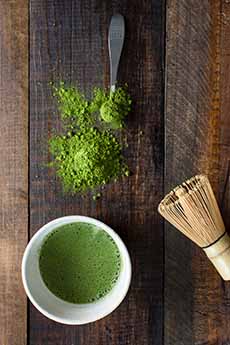
Cup Of Green Tea
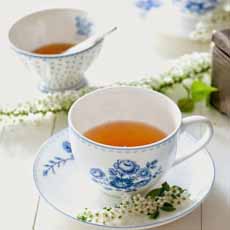
[1] Most Asian countries serve tea in handle-less cups (photo © Kanaya Tea).


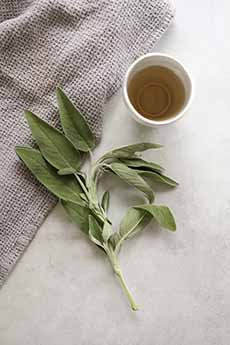
[2] These are freshly-picked tea leaves (photo © Paulina H | Unsplash).


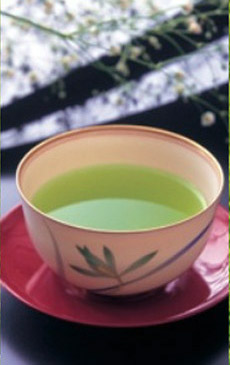
[3] Matcha, originally a ceremonial tea only, has even smaller cups (photo © T2 | Unsplash).


If you eat at Asian restaurants, you may (or may not) have given a thought to the teacups. They don’t have handles. Since January is National Tea Month, we decided to ask why. Here’s a brief answer. You can read the whole article at TeaMuse, the blog of Adagio Teas.

The short answer is that various Asians cultures believe that if the cup is too hot to hold, the tea is too hot to drink.

But that’s not all.

Beginning with early man, who was nomadic, a minimum of possessions were carried. Food and drink were both consumed from bowls, so the evolution to handle-less cups was natural.

Fast forward to the e 18th and 19th centuries in Europe: Cups with handles took a while to evolve. It was not easy to attach a looped handle to a cup, and firing methods for various clays were still developing.

England was the leader in the development. Historians believe that the first cups with handles may have been more of a fashion than a utility, since these early handles often had curlicues, gilt, and images.

The handle slowly became a fixture of the British teacup. American, Bavarian, French, German, and Russian teacups followed suit.
 
 
THE PROPER TEMPERATURES FOR TEA

The proper tea brewing temperature can range anywhere from 140°F for specialty green teas to 212°F (a full boil) for black and herbal teas. There are plenty of gradations in between.

Ultimately, it’s a matter of personal taste, along with how you brew your tea (whether you pre-warm the teapot, the ratio of water to loose tea leaves, if the tea is finished by steaming or pan-firing, etc.).

You’ll see different temperatures in different articles, but here’s a guide. These are the temperatures used by tea connoisseurs to bring out the best in fine, loose-leaf tea. If you’re using an everyday tea bag, don’t sweat it.

  • Black tea: 200F to 212°F
  • Green tea: 150°F to 180°F
  • Herbal tea: 212°F
  • Oolong tea: 190°F to 200°F
  • Pu-ehr tea: 200°F to 212°F
  • White tea: 160°F
  •  
     
    TEA TRIVIA: WHY IS “TEACUP” ONE WORD BUT “COFFEE CUP” IS TWO?

    Here’s a longer discussion of the issue, but to be brief:

  • In the U.S., teacup is preferred spelling, while coffee cup is written as two words. It’s more strange since coffeecake, coffeemaker, and coffeepot are compound nouns.
  • In the U.K., The Oxford English Dictionary hyphenates both: “tea-cup” and “coffee-cup.”
  • Over time, some individual nouns become compound nouns or hyphenated nouns (e.g. bookstore, swimsuit, no-brainer, self-defense). But it hasn’t happened (yet) for coffee cups.
  •  
     
    > THE HISTORY OF TEA
     
    > THE HISTORY OF TEA BAGS
     
    > THE DIFFERENT TYPES OF TEA


    CHECK OUT WHAT’S HAPPENING ON OUR HOME PAGE, THENIBBLE.COM.


    Comments off

    A Great Whole Grain: Quinoa Recipes For National Quinoa Day

    National Quinoa Day is January 16th, celebrating a whole grain* that came to prominence in the U.S. about a decade ago. Yet, many people have never tried it.

    Those who have are nutrition-oriented, excited that quinoa (pronounced KEEN-wa or KEE-noo-ah) contains more high-quality protein than any other grain. In fact, it’s a complete protein: It contains all nine essential amino acids†. It’s equivalent to milk as a protein source. It’s also high in fiber, and is a good source of calcium, iron, magnesium, phosphorus, vitamins A, B and E, and zinc.

    Cooked quinoa has nutty-earthy tones and is extremely versatile: It can be used in the place of almost any other grain, including rice, to make everything from appetizers to desserts.

    Quinoa (Chenopodium quinoa) is the Quechua (Inca) word for “mother grain” or “super grain.” A broad-leafed, annual herb, quinoa grows wild in the Andes Mountains of South America; it was first cultivated more than 5,000 years ago by the Incas and was, along with corn and potatoes, the foundation of the Andean diet.

    The sad part of the story is that since quinoa became a sensation on the world stage, many of the poor farmers who grow it can no longer afford to eat it.

    > The history of quinoa and more about this superfood.

    > More ancient grains.

    > The year’s 35+ grain holidays.

    > Check out the recipes below.
     
     
    COOKING WITH QUINOA

    Quinoa seeds range in color from red, orange, and yellow to black or white. The tiny seeds are the principal crop.

    Before consuming, quinoa seeds must be processed to remove their bitter coating of saponin. After washing or dry polishing, the ready-to-cook seeds are white, red, or beige in color. The spinach-like leaves, which unfortunately seldom reach the consumer, may be eaten raw in salads or cooked like spinach.

    Cooked quinoa is delicious and extremely versatile; it may be used in the place of almost any other grain, including rice, to make everything from appetizers to desserts (make quinoa pudding instead of rice pudding). It has a slightly nutty flavor (red quinoa is the nuttiest), which makes it a good substitute for couscous or bulgur.

    Quinoa has a unique texture as well. When cooked, the thin germ circlet falls from the seed and remains crunchy, while the pearly grain melts in the mouth.

    If you don’t want to cook up a pot-ful, you can find heat-and-eat, microwavable quinoa from companies like Ancient Harvest, Earthly Choice, and Seeds Of Change.
     
     
    QUINOA RECIPES

  • Moroccan Roasted Carrots & Quinoa
  • Pomegranate Quinoa Tabouli
  • Quick Quina Paella
  • Quinoa-Crusted Roast Lamb With Hazelnuts
  • Quinoa Fried Fice
  • Quinoa Porridge
  • Rice Pudding With Crunchy Quinoa Topping
  • Stuffed Peppers With Quinoa
  •  


    [1] Greek salad bowl with hummus, and quinoa. Here’s the recipe (photo © Baked Greens).

    Roasted Carrots With Quinoa
    [2] Moroccan roasted carrots and quinoa. Here’s the recipe (photo © Good Eggs).

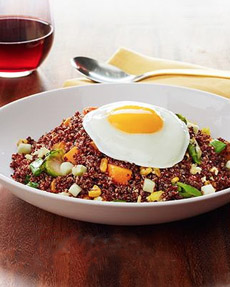
    Red Quinoa Fried Rice
    [3] Quinoa fried rice topped with a fried egg (photo © P.F. Chang’s).


    ________________

    *Although technically a seed, quinoa is classified as a whole grain.

    Amino acids are organic compounds composed of nitrogen, carbon, hydrogen, and oxygen, along with a variable side chain group. The body needs 20 different amino acids to grow and function properly. Though all 20 of these are important for your health, only nine amino acids are classified as essential. Lysine is an essential amino acid, along with histidine, isoleucine, leucine, lysine, methionine, phenylalanine, threonine, tryptophan and valine. Unlike nonessential amino acids, essential amino acids can’t be made by the body and must be obtained through your diet. Here’s more about each essential amino acid and what it does in the body.

    Nonessential amino acids are produced by the body, and are not contingent upon the foods we eat. Nonessential amino acids include: alanine, arginine, asparagine, aspartic acid, cysteine, glutamic acid, glutamine, glycine, proline, serine, and tyrosine.
     
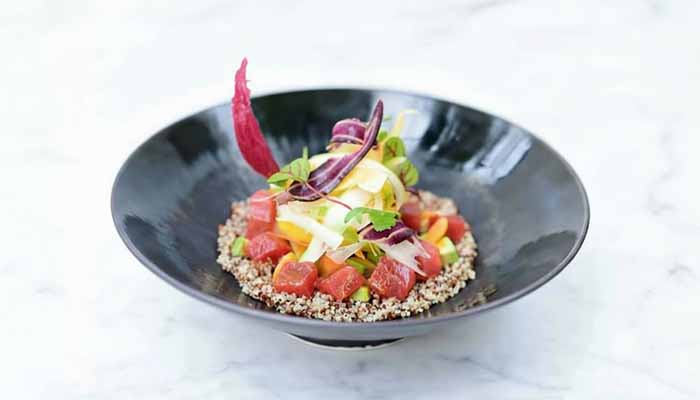
    Poke Bowl On Quinoa
    [4] You can use quinoa as you would rice—as a base for just about anything—like the poke/sashii here (photo © Sushi Samba).


    CHECK OUT WHAT’S HAPPENING ON OUR HOME PAGE, THENIBBLE.COM.


    Comments off

    Fig & Ham Sandwich Recipes


    [1] Crusty country bread topped with fig jam, ricotta, San Daniele ham (a sweeter alternative to prosciutto) and arugula.


    [2] Roasted ham, fresh figs and arugula on a baguette (photo © The Model Bakery | St. Helena, California).


    January 16th is National Fig Newton Day, but we have no Newtons at hand. We do, however, have figs…and bread…and cheese…and ham. So we’re creating a savory Fig Newton sandwich for lunch, substituting fresh figs and fig jam for the Newton filling, and bread for the cookie portion. We have enough ingredients to make the sandwich in a number of ways:

  • Figs: Fresh or dried figs (the different types of figs).
  • Jam: Fig jam or fig spread.
  • Ham: boiled, roasted, prosciutto, serrano and other varieties.
  • Cheese: Goat cheese, ricotta, or for a ham and fig grilled cheese, mozzarella, Gruyère or other semihard cheese.
  • Bread: baguette, country loaf or focaccia (we just baked this grape focaccia), although any bread works.
  • Greens: arugula, fresh spinach or watercress.
  •  
    When you make a ham sandwich, think of this:

    While today ham is the food of Everyman, for a long time it was an elite meat: enjoyed by royalty and served by the affluent on special occasions. In the Roman Empire, it was served to emperors and their guests.
     
     
    > THE HISTORY OF SANDWICHES
     
    > THE HISTORY OF HAM
     
    > THE DIFFERENT TYPES OF HAM
     
    > THE HISTORY OF FIGS


    CHECK OUT WHAT’S HAPPENING ON OUR HOME PAGE, THENIBBLE.COM.


    Comments off

    Rosemary & Grape Focaccia Recipe For Snacking & Cocktails

    Get ready for weekend cocktail hour with this Rosemary & Grape Focaccia recipe from King Arthur Baking. Roasting the grapes concentrates their flavor and tightens their texture. When baked on top of focaccia and garnished with fresh rosemary, the result is a flatbread that’s excellent for snacking, or for pairing with cheeses and charcuterie or Italian salumi.

    > The history of focaccia.

    > There are more focaccia recipes below.
     
     
    WHAT IS FOCACCIA

    Focaccia (foe-KAH-cha) is an Italian yeast bread, baked in a flat or round pan. It is one of the most popular breads in Italy.

    A bit of history: In the old days before the availability of baking pans, yeast-risen breads and cakes were patted into rounds and baked on hearthstones or griddles. By the 17th century, hoops made of metal or wood were placed on flat pans to shape breads and cakes.

    In the 17th century, cookware developed so that the European kitchen contained a number of skillets, baking pans, a kettle and several pots, along with a variety of pot hooks to hold the cookware over the fire, and trivets to place the hot cookware when removed from the fire.
     
     
    RECIPE: ROSEMARY & GRAPE FOCACCIA

    If you want to be more creative, you can mix different colored grapes.

    Prep time is 15 minutes, bake time is 23 to 27 minutes, plus 1-2 hours rising time. Total 2 hours 48 minutes.

    Ingredients For The Dough

  • 1/4 cup (50g) olive oil
  • 2 teaspoons rosemary, fresh preferred, chopped
  • 3/4 cup (170g) water, warm
  • 2 teaspoons instant yeast or active dry yeast
  • 2 tablespoons (25g) granulated sugar
  • 1 large egg
  • 1-1/4 teaspoons (8g) salt
  • 3 cups (360g) unbleached all-purpose flour
  •  
    IngredientsFor The Topping

  • 1-1/4 pounds seedless red grapes (about 80 grapes)
  • 2 tablespoons (25g) olive oil
  • Fresh rosemary sprigs, for garnish
  •  
    Preparation

    1. MAKE the dough. Weigh your flour; or measure it by gently spooning it into a cup, then sweeping off any excess. Combine all of the dough ingredients in a large mixing bowl and mix until a soft dough forms. Knead using a mixer at medium speed for 6 minutes or by hand on a lightly floured surface for 8 minutes, until the dough is smooth and supple.

    2. TRANSFER the dough to a greased bowl, cover, and let rise for 1 to 2 hours, until doubled.

    3. WASH and drain the grapes.

    4. ASSEMBLE: Lightly oil an 18″ x 13″ baking sheet. Transfer the dough to the pan and gently press it out to fill the pan. If the dough starts to snap back, cover and let it rest for 10 minutes before pressing it out further.

    5. DRIZZLE 2 tablespoons of olive oil over the dough and arrange the grapes across its surface. Cover the dough with greased plastic wrap or your favorite reusable cover and let it rise for 30 minutes.

    6. REMOVE the cover and gently press the grapes down into the dough; they should be embedded, not resting on top. Re-cover and let rise for another 30 minutes, while you preheat the oven to 375°F.

    7. UNCOVER the focaccia, add the rosemary sprigs and bake for 23 to 27 minutes, until golden brown. Remove from the oven and serve warm.

    Store any leftovers, well wrapped, at room temperature for a couple of days; or freeze for longer storage. (But we bet there won’t be any leftovers, and you’ll be sorry you didn’t make two flatbreads!).
     
     
    MORE FOCACCIA RECIPES

  • Blueberry Focaccia
  • Different Focaccia Toppings
  •  


    [1] Rosemary and grape focaccia. Enjoy it warm from the oven, as a snack or with wine and cocktails (photo © King Arthur Baking).


    [2] Red grapes add more color to the beige focaccia, but you can use a mix of red and green grapes if you like (photo © Polina Kovaleva | Unsplash).

    Fresh Rosemary
    [3] Fresh rosemary can be added to breads and muffins, eggs, olive oil, olive oil cakes, salads, soups, stews and more, and the whole twig can be used as a garnish in cocktails and on plates and platters (photo © Burpee).


    [4] Focaccia can be decorated with vegetables for a beautiful presentation. Here’s the recipe (photo © Sugar Geek Show).


    CHECK OUT WHAT’S HAPPENING ON OUR HOME PAGE, THENIBBLE.COM.


    Comments off

    FOOD FUN: Pepperoni Pizza Popcorn Recipe


    [1] Pepperoni popcorn. This original recipe from The Popcorn Board didn’t contain tomato powder, which we added (photo © The Popcorn Board).


    [2] Tomato flakes are available from The Spice Lab. Tomato powder is another option.


    [3] Turkey pepperoni (photo © Applegate Naturals).


    The Popcorn Board is a non-profit organization funded by U.S. popcorn processors to raise awareness of popcorn as a versatile, whole-grain snack. They excel in finding new and creative ways to use popcorn—from skillet bread and meatloaf to ice cream sandwiches and many, many flavored popcorn recipes and holiday treats. Their latest recipe is popcorn with the seasoning of pepperoni pizza.

    The recipe is below. We added tomato flakes to the seasoning for an all-out pizza flavor. The tomato flakes (or the finer-grained tomato powder) may give a Cheetos-type dusting to your fingertips, but just like the orange cheese dust, it’s worth it.

    > Check out many more popcorn recipes, both savory and sweet, from The Popcorn Board.

    > Take a look at the history of popcorn.

    > Have you ever had popcorn salad? Use some of the pepperoni pizza popcorn to top salad greens.
     
     
    WHAT ARE TOMATO FLAKES & TOMATO POWDER?

    Tomato flakes and tomato powder are seasonings that add tomato flavor to any savory recipe: breads, chili, eggs, meats, pasta and pizza, salads, sauces, smoothies, soups, stews, and even tomato juice.

    Add them to potatoes and rice, enhance salad dressing, and mix them into sour cream or yogurt for a dip.

    Both products are made from dehydrated tomatoes and contain all the lycopene, vitamins A and C, and other nutrients of fresh tomatoes.
     
     
    RECIPE: PEPPERONI PIZZA POPCORN

    If you don’t have time to get tomato flakes or powder, make the recipe without it.

    Ingredients

  • 12 cups air-popped popcorn
  • 3/4 cup turkey pepperoni, cut into bite-size bits
  • Olive-oil cooking spray
  • 1/4 cup nonfat Parmesan cheese
  • 2 teaspoons garlic powder
  • 2 teaspoons tomato powder or flakes
  • 1/4 teaspoon dried oregano
  • 1/4 teaspoon dried marjoram leaves
  • 1/4 teaspoon dried basil leaves
  • 1/8 teaspoon dried sage
  • Black pepper, to taste
  •  
    Preparation

    1. COMBINE the Parmesan cheese, spices, and seasonings in a small bowl; mix well.

    2. PLACE the popcorn and turkey pepperoni in a large bowl; spray lightly with cooking spray. Sprinkle the popcorn and pepperoni with cheese and spice mixture and toss to coat evenly.


    CHECK OUT WHAT’S HAPPENING ON OUR HOME PAGE, THENIBBLE.COM.


    Comments off

    The Nibble Webzine Of Food Adventures
    RSS
    Follow by Email


    © Copyright 2005-2026 Lifestyle Direct, Inc. All rights reserved. All images are copyrighted to their respective owners.