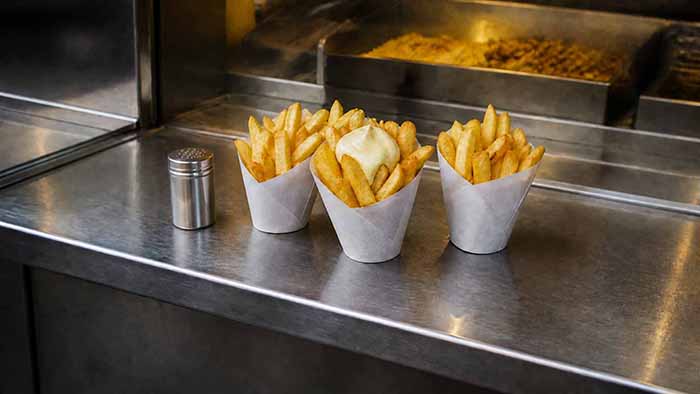
The 40+ Different Types Of French Fries: A Glossary - The Nibble Webzine Of Food Adventures Different Types Of French Fries-A Glossary Of 30+ Varieties


THE NIBBLE BLOG: Products, Recipes & Trends In Specialty Foods


Also visit our main website, TheNibble.com.

The 40+ Different Types Of French Fries: A Glossary

Updated August 2026

Americans, rejoice: August 12th, is National Julienne Fries Day. We’re here to talk French fries, julienned, and beyond.

National French Fry Day is the second Friday in July. We’ve always thought of having a party with at least 10 different types of fries, but it’s not easy to pull off with a small apartment kitchen.

Below:

> What are julienne fries?

> The French Fry Glossary: more than 40 types of fries!

> The history of French fries.

Elsewhere on The Nibble:

> 16 deliciously different recipes for fries.

> Make your own signature French fries recipe.

> Top 10 favorite dips for fries.

> The history of potatoes.

> The different types of potatoes: a photo glossary.

> The year’s 30 potato holidays.

> The year’s 24 fried food holidays.
 
 
1. WHAT ARE JULIENNE FRIES?
 
Julienne Fries
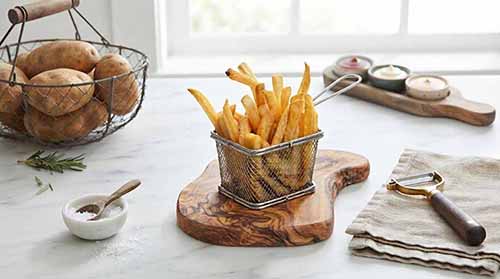
[8] Fries are typically made from russet potatoes, the gold standard due to their high starch and low moisture content that yield- a fluffy interior and crispy exterior (photo © The Nibble).
 
Julienne is a French cutting technique, typically for vegetables, in which the food item is cut into long thin strips or sticks, similar to matchsticks. Another word for the same cut is allumette—which is the French word for matchstick—although a thinner matchstick than julienne.

So why use the name “julienne?”

Etymologically, the word translates from French as “in the manner of Julien or Jules.”

Food historians debate the exact origin. Some point to an otherwise unknown chef named Jean or Julien. We place our bet on the more substantive theory, which links the name to an early 18th-century recipe, potage à la julienne, a clear vegetable broth garnished with finely cut strips of greens and roots.

The word eventually evolved to describe the cut itself.

Different countries use different words. In France, both julienne and allumette are used, but they traditionally refer to slightly different applications.

  • Julienne, in French kitchens, is the precise technical knife cut for vegetables (like carrots, leeks, or celery), typically measuring about 2 to 3 millimeters thick by 4 to 5 centimeters long.
  • Allumette is the term more frequently used in France specifically for potatoes. Pommes allumettes desribe thinner and crisper that Americans call shoestring fries.
  •  
    Related “Stick” Cuts

  • The thinnest cut is shoestring, around 1/16 inch thick x 2-3 inches.
  • The official julienne size is 1/8 inch × 1/8 inch × 2 inches.
  • The next thicker cut, batonnet, is 1/4 inch x 1/4 inch x 2½ to 3 inches.
  • The baton is the thickest stick cut: 1/2 inch x 1/2 inch x 2-1/2 inches.
  •  
    The standard fry at many U.S. restaurants is closer to a batonnet/baton-style fry than a true julienne. At French restaurants, the julienne rules.
     
    Different Types Of Fries
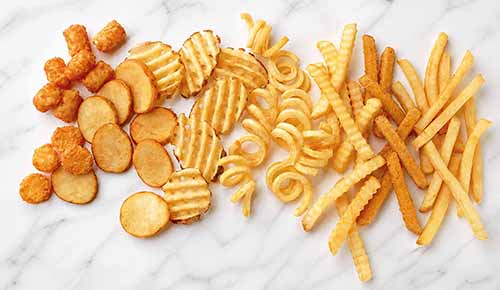
    [9] Can you name the fries? From the top: tots, chips, waffle fries, curly fries, crinkle fries, sweet potato fries, and what most Americans think of as the classic French fry, the baton (photo © Idaho Potato Commission).
     
     
    2. A GLOSSARY OF 40+ TYPES OF FRIES

    Fries, or French fries, refer to sliced, deep-fried potatoes. They can be:

  • Made with sweet potatoes instead of white potatoes.
  • Baked instead of fried.
  • Served plain or with a myriad of condiments (barbecue sauce, blue cheese dressing, ketchup, gravy, malt vinegar, mayonnaise, mustard, ranch dressing, Thousand Island dressing.
  •  
    While julienne and baton are the most typical cut, here is a delicious accounting of the different types of fries.

  • Bistro Fries: Served at bistros in metal holders, these “frites” are usually fried twice for extra crispness. They are thicker than julienne fries, typically 3/8- to 1/2-inch thick. They’re also called Euro fries.
  • Belgian Fries: Thick-cut fries served in a paper cone with mayonnaise and eaten with a small fork (the cut is about 1/2 inch, compared to 1/8 inch for julienne fries). They are traditionally double-fried in beef tallow, making them crispier on the outside.
  • Boardwalk Fries: From the Mid-Atlantic area, these long, square-cut fries are seasoned with Old Bay Seasoning and malt vinegar. Also called country fair fries.
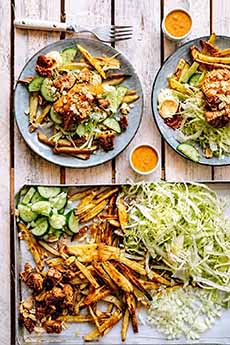
  • Carne Asada Fries or Carne Fries: A specialty of Mexican restaurants in the San Diego area, comprising a base of fries topped with carne asada (grilled flank or skirt steak) with garnishes of cheese, guacamole, pico de gallo, shredded lettuce and sour cream; some establishments include pico de gallo and lettuce. Here’s a recipe.
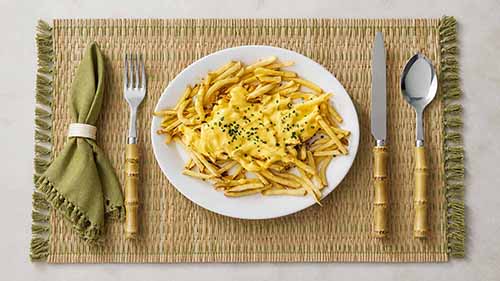
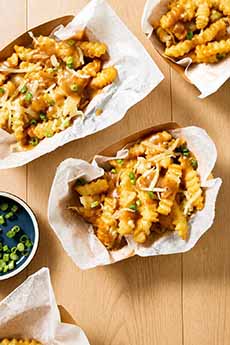
  • Cheese Fries: Crinkle, julienne, or other fry shape topped with melted cheese: grated Parmesan, shredded Cheddar, mozzarella or Swiss cheese, Cheez Whiz, Velveeta—even blue cheese or ranch dressing. Chili, bacon, chives/green onion, garlic, jalapeños, mayonnaise, and other ingredients can be added. Here’s a recipe (photo immediately below).
  •  
    Cheese Fries
    [10] Instead of Velveeta, elevate your cheese fries with a young Gouda, Monterey Jack, or the ultimate melting cheese, Raclette. You can easily turn them into chile cheese fries. Here’s the recipe (photo © The Nibble).

      Bowl Of Julienne Fries With Ketchup
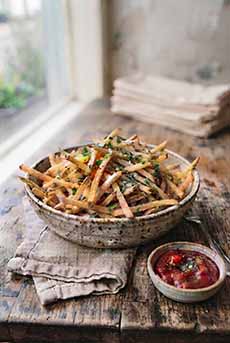
    [1] Always irresistible: julienne fries and ketchup (photo © The Nibble).

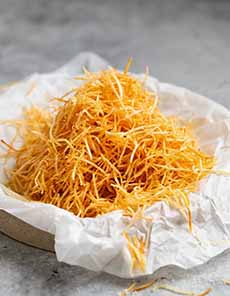
    Pommes Paille (Straw Potatoes)

    [2] The thinnest fries possible are pommes paille, translated literally as straw potatoes. In the U.S., we call them shoestring fries Here’s a recipe (photo © Recipe Tin Eats).


    [3] Sidewinders, a new shape made to generate excitement at restaurants (photo © Simplot).

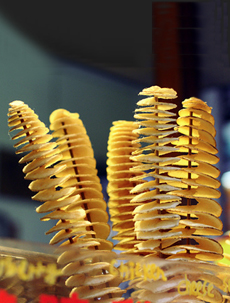
    Tornado Fries (On A Stick)
    [4] Tornado fries, also called spiral fries, were created following the craze for sidewinders. Here’s a recipe (photo © Grumpy Recipes).

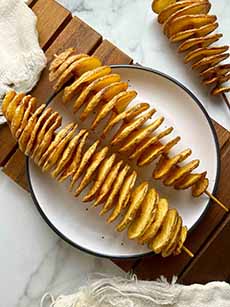
    Potato Spirals
    [5] Potato spirals, made by piping a mash into spirals. Here’s the recipe (photo © Taste Made).

    Disco Fries
    [6] Disco Fries, New Jersey’s homage to poutine (photos #12 and #13). Taste of Home).

    Patatje Oorlong, Dutch Fries
    [7] Patatje Oorlog Here’s the recipe (photo © Marley Spoon).

  • Chicken Fries: These are not potato fries, but chicken strips shaped to look like fries. They were popularized by Burger King and became a permanent menu item in 2015.
  • Chile Fries: Not to be confused with chili fries (spelled with an “i” at the end), this is a popular dish in New Mexico—fries topped with green chile peppers.
  • Chili Fries or Chili Cheese Fries: Fries topped with chile con carne.
  • Chip Butty: A U.K. sandwich of fries (called chips in the U.K.) on a buttered roll or bread, optionally eaten with condiments such as brown sauce, ketchup, mayonnaise, or malt vinegar.
  • Chips: The British word for fries. In America, the term can refer to homemade potato chips, a popular restaurant item. Make your own with this recipe, or try these gourmet homemade potato chips with truffle oil.
  • Chorrillana: A Chilean dish, a plate of fries is topped with strips of sliced beef, eggs, fried onions, and occasionally, sausages.
  • Cottage Fries: Thick coin shapes. Sometimes they’re cut with ridges, but the photo below is the standard.
  •  
    Cottage Fries
    [11] Cottage Fries can be served as a side or as a snack with dip. Here’s the recipe (photo © Mihaela Kozaric Sebreks | Simply Recipes).
     

  • Country Fair Fries: See Boardwalk Fries.
  • Crinkle or Crinkle-Cut Fries: Fries with grooved edges that are made with a special crinkle cutter.
  • Curly Fries: French fries cut with a special curly fry cutter that creates long, thin spirals. Sometimes called wavy fries, they are often served with melted cheese. Ketchup, sour cream, or sweet chili sauce are also popular condiments. History: In 1938 the Dolores Restaurant & Drive-In on Route 66 in Oklahoma introduced Suzi-Q Fries, adapted by others and called, generically, curly fries.
  • Curry Chips: Fries covered in curry sauce, a popular item served in chip shops in Ireland and Northern England (in the U.K., “chips” is the term for fries, and “crisps” is the term for what Americans call chips).
  • Disco Fries or Elvis Fries: A New Jersey specialty, made with steak fries topped with brown gravy and mozzarella cheese fries; some establishments substitute processed American cheese (photo #6 ). Also, see Newfie Fries and Poutine.
  • French Fries, French Fried Potatoes or Fries: In French, the formal name for fried potatoes is pommes de terre frites (PUM-duh-tare-FREET). The term is often shortened to pommes frites or simply, frites. The terms aiguillettes or allumettes refer to very thinly sliced chips.
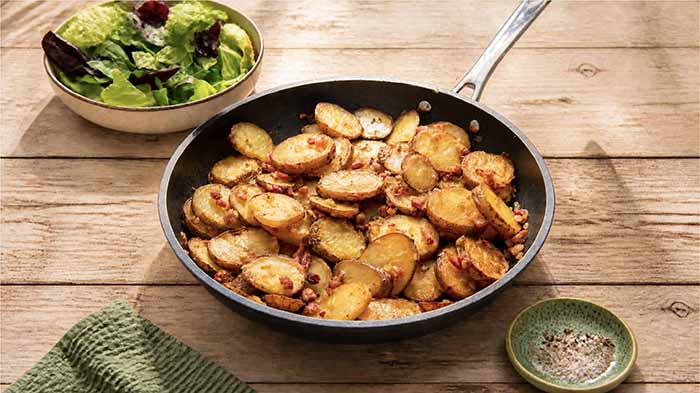
  • Home Fries or Cottage Fries: A potato dish made by pan-frying sliced potatoes that have been par-cooked by boiling or other technique, then pan-fried in butter or oil—not deep fried. When diced green and red bell peppers are added, and optional chopped onions, they are called Potatoes O’Brien. The dish was created at John’s restaurant in Manhattan in the early 1900s. Here’s a recipe.
  •  
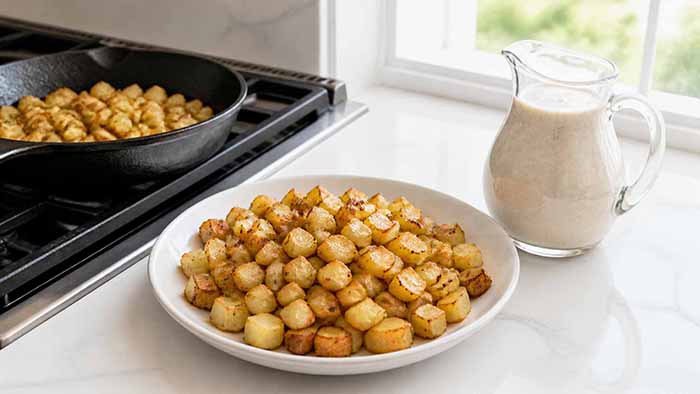
    Home Fries & Country Gravy
    [12] Home fries are pan-fried rather than deep-fried. Some people like them with ketchup or hot sauce but we like them Southern-style, with country gravy or sausage gravy (photo © The Nibble).
     

  • Julienne Fries: The classic: a popular width for French fried potatoes in the U.S. and elsewheeree, 1/8 inch × 1/8 inch × 2 inches.
  • Jojo Fries: A type of potato wedge, typically cut thick, dip in egg, and coat in a flour‑and‑spice mix (often including Lawry’s salt), and deep-fried in a pressure cooker. They are a regional specialty in the Pacific Northwest and some parts of the Midwest, sometimes referred to as “broasted potatoes” or “jojos.” Here’s a recipe.
  • Loaded Fries: Top the fries with melted cheese, diced onions, sliced jalapeños, bacon, and sour cream. Here’s a recipe.
  • Matchstick Fries: Another name for shoestring fries. They’re called pommes allumettes in French.
  • Newfie Fries: A dish originating in Newfoundland: fries, dressing (turkey stuffing made with summer savory), and gravy. One variation adds ground beef or hot dogs and cheese.
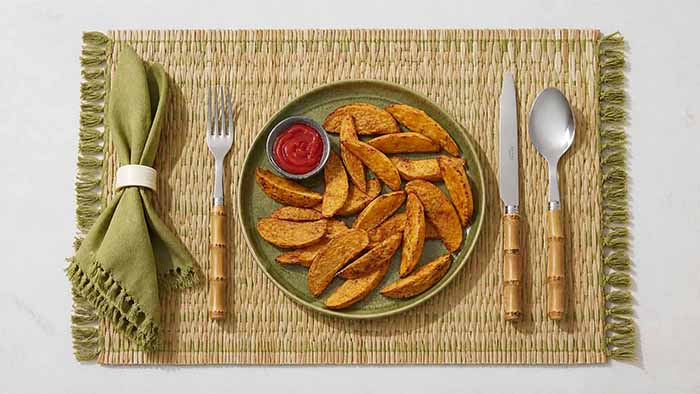
  • Oven Fries: Also called baked fries, these are fries that are baked in the oven instead of fried. Here’s a recipe (photo immediately below).
  •  

    [13] Oven fries use much less oil than deep-fried fries, making them lower in fat and calories. It’s also safer and easier to clean up because you’re not handling a pot of hot, splattering oil. These are cut into wedges and sprinkled with paprika and garlic powder. Here’s the recipe (photo © The Nibble).
     

  • Patatje Oorlog: Dutch for “war fries,” pronounced pa-TAH-che OR-lock, this popular Dutch street food consists of deep-fried fries topped with a “battlefield” mix of mayonnaise, peanut-based satay sauce, and raw diced onions. Often served in a paper cone, it sometimes featuring extras like curry ketchup with eight or more relishes and sauces, including mayonnaise and peanut sauce. Some establishments provide up to 40 different condiment variations (photo #7)
  • Pommes Paille: The English translation is “straw potatoes,” so-called because they are sliced as thin as straw (photo #2). They are the equivalent to America’s shoestring potatoes.
  • Potato Spirals: also known as spiral fries, tornado potatoes, or twist potatoes, are a fun and visually appealing snack made from a potato that has been mashed and piped into a continuous spiral shape (photo #5). They deep-fried and often seasoned with various spices.
  • Potato Wedges: Fries made from large, wedge-shaped chunks of potato, often unpeeled. Regional terms include jojos and tater babies. The wedges can be baked instead of fried. Popular condiments include barbecue sauce, brown sauce, gravy, ketchup, mayonnaise, ranch dressing, sour cream, and sweet chili sauce. Here’s a recipe for Parmesan wedge fries.
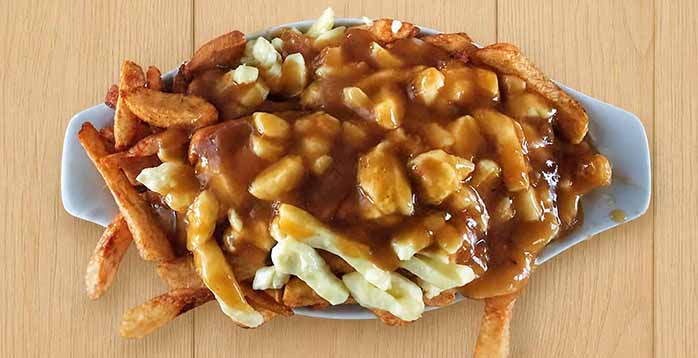
  • Poutine: A Canadian dish from rural Quebec that tops French fries with fresh cheese curds (sometimes grated cheese), covered with hot gravy (photos #12 and #13). Disco fries, from New England, are a variation (photos below). Here’s a classic poutine recipe.
  •  
    A Plate Of Poutine
    [14] Poutine is often served in an untidy presentation like this. But take a look at the next photo (photo © V. W. Campin-CC-BY-NC-SA-2.0-License).
     
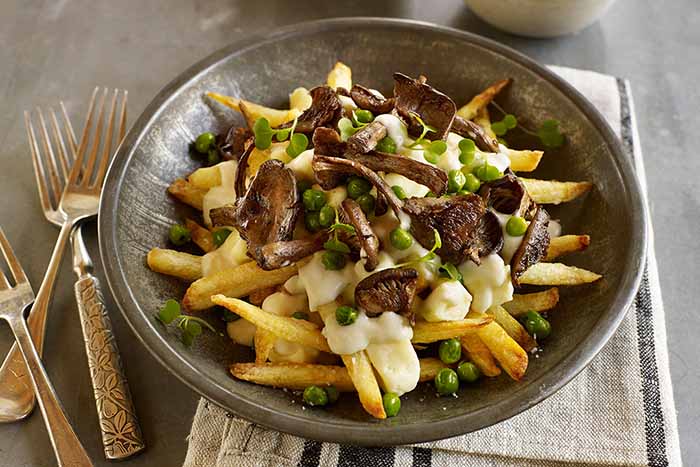
    A Dish Of Poutine With Mushrooms & Peas Added
    [15] In the hands of a good chef (or an artistic home cook), poutine can have this sophisticated take, with spring peas, trumpet mushrooms, and béchamel sauce instead of generic white gravy. Here’s the recipe (photo © Idaho Potato Commission).
     

  • Rounds: Coin-shaped chips.
  • Seasoned Fries: French fries coated with spices. Black pepper, garlic powder, chili flakes, onion powder, and paprika are popular, but you can make curry fries, basil-dill fries, or whatever you find appealing. Check out these recipes.
  • Shoestring Fries: Cut even thinner than julienne fries—in fact, roughly half the thickness of a julienne. Because they are so slender, they cook almost instantly, turn exceptionally crispy, and are closer to what the French call pommes allumettes.
  • Sidewinders: A new shape developed by Simplot for restaurant service (photo #3). Created in South Korea as street food, the company describes the shape as a bent elbow.
  • Steak Fries: These are thicker-cut fries—baton or wider—often cooked with the skin on. They can be fried or coated with spices and baked. They are also called wedge fries. They are the least crunchy, as they have the highest interior-to-surface ratio (i.e., the most potato “filling.”)
  • Sweet Potato Fries: Made from sweet potatoes, typically in the julienne or shoestring cut, or in wider batons.
  • Texas Fries or Texas-Style Fries: Steak fries with the skin on.
  • Tornado Fries: A shape invented by the Tornado Fries company and copied by others (photo #4). They are made from a single potato cut with a gadget into a one-piece spiral, which is fried on 18- or 26-inch skewers. Other names include chip sticks, potato springs, potato twisters, ribbon fries, rotato, and spiral spuds.Sometimes they are wrapped around a foot-long hot dog.
  • Tornado Potato (Hoeryori Gamja): The original and official name for the fried potato spirals, which were invented in South Korea as a street snack. This is the most common term in international street food markets and culinary circles. Tornado Fries is the more common name used in fairgrounds and other venues in the U.S. and Canada (photo #5).
  • Tots or Tater Tots: Small cylinders made from deep-fried, grated potatoes. “Tater Tots” is a trademark of Ore-Ida, which invented the little potato bites in 1953. Here’s a recipe to make your own baked tots.
  • Waffle Fries or Waffle Cut Fries: French fries cut with a special tool into a crisscross pattern. In France they’re called pommes gaufrettes (gaufrette is the French word for waffle).
  • Wavy Fries: Another term for curly fries.
  • Wedge Fries: Another term for steak fries.
  • Incas Cultivating Potatoes
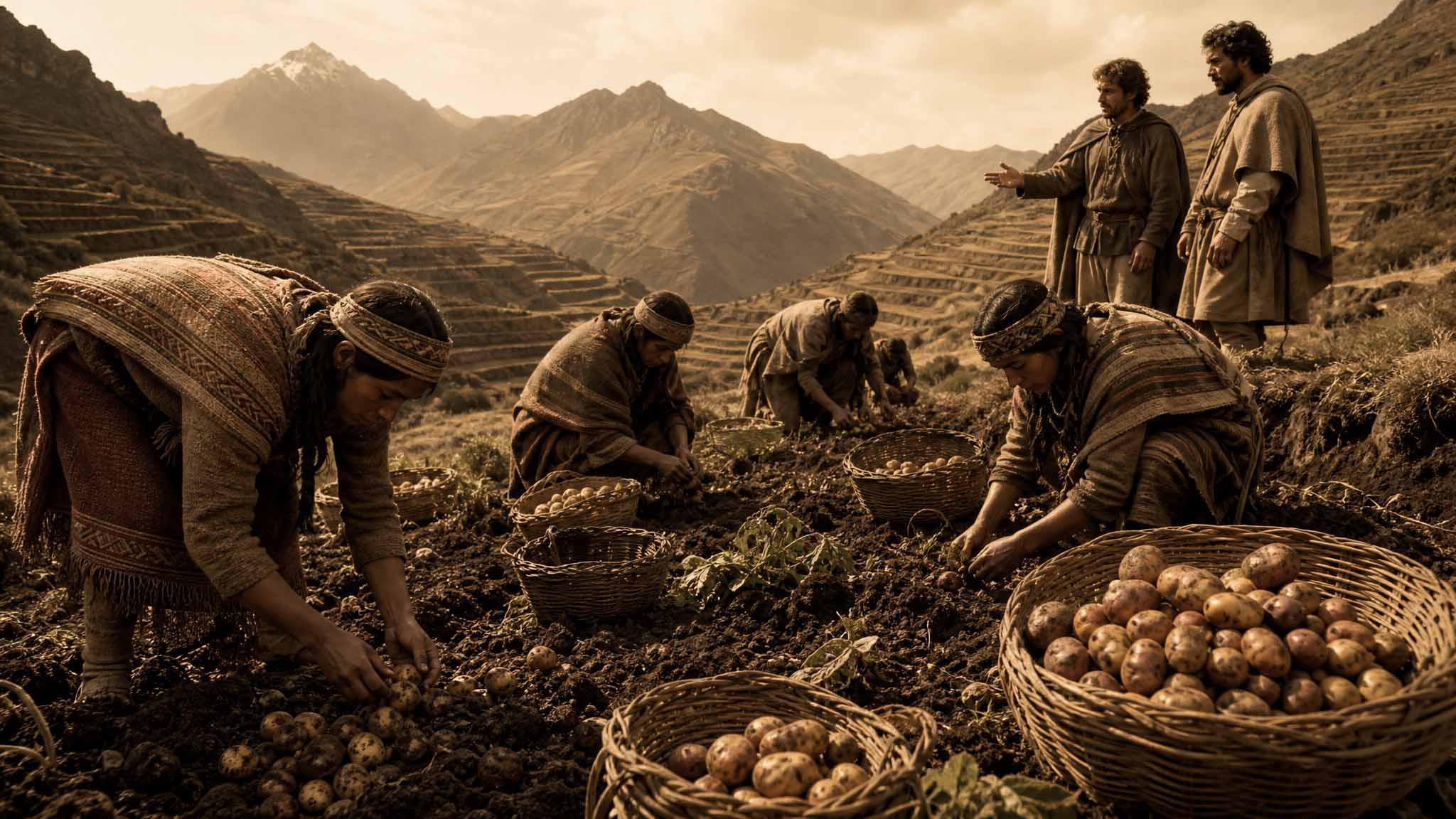
    [16] With gratitude to the Indigenous Andean farmers who first cultivated potatoes (image © The Nibble)The Nibble).
     
     
    3. THE HISTORY OF FRENCH FRIES/FRIED POTATOES

    Wild potato species are native across parts of the Americas, including the present-day southwestern United States. But the cultivated potato that became a global staple was first domesticated by Indigenous peoples in the Andes, near present-day southern Peru and northwestern Bolivia, likely in the Lake Titicaca region.

    While we know that cultivation began millenia ago, it can’t be documented when cooking potatoes in fat over a fire began. The first surviving documentation is a 17th-century account describes papas fritas among Mapuche people in what is now Chile—although the form appears to have differed from the modern fried potato stick.

    Spanish colonizers encountered potatoes in South America and introduced them to Europe in the 16th century.

    In parts of Europe, including France, potatoes were initially viewed with suspicion and were often used as animal feed rather than embraced as human food. In 1748, French authorities prohibited potato cultivation amid fears that potatoes could cause leprosy and other diseases.

    The precise origin of the modern French fry is disputed. A popular Belgian story places its invention along the Meuse River in the late 17th century, but historians question the evidence and note that potatoes likely did not reach that region until decades later.

    Antoine-Augustin Parmentier, a French army pharmacist, was taken prisoner by the Prussians during the Seven Years’ War. While in captivity, he ate potatoes and later became one of France’s most influential advocates for their use as human food. Through Parmentier’s efforts, the Paris Faculty of Medicine declared potatoes edible for humans in 1772.

    Poor harvests and famine, including a severe crisis in 1785, helped accelerate wider French adoption of potatoes, which certainly included pommes frites, fried potatoes.

    In the U.S., during his presidency (1801-1809), Thomas Jefferson recorded a French recipe for pommes de terre frites à cru, en petites tranches—“potatoes deep-fried while raw, in small cuttings.” His French chef, Honoré Julien, worked in the presidential household, and Jefferson’s notes are among the earliest known American references to fried potatoes resembling French fries.

    The Thomas Jefferson Foundation at Monticello describes it as perhaps the earliest American reference to the food, while noting that the historical potatoes may have been rounder slices rather than modern fries.

    By the late 19th and early 20th centuries, “French fried” was also used in English to describe other foods cooked by deep-frying.
     
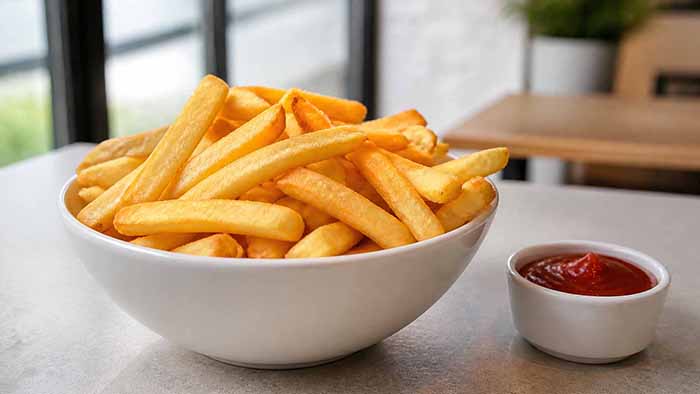
    Bowl Of French Fries With Ketchup
    [17] The modern French fry: simple and satisfying (photo © The Nibble.
     
    The Modern Fry

    The exact origin of the modern French fry remains disputed. A famous Belgian story says that villagers fried potatoes when frozen rivers prevented them from catching fish, but historians question the evidence and the timeline. France also has a plausible claim through its late-18th- and early-19th-century fried-potato traditions.

    A popular story credits American troops in French-speaking Belgium during World War I with calling the dish “French” fries. However, the term “French fried potatoes” was already in American print decades earlier, so World War I was not the origin. The phrase may instead have referred to a French style of frying.

    In fact, the term “French fried potatoes” was already in print in the U.S. at least by 1856

    A French army medical officer named Antoine-Augustine Parmentier was forced to eat potatoes as a P.O.W. and discovered their culinary potential. Through his efforts, in 1772, the Paris Faculty of Medicine finally proclaimed that potatoes were edible for humans—though it took a famine in 1785 for the French to start eating them in earnest.

    In 1802, Thomas Jefferson’s White House chef, Honoré Julien, a Frenchman, served “potatoes served in the French manner” at a state dinner. The potatoes were “deep-fried while raw, in small cuttings.” French fries had arrived in the U.S., if not in name, then in form.

    The French didn’t call them French fries, but frites, the word for fried potatoes.

    So how did they get called “French” fries? One prevailing theory is that “French” came from American soldiers who arrived in Belgium during World War I. They came across frites.

    Since the dominant language of southern Belgium is French, they dubbed the tasty potatoes “French” fries and brought the term (and the demand) back home.

    Shortly afterward, in the early 20th century, the term “French fried,” meaning “deep-fried,” was being used for other foods as well (onion rings and zucchini sticks, anyone?)

    Belgian fry culture, especially the tradition of the fritkot or friterie, has been recognized as cultural heritage within Belgium. Advocates have also sought UNESCO Intangible Cultural Heritage recognition, but Belgian fries have not yet been inscribed on UNESCO’s international list.

    A renewed request involving Flemish authorities was reported in 2021. It’s a slow process: Nominations proceed on a limited, scheduled basis.

    Belgium is especially known for serving fries in paper cones, often with mayonnaise. So show your support by dipping your next serving of fries in mayo.

    Whether you call them fries, frites, frieten, or French fried potatoes, your delicious plate of fries have come a long way from Indigenous Andean agriculture, becoming a shared culinary history across the Americas and Europe.

    Trivia: The average American eats 137.9 pounds of potatoes each year.
     
    Belgian Fries With Mayonnaise
    [18] Belgian frites. The mayo is typically added from a pump dispenser or ladled from a large jar by the customer (photo © The Nibble)The Nibble).


    CHECK OUT WHAT’S HAPPENING ON OUR HOME PAGE, THENIBBLE.COM.


    Comments are closed.

    The Nibble Webzine Of Food Adventures


    © Copyright 2005-2026 Lifestyle Direct, Inc. All rights reserved. All images are copyrighted to their respective owners.