THE NIBBLE BLOG: Products, Recipes & Trends In Specialty Foods


Also visit our main website, TheNibble.com.

PRODUCTS OF THE WEEK: Non-Dairy Ice Cream

Over the last few years there’s been a huge move to non-dairy substitutes.

As part of the move to veganism and/or sustainability, plus diets that are kosher or lactose-free, more consumers seek animal-free dairy products.

You can now find delicious milks, yogurts, ice creams and cheeses made from non-dairy plant products.

Some examples in the milk category alone:

  • Almond milk
  • Cashew milk
  • Coconut milk
  • Hemp milk
  • Macadamia milk
  • Oat milk
  • Rice mlk
  • Soy milk
  •  
    Non-dairy ice cream has long been made from coconut milk. But more recently, flavor scientists have developed alternatives that provide superior creaminess without the coconut undercurrent.

    Most of us wouldn’t realize that we’re eating a non-dairy frozen dessert (which is the proper term for non-dairy ice cream).

    Haagen Dazs’s Non-Dairy flavors are made from a base of almonds, sunflower oil and coconut oil.

    Graeter’s Perfect Indulgence line is made with Perfect Day®’s animal-free dairy proteins (more about that in a minute).

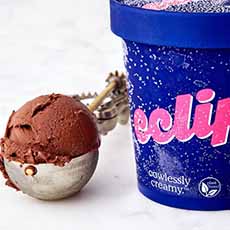
    Eclipse Foods’ non-dairy ice cream—“cowlessly creamy,” they call it—has a base made from cassava, corn, oats and potatoes, plus canola oil.

    Note that non-dairy doesn’t mean lower calorie. These products have calories equal to the dairy-based originals.
     
     
    1. PERFECT INDULGENCE FROM GRAETER’S ICE CREAM

    Graeter’s, America’s oldest family-owned and operated ice cream producer, has joined the non-dairy movement with its handcrafted ice creams.

    The company has turned its favorite ice cream flavors into a dairy-free line called Perfect Indulgence.

    The line is named after a product developed by Perfect Day Foods, which has developed a Non-Animal Whey Protein Isolate*.

    This non-animal whey protein has the same nutrition profile and culinary functionality as whey protein from cow’s milk.

    But it’s vegan; free from lactose, cholesterol, hormones and antibiotics; and has a smaller environmental footprint than conventional whey protein isolate.

    It also provides a rich, creamy, smooth, and indulgent eating experience.

    Note that while Perfect Indulgence is vegan and lactose-free, the animal-free dairy proteins that are produced still contain certain milk allergens.

    Those with sensitivity to dairy products should read the ingredient panel closely.

  • Black Cherry Chocolate Chip
  • Chocolate
  • Chocolate Chip
  • Cookies & Cream
  • Mint Chocolate Chip
  • Oregon Strawberry
  •  
    Our favorite conventional Graeter’s flavor, Black Cherry Chocolate Chip, tasted as good or maybe even better as Perfect Indulgence.

    The other flavors also hit it out of the park.

    > Discover more at Graeters.com.
     
     
    ECLIPSE NON-DAIRY FROZEN DESSERT

    The Eclipse line is nut free, and divided into the “classic” flavors plus the Chef Collection.

    As with Graeter’s and Häagen-Dazs (and other brands not covered here), no one will realize they’re eating a non-dairy ice cream.

    The classic flavors:

  • Chocolate
  • Cookie Butter
  • Vanilla
  •  
    The Chef’s Collection is made in collaboration with leading chefs, with proceeds going to the charity of each chef’s choice.

    The collection currently includes:

  • Botanica x Eclipse: Cocoa Black Sesame Tahini
  • Mamahuhu x Eclipse: Figgin’ Delicious
  • Monsieur Benjamin x Eclipse: Palmier Cookie with Calvados Caramel
  •  
    The Chocolate and Vanilla are excellent. Chocolate, made with Alter Ego chocolate, is one of the best chocolate ice creams you can try—dairy or non-dairy.


    [1] The new plant-based ice creams are indistinguishable in looks and taste (photo © Häagen-Dazs Nondairy).


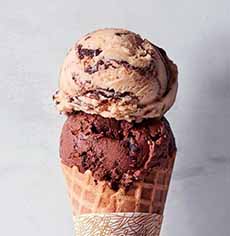
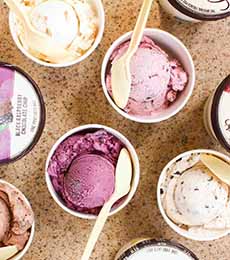
    [2] Graeter’s classic flavors are now available in non-dairy versions (photos #2 and #3 © Graeter’s Ice Cream).


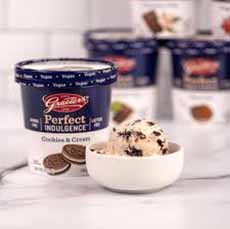
    [3] Dairy-free Perfect Indulgence Cookies & Cream from Graeter’s.


    [4] Eclipse’s outstanding nondairy Chocolate ice cream (photos #4, #5 and #6 © Eclipse Foods).


    [5] Eclipse’s Vanilla is an intense vanilla experience.


    [6] At left, a chocolate chip ice cream sandwich with Eclipse Vanilla; at right, a dish of Chocolate accompanied by squares of Alter Ego chocolate.

     
    Fudgy and intensely chocolate, you won’t find a better chocolate ice cream experience.

    The Vanilla is super-charged with vanilla flavor. It, too, is indistinguishable from its dairy colleagues.

    The Cookie Butter was not our cup of tea, but that’s a personal preference.

    We tried only one of the Chef’s Collection, Palmier Cookie with Calvados Caramel.

    The sophisticated, complex layering of flavors made us long to try the other two. (Fortunately, they’re easily available online.

    > Get Your Eclipse pints here.

     
    ________________

    *Rather than using the traditional dairy from cows or other animals, these proteins come from a process utilizing micro-flora fermentation. It’s still dairy; it’s just animal-free dairy because of the manufacturing process. The isolate comprises lab-grown versions of the proteins that are found in cow’s milk, such as casein and whey, but without the need for any animals. The sustainability argument is that the production of cellular milk requires less energy, greenhouse gas emissions and land usage, and is thus more resource-efficient than animal farming.


    Comments off

    TIP OF THE DAY: Freeze Grapes For A Sweet Snack


    [1] Purple grapes (photo © Tijana Drndarski | Unsplash).

    Box Of Red Grapes
    [2] Buy whatever grapes appeal to you—as long as they’re seedless (photo © Good Eggs).


    [3] Cotton candy grapes, named for their extra-sweet flavor profile (photo © Melissa’s Produce).


    [4] Wash the grapes and let them dry thoroughly (photo © Whole Foods Market).


    A trick long known by clever dieters is to freeze grapes.

    Then, when you’re aching for something sweet, just pop a few grapes into your mouth.

    Freezing intensifies the sweetness of the grapes. Makers of the sweet dessert wine, ice wine*, rely on frozen grapes.

    The result is like a grape slush (Slushie is a brand name) or sorbet. It’s as tasty for adults as for kids.

    Grapes are good nutrition, too: high in antioxidants, manganese, potassium and vitamins B-1 (thiamine) and C.

    They’re low-fat and low-calorie, too: an excellent snack food.
     
     
    HOW TO FREEZE GRAPES

    First, use seedless grapes. For eye appeal, consider using a mixture of colors.

    1. WASH the grapes and let them air-dry thoroughly. Then, take them off the stems and lay them on a baking sheet or tray atop parchment, plastic wrap, or wax paper.

    2. PLACE the tray in the freezer. Grapes are around 80% water, so they’ll freeze quickly.

    3. REMOVE the frozen grapes from the tray and place them into a freezer-friendly bag or container.

    They’re ready and waiting in the freezer for your next snack attack.
     

    THE HISTORY OF GRAPES

    Grapes are an ancient crop. The ancestor of European grapes, Vitis vinifera, grew wild in the Near East, as early as the Neolithic era.

    Viticulture, the cultivation of grapes, may have begun as early as 6500 B.C.E.

    Wild yeast occurs naturally on the skins of grapes, leading to an automatic fermentation that produced wine.

    The earliest archeological evidence for wine-making has been found some 8,000 years ago in Georgia, in the Caucasus region of Eurasia [source].

    Not surprisingly, the cultivation of grapes for wine-making became a focus for many farmers.

    As early as 3000 B.C.E., the Hittites spread viticulture westward, to Crete, the Bosporus and Thrace (now modern Turkey).

    By 4000 B.C.E., viticulture extended from Transcaucasia to Asia Minor, and through the Nile Delta of Egypt.

    Later, the Greeks and Phoenicians extended grape-growing to Carthage, Sicily, southern Italy, Spain and France. Under the influence of the Romans, grape production spread throughout Europe.

    King Hammurabi of Babylon (1792 – ca. 1750 B.C.E.) may have enacted the world’s first liquor law when he established rules for the wine trade in 1700 B.C.E. [source].
     
     
    After The Fall Of The Roman Empire

    By the time of the fall of the Roman Empire, 395 C.E., grape culture and wine-making had become the province of monasteries. Wine was used in religious rites.

    By the Renaissance, the use of wine extended beyond religion to popular social custom.

    This increased demand for grapes, and grape culture grew steadily from the 16th to the 20th century.
     
     
    Grapes In America

    In North America, native grapes grew wild across the continent. They were a part of the diet of many Native Americans, but were not considered particularly enjoyable by early colonists.

    It wasn’t until the 1850s, when American grapes began to be hybridized with European varieties, that table grapes became more widely grown and consumed [source].

     
    Early European colonists also found the native grape varieties to be unsuitable for wine.

    (Two varieties ultimately were successful: the Catawba grape and the Concord grape, both varieties of Vitis labrusca.)

    In 1629, Spanish Missionaries discovered the dry climate and sandy soils of New Mexico. They planted the first Vitis vinifera (European grape variety) vineyards on the continent in their missions.

    The grape variety, brought from Spain, became known as the Mission grape.

    Other grape seeds and cuttings were brought from Europe and planted in America. In California, the first vineyard and winery was established by Spanish Catholic missionaries in 1769 [source].

    If you wonder why the historic record focuses on wine-making and not on table grapes for eating, the answer is simple. As with beer, wine was safer to drink than water, the sources of which were often contaminated.

    Equally, the mood-enhancing qualities of alcoholic beverages were welcome.
     
    ________________

    *Ice wine (Eiswein in German) is a type of dessert wine produced from grapes that have frozen while still on the vine. The sugars and other dissolved solids do not freeze, but the water does. This creates a more concentrated grape juice. The frozen grapes are then pressed, resulting in a more concentrated, very sweet wine.


    Comments off

    TIP OF THE DAY: Buy Some Chicory

    It’s winter, where produce options are limited. But there’s still much to discover.

    Take the chicory family. Can you name three chicories? (Check the photos at right.)

    They are cool weather crops that come into season in late fall, and last through early spring.

    Much more popular in Europe than in the U.S.*, the chicory family is a large one.
     
     
    LOOK FOR THESE CHICORY VARIETIES

    There are many varieties across the world. Each differs in appearance, color, and to some extent, flavor.

    The heads can be loose-leafed or tightly-headed, tapered or round, smooth-leaved or frilled.

    The colors range from the purest white and pale yellow, to bright green and maroon.

    All share a slightly bitter taste.

    The varieties best-known in the U.S. are:

  • Belgian endive (photo #1), also called French endive and witloof (white and red varieties)
  • Escarole (photo #2)
  • Frisée (a.k.a. curly endive—photo #3)
  • Puntarelle (a.k.a. cicoria di catalogna, cicoria asparago—photo #7)
  • Radicchio (radicchio treviso [photo #4], radicchio Castelfranco, chioggia radicchio, speckled and other varieties)
  •  
    Check out a large photo of the different varieties, below.
     
     
    HOW IS CHICORY RELATED TO LETTUCE?

    Chicories are closely related to lettuces, but heartier, with a bitter edge.

  • Chicory (Cichorium intybus) is a genus of plants in the dandelion tribe within the sunflower family (Asteraceae).
  • Lettuce (Lactuca sativa) is an annual plant also in the daisy family, but branches off from chicory at the subfamily level.
  •  
    Thus, while varieties of chicory may be referred to as lettuce,they aren’t.
     
     
    WHY DON’T WE EAT MORE CHICORY

    More than a few Americans don’t seem to like chicories, possibly due to their bitterness.

    Perhaps in our country, where sugar is dumped into everything from bread to mustard and the government has looked at regulating the excessive amount of salt in prepared foods, people have been weaned away from the bitter flavor.

    Bitter is one of the five tastes, along with salty, sour, sweet and umami.

    Give it a chance. And check out the next section.
     
     
    HOW TO TAME THE BITTERNESS OF CHICORIES

    The easiest way to soften the bitterness in chicories is to shock them in an ice bath.

  • Simply plunge the vegetables into icy water (add ice cubes to cold tap water or refrigerated water) and leave them there for an hour or so. Then, give them a little nibble.
  • If they’re still too bitter for your taste, repeat; continue to do so until you’re happy with the result. Then, remove and spin the leaves dry (if you don’t have a salad spinner, air drying is fine). You will be shocked (pun intended) at the difference it makes.
  • If you’re serving the vegetable raw, remove the core from the head (the core is the most bitter part). With Belgian endive and radicchio, the easiest method is to cut the head in half lengthwise and then cut away the core.
  •  
     
    HOW TO USE CHICORIES

    Chicories shine in salads, and you can add or pair nuts, fruits or rich cheeses.

    But their hardiness also lends themselves to braises, sautéed and roasted dishes, grilling, even turned into soup.

    Two favorites:

  • Grilled radicchio is delicious, finished with nothing more than a drizzle of olive oil, a squirt of lemon, a few pinches of coarse salt and some freshly ground pepper.
  • Escarole sautéed with garlic in olive oil is a simple pleasure.
  • For salads, Belgian endive, frisée (curly endive) and radicchio are beautiful additions.
  •  
    Some Recipes

  • Radicchio overview and recipes
  • Festive radicchio salad
  • Pear salad with blue cheese
  • Spinach, citrus and radicchio salad Pear salad with blue cheese and radicchio
  • Grilled bitter greens with caraway peach dressing
  • Belgian endive salad with roquefort, figs and walnut oil
  •  
     
    FOOD TRIVIA

    FOOD TRIVIA #1: The roots of most chicory plant varieties have long been used as a coffee substitute. It’s naturally caffeine free.

    In the 19th century it was used as a coffee additive to stretch limited supplies of coffee; substitute became widespread in France and in some of the French colonies, like New Orleans.

    The roots are roasted, ground, and combined with coffee to create the chicory coffee enjoyed in Creole cuisine.

    During the Civil War, when coffee was unattainable in the South, chicory became the substitute drink. (We’ve had it in New Orleans; it’s a nutritious drink but an acquired taste.)

    FOOD TRIVIA #2: What Americans call endive, the British call chicory; and what the Americans call chicory, the British call endive [source].


    [1] Belgian endive, also called French endive and witloof (photo © Max Straeten | Morguefile).


    [2] Escarole, one of the most widely-available chicories (photo © Specialty Produce).


    [3] Frisee, delicious in a salad with lardons, bacon and sliced pears (photo © Wise Geek).


    [4] Radicchio treviso, a fancy variety of the round red head (photo © Good Eggs).


    [5] You may mistake this for radicchio, but it’s red Belgian endive. Compare it to photo #1 (photo © Melissa’s Produce).


    [6] This hard-to-find beauty is castelfranco chicory (photo © Good Eggs).


    [7] Puntarelle is perhaps the most difficult chicory variety to find in the U.S. Some call it the “asparagus” of chicory varieties (photo © Jerome Prohaska | Wikipedia).


    [8] Some of the chicory varieties (photo © Good Eggs).

     
    ________________

    *When we were quite young, our family patronized an Italian restaurant, where the “house salad” was made with escarole, instead of the then-popular iceberg lettuce. Mother did not approve.


    Comments off


    © Copyright 2005-2026 Lifestyle Direct, Inc. All rights reserved. All images are copyrighted to their respective owners.