THE NIBBLE BLOG: Products, Recipes & Trends In Specialty Foods


Also visit our main website, TheNibble.com.

FOOD HOLIDAY: The History Of National Oysters Rockefeller Day


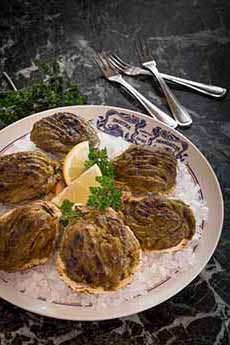
[1] The original Oysters Rockefeller from Antoine’s Restaurant in New Orleans (photo © Antoine’s).


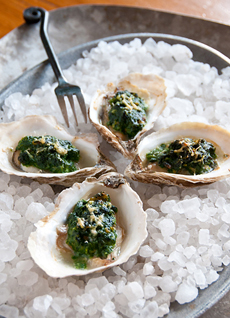
[2] Chefs who adapted the secret recipe often use spinach and diced bacon. Here’s the preparation at Monahan’s Seafood Market in Ann Arbor, Michigan (photo © Monahan’s Seafood Market).


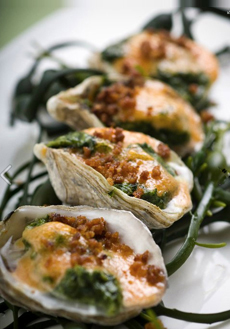
[3] Some “builds” include Mornay sauce, a classic French cheese sauce made with Gruyère. Some American chefs substitute Cheddar but—please don’t (photo © Arch Rock Fish in Santa Barbara [alas, closed]).


January 10th is National Oysters Rockefeller Day. It was first celebrated in 2017 at Antoine’s restaurant in New Orleans.

If you live anywhere near New Orleans, you be rewarded with a special treat.

That’s because this weekend, Antoine’s will celebrate National Oysters Rockefeller Day with by offering orders of Oysters Rockefeller for just $5.

The legendary dish was invented in Antoine’s kitchen in 1899 by Jules Alciatore, the son of the restaurant’s namesake founder, Antoine Alciatore.

The recipe was an innovation in the art of cooked oysters, an unanticipated mother of invention.

At the end of the 19th century, there was a shortage of European snails—then a gourmet treat—arriving from Europe to New Orleans.

Jules identified a locally sourced replacement: oysters.

In creating the dish, Jules combined a buttery sauce with green vegetables, producing such a richness of flavor that he named it after one of the wealthiest men in the United States: John D. Rockefeller.

While Mr. Rockefeller reportedly despised the affiliation, grilled Oysters Rockefeller became an iconic dish.

It has approximated by chefs around the world. The original recipes a closely-guarded family secret.
 
 
OYSTERS ROCKEFELLER VARIATIONS

Here’s one big difference:

While just about every tribute recipe tops the oysters with spinach, Antoine’s original recipe does not contain spinach. Is it watercress?

Maybe: You’ll could head to New Orleans to find out.

But even then, you’d need to be a super-taster to have any success.

To safeguard the recipe, Antoine’s has subsequently puréed the topping ingredients and piped them on top of the grilled oysters (photo #1).

When we first had them at Antoine’s decades ago, the ingredients were still recognizable—and if we had known that food writing lay in our future, we would have taken closer notice.

Most imitators top the oysters with sautéed or blanched spinach, others cream the spinach or substitute a whole blanched spinach leaf.

Some add a garnish of bread crumbs, diced bacon and/or parmesan cheese (photo #2).

We’ve even had the oysters with topped with a Mornay sauce—a béchamel sauce turned into cheese sauce with Gruyère—before adding the spinach and bacon (photo #3).

Some modern interpretations even fry the oysters and serve them with conventional “imitator” garnishes: spinach, bread crumbs, bacon.

Since you’ll never know the original recipe, you can add the ingredients that please your palate most.

It may not be “Oysters Rockefeller” as Jules Alciatore created it; but it will be your Oysters Rockefeller.

Here’s a recipe to start you off, along with more garnish ideas.
 
 
ABOUT ANTOINE’S RESTAURANT

Antoine’s, an iconic New Orleans institution, is managed by fifth-generation CEO and Proprietor Rick Blount, whos estimates that the restaurant has prepared Oysters Rockefeller more than five million times since its introduction.

Beyond being known as the birthplace of Oysters Rockefeller, the legendary New Orleans restaurant is the oldest continuously-operating restaurant in the U.S. It remains owned by the same family that founded it in 1840.

The restaurant celebrated its 175th anniversary in 2015. It’s now 180, and we bet they’ll still be serving Oysters Rockefeller at age 200 and beyond.

For more information, visit Antoine’s website.


Comments off

FOOD 101: Pizza In America – Pizza Holidays


[1] The classic, a Margherita pizza is a cheese pizza topped with fresh basil (photo © Nadezhda Filatova | Unsplash).

Arugula Pizza Slices
[2] Slices topped with fresh arugula (photo © Sahand Hoseini | Unsplash).


[3] Pile it on! This pepperoni pizza has veggie companions: black olives, fresh basil and tomatoes (photo © Like Meat | Unsplash).


[4] Eat your veggies! This pizza sports Brussels sprouts and broccolini, with pesto. Here’s the recipe from DeLallo (photo © DeLallo).


[5] America’s favorite topping: pepperoni (photo © Tablespoon | TBSP).


[6] Breakfast pizza, with eggs and pancetta. Here’s the recipe from DeLallo (photo © DeLallo)


National Pizza Week kicks off on the second Sunday in January. That’s tomorrow. Plus, we have a year of pizza holidays.

National Pizza Week is just one of 12 “pizza holidays” in the U.S. alone. We’ve listed them all, below.

You have an entire week to celebrate one of America’s all-time favorite foods: comforting, affordable, ubiquitous…and delicious! Here we reveal the #1 pizza-eating states and countries, plus America’s favorite toppings.

> Head to the pizza holidays and mark your calendars!

> The history of pizza.

> 50+ yummy pizza recipes.
 
 
AMERICA’S PIZZA PASSION

How much do Americans like pizza?

We Americans love our pizza. Depending on the survey, it’s America’s favorite food (vying with the burger).

Global data specialist BoldData determined that the number of pizza restaurants in the U.S. increased by a whopping 39.2% over the last five years.

(Note that the definition of “restaurant” can range from a large venue with table service to a take-out counter that delivers.)

Alas, thanks to the pandemic, the growth spurt abruptly stopped in 2020…with bright hopes for the post-pandemic future.

But because so much pizza is takeout and delivery rather than eat-in, the pizza party didn’t end in 2020.

Take a look at the growth curve: In 2016 there were 65,213 pizza places. In 2020, there were 90,817 pizza restaurants or counters.

Based on the trajectory, the beginning of 2021 should have reached the magical number of 100,000 pizza restaurants.

But thanks to COVID-19, the increase in 2020 was just 581 new outlets.
 
 
WHO’S NUMBER ONE?

  • California. When it comes to pizza, California is the place to be. The state has 8,271 pizza places, of which 2,044 are based in the Los Angeles area.
  • New York. The Big Apple comes in second with 7,190 restaurants, a growth of 48% compared to 2016.
  • Hawaii. The biggest growth in pizza outlets took place in Hawaii: a whopping 69%.
  • Wyoming-Not. Pizza lovers had better stay away from Wyoming, the state with the lowest number of pizza joints—just 133. To be fair, Wyoming is the least populous and least-densely-populated state in the contiguous United States.
  •  
     
    THE WORLDWIDE CHAMPION

    There are 245,244 pizza restaurants worldwide.

    The U.S. takes the biggest slice of the worldwide pie. It’s home to the largest number of pizza restaurants: 90,817 restaurants for a population of 328.2 million population (in 2019).

    The U.S. has more pizzerias than the next four countries combined (which total 88,100). That’s 36% of all pizza restaurants worldwide

    Italy, where the modern pizza originated, comes in second with 42,288 pizzerias for a population of 60.36 million (2019). That’s 17% of the world’s total.

    Brazil takes third place, with 32,283 pizzerias (population 209.5 million in 2018).

    The top three countries combined are home to 67% of the world’s total amount of pizza restaurants.

    Australia is number 8 on the list. With 5,598 pizza restaurants, they have one of the highest numbers of pizza places per capita.
     
     
    DELIVERY FAVORITES

    The Huffington Post gathered favorite pizza toppings from a 2018 survey of the online food delivery service, Caviar.

    While Caviar doesn’t represent a representative sampling of the entire country (it covers 20 major cities), here are its data on the most popular pizza toppings:

  • Pepperoni
  • Sausage
  • Garlic
  • Olives
  • Mushrooms
  • Onions
  • Chicken
  • Oregano
  •  
    Their toppings data doesn’t include a slot for people who just ordered a plain cheese pizza (the Margherita*).

    > Check out the 50 largest pizza chains worldwide.

    Canada’s Panago Pizza beat out America’s Domino’s Pizza for first place.
     
     
    THE YEAR’S 12 PIZZA HOLIDAYS

    Whether you get takeout pizza or make your own, mark your calendars for:

  • January, Beginning 2nd Sunday: National Pizza Week
  • February, 2nd Week: Great American Pizza Bake
  • February 9: National Pizza Day (a.k.a. National Pizza Pie Day)
  • April 5: National Deep Dish Pizza Day
  • May, 3rd Friday: National Pizza Party Day
  • June 11: Pizza Margherita Day
  • September 20: National Pepperoni Pizza Day
  • October: National Pizza Month
  • October 9: International Beer and Pizza Day
  • October 11: National Sausage Pizza Day
  • October 22: National Tavern-Style Pizza Day
  • November 12: National Pizza With Everything Except Anchovies Day
  •  
    ________________

    *The Margherita is the original modern pizza. It was named after Queen Margherita, consort to Umberto I, King of Italy from 1878 to 1900. As the story goes, during a visit to Naples, she asked the best pizza maker in town, Don Raffaele, to make her a pie. He made it in the colors of the Italian flag (red, white, and green). The result: a simple but delicious pie of basil, mozzarella, and tomatoes.


    CHECK OUT WHAT’S HAPPENING ON OUR HOME PAGE, THENIBBLE.COM.


    Comments off

    FOOD ART: Boursin Cheese With Tomato Flowers

    Some “food art” can only be achieved by professional food stylists.

    We’re always delighted to come across something simple, that we can make ourselves.

    Serve the tomato flowers with a round of Boursin as an appetizer, or use individual “flowers” as an individual plate garnish.

    Thanks to Boursin for the idea.
     
     
    RECIPE: BOURSIN CHEESE FLOWERS

    Ingredients

  • 2 different flavors of Boursin*
  • Grape or pear tomatoes
  • Fresh chives
  • Baguette slices or crackers
  •  
    Preparation

    1. SOFTEN the cheese for stuffing the flowers. Leave at room temperature until it is soft enough to pipe into the tomatoes.

    2. TRIM the chive stems to the desired length.

    3. USE an ice pick or other sharp implement to create a hole on the bottom of the tomatoes for the chives.

    4. SLICE into the top of the tomatoes with a small paring knife and hollow out a small place to pipe the cheese. The opening can go just halfway down the tomato. You can refrigerate this until ready to serve. Then…

    5. UNWRAP and place the second wheel of Boursin on the serving plate. Insert the chive “stems” into the base of the tomatoes (we used the end of a skewer to push them in.

    6. PLACE the tomato flowers on the serving plate as desired. Most of our guests picked up the tomatoes, leaving the chives on the plate; so we put the rest of the tomatoes that hadn’t been “flowerized” in a ramekin with another ramekin of sea salt.
     
     
    BOURSIN CHEESES

    The Boursin line of soft, spreadable French cheeses includes:

  • Basil & Chive
  • Garlic & Fine Herbs
  • Pepper
  • Shallot & Chive
  • Season Flavors (Cranberry Spice and Fig & Balsamic for the holidays, e.g.
  •  
     
    BOURSIN CHEESE HISTORY

    Boursin Garlic and Fine Herbs, sold in a little foil cup, was created in 1957 by François Boursin, a cheesemaker in the commune of Croisy-sur-Eure commune in Normandy, northern France.

    The cheese was inspired by a traditional Normandy party dish of garnished fromage frais (French for “fresh cheese”); a fresh, unaged cheese intended to be eaten within days of its production.

    In the case of Boursin, guests would take their portion of cheese and top it with herbs to add herbs for flavor.

    Boursin thought: Why not sell the cheese with the herbs already blended in?

    Voilà: Boursin Garlic and Fine Herbs, the first flavored cheese product to be sold nationally in France.

    In 1990, the brand was acquired by Unilever, who sold it to Groupe Bel 2007 [source].

    The original cheese, fromage frais, is simply drained, lactic set curd, lightly salted, that does not undergo a ripening period. It has a creamy, soft texture and fresh and a fresh, milky flavor.

    Fromage frais differs from fromage blanc, another fresh, white French cheese, in that by law, fromage frais must contain live cultures when sold, whereas with fromage blanc, the fermentation has been halted [source].

    It is often eaten for breakfast (we love it with toast), with fruit for dessert, or in cooking.
     
    ________________

    *Since we needed a separate package to stuff the tomatoes, for variety we used two different flavors of Boursin. You could also use a different cheese for the tomatoes, e.g., cream cheese, mascarpone, quark or ricotta. You can add herbs or spices to any of these cheeses.


    > THE DIFFERENT TYPES OF CHEESE
     
     
    > THE HISTORY OF CHEESE


    [1] Boursin with grape tomato flowers (all photos © Bel Brands USA).


    [2] Boursin is available in four flavors, plus seasonal specialties.


    [3] One of our favorite appetizers, mango, spinach and Boursin prosciutto wraps.


    [4] Keep a box of Boursin in the fridge, and you’ll always have something delicious to serve with wine, beer, or a cup of tea.


    [5] Go fancy with an appetizer of baby potatoes stuffed with Boursin and caviar or shrimp.


    [6] Is the new cheeseburger a burger topped with Boursin?


    Comments off


    © Copyright 2005-2026 Lifestyle Direct, Inc. All rights reserved. All images are copyrighted to their respective owners.