THE NIBBLE BLOG: Products, Recipes & Trends In Specialty Foods


Also visit our main website, TheNibble.com.

TIP OF THE DAY: Seacuterie Instead Of Charcuterie


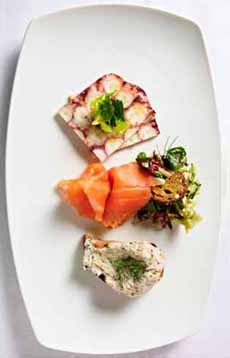
[1] A seacuterie plate from Oceana restaurant, with octopus salami, gravlax with dressed microgreens, and crab spread on toasted baguette (photo © Paul Johnson | Oceana Restaurant).


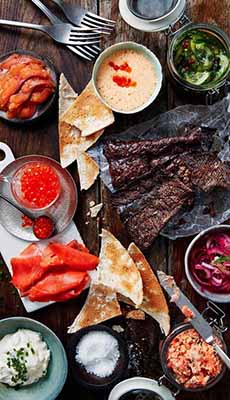
[2] A put-it-together seacuterie board: You can purchase most of what’s here. Here are the recipes fi=or the rest (photo © Wild Alaska Food).


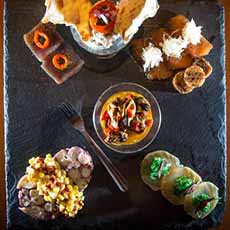
[3] An ample lunch, first course, or dinner at PB Catch raw bar in Palm Beach (photo © PB Catch).


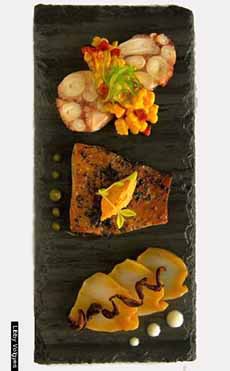
[4] An individual seacuterie board from PB Catch, with octopus salami, salmon pastrami and smoked cod (photo © Libby Volgyes | PB Catch).


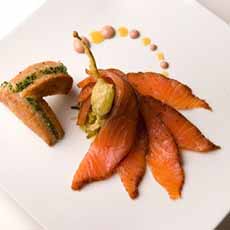
[5] The start of it all: Chef David Burke’s Pastrami Salmon. Here’s the recipe (photo © David Burke Group).

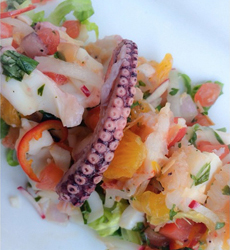
Ceviche With Octopus
[6] Ceviche is an easy dish to make, and a low-calorie, low-carb addition to a seacuterie plate or board (photo © Lola | Denver).


Back in 2017 we wrote an article about seacuterie (see-KEW-tuh-ree).

It’s the seafood-based version of charcuterie.

Instead of cured meats (mortadella, prosciutto, salami, etc.) and cheeses, seacuterie leaves the “turf” for the “surf”: seafood choices that are equally tasty, more healthful, and appeal to consumers who want to eat less meat or more sustainable foods in general.

We have long served charcuterie—and now, seacuterie—on a board with cocktails, or individually plated as a first course with dinners.

So…
 
 
WHAT IS SEACUTERIE?

Seacuterie is a different approach to two popular starters:

  • The charcuterie board, replaced with seafood
  • A seafood platter, or plateau de fruits de mer*
  •  
    Seacuterie expands the concept of the seafood platter, which is mixed shellfish, both raw and cooked, served cold, usually on a bed of ice; with condiments of mignonette sauce, cocktail sauce and lemon wedges.
     
     
    Beyond The Seafood Platter

    A classic seafood platter is laden with some assortment of clams, crabs, langoustines, lobster, mussels, oysters, prawns, scallops and shrimp.

    Occasionally, more exotic mollusks like cockles, periwinkles or snails will appear; and if we’re lucky, one of our favorite shellfish, sea urchin (uni).

    Seafood platter items are served raw or lightly cooked (boiled, poached).

    Here’s where a seacuterie board or plate diverges:

    Seacuterie can include some seafood platter items, but it adds complexity to the variety by adding fish and preparations.
     

    And the good news is that you don’t have to prepare them all yourself (or even any of them, if you so choose).
     
    A seacuterie plate or platter can include elements that you purchase, ready-to-eat:

  • Caviar or other roe (see the different types)
  • Clams and oysters (types of oysters)
  • Eel (ready-to-serve from Asian markets)
  • Hot smoked salmon
  • Pickled herring
  • Salads: crab, herring, shrimp, tuna, whitefish
  • Salmon or tuna jerky
  • Sardines, plain or flavored (we’re fans of the Bela Brand)
  • Smoked salmon or gravlax (here’s a recipe to make gravlax)
  • Smoked mackerel, trout, tuna, sable, sturgeon, whitefish
  • Raw shellfish: clams, mussels, oysters, scallops; lightly cooked varieties such as octopus and squid
  • Sashimi† or sushi
  • Seafood sausages
  • Taramasalata (whipped carp roe)
  •  
    And, it should include recipes that you have prepared:

  • Anchovy picks with cocktail onions
  • Ceviche
  • Crab dip
  • Grilled shrimp and/or scallop skewers
  • Grilled squid
  • Potato slices with caviar/roe
  • Salmon rillettes (or any other fish you like)
  • Tuna or salmon tartare or tataki (recipe)
  •  
     
    WHAT TO SERVE WITH SEACUTERIE

  • Baguette or other bread slices
  • Capers and olives
  • Condiments: mustard, horseradish sauce
  • Crackers
  • Dill for garnish
  • Pickled vegetables (including pickled onions)
  • Seaweed salad
  •  
     
    WHAT TO DRINK

    Seacuterie pairs best with white wine or rosé and sparkling wines.

    But you can serve lighter reds like Beaujolais and Pinot Noir. Plus:

  • Aperitif wine such as Lillet
  • Beer
  • Dry Sherry (e.g. Manzanilla and very dry fino sherry like Tio Pepe
  • Vodka/Aquavit
  • Whiskey
  •  
    For cocktails: Martinis are ideal, but a Bloody Mary also hits the spot.

    Check out these non-sweet cocktails.
     

    THE HISTORY OF SEACUTERIE

    The birth of seacuterie is attributed to the endlessly creative New York Chef David Burke.

    In 1998 at the helm of the [late, lamented] Park Avenue Café in Manhattan, he riffed on the Scandinavian cured salmon dish, gravlax [source].

    It was a dazzling concept, bursting with flavor, unheard of at the time.

    Trading the traditional dill, sugar and salt marinade, he used the more assertive “pastrami spices” (actually black pepper, coriander, parsley, paprika and maple syrup.

    Once marinated and preserved, the salmon sides are sliced in the same way as pastrami.

    Instead of the thin slices of gravlax, he sliced the cured salmon in the manner of pastrami. Here’s the recipe.

    The result, Pastrami Salmon, became a sensation among food writers and the foodies who follow them. Burke subsequently trademarked the name [source].

    And the kernel of a future trend—seacuterie—was born.

    We are fortunate to have had Pastrami Salmon numerous times at the Park Avenue Café.
     
    Chefs have continued to evolve fancy seacuterie options with preparations such as octopus pastrami, salami or torchon; scallop mortadella; swordfish ham; tuna bresaola and tuna ‘nduja; and other visual- and palate-excitement [source].

    What’s next?

    Stay tuned!


    ________________

    *Plateau de fruits de mer is pronounced plah-TOE duh froo-EE duh MARE. It is a French term for means a platter of the fruits of the sea, i.e., seafood. In French, plateau means platter or tray, as opposed to its meaning in English, a geological term for a high plain.

    †You can purchase a loin of tuna or salmon, freeze it and slice it thinly while still partially frozen. Note that with salmon, you should be sure that the pin bones have been removed.


    Comments off

    CANDY & CHOCOLATE: See’s Candies Celebrates 100th Anniversary

    Love candy? Here’s your chance to make candy history—at least, See’s Candies history.

    See’s Candies is officially 100-years-old!

    The iconic American manufacturer of chocolates and other candies was founded by Charles See, his wife Florence, and his mother Mary in Los Angeles in 1921.

    Mary See had developed the recipes that became the foundation of the See’s candy business, while helping run her late husband’s hotel on Tremont Island in Ontario.

    Want to know why See’s chocolates taste so good?

    The couverture chocolate used by to make the candies is from the Guittard Chocolate Company, America’s finest producer of couverture chocolate.
     
     
    SEE’S IS NOW 100 YEARS OLD!

    Kicking off its Centennial Anniversary See’s is asking its fans to create the next piece of candy to be produced.

    The campaign is called “What’s Your Sweet Idea?”

  • You don’t have to make it—just come up with the idea.
  • Head to Sees.com and see what’s missing from the line.
  • All ideas are welcome, no matter how simple or complex.
  • Then, enter your idea at Sees.com/Sweet Idea.
  •  
    > Submit your idea today through January 20th.

  • See’s will then pick the finalists and hold a final voting by fans, from February 15th through March 1st.
  • Since See’s opened for business in November 1921, the new piece will be launched in November 2021.
  •  
    We can’t wait to see the finalists!

    So have fun with it: Your fantaSEE piece of candy may be the Centennial Anniversary choice!
     
     
    SEE’S FAVORITES

    See’s top sellers are:

  • Lollypops (Butterscotch, Chocolate, Cinnamon, Mint Cream, Vanilla)
  • Peanut Brittle (there’s also a sugar-free version)
  • Bordeaux (creamy brown sugar soft center covered in rich dark chocolate and decorated with chocolate rice)
  • Scotchmallow (a layer of caramel topped with a layer of honey marshmallow, covered in dark chocolate)
  • Butterscotch Square (a soft center of brown sugar and cream with a touch of vanilla, covered in dark or milk chocolate)
  • Caramel Pattie (a pattie-shaped caramel covered dark or milk chocolate)
  • Chocolate Butter Caramel (buttery chocolate caramel coated in milk chocolate)
  •  
    Hungry yet?
     
     
    SEE’S CANDY TRIVIA

  • Lucy: In 1952, Lucille Ball and Vivian Vance spent a half day at the See’s Candies store on La Cienega Boulevard in Los Angeles, learning to dip chocolates and work the production line in preparation for the iconic “Job Switching” episode of “I Love Lucy.”
  • The episode, which featured Lucy and Ethel getting jobs on the dipping line in a chocolate factory, became one of the most popular in the show’s history. You can see the full episode on CBS All Access.
  • Cher: Singer Cher was working at See’s in 1962, when she met Sonny Bono; she quit her job to become his housekeeper.
  •  


    > THE DIFFERENT TYPES OF CHOCOLATE
     
     
    > THE HISTORY OF CHOCOLATE
     
     
    > THE HISTORY OF CANDY
     
     
    > THE HISTORY OF LOLLIPOPS


    [1] Will the new See’s Centennial chocolate be your creation (all photos © See’s Candies)?


    [2] Toast to See’s Centennial Anniversary. Here’s how to pair chocolates with wine.

    See's Peanut Brittle
    [3] See’s peanut brittle, a fan favorite.


    [4] See’s Lollypops. The company uses the old-fashioned spelling.


    [5] Ready for dessert?


    Comments off

    PRODUCT OF THE WEEK: Kickin’ Kream Mustard


    [1] Our new favorite mustard to slather on almost everything (photos #1 and #2 © Milo’s Whole World Gourmet).


    [2] Sweet, hot, creamy and delicious!

    Chicken Nuggets With Mustard
    [3] You can also use it as a dip (photo © Betty Crocker—here’s the recipe for the Honey Mustard Chicken).


    Our new favorite mustard condiment is Kickin’ Kream Mustard from Brownwood Farms.

    Kickin’? Yes!

    Creamy? Very!

    Special? Yes!

    Sweet, hot, creamy and delicious, it combines honey* mustard-type flavor with a little extra zing from jalapeño chile peppers and a dash of cayenne pepper.

    All for just 15 calories per teaspoon!

    If you shy away from hot and spicy foods, let us assure you that Kickin’ Kream is not all that hot. We personally use mild salsa (never the medium-hot version); but we love the sizzle we get from this condiment.

    There’s a kick of spice—a delightful one.

    After we opened our first jar, we found ways to use it every day.
     
     
    WAYS WE’VE USED KICKIN’ KREAM MUSTARD

    We like it so much, we’ve been eating it from the jar…as well as:

  • With meats (see Seemore sausages) and poultry
  • As a glaze on roasted chicken and grilled salmon
  • As a dip with pretzels (see Eastern Standard pretzels), crudités, chicken fingers, etc.
  • On sandwiches
  • On burgers and hot dogs
  •  
     
    GET YOUR KICKIN’ KREAM

    Kick your taste buds into high gear and spread this creamy deliciousness on anything you choose.

    It’s sold at specialty food stores, but easiest to find on Amazon.
     
     
    Check out BACON MAPLE ONION JAM, a recent Tip Of The Day from the same producer.
     
     
    > THE HISTORY OF MUSTARD
     
    > THE DIFFERENT TYPES OF MUSTARD

     
    ABOUT BROWNWOOD FARMS

    Brownwood Farms is a brand of Milo’s Whole World Gourmet, a creator and producer of specialty foods based in Athens, Ohio.

    Milo’s seeks to procure ingredients from the finest sources in the U.S., especially the Great Lakes region

    All of Milo’s gourmet are products in small batches, with clean and minimal ingredients; and with the quality and care one would find in a homemade product.

    The Brownwood Farms line of farm-fresh quality sauces and condiments includes mustards, BBQ sauces, fruit salsas, pie fillings and spreads.

    Says Milo: “By starting with a foundation of clean and natural ingredients to craft our homestyle recipes, we are able to cultivate an array of savory and bountiful flavors you’ll be amazed we fit into a jar!”

    ________________

    *In this recipe, tapioca syrup is used instead of honey. Tapioca syrup is made from the starch of cassava/manioc root. The different types of sugar and syrup.


    Comments off


    © Copyright 2005-2026 Lifestyle Direct, Inc. All rights reserved. All images are copyrighted to their respective owners.