THE NIBBLE BLOG: Products, Recipes & Trends In Specialty Foods


Also visit our main website, TheNibble.com.

APPLIANCE: Cuzen Matcha Maker For Easy Matcha Tea


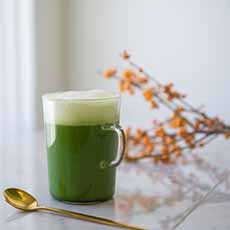
[1] Enjoy a cup of matcha effortlessly, with Cuzen Matcha (photos #1 to #5 © Cuzen Matcha).


[2] You can turn the whisked matcha into a hot or iced latte.


[3] The ground matcha leaves drop into a cup of hot water, where they are whisked into a froth with a magnetic whisk.


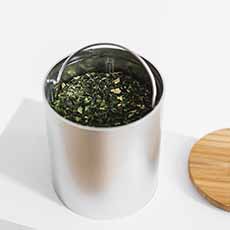
[4] Dried whole matcha leaves—a rare sight (are they ever seen outside of Japan?).


[5] The whole leaves are broken into a size that fits into the machine.


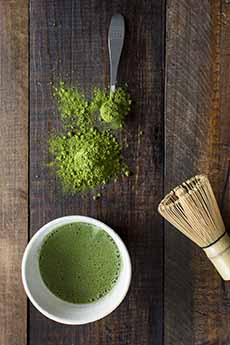
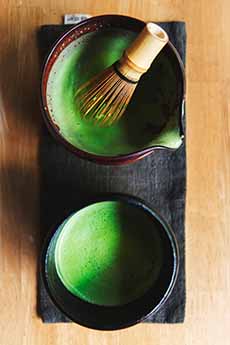
[6] The traditional preparation is to whisk the ground matcha powder in water until it froths. You can build up arm muscles if you do it often enough (photo © Match & Co | Unsplash).


[6] Whisking matcha in a bowl, then pouring it into an individual cup (photo © Raw Pixel | Pexels).


October is National Hot Tea Month, and January 12th is National Hot Tea Day.

We love tea, and have brewed it every which way: from tea bagas to tea ball infusers for loose tea, from a whistling tea kettle to electric kettles, from and the Cuisinart TEA electric brewer and the fancy Breville tea maker.

Every so often we come across a niche product that’s really interesting.

But, we think, how many of these can they sell?

In the case of the Cuzen Matcha Maker, it depends on how many matcha tea lovers have $369 and space on the kitchen counter.

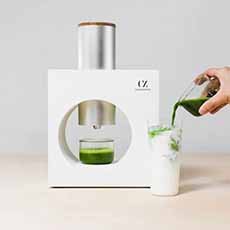
The matcha-drinking world is all abuzz over this dedicated matcha making machine (photo #2).

It was a hit at the Consumer Electronics Show (CES) earlier this year and showered with awards‡. (Note: we have not tried the Cuzen machine.)

It takes all the effort from whisking up a cup of matcha tea (photos #5 and #6), the bright-green Japanese signature tea noted for its super-nutrient-packed green tea.

Here’s a video of traditional matcha-making.

Here’s a video of the Cuzen Matcha machine in action.

Here’s more about matcha tea.
 
 
THE HEALTH BENEFITS OF MATCHA GREEN TEA

While all tea* comes from the Camellia sinensis plant, matcha is grown differently† from other teas. The process gives it a unique nutrient profile.

Matcha, which comprises tea leaves ground into a powder, has more catechins and antioxidants than steeping a cup of green tea from leaves.

Here’s a chart that compares the nutritional profile of matcha versus brewed green tea leaves.

Catechins are the antioxidant compounds that are found in tea. The caffeine level is higher, too; it’s similar to coffee.

Antioxidants help stabilize harmful free radicals—the compounds that can damage cells and cause chronic diseases.

In addition to antioxidants, some studies have found that the antioxidants in matcha boost brain function, may help protect the liver, may help prevent cancer, may promote heart health, lower blood pressure, lower cholesterol, and actually help with weight loss. Here are the details.

By one estimate, the number of certain catechins in matcha is up to 137 times greater than in other types of green tea [source].

That’s why some people who are focused on health and nutrition drink lots of matcha.

And any green tea lover will appreciate its unique flavor and frothiness.

Matcha is sweeter and creamier than regular green tea—and sometimes a bit grassy.

More people would make matcha at home if it didn’t involve a substantial amount of whisking the fine green powder into a froth.
 
 
WHY DO YOU NEED A SPECIAL MACHINE?

For thousands of years, matcha tea has been a powder, ground from a particular type of tea leaf from Japan. Crafting the powder involves precise measurements, sifting and rapid flicks of a bamboo whisk to create the right froth (photo #6).

Cuzen Matcha does it all, with a clever magnetic whisk (at the bottom of the cup in photo #2) that does all the labor. We found that hand-whisking was fun the first couple of times, then became tiresome.

With Cuzen Matcha, just add pre-measured packets of organic tea leaves into the machine (photo #5), where they’ll be ground and whisked into your cup of hot water in 90 seconds. (A bonus is the aroma wafting from the freshly-ground leaves.)

The only cleanup is a quick rinse of the cup and the whisk.

With a Cruzen Matcha machine, you can:

  • Enjoy a cup of hot matcha with ease.
  • Make a matcha latte or an iced matcha latte.
  • You use the ground leaves for baking or other drinks.
  •  
    The downside is that this is a new product. If the company doesn’t get enough customers, it is likely to disband. The machine will still work, but you may not be able to find the un-ground matcha leaves (photo #4).

    You’ll still be able to use the machine to whisk matcha powder—which is an easy way to prepare matcha, but may not merit a dedicated appliance.

    You could certainly try grinding other types of tea leaves and whisking them into a froth.

    Every day is a food adventure!
     
     
    > HEAD TO CUZENMATCHA.COM to learn more and purchase a machine.
     
     
    MORE MATCHA

  • More Uses For Matcha Tea Powder
  • Make A Matcha Latte
  • Make An Iced Matcha Latte
  • Bake Matcha Shortbread Cookies
  •  
     
    > THE HISTORY OF TEA
     
     
    > THE DIFFERENT TYPES OF TEA

    ________________

    *This refers to conventional black, green and white teas. Herbal teas, which are brewed from many different plants but not Camellia sinensis, are not included in this analogy, although each has its own nutrient profile and health benefit(s).

    †The tea plants are covered to avoid direct sunlight, for 20–30 days before harvest. This increases chlorophyll production and boosts the amino acid content. The leaves are harvested, the stems and veins are removed and the leaves are then ground into the fine powder known as matcha.

    ‡In 2020 the Cuzen Machine was named to TIME magazine’s list of the 100 Best Inventions of 2020, won the Future of Foods Award at San Francisco Design Week Awards 2020, was a CES 2020 Innovation Awards Honoree, and was longlisted for the 2020 Dezeen Awards.


    Comments off

    HOLIDAY: Whisky Chocolates For Robert Burns Day

    When you sang “Auld Lang Syne” on New Year’s Eve, did you recall that it was first a poem by Robert Burns, the national poet of Scotland (1759-1796)?

    His birthday, January 25th, is celebrated in Scotland as Burns Night.

    Family and friends gather for an evening of good food and company. It’s a warm and happy event much like our Thanksgiving. A traditional Burns’ Supper is served.

    Here’s a Burns Night dinner menu.

    But dinner or not, we never pass up this once-a-year opportunity to have a box of whisky-infused chocolates from the prominent artisan chocolatier Larry Burdick.

    Why do the Scottish spell it “whisky” and the Irish spell it “whiskey?”

    Here’s the scoop.
     
     
    WHISKY-INFUSED CHOCOLATES

    Call them chocolates, bonbons or truffles, this Scotch-infused assortment (photo #1) is available for just a few weeks each January.

    This year, the dates are from January 4th through January 29th.

    The eagerly-awaited, limited-edition collection of handcrafted bonbons is filled with whisky-infused chocolate ganache.

    Some of the finest single-malt Scotch whiskies are used: Glenfarclas, Highland Park, Lagavulin, Macallan, Springbank and Talisker.

    The chocolates are available in both half-pound and one-pound boxes.
     
     
    SCOTCH WHISKY CHOCOLATE CIGAR ASSORTMENT

    Burdick’s signature dark chocolate is infused with fine single-malt Scotch whisky and rolled into gourmet chocolate cigars.

    A box of six (photo #2) has three each of cigars made with 10-year-old Laphroaig and 12-year-old Old Pulteney.

    You can buy the box, or individual Laphroaig cigars (photo #3).
     
     
    MORE WAYS TO CELEBRATE BURNS NIGHT

  • Gingerbread Men In Kilts
  • Robert Burns Poems
  • Scotch & Chocolate Tasting
  • Scotch Whisky Tasting
  •  
    You don’t have to be Scottish to celebrate Burns Night.

    All lovers of food adventures are welcome!


    [1] A half-pound box of Scotch Whisky Chocolate Assortment. A one-pound box is also available (all photos © Burdick Chocolate).


    [2] Cigars for the chocolate connoisseur are made in two varieties: Laphroaig and Old Pulteney


    [3] Individual chocolate whisky cigars in cigar-type tubes are made with Laphroaig single malt whisky.


    Comments off

    TOP PICK OF THE WEEK: Sumo Citrus, A Hefty Mandarin

    You may purchase lots of grapefruits, lemons, limes and oranges—the same ones you’ve been buying for years. But if you cast a wider net, you can find some real citrus excitement—like these Sumo Citrus® mandarins.

    Like Sumo wrestlers, Sumo Citrus is super-sized, and it has a topknot.

    It looks like a big orange, but it’s in the mandarin family (the difference between mandarins and oranges).

    Mandarins are easy to peel and segment, and Sumo Citrus is:

  • Sweet and juicy, but not messy.
  • Seedless.
  • A great on-the-go snack.
  • In season now!
  •  
    Look for it, buy it; just don’t call it an orange.
     
     
    THE HISTORY OF SUMO CITRUS

    Sumo Citrus was bred from the pomelo, navel orange and mandarin.

    In addition to size, it’s also one of the world’s sweetest mandarins.

    In Japan, it is known as shiranui and nicknamed the “dekopon,” a reference to its distinctive top knot.

    Not every dekopon is a Sumo Citrus however. It’s a brand distinction available only those fruits meeting size and taste standards.
     
     
    Not All Topknot Mandarins Are Sumo Citrus

    Originally, the different prefectures in Japan that grew the citrus gave them different names.

    However, an agreement was reached whereby any grower can use the name “dekopon” if they pay a licensing fee and meet certain quality standards.

    So the name “dekopon” now can refer to the fruits grown anywhere in Japan.

    In the U.S., something snazzier was needed to market the fruit. The brand name Sumo Citrus® was created.

    Think of the generic clementine mandarin, branded by different growers as Cuties and Halos, for marketing appeal.
     
     
    GROWING SUMO CITRUS

    While it’s sometimes hard to tell some mandarin varieties from others, you can’t miss Sumo Citrus and its topknot.

    This rare seedless variety was originally cultivated in Japan in the 1970s by a grower who set out to develop “the ultimate citrus experience.” This variety was dubbed the “dekopon” [source].

    In Japan, the fruits are usually grown in large greenhouses to keep them at a constant temperature, and are harvested from December to February.

    In the case of orchard farming, the dekopon is harvested from March to April.

    Harvesting trivia: After harvesting, the dekopon is usually left to sit for a period of 20–40 days so that the levels of citric acid in the fruit decrease, while the sugar levels increase.

    This creates a more appealing taste. Only dekopons with sugar levels above 13°Bx† and citric acid below 1.0% can be sold with the name dekopon.
     
    Outside Of Japan

    Sumo Citrus is only grown in the San Joaquin Valley of California, and with partner growers in Australia, all of whom have licensed the ability to grow it.

    Sumo seedlings were first imported into the U.S. in 1998, but because the Sumo is one of the most challenging varieties to grow, it wasn’t until 2011 that they became available to the public.

    The dekopon was released as a commercial product in the U.S. under the name Sumo Citrus® in early 2011.

    After many years, there is now enough Sumo Citrus available in the U.S. for most of us to try it—with thanks to family farms in California whose incredibly high growing standards made the crop possible.

    Sumo season in the U.S. is just four months: January through April.
     
     
    GET YOUR SUMO CITRUS

    Check the store locator on SumoCitrus.com for the retailer nearest you.

    You can also send a Sumo Citrus gift box.


    [1] Why they’re called “Sumo”: the wide girth and the topknot (photos #1, #2, #3 and #4 © Sumo Citrus).


    [2] They may look small in a photo, but Sumo citrus is double or triple the size of other mandarins.


    [3] A benefit of mandarins versus oranges is that they’re so easy to peel. Some people pride themselves on being able to peel a mandarin in a single long swirl.


    [4] Add Sumo Citrus segments to green salads and grain bowls,


    [5] These are not mandarins, but they are food fun: Can you name these citrus varieties? The answer is in the footnote.<

     
    ________________

    *The citrus varieties from top to bottom: yuzu, variegated lemon, kaffir/kieffer lime, calamondin. Calamondin is a cross between a mandarin orange (Citrus reticulata, tangerine or Satsuma) and a kumquat (Fortunella margarita).

    †Bx, an abbreviation for brix, measures the sugar content of an agricultural product.


    Comments off


    © Copyright 2005-2026 Lifestyle Direct, Inc. All rights reserved. All images are copyrighted to their respective owners.