THE NIBBLE BLOG: Products, Recipes & Trends In Specialty Foods


Also visit our main website, TheNibble.com.

TIP OF THE DAY: Make A Lattice Pie Crust

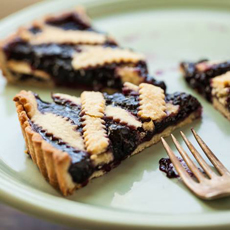
lattice-crust-blueberryjamtart-goboldwbutter-230sq
Many people think a lattice is the prettiest
pie crust. Photo courtesy Completely
Delicious via Go Bold With Butter.
 

“A home-baked fruit pie with a lattice crust is a guaranteed crowd pleaser,” says Annalise Sandberg of CompletelyDelicious.com. If you’ve always wanted to make one but haven’t yet, Annalise is here to help with a step-by-step photo tutorial.

A lattice crust is a top crust for pies or tarts made from strips of dough woven into a criss-cross pattern.

In addition to the eye appeal, the openings between the strips of dough allow steam to escape during baking. Some of the water in the fruit juices evaporates, which can caramelize the filling and makes for a less drippy filling. That’s why you typically find a lattice top on fruit pies.

The lattice is made from the top crust dough of a double crust pastry recipe. The dough is cut into strips using a sharp knife or, preferably, a pastry wheel cutter which provides a beautiful crimped edge.

If you need to buy a pastry wheel, we like this one which has both crimped and straight cutting blades. You can use the same tool to cut ravioli.

LATTICE CRUST TIPS

  • Chill the dough before cutting.
  • If you don’t want to rely on your eye, use a ruler to make the strips even-width.
  • Some people use an egg wash to make their top crusts golden brown. We think a lattice looks nicer without the egg wash.
  • Here’s a video.
  •  
    RECIPE: LATTICE PIE CRUST

    Ingredients

  • Your favorite fruit pie recipe and a double pie crust recipe (how about a delicious peach pie recipe?)
  •  

    Preparation

    1. MAKE the fruit filling of your choice. Set aside and make your favorite pie crust recipe, divided into two disks. Chill the dough.

    2. ROLL out first disk of dough, place it in the pie pan and fill it with the fruit.

    3. ROLL out second disk of dough. Use a plain or decorative pastry wheel cutter (or a very sharp knife) to slice the dough into strips approximately 1-inch wide. Use 10 strips as you first master the technique. Later you can get creative with the width of the lattice and the number of strips you use.

    4. PLACE 5 dough strips on top of pie, spaced evenly. The longest strips should be in the center.

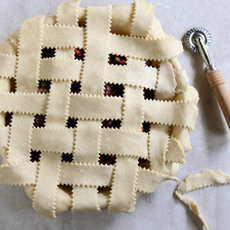
    5. WEAVE the second group of strips under and over the first five (and if these instructions sound confusing, look at the photo at right, watch the video or this photo layout).

      Lattice-unbaked-230sq
    Ready, set, bake! Photo courtesy Annalise Sandberg of CompletelyDelicious.com. Here’s her recipe.
    > PULL back the second and fourth strips halfway and place another strip down center of the pie, perpendicular to first set. Lay folded strips back down.
    > FOLD the first, third, and fifth strips back and place another perpendicular dough strip on top of pie. Unfold those strips, and again fold second and fourth strips. Lay one more perpendicular strip.
    > ROTATE the pie 180 degrees and repeat on the other side until you have finished the lattice.
    > TRIM the ends of the strips so that they match up with the overhang of the bottom crust. Pinch the top and bottom crusts together to seal, fold under and crimp as desired.

    6. BAKE as directed and impress your friends and family!
     

    LATTICE TRIVIA

    Before it was adapted to a pie crust design, a lattice was a structure of crossed wooden or metal strips, often arranged to form a diagonal pattern on trellises (for vines), gazebos, summerhouses, arches and other structures.

    The word first appears in print as an English noun in the late 13th century, derived from an Old English variant of laett, from the German latte—which is not a beverage but a thin slat of wood. The root can be found in numerous old languages, including Proto-Germanic, Old Norse and Old Saxon. The verb appears in the 1530s.

    Im Middle English the word was spelled latis; in Middle French, lattis. The French spelling is the same today.
      

    Comments off

    Oven Fried Chicken With Corn Flakes Recipe & Corn Flakes History


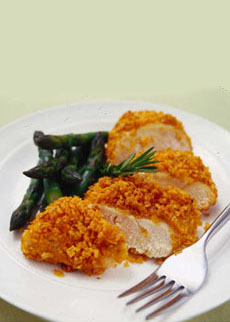
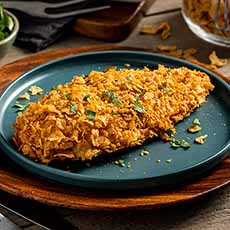
    Photo courtesy Cereal Lovers Cookbook.

      July 6th is National Fried Chicken Day. Our favorite fried chicken recipe is breaded with Corn Flakes. We usually make this skillet fried chicken recipe, but here’s a “bake fry” recipe.

    Of course, it’s breaded with Corn Flakes crumbs. Not only is the texture superior to flour, but the corn flakes add a delightful flavor note. (Panko, Japanese bread crumbs, provide the texture but not the flavor.)

    You can make this recipe with or without the chicken skin. We remove it to cut back on cholesterol.

    > The history of Corn Flakes is below.
     
     
    RECIPE: OVEN FRIED CHICKEN WITH CORN FLAKES

    Ingredients

  • 7 cups Kellogg’s Corn Flakes, crushed to 1-3/4 cups
  • 1 egg
  • 1 cup fat-free milk
  • 1 cup all-purpose flour
  • 1/2 teaspoon salt
  • 1/4 teaspoon pepper
  • 3 pounds chicken pieces, rinsed and dried
  • 3 tablespoons butter, melted
  • Preparation

    1. CRUSH. Crush corn flakes in a plastic bag with a rolling pin or wine bottle. Place crushed cereal in a shallow dish or pan. Set aside.

    2. MIX. In medium mixing bowl, beat egg and milk slightly. Add flour, salt and pepper. Mix until smooth. Dip chicken in batter. Coat with cereal. Place in single layer, in shallow baking pan coated with cooking spray or foil lined. Drizzle with margarine.

    3. Bake at 350° F about 1 hour or until chicken is tender, no longer pink and juices run clear. For food safety, internal temperature of the chicken should reach at least 165ºF. Do not cover pan or turn chicken while baking. Serve hot.

    > The different cuts of chicken. How many can you name?

    > The history of chicken.

    > The year’s poultry holidays: chicken, turkey and duck.


    CORN FLAKES HISTORY

    Corn flakes were developed by Dr. John Harvey Kellogg, a surgeon and vegetarian who built a sanitarium in Battle Creek, Michigan, and his brother Will Keith (W.K.) Kellogg, the sanitarium’s bookkeeper.

    Many of the patients were wealthy individuals with digestive problems.

    Seeking to develop a more digestible form of bread for the patients, the brothers Kellogg had just placed a sample of boiled wheat berries on a baking sheet when Dr. Kellogg was summoned to the operating room for an emergency.

    W.K. was also called away to supervise arrangements for the funeral of another patient. No one was watching the wheat berries.

    When they returned to their experiment, they ran the overcooked wheat berries through rollers and, to their surprise, found that each wheat berry formed a large, thin flake.

    The brothers had accidentally discovered the principle of tempering grains, and called the flaked wheat cereal Granose.

    They applied the same technique to create Corn Flakes, made from white corn grits; and rice flakes.

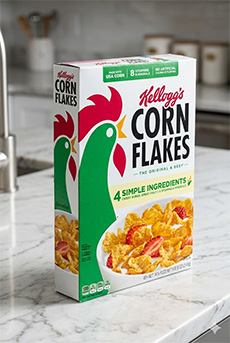
      corn-flakes-box-230
    For breakfast or breading! Photo courtesy Kellogg.
     
    The first corn flakes appeared in 1898 and were called Sanitas Corn Flakes (presumably after the sanitarium, a questionable inspiration for a breakfast food). They were manufactured by Dr. Kellogg’s Sanitas Food Company.

    In 1906, W.K. Kellogg formed his own company for nationwide marketing of Corn Flakes (Dr. Kellogg preferred healthcare to business).

    C.W. Post, a former patient at the sanitarium, came out with his own corn flakes at about the same time. At first he called them Elijah’s Manna, and later changed the name to Post Toasties.

    The Kellogg’s Corn Flakes rooster actually has a name: Cornelius Rooster. The artwork was created in 1957 by Rena Ames Harding at the Leo Burnett Advertising Agency.

    It has been pictured on the front of Kellogg’s Corn Flakes box ever since.


    CHECK OUT WHAT’S HAPPENING ON OUR HOME PAGE, THENIBBLE.COM.


    Comments off

    RECIPE: Blueberry Pineapple Salsa

    blueberry-pineapple-salsa-blueberrycouncil-230
    A salsa with something special: blueberries! Photo courtesy BlueberryCouncil.org.
     

    July is National Blueberry Month, and the price of the little blue nuggets should be at its lowest. In fact, experts recommend that blueberry lovers with lots of freezer space buy and freeze them to enjoy in winter. (Freezing tip: First freeze the berries in one layer in baking pan or rimmed cookie sheet so they don’t stick together; then store in freezer bags.)

    But our focus today is on summer and fruit salsa, with this recipe from the Blueberry Council. Use it with tortilla chips or to top grilled fish or chicken. We also like it as a topping for lemon sorbet (without the red onion)!

    RECIPE: BLUEBERRY PINEAPPLE SALSA

    Ingredients

  • 2 cups fresh blueberries
  • 1 cup finely diced fresh pineapple
  • 1 jalapeño, seeds and membrane removed, minced
  • 2 to 3 tablespoons lime juice, divided
  • 1/2 teaspoon lime zest
  • 3 tablespoons chopped cilantro
  • 1/4 cup diced red onion
  • Salt to taste
  • Preparation

    1. COMBINE the blueberries, pineapple, jalapeño, 2 tablespoons of lime juice, lime zest, cilantro and red onion. Season with salt, taste and add more lime juice as needed.

    2. SERVE with tortilla chips or as an accompaniment to fish or chicken.

    Find more delicious recipes at BlueberryCouncil.org. Check out the savory blueberry pizza!
     
    BLUEBERRY BUYING TIPS

    When you buy fresh blueberries, look for berries that are firm, dry, plump and smooth-skinned, with a silvery white surface bloom. If the bloom is gone, the berries are old.

    If you see juice stains on the bottom of the container of blueberries, the fruit can be bruised. Pick another carton.

    Berry size isn’t an indicator of maturity, but color is: The berries should be deep purple-blue to blue-black. Reddish blueberries aren’t ripe, and won’t ripen after they are picked (but you can use them in cooking).

    Refrigerate fresh blueberries when you get them home, either in their original plastic pack or in a covered bowl or container. Wash the blueberries just before using.

    Don’t buy more than you’ll use, and and eat them within 10 days of purchase (the sooner, the better).


    Comments off

    TIP OF THE DAY: Summer Sangria Recipe

    Thanks to our friends Laura and Charles for reviving our interest in sangria, a Spanish fruit punch. At a light summer dinner last week, the sangria they served paired beautifully with every dish.

    Americans were first introduced to sangria at the 1964 World’s Fair in New York City. The Spanish Pavilion had three restaurants, and the sangria offered with meals changed the way Americans thought of fruit punch.
     
     
    ENJOYING SANGRIA

    There are many recipes for red, rosé and white sangria. The types of wine and fruit used in Spain depended on what was grown in the particular region.

    We have two recipes from Courvoisier that are a bit more elegant than most recipes. The first uses sparkling wine instead of still wine, plus Cognac and peach liqueur, which complements the fresh summer peaches.

    It’s easier to serve sangria from a pitcher, but if you want to show off your punch bowl, go ahead. A tip about ice: The larger the pieces of ice, the slower they melt (and don’t water down the punch). If you have metal ice cube trays with a removable insert, you can omit the insert and freeze a block of ice in the base.

    If you happen to have other fruit or mint at hand, feel free to add it to the recipe, in addition to the fruits specified. There is no “best” recipe for sangria. It’s all delicious, and that’s what makes it such an easy drink to concoct (and serve), whether for parties, weekday dinner or weekend lounging.

    Sangria is not just for summer. With varied ingredients (stronger wines, more liqueur, winter fruits) it’s a year-round drink. Here’s the history of sangria.
     
     
    RECIPE #1: SPARKLING WHITE SANGRIA

    Ingredients

  • 4 parts VS* Cognac
  • 4 parts peach liqueur or schnapps†
  • 2 bottles Prosecco or other sparkling white wine
  • ½ cup white grape juice
  • 2 ripe peaches
  • Green grapes
  • Ice cubes
  •  

    White Sangria
    [1] Sangria can have just a few pieces of fruit garnish; or you can turn it into a “fruit cocktail” as in this version from Dante Restaurant (photo © Dante Restaurant).

    white-sangria-courvoisier-230r
    [2] While many of us started with red sangria (it was introduced at the 1964 World’s Fair), in Spain the type of wine used is based on the wines made in the particular region (photo © Courvoisier).

     
    Preparation

    1. CUT the fruit: Thinly slice the peaches and cut the grapes in half. Add the fruit to a pitcher with the Cognac, peach liqueur and grape juice.

    2. CHILL in the refrigerator for for 1-3 hours. Immediately before serving, add the Prosecco and stir gently (you don’t want to break the bubbles). Serve over ice.
     
    *If you only have VSOP (the next higher grade of Cognac) and don’t want to buy VS just for this recipe, go ahead and use it. V.S. Cognac, also called Three Star, stands for Very Special. The youngest brandy in the blend has been aged for at least two years in cask. Many people prefer VSOP, Very Superior Old Pale, where the youngest spirit in the blend is aged four years in cask but the average can be 10 to 15 years. Scroll down here for the different classifications of Cognac, which are based on how long they have been aged prior to bottling.

    ____________________
    †Is it schnapps or Schnaps, capital letter or lower case? Schnaps is the German spelling (and German nouns are always capitalized). The English added the extra “p,” and “schnapps” prevails in the U.S. In Germany the term refers to any type of strong alcoholic drink. In the U.S. it refers to a liqueur.


    white-punch-courvoisier-230

    It’s easier to serve sangria (or any punch) from a pitcher; but if you want to show off your punch bowl, go ahead! Photo courtesy Courvoisier.
     

    RECIPE #2: LEMONADE PUNCH

    This recipe omits wine altogether, substituting a summer favorite, lemonade.

    Ingredients

  • 250ml/8-9 ounces VS Cognac
  • 750ml/25 ounces lemonade
  • 20 dashes Angostura aromatic bitters
  • 3 orange wheels
  • 6 lemon or lime wheels
  • Ice
  •  
    Preparation

    1. ADD the freshly cut fruit to a punch bowl or pitcher. Pour in the remaining ingredients.

    2. INFUSE for at least 10 minutes, or for several hours. Refrigerate until ready to serve. Add ice immediately prior to serving.


    EAU DE VIE, CORDIAL, LIQUEUR & SCHNAPS: THE DIFFERENCE

    Most people—including American producers and importers—use these terms interchangeably. But there are differences:

  • Schnaps/schnapps, a generic German word for liquor or any alcoholic beverage, is more specific in English, where it refers to clear brandies distilled from fermented fruits. The English added a second “p,” spelling the word as schnapps. True Schnaps has no sugar added, but products sold in the U.S. as schnapps may indeed be sweetened. As one expert commented, “German Schnaps is to American schnapps as German beer is to American Budweiser.”
  • Eau de vie is the French term for Schnaps. American-made brands labeled “eau de vie” (water of life) are often heavily sweetened, and have added glycerine for thickening.
  • Liqueur is an already distilled alcohol made from grain which has already been fermented, into which fruits are steeped. It is sweeter and more syrupy than a European eau de vie or schnapps.
  • Cordial, in the U.S., almost always refers to a syrupy, sweet alcoholic beverage, a synonym for liqueur. In the U.K., it refers to a non-alcoholic, sweet, syrupy drink or the syrup used to make such a drink. Rose’s Lime Cordial, a British brand, is called Rose’s Lime Juice in the U.S. so Americans don’t think it’s alcoholic.
  •  
     
    WATER OF LIFE

    Because spirits were initially intended to be medicinal, “water of life” was a logical term.

  • Eau de vie means water of life in French.
  • The Russian term zhiznennia voda, which was distilled down into “vodka” (that’s a pun), also means “water of life” (the literal translation of vodka is “little water”).
  • The Gaelic uisce beatha, pronounced ISH-ka BYA-ha, also means “water of life.” The pronunciation evolved into the more familiar term, whiskey.
  •   

    Comments off

    PRODUCT: Goodie Girl Cookies, Gluten Free

    Thanks to a New York City media relations consultant and mom who began baking gluten-free cookies in her home kitchen, Goodie Girl is pleasing palates from coast to coast.

    Simply put, these gluten-free cookies are addictive. Samples arrived at my door in a box irresistibly marked “Cookies.” The box was packed with Goodie Girl’s brightly colored bags in a popular array of flavors.

  • Crunchy Chaos is laden with buttery toffee, crisped rice and mini chocolate chips. Here, chaos is a good thing.
  • Mint Slims, a chocolate-draped chocolate-mint wafer, will comfort those feeling left out of Girl Scout cookie season
  • Midnight Brownie is a dark chocolate cookie packed with chunks of semisweet Belgian chocolate.
  • Oatmeal Raisin is an old-fashioned style, with just the right amount of cinnamon.
  • Quinoa Choco-Chunk deliciously unmasked my deeply buried Chips Ahoy fetish, put aside when I began a gluten-free lifestyle.
  •    

    goodie-girl-oatmeal-raisin-230
    Your favorite cookie flavors, gluten-free. Above, Oatmeal Raisin. Photo courtesy Goodie Girl.

     
    CRUNCHY DElIGHTS

    In fact, all of the cookies sampled were unabashedly crunchy. There was no trying to play both sides of the cookie viscosity divide: They crunch, they munch and then dissolve cheerily away with a buttery aftertaste. The cookies packs a wallop of flavor and doesn’t skimp on density.

    And the cookies are just the right size, although no sooner are you finished with one that the thought occurs that it would be good to have another, and another…


    midnight-brownie-230sq
    Midnight Brownie, a dark cocoa cookie with Belgian chocolate chunks. Photo courtesy Goodie Girl.
      The bag, with its resealable top, is very conducive to sitting down with the intention of eating just a few. Watch that you don’t slip into “potato chip-mode,” continuously reaching into the bag until your chest is sprinkled with crumbs.

    But I’m not embarrassed to be covered in crumbs, that’s how good these cookies are. They are an experience every gluten-free person should have, and one that we can feel free to share with our wheat-centric friends.

    Goodie Girl cookies come in 6-ounce bags as well as in lunchbox-size one-ounce Go-Paks.

  • At $4.99 per 6-ounce pouch, they’re affordable for home and for gifting to anyone in gluten-free mode.
  • The one-ounce Go Paks-are available in Quinoa Choco-Chunk and Midnight Brownie, $9.99 for a box of 12 one-ounce bags.
  •  

    Check the store locator for a retailer near you, or purchase them online from GoodieGirlCookies.com.

    —Georgi Page


    Comments off

    The Nibble Webzine Of Food Adventures
    RSS
    Follow by Email


    © Copyright 2005-2026 Lifestyle Direct, Inc. All rights reserved. All images are copyrighted to their respective owners.