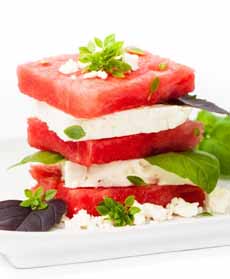
Watermelon and feta stacks. The recipe is below (photo courtesy Mozzarella Company).
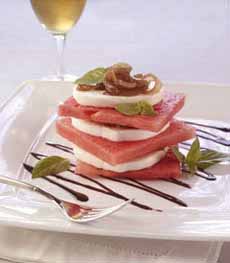
[2] Instead of the dressing in the recipe below, you can drizzle balsamic glaze across the plate, as shown (photo courtesy Watermelon.org).
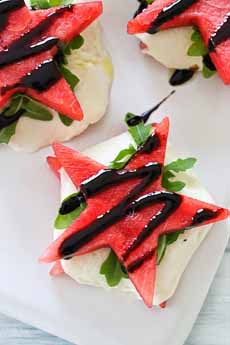
[3] This Watermelon “Caprese” uses the conventional Caprese cheese, mozzarella, and substitutes watermelon for the not-yet-in-season tomatoes. It adds pizzazz with a star-shaped cookie cutter. Here’s the recipe (photo courtesy Skinny Taste).
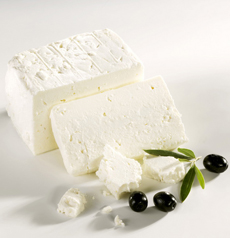
[4] Feta cheese with a favorite accompaniment, Greek olives (photo courtesy Aragec). |
|
Last month we published a recipe for Watermelon Salad, using the conventional Caprese cheese, mozzarella.
Take a look: It has star-shaped watermelon slices for holiday weekends, plus a recipe for cherry tomatoes and bocconcini, bite-size mozzarella balls, stuffed into an avocado half.
This recipe, from cheese maestra Paula Lambert’s cookbook, Cheese Glorious, Cheese! uses a different cheese pairing: the classic watermelon and feta salad.
Her watermelon and feta salad uses bite-size watermelon cubes and crumbled feta.
We suggest a more glamorous version, Watermelon-Feta Stacks (photo #1). , because the slices are evocative of the cheese and fruit slices in a conventional Caprese salad.
The tanginess of feta plays well against the sweet watermelon, as do their differences in texture. This recipe is © copyright 2007, Paula Lambert,
RECIPE: WATERMELON-FETA STACKS
Ingredients (ingredients for 6 servings)
18 watermelon slices (3 per serving)
12 slices (1/2″) feta (2 oer serving)
4 scallions, trimmed to 6” in length, very thinly sliced crosswise
2 tablespoons minced chives
½ teaspoon grated lemon zest
4 large leaves mint, cut into a fine chiffonade (substitute basil)
2 tablespoons extra-virgin olive oil
1 tablespoon lemon juice
Salt and freshly ground black pepper to taste
Garnish: whole mint or basil leaves (if you can find opal (purple) basil, grab it!)
Optional garnish: Kalamata or Picholine olives
Preparation
1. SLICE the watermelon and feta into like-sized slices and set aside in the fridge to chill.
2. MAKE the dressing. Combine the scallions, chives, lemon rind, and mint in a bowl; add the olive oil and lemon juice and blend well. Season with salt and pepper to taste. Chill until ready to serve. Note: If you like more dressing rather than less, increase the amount of oil and lemon juice.
3. PLATE the feta and watermelon in stacks, as shown in photo #1. Drizzle the dressing over the stacks; or, if you prefer, spoon it around the sides of the stacks (drizzling will create pools anyway).
MORE CAPRESE SALAD RECIPES
Caprese Pasta Salad
Goat Cheese Caprese Salad
Deconstructed Caprese Salad
Mango Caprese Salad
Plum Caprese Salad
Tofu Caprese Salad
Watermelon – Feta Caprese Salad
All are delicious food fun!
THE HISTORY OF FETA CHEESE
Feta is a brined-curd white cheese made from sheep’s or goat’s milk. It is formed into bricks, salted and cured in a brine solution. The cheese is semi-hard, with a flavor that can range from mild and milky to salty with a very tangy acidity. It crumbles easily.
The first cheese on record comes from Homer’s Odyssey, in the 8th century B.C.E. While it was called, simply, cheese, the description of how it was made matches that of the cheese that came to be known as feta. It was made from the milk of goats and/or sheep.
The name feta, which literally means “slice” in Greek, first appeared in the 17th century. It is believed to refer to the practice of slicing the cheese to place into barrels for brining, a tradition still practiced today.
|
Butter, cheese and yogurt evolved naturally, as a result of milk being carried in containers or saddlebags.
In the case of butter, the movement on horseback churned the milk into butter.
Yogurt came about because herdsmen carried the milk in animal stomachs, and the natural enzymes in those containers curdled the milk, essentially making yogurt. As with butter and cheese, yogurt extended the shelf life of the milk. which was very short in the days before pasteurization and refrigeration.
Cheese was first formed when the milk was carried in the stomachs of ruminant animals (cattle, goats, sheep and other mammals). It reacted with the rennet in the stomachs of unweaned animals. Rennet is a complex of enzymes that enable the young to digest their mothers’ milk (after the animals are weaned, they no longer produce rennet). In cheese-making, rennet separates milk into solid curds—which are pressed into cheese—and liquid whey.
Feta has been enjoyed in Greece for some 2000 years or longer. In the 20th century, a mass immigration from Greece swelled the Greek populations of to Australia, Canada, Germany and the U.S.
These immigrants brought their culinary traditions with them, resulting in the import, and later the local production, of feta.
Feta adapted itself to local cuisines. In addition to traditional Greek appetizers, mains and sides, feta is used for everything from burger toppings, pizza, and salads: not just “Greek salad” but pairings with different fruits (try melon and stone fruits) and vegetables (our favorite is roasted squash with feta, pumpkin seeds, and greens of choice).
Today, only 2% of the feta consumed in the U.S. actually comes from Greece. Much of it is saltier feta from Bulgaria.
If you purchase cheese that is too salty, soaked it in water or milk to remove some of the saltiness.
We prefer a creating a creamy, tangy cheese with citric notes and a modest amount of salt. To find your ideal feta, try different brands and get as many tastes as you can from cheese counters that slice to order.
MOZZARELLA COMPANY FETA
Company founder Paula learned to make feta decades ago. She joined shepherds in the mountains of Greece, to learn the process from beginning to end.
Authentic feta is aged in wood barrels for 60 days. While the PDO (designated origin protection) of the European Union limits authentic feta to whole sheep’s milk, or a blend of sheep’s and up to 30% goat’s milk, Paula makes two distinctive feta cheeses: one from goat’s milk and one from cow’s milk.
“The two cheeses are made just alike, but there is a dramatic difference in the taste of the finished cheese,” she says. “The cow’s milk version is mild, while the goat’s milk Feta is tangy with a more pronounced flavor.
“The texture of the two cheeses is different [as well]: the cow’s milk feta is creamier and the goat’s milk feta is more crumbly.”
Here’s how the cheese is made:
“We begin by pasteurizing our farm-fresh milk; then we add cultures and enzymes. Once the curd has formed, we cut it into small pieces and stir it gently. After just a few hours, when matured to the proper acidity, we scoop the fragile little curds into baskets lined with cheese cloth. After most of the free whey has drained away, we place a weight atop the cheese, still in the baskets, and press it overnight. After drying for several days, the cheese is immersed in big vats of brine to mature. We mature the Feta made from cow’s milk for one month and the goat’s milk feta is matured for two months and even longer. Our feta is soft and creamy, yet dry enough to crumble.”
We love all the cheeses she makes at Mozzarella Company; so if you need a treat for yourself or a fine cheese gift, head to Mozzarella Company’s website.
CHECK IT OUT: THE HISTORY OF CHEESE
|