THE NIBBLE BLOG: Products, Recipes & Trends In Specialty Foods


Also visit our main website, TheNibble.com.

FOOD FUN: A Bouquet For Your Poultry

Chicken, Cornish hen, duck, goose, guinea hen, partridge, pheasant, poussin, turkey, quail…

We love poultry!

Here’s an idea from Chef Daniel Humm, co-owner of Eleven Madison Park in New York City.

Chef Humm’s decoration is accessible to anyone who roasts a bird: Fill the opening of the cavity with a bouquet before bringing it to the table.

As you carve, you can garnish each plate with some herbs from an herb bouquet.

If you have an herb garden, you’re in luck: It’s easy to pick a mini bouquet and bind it with kitchen twine.

If your garden has blossoms but no herbs—and you forgot to buy herbs at the market—gather a small bouquet with leaves.

Just make sure the varieties you pick have no toxicity. Here’s a list of the 12 most toxic garden plants.

That lovely lily of the valley? Nix!

Our favorite bouquet: basil, sage, rosemary. Parsley or cilantro blend well.

Blooming chives are a home run, as are purple basil and lemon thyme—all provide a hit of color. Lavender is always lovely.

  Duck With Flower Garnish

A duck with a floral bouquet. You can substitute herbs; in fact, it’s better for distributing stems of the bouquet as plate garnishes (photo courtesy Chef Daniel Humm).

 
By the way, Eleven Madison Park is our top restaurant recommendation for gourmets who are seeking food excitement. Just bring deep pockets.


Comments off

TIP OF THE DAY: Brew Iced Tea With Fruit

Iced Tea With Fruit
[1] It’s not sangria: It’s iced tea! (Photo courtesy Melissa’s.)

Iced Tea With Fruit
[2] Iced tea for dessert? (Photo courtesy The Maple Guild.)


It’s a scorching day today, so we’re alternating glasses of ice water with glasses of iced tea.

If you brew your own tea, you can give iced tea the “sangria treatment” by adding fresh fruit to the pitcher (photo #1).

It can be black, green, herbal or white tea.

You can add any fruits; just be sure they’ll fit in the glass when you pour the tea. A large orange slice might not, for example, but you can cut it in half.

Here are popular fruits; three varieties (more if you like) is a good mix.

  • Apple slices
  • Berries
  • Citrus slices: lemon, lime, orange
  • Fresh cherries, pitted*
  • Fresh mint sprigs
  • Lychees
  • Stone fruit slices: apricots, nectarines, peaches, plums
  • Tropical fruits: mango, papaya, pineapple
  •  
    The key to fresh fruit flavor is to infuse the fruits in the tea for several hours, preferably overnight.
     
    Preparation

    You can make the tea up to two days in advance.

    1. BREW the tea (here’s how to brew iced tea).

    If you sweeten your tea, now is the time to add the sweetener. But the fruits add sweetness, so use less sweetener. We don’t use any, but provide different sweeteners for individual tastes: agave, honey, maple syrup, superfine sugar or simple syrup.

     
    2. STRAIN the tea into a serving pitcher. While the tea is steeping…

    3. CUT the fruits. How much fruit do you need? We use 1/8 cup fruit per cup of tea. But you can turn the infusion into an infused fruit salad by packing a glass or Mason jar with fruit (photo #2), and using the tea as the “fruit juice.”

    4. ADD the fruits to the pitcher while the tea is still warm, for the best infusion. Refrigerate, covered, overnight or until you’re ready to serve.

    Consider making iced tea ice cubes for serving: They keep the tea extra-cold without diluting it.

    5. SERVE: Add ice to the glass. Scoop in some fruit. Add the iced tea. Serve with straws or iced tea spoons for eating the fruit.

    To make a non-alcoholic sangria, top off the glass with ginger ale.
     
     
    ICED TEA TIPS

  • How To Dissolve Sugar In Cold Drinks
  • How To Keep Homemade Iced Tea Clear
  • Make Ice Cubes From Iced Tea
  • The History Of Iced Tea
  • ________________

    *The fruit needs a cut surface so the flavor will infuse.


    Comments off

    TIP OF THE DAY: Crudités On A Cutting Board

    We traditionally serve cheese on a platter; sometimes on a cutting board, especially one that looks great because we’ve never used it for cutting.

    (The rustic look, using a well-worn cutting board like the one in the photo, doesn’t look right with our fancy decor.)

    Our crudités have always been arranged on a large plate, platter or bowl.

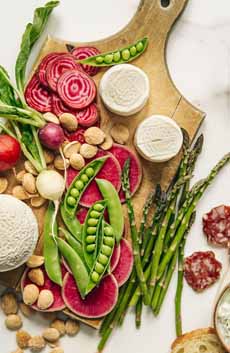
    But when we saw this cheese and veggie arrangement from Vermont Creamery, we said: whoa! Colorful crudités look great on a cutting board.

    Today’s tip may be obvious but we’d simply never done it.

    So we dug out one of our more attractive cutting boards and shopped the market for colorful veggies.
     
    SELECT VIVID VEGGIES

    Don’t the striped chioggia beets and watermelon radishes look great next to the sugar snap peas and asparagus?

    Add some carrots and scatter a box of multi-colored cherry or grape tomatoes, and you’ve got a nutritious explosion of color—so much so that even the white radishes look colorful!

      Crudites Board

    Grab the cutting board and the crudités (photo courtesy Vermont Creamery).

     
    Seek and ye shall find: This week, we scored a purple cauliflower, burgundy scallions and a bag of rainbow baby carrots at a nearby healthy foods market.

    If you don’t want to make a dip, buy one. In our home, hummus is the better dip option: protein-packed, lactose-free, vegan and most importantly, popular.

    Now, all we need is a Martini with a pick of olives.


    Comments off


    © Copyright 2005-2026 Lifestyle Direct, Inc. All rights reserved. All images are copyrighted to their respective owners.