THE NIBBLE BLOG: Products, Recipes & Trends In Specialty Foods


Also visit our main website, TheNibble.com.

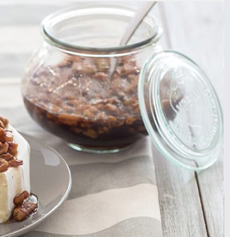
TIP OF THE DAY: Cinnamon Pecan Topping

For holiday season, it’s good to have a trick up your sleeve that quickly turns everyday food into festive food.

We nominate homemade cinnamon pecan topping, which can be used to garnish both sweet and savory foods. See our list of uses below.

You can use any nut, but pecan goes particularly well in this type of topping.

We adapted this recipe from McCormick. It makes 12 servings, 2 tablespoons each. You can make a double batch and keep it in the fridge.

Although the McCormick version uses rum flavor, feel free to substitute real rum or whiskey.

Plan ahead: You can bring a jar of topping as a house gift, or give it as holiday gifts.

Prep time is 5 minutes, cook time is 12 minutes.

RECIPE: CINNAMON PECAN TOPPING

Ingredients For 1-1/2 Cups

  • 1/2 cup firmly packed brown sugar
  • 1/2 teaspoon ground cinnamon
  • 1/4 teaspoon salt
  • 1/8 teaspoon ground nutmeg
  • 3 tablespoons butter, divided
  • 1 cup pecans, chopped
  • 1/2 cup light corn syrup
  • 2 tablespoons water
  • 1 teaspoon pure vanilla extract
  • 1/2 teaspoon rum flavor
  •    

    Pecan Topping

    caramel-pecan-topping-yummly-230

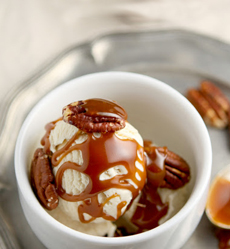
    TOP PHOTO: Top a Brie with homemade cinnamon pecan topping Photo by Caroline Edwards from Chocolate and Carrots | McCormick.com. BOTTOM PHOTO: Turn a plain scoop of ice cream into a sundae. Photo courtesy Yummly.com.


    Pecan Topping
    Keep it in the fridge to pull out whenever you need it. Photo courtesy McCormick.


    Preparation

    1. MIX the brown sugar, cinnamon, salt and nutmeg in small bowl until blended. Set aside.

    2. MELT 2 tablespoons of the butter in large skillet over medium heat. Add the pecans and toast for 5 to 7 minutes or until golden brown, stirring frequently. Reduce the heat to low.

    3. STIR the remaining 1 tablespoon butter, corn syrup, water, vanilla extract, rum flavor and the brown sugar mixture into the skillet. Cook, stirring until the butter is melted and the mixture is heated through.

    4. REMOVE from the heat. The mixture will thicken as it cools. Serve at room temperature.


    WAYS TO USE THE PECAN TOPPING

  • Breakfast: Top French toast, pancakes, waffles.
  • Desserts: Use as a cake topping or filling; fill crêpes and tartlets; top ice cream, ice cream cake or ice cream pie; garnish blondies/brownies or pie; mix with mascarpone or ricotta to spread on biscotti or shortbread.
  • Hors d’oeuvre: Top regular or baked Brie.
  • Sides: Top a baked sweet potato with pecan topping and Greek yogurt or sour cream.
  • Snack: Mix into yogurt, stir into coffee or tea.
  •   

    Comments off

    FOOD HOLIDAY: The History Of Deviled Eggs

    November 2nd is National Deviled Egg Day.

    Deviled eggs took off as picnic and cocktail party fare after the Second World War. But their roots date back to ancient Rome.

    The cooks of wealthy Romans boiled eggs, seasoned them with spicy sauces, and served them as a first course (known as gustatio).

    Serving these deviled eggs to guests was so common that it featured in a Roman saying, “ab ova usque ad mala,” literally from eggs to apples (indicating from the beginning of a meal to the end), or what we might call “from A to Z.”

    The culinary record is relatively quiet until the 13th century when stuffed egg recipes begin to appear in Andalusia, the south of Spain. The yolks of boiled eggs are mixed with cilantro, onion juice, pepper and coriander, fish sauce, oil and salt. After the mixture was stuffed into the egg whites, the two halves were fastened together with a small stick and seasoned with pepper.
     
    DEVILED EGGS VS. STUFFED EGGS

    By the 15th century, stuffed eggs were found throughout Europe. One medieval recipe filled them with raisins, cheese, marjoram, parsley, and mint. They were then fried in oil and topped with a sauce of cinnamon, ginger, cloves, raisins, and verjuice, or dusted with sugar. Both executions were served hot.

    The first known printed mention of “devil” as a culinary term appeared in Great Britain in 1786. It referred to dishes that contained hot and spicy ingredients (like paprika), or those that were highly seasoned and broiled or fried.

    By 1800, deviling had become a verb to describe the process of making food spicy. Deviled eggs were seasoned with chiles, horseradish, mustard, paprika, and spicy sauce.

    So all deviled eggs are stuffed eggs, but only stuffed eggs with hot spice are deviled eggs.

       
    dlish-deviled-eggs-230
    Deviled Eggs With Smoked Okra

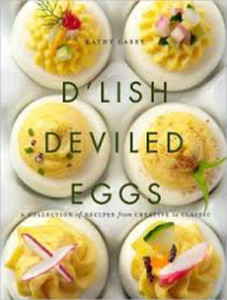
    TOP PHOTO: A book of deviled egg recipes. Get yours at Amazon.com. BOTTOM PHOTO: Deviled eggs with smoked okra (recipe). Photo courtesy Rick’s Picks.


    Nonspicy versions were called dressed eggs, mimosa eggs, salad eggs or stuffed eggs.

    In the United States, stuffed eggs began making an appearance in cookbooks by the mid-19th century.


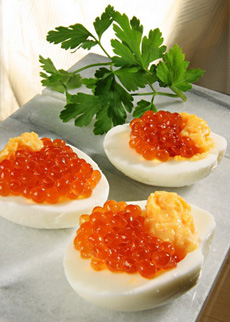
    Deviled Eggs With Salmon Caviar
    TOP PHOTO: Deviled eggs topped with
    salmon caviar. Photo courtesy Red-
    Caviar.com.
     

    THE MODERN DEVILED EGG EVOLVES

    A recipe from Fannie Farmer’s 1896 Boston Cooking-School Cookbook was one of the first to use mayonnaise as a binder for the filling of stuffed eggs.

    While mayonnaise began to be distributed commercially in the U.S. in 1907, the condiment was not commonly featured in deviled egg recipes until the 1940s. The classic version of deviled eggs mixed the yolks with mayonnaise, mustard, and paprika.

    In more recent times, cooks have reworked the classic with modern ingredients, from beets, chutney, and smoked okra to luxury ingredients like caviar, crab, and smoked salmon to international influences like kimchi, sriracha, and wasabi.
     
    DEVILED EGG RECIPES

  • Bacon & Cheddar Deviled Eggs (recipe)
  • Barbecue Deviled Eggs (recipe)
  • Curried Deviled Eggs (recipe)
  • Halloween Eyeball Deviled Eggs (recipe)
  • Sweet Pea Deviled Eggs For Spring (recipe)
  • Valentine Deviled Eggs With Beets (recipe)
  •  
    This recipe was adapted from History.com.


    CHECK OUT WHAT’S HAPPENING ON OUR HOME PAGE, THENIBBLE.COM.


    Comments off

    RECIPE: Pumpkin Cheesecake Pie

    This fall and Thanksgiving dessert from King Arthur Flour has the wisdom of Solomon. When you can’t decide between pumpkin pie or pumpkin cheesecake, go zebra* and combine them into one dessert!

    Prep time is 25 to 33 minutes, bake time is 40 to 45 minutes.

    RECIPE: PUMPKIN CHEESECAKE PIE

    Ingredients For A 9-Inch Pie, 10-12 Servings

    For The Crust

    Make your favorite pie crust or purchase a deep 9″ prepared crust. You can also use a cheesecake crust of graham crackers or gingersnaps.

  • Cheesecake crust variations
  • Gingersnap crust
  •  
    For The Cheesecake Layer

  • 8 ounces cream cheese, softened
  • 1/3 cup sugar
  • 1 large egg
  • 1 teaspoon vanilla extract
  • Optional: 1/4 cup crushed crystallized ginger (photo below)
  •  
    For The Pumpkin Layer

  • 3/4 cup sugar
  • 1/4 teaspoon salt
  • 1 teaspoon ground ginger
  • 1 teaspoon ground cinnamon
  • 1/2 teaspoon ground nutmeg
  • 1/4 teaspoon ground allspice
  • 1 can (15 ounces) pumpkin purée
  • 1 cup light cream or evaporated milk
  • 3 large eggs, lightly beaten
  •    
    /home/content/p3pnexwpnas01 data02/07/2891007/html/wp content/uploads/pumpkin pie cheesecake kingarthur 230L1

    The bottom layer is cheesecake, the top layer is pumpkin pie. Photo courtesy KingArthur.com.

     
    *A zebra is a cheesecake bottom and a brownie top, or vice versa. Here’s a recipe.


    pumpkin-pie-cheesecake-snackworks-230

    Crystallized Ginger
    TOP PHOTO: A slice of Pumpkin Pie
    Cheesecake. Add a pinch of ground ginger
    from the whipped cream. Photo courtesy
    Snackworks.com. BOTTOM PHOTO:
    finely diced crystallized ginger. You can buy it at KingArthurFlour.com in a small dice for baking. Photo courtesy King Arthur Flour.


    For Serving

  • Optional garnish: candied pecans (recipe)
  • Whipped cream (recipe)
  •  
    Preparation

    1. PREHEAT the oven to 425°F.

    2. REMOVE the crust from the refrigerator and allow it to rest at room temperature until it’s warm enough to work with (10 to 30 minutes, depending on how long it’s been refrigerated).

    3. FLOUR your work surface, and roll the crust into a 13″ round. Transfer it to a pie plate that’s at least 9″ wide and 2″ deep. A giant spatula works well for this task. IMPORTANT: Be sure the pan is 2″ deep or all the filling won’t fit. If you find yourself with too much filling, pour it into a ramekin and bake it until the center is set. You’ll have an individual dessert or snack.

    4. GENTLY SETTLE the crust into the plate, and crimp the edges.

    5. MAKE the cheesecake filling: Combine the room-temperature cream cheese and sugar, beating slowly until the mixture is fairly smooth. It may appear grainy, or a few lumps may remain; that’s OK.

    6. STIR in the egg, vanilla and optional ginger. Spoon the filling into the pie crust.

    7. MAKE the pumpkin filling: Whisk together the sugar, salt and spices in a medium-sized mixing bowl. Add the pumpkin, cream or evaporated milk and eggs, and whisk gently until smooth. (You don’t want to beat a lot of air into this mixture; just be sure it’s thoroughly combined.)

    8. GENTLY SPOON the pumpkin filling atop the cheesecake layer, filling within 1/4″ of the top of the crust. NOTE: Do this carefully at first, so as to not disturb the cheesecake layer. Once you’ve covered the cheesecake, you can be less careful.

     
    9. BAKE the pie for 15 minutes. Reduce the oven temperature to 350°F and continue to bake for 40 to 45 minutes, covering the edges of the pie with a crust shield or aluminum foil if they seem to be browning too quickly. The pie is done when it looks set, but still wobbles a bit in the center when you jiggle it. If you have a digital thermometer, the pie will register 165°F at its center when it’s done.

    10. REMOVE the pie from the oven, allow it to cool to room temperature, then refrigerate it until serving time. Serve with lightly sweetened whipped cream flavored with a pinch of ginger and teaspoon of vanilla.


    Comments off

    PRODUCT: Ambrosia Apples

    THE ORCHARD OF EDEN

    No one is sure about which apple variety Eve might have plucked from the tree of knowledge, causing all hell to break loose. In the millennia gone by though, the rest of us have gone from fig leaf to overalls trying to re-create the paradigm of that luscious, lascivious fruit.

    Leave it to a maverick bee. Rather than head for the usual haunts, this one took a tour of British Columbia, picking up some pollen from this apple blossom and leaving it on that apple blossom en route.

    One day, a lucky apple grower noticed a stranger in his orchard: an apple that didn’t look like the others. Without so much as a snake to tempt him, he bit. Ahhh. Ambrosia!

    Indeed, Ambrosia is the recently coveted variety of apple that Washington State apple growers have been perfecting for several years, and now it’s freshly harvested and making its way to markets far and wide, including yours.

    What has made Ambrosia sprint to the top 10 varieties of apple sold in 2015? It has everything going for it:

  • It’s thin-skinned, crisp as a potato chip, honey-sweet, and so juicy that you’ll have to lick your fingers now and then.
  • It’s shapely and has a blemish-free, enviably blushed complexion.
  • It cooks and bakes up beautifully, although eating one out of hand is enthusiastically recommended.
  • Add the just-100 calories per apple factor and Ambrosia truly takes away the cake for health-savvy snackers craving something sweet.
  •  
    A visit to Washington State’s McDougall & Sons, the family-owned and operated orchard that is currently the exclusive grower of Ambrosia apples in the U.S., reveals the intensely detailed hand labor required to produce such perfection.

      Ambrosia Apple Tree

    Apple Bath

    TOP PHOTO: Like the Garden of Eden: a tree brimming with Ambrosia apples. Photo courtesy AmbrosiaApples.com. BOTTOM PHOTO: After picking, apples are sorted and get a bath prior to packing and shipping. Photo by Rowann Gilman | THE NIBBLE.

     
    From root stock to loading dock, every apple is hand-picked, graded, sorted and even x-rayed for imperfections so that each one that reaches you is Garden of Eden-worthy.

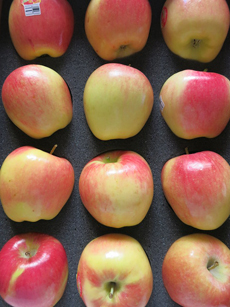
    The process takes an entire year, after which the fruit is cold-stored for shipping to markets from September through July. Ambrosia are harvested with an ideal sugar/starch balance in mind rather than color as other apples are, and because of that you can always spot Ambrosia in a crowd: The pretty patterns arrayed around their stems and cheeks are creamy yellow where leaves have shaded them from the sun.

    GENERAL TIP: Select apples that have stems intact. The stem acts as a “cork,” making sure moisture and flavor do not dissipate.

    To become an Ambrosian, just look for the label in the photo below.

    Discover more at MySweetAmbrosia.com.

    —Rowann Gilman


    Ambrosia Apples

    label-ambrosia-apples-stemit-230
    TOP PHOTO: Fresh off the tree. BOTTOM
    PHOTO: Look for the label. Photos courtesy
    Ambrosia Apples.


    THE HISTORY OF APPLES

    Apples seem like the universal European fruit. But they first grew wild in the Tien Shan mountains of Kazakhstan, in Central Asia, millions of years ago.

    Those early apples were likely smaller and more sour than modern apples—more like crabapples.

    By about 6500 B.C.E., travelers were carrying cultivated apple seeds west, to West Asia, and east to China. Charred remains of apples have been found at a Stone Age village in Switzerland. (The Stone Aged spanned 6000 B.C.E to 2000 B.C.E.) [Source]

    The Greeks grew several varieties of apples by the third century B.C.E.; the ancient Romans also grew and loved the fruit.

    Around 100 C.E., the Roman Legions brought apples with them as they advanced north through Europe. Gaul (ancient France) became a fertile region for apple cultivation. Brittania (England) also grew the Roman-brought apples. Centuries later, following the Norman conquest in 1066, new varieties of apple from France were introduced to England.

    Apples were a boon to Europeans. They ripened just as it was getting cold and they could keep all winter, a valuable food source when nothing else was growing. Apples were also sliced, dried and stored. And bitter varieties were pressed to make cider.

    Apples arrived in the New World in 1607, with the Jamestown settlers. The seeds and cuttings they brought from Europe were not all suited for cultivation in Virginia, but they began to mutate to new varieties of American apples.

    Many of these apples were fairly bitter—not hand fruit, but important for making cider, which was more valuable than hand fruit or cooking fruit.

     
    Most colonists grew their own apples. Due to unhealthy water supplies, most people, including children, drank beer or hard cider instead of water (the same was true in Europe).

    Apples were being grown in Massachusetts as early as 1630. Mutation was continually creating new breeds. The McIntosh mutation was discovered in 1796 (by a farmer named John McIntosh).

    Sweet apples for eating were grown as well (and today they’re grown in every state). Thomas Jefferson had a part in the development of the Fuji apple.

    As the story goes, the French minister to the United States gave Jefferson a gift of apple cuttings; Jefferson donated them to a Virginia nursery which cultivated them as the “Ralls Genet.” In 1939, Japanese apple breeders crossed the genes from the Red Delicious apple with the Ralls Genet, resulting in the now-ubiquitous Fuji apple. [Source]


    Comments off

    RECIPE: Hot Cheese & Bacon Dip

    When the weather gets cooler, the foods get warmer.

    Here’s a flavorful hot fall and winter dip from Kraft. You serve it warm and bubbly, with crudités, crackers, cocktail franks or cut-up regular franks or brats.

    Kraft developed it with their brands: Kraft Real Mayonnaise, Oscar Mayer Brand bacon, Philadelphia Cream Cheese and Shredded Three Cheese and Kraft Natural Shredded Three Cheese With Touch Of Philadelphia, which combines Cheddar, Colby and Monterey Jack with a touch of cream cheese.

    We grated what we had at home: a combination of Emmental (the real Swiss cheese) and Sharp Cheddar.

    We also added what we think is the perfect hot, tangy complement: prepared horseradish (from a jar, not fresh root). If you want more tang and don’t like horseradish, try Dijon mustard (not Honey Dijon).

    Prep time is 10 minutes, total time is 25 minutes.

    RECIPE: HOT CHEESE & BACON DIP

    Ingredients For 12 Servings

  • 3/4 cup shredded cheese, divided
  • 4 slices cooked bacon, crumbled, divided
  • 2 green onions, finely chopped, divided
  • 1 package (8 ounces) cream cheese, softened
  • 1/3 cup mayonnaise
  • Optional: 1 tablespoon prepared horseradish or Dijon mustard
  •  
    Plus

  • Dippers: crackers, crudites, hot dogs, etc.
  •  

    /home/content/p3pnexwpnas01_data02/07/2891007/html/wp content/uploads/hot cheese bacon dip kraft 230
    How yummy! Photo courtesy Kraft Foods.

     
    Preparation
    If you have a warming tray, hot plate or other tabletop item with a heat source, get it out to keep the dip warm.

    1. HEAT the oven to 350°F. Reserve 2 tablespoons each of the bacon, cheese and onions for garnish.

    2. MIX the remaining ingredients until blended, and spread onto bottom of 9-inch pie plate sprayed with cooking spray. Bake for 15 minutes, or until hot and bubbly around the edges.

    3. GARNISH with the reserved ingredients and serve with the dippers.


    Comments off

    The Nibble Webzine Of Food Adventures
    RSS
    Follow by Email


    © Copyright 2005-2026 Lifestyle Direct, Inc. All rights reserved. All images are copyrighted to their respective owners.