THE NIBBLE BLOG: Products, Recipes & Trends In Specialty Foods


Also visit our main website, TheNibble.com.

FOOD 101: The History Of Dessert

October 14th is National Dessert Day.

Our word “dessert” emerged in mid-16th-century French, a combination of the past participle of desservir “to clear the table,” and servir, “to serve.”

The name reflects that dessert was served after the table had been cleared of other dishes.

A variety of desserts set on the table of the same time became known as service à la française. The practice of serving a meal in differentiated courses (as opposed to the buffet or groaning board) was called service à la russe, Russian-style.

Desserts can be sweet or savory, solid or liquid:

  • Beverages such as dessert wine, liqueur or coffee (cappuccino, espresso, with or without confections)
  • Cakes, pies or pastries
  • Cheeses
  • Confections, such as chocolates, petit fours, mignardises
  • Cookies
  • Custards, puddings, gelatin
  • Fruits and nuts
  • Ice cream or other frozen dessert
  • Sweet soups (fruit, custard)
  •  
    This western concept of dessert—a dish that concludes the meal—is found elsewhere in the world. But in some parts of Africa, and most parts of China, there is no such tradition.
     
     
    THE HISTORY OF DESSERT

    Sweets appear in the earliest civilizations. They were offered to the gods in Mesopotamia, India and other ancient civilizations [source].

    Dried fruit and honey were probably the first desserts, and more elaborate preparations were made with honey.

    But the spread of sugar cane around the world encouraged the development of more, and more elaborate, types of dessert.

    Sugar cane, which originated in Southeast Asia (the history of sugar), was grown and refined into crystals in India before the fourth century B.C.E.

    It was traded, to Macedonia by 300 B.C.E. and China by 600 C.E. In South Asia, the Middle East and China, sugar became a staple of both main meal cooking and desserts.

    Sugar was little known in Europe. Crusaders returning to Europe in the 12th century brought sugar with them.

    While Europeans began to manufacture beet sugar in the Middle Ages, it wasn’t until the 16th that sugar plantations were started in the Canary Islands and the West Indies, bringing more sugar to Europe.

    It was a luxury product for the wealthy, and made wealthy people of the sugar planters and merchants.

    Finally, by the 18th century, all levels of society could afford the former luxury product. And beyond sweetening tea and coffee, they made desserts: lots of them.

    With the Industrial Revolution, desserts, along with other foods, began to be mass-produced. Frozen foods, including desserts, became very popular in the 1920s when frozen foods became widely available.

      Strawberries Romanoff
    [1] Simple platters of fruit evolved into fruit in cream or other sauces, or baked, with or without pastry or crusts (photo of Strawberries Romanoff and recipe from Only Best Cooking).

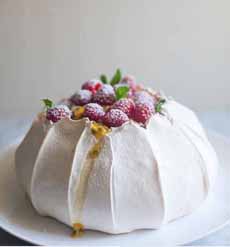
    Pavlova
    [2] As new techniques were created, desserts like the Pavlova emerged, nestling the fruit in meringue (photo courtesy Zoe Bakes).

    Strawberry Cream Cheese Pie
    [3] Different types of pastry were created to envelope fruit. Here’s the recipe for this strawberry cream cheese pie from Sugar Spun Run.


    Comments off

    RECIPE: Classic Apple Crisp

    Apple Crisp
    [1] Classic apple crisp (photo courtesy Urban Accents).

    Gala Apples
    [2] Gala apples (photo courtesy Good Eggs).


    Looking for a weekend baking project?

    This easy dessert is as popular as apple pie, and easier to make. It is called a crisp because the topping, which contains oats (oatmeal), gets crispy when baked.

    In the U.K., the same dish is called a crumble. Take a look at similar fruit dishes with different toppings: the betty, cobbler, grunt, pandowdy and others.
     
    RECIPE: CLASSIC APPLE CRISP

    For the apples, select Braeburn, Empire or Gala.

    Prep time is 15 minutes, cook time is 35 minutes.

    Ingredients

  • 3/4 cup all-purpose flour
  • 1/4 cup packed light brown sugar
  • 1/2 teaspoon salt
  • 1/2 cup plus 2 tablespoons granulated sugar
  • 8 tablespoons (1 stick) unsalted butter, cold, cut into small cubes
  • 1 cup old-fashioned rolled oats (not quick-cooking)
  • 3 pounds apples, peeled, cored, and cut into 1/2-inch chunks
  • 2 tablespoons fresh lemon juice
  • 1/2 teaspoon ground cinnamon
  • Optional garnishes: whipped cream and/or caramel sauce
  • Less sweet garnishes: crème fraîche, plain Greek yogurt/sour cream with some cinnamon and optional lemon zest (lightly sweetened as desired)
  •  
    For a fancy topping, you can make meringue and brown it with a culinary/kitchen torch.

     
    Preparation

    1. PREHEAT the oven to 375°F.

    2. MAKE the topping. In a large bowl, combine the flour, brown sugar, salt and 2 tablespoons of granulated sugar. Cut the butter into the flour, using a pastry blender or two knives, until mixture is the texture of coarse meal. Add the oats; use your hands to toss and squeeze the mixture until large, moist clumps form. Transfer to the freezer to chill.

    3. TOSS the apples in a clean large bowl with the lemon juice, cinnamon and the remaining granulated sugar. Transfer to a shallow 2-quart baking dish, and sprinkle with topping mixture. Place baking dish on a rimmed baking sheet, and bake until golden and bubbling, 55 to 65 minutes. Let cool 10 minutes before serving.


    Comments off

    TIP OF THE DAY: Soup Napoleon & Uses For Ring Molds

    What’s a soup napoleon? It’s a name we gave to this recipe concept from Vaucluse restaurant in New York City.

    It sounds more appealing than “stack” or “cylinder” and more accurate than “tower.” A pastry napoleon is a stack of layered pastry, custard, and optionally, fruit.

    The mechanics are simple: A stack of four or five layers of contrasting ingredients are set in a ring mold in the dish. The ring mold is removed, and the soup is poured (ideally from a pitcher) around the cylinder/stack/tower.

    It’s a dramatic presentation when done at the table (photo #1). From the kitchen, bring the dishes of cylinders and place them in front of the diners; then pour the soup around the cylinder.

    It’s a substantial first course; and can be made in a larger portion as a vegetarian main course.

    While it may look complicated, it doesn’t take any great skill. Beyond preparing (or buying) the soup, the only time-consuming part is chopping, slicing, and forming the stacks.

    You can also serve the napoleon without the soup (photo #2): on a plate with a drizzle or dots of sauce or balsamic glaze around it, or on a bed of greens.
     
     
    WHAT’S IN THE NAPOLEON?

    The stack can include whatever you like. But first, pick a direction:

  • Decide on the soup you want to serve, then pick the napoleon layers.
  • Alternatively, you may be ingredient-focused—e.g., crab, lobster, or a seasonal vegetable like winter squash or spring asparagus. Pick the featured ingredient, then pair a soup with it.
  •  
    In photo #1, the napoleon with five layers: lobster, sautéed squash cubes, cucumber julienne, croutons and salmon caviar. It’s topped off with a nasturtium leaf, but a basil leaf or no leaf is just fine.

    After the napoleon is built, squash soup is added, almost to the top of the lobster layer, or whatever your first layer is.

    You don’t need to serve a lot of soup: an inch of it is fine. Just make your bottom layer at least an inch deep. The other layers can be as deep or narrow as you like.

    To choose your ingredients, use layers of different colors and textures. Examples:

  • Cooked or raw vegetables, finely diced.
  • Crunch: Corn Flakes, crunchy raw vegetables (e.g. carrots), mini croutons, panko bread crumbs and more (how to add crunch to foods)
  • Fish or seafood, sliced or diced.
  • Grains (a great opportunity to use red or black rice).
  • Meat or poultry, minced or diced.
  • Seeds or chopped nuts
  • Optional garnish: chopped chives, toasted sesame seeds, any flavor or color contrast that works
  •  
    Whatever you choose, it will be delicious, artistic and fun. Tamp down each layer as you build it, so they hold together. When you’ve added all the layers, tamp the stack lightly. Then twist the ring slightly to remove it.

    The only special item you need is a ring mold (photo #3).

      Squash Soup With Lobster Napoleon
    [1] Squash soup with lobster napoleon, at Vaucluse in New York City. It’s topped with salmon caviar and nasturtium leaves.

    Shrimp & Avocado Stack
    [2] You can serve the napoleon as an appetizer on its own, plain with a drizzle of sauce or on a bed of greens (here’s the recipe for this spicy shrimp and avocado stack from SkinnyTaste).

    Ring Mold Set
    [3] Ring mold set from Ateco, available on Amazon and elsewhere.

     
    Note that size is important. If you have a large ring mold, the stack will take up much of the bowl. The larger the stack, the less soup.

    There’s no right or wrong: It’s how you want to present the dish.

    Ring molds are inexpensive, but if you want to experiment without buying one, just remove the top and bottom from shorter cans of food.
     
     
    USES FOR RING MOLDS

    Ring molds are cylinders with open ends that are used for food styling and presentations (photo #3). They are made in a variety of diameters and heights.

    They are primarily used to form food(s) into towers/cylinders/stacks: forming appetizers and crab cakes, molding salads and steak tartare, vegetable timbales, and desserts.

    You can also use them to cook food in a perfectly round shape: eggs and pancakes, for example. You can also use them to cut perfectly round burgers or sliders; biscuits, gelatin, pastry and polenta.

    The rings are made from stainless steel. We prefer those that come with a tamping device, which helps to pack the food in tightly.
     
     
    FOOD TRIVIA

    The napoleon, known best as a layered custard pastry, was not named after Emperor Napoleon. It isn’t even French.

    It was created in Naples, Italy, where it was known as a napolitano. The name translated to napoleon in French and English.


    Comments off


    © Copyright 2005-2026 Lifestyle Direct, Inc. All rights reserved. All images are copyrighted to their respective owners.