THE NIBBLE BLOG: Products, Recipes & Trends In Specialty Foods


Also visit our main website, TheNibble.com.

TIP OF THE DAY: Spring Crostini

We recently wrote about spring crudités, but what else should be spring-ified?

How about crostini, one of our favorite, easy-to-make nibbles. We serve them as snacks and with cocktails (including wine, beer and cider). You can also serve a couple of them as a first course, with a small lettuce salad.
 
SPRING CROSTINI INGREDIENTS

Take a selection of spring veggies and top crostini (the word is Italian for croutons, but in the U.S. it means “toasts,” as in small slices of toasted bread).

Spread the crostini with goat cheese, hummus or ricotta, and then artfully arrange a selection of these spring vegetables:

  • Asparagus
  • Cardoons
  • Fava beans*
  • Fennel (including the fronds)
  • Fiddleheads
  • Garlic scapes
  • Morels*
  • Ramps
  • Spring peas and pea greens/shoots
  • Snow peas
  • Sugar snap peas
  •  
    Add some color with:

  • Cherry or grape tomatoes, halved
  • Edible flowers
  • Peppadew or pimento, sliced
  • Radicchio leaves, torn into bite size
  • Red bell pepper, diced
  • Sundried tomatoes in olive oil, diced
  •  
    We like to finish with snipped chives, but you can let guests top their own, by providing ramekins with:

  • Chopped nuts
  • Heat: red chili flakes or minced red jalapeños
  • Minced herbs
  • ________________

    *Morels and fava beans need to be cooked. You may elect to lightly steam some of the other vegetables.


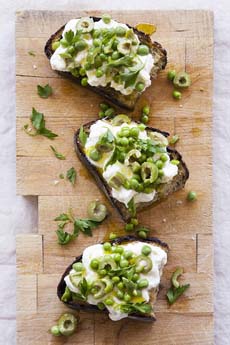
    Spring pea Crostini
    Crostini with burrata and spring peas, garnished with sliced olives and fresh herbs (photo courtesy Good Eggs).

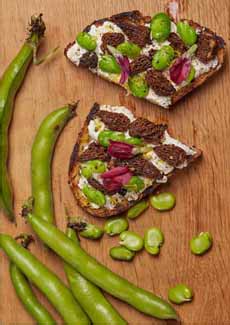
    Spring Crostini

    Crostini spread with ricotta and topped with lightly cooked morels and fava beans. Torn radicchio leaves add some color (photo courtesy Il Buco Alimentari).

     
    BRUSCHETTA VS. CROSTINI: WHAT’S THE DIFFERENCE?

    Bruschetta and crostini are popular hors d’oeuvres that are easy to make. They also can be served as a first course or a light meal, with salad and/or soup.

    Many people—even culinary professionals—confuse the two. What’s the difference?
    The answer, in brief, is the size of the slice, plus grilling versus toasting. Bruschetta (three or four inches in diameter) are cut from an Italian loaf and grilled; crostini (about two inches in diameter) are cut from a thinner loaf such as a baguette, and toasted.

    Bruschetta (pronounced broo-SKEH-tuh) are grilled bread rubbed with garlic and topped with any variety of items. The toppings can be as simple as extra-virgin olive oil, salt and pepper, to diced tomatoes and basil, to almost any spread, vegetable, cured meat or cheese—even fruit.

    Bruschetta originated in the Tuscany region of Italy, where it is commonly served as a snack or appetizer. It may have been the original garlic bread.

    The word comes from the verb bruscare in Roman dialect, which means “to roast over coals.” If you have access to a grill, grill the bread for authenticity. If not, you can toast it.

    Some American manufacturers and others in the food industry misuse the term, using it to refer to the topping only and selling jars of “bruschetta” (it should be bruschetta topping). Show your superior knowledge and don’t allow the term to be distorted: The word bruschetta refers to the grilled bread, not the topping.

    Crostini (cruh-STEE-nee) are croutons: not in the American sense of small cubes tossed into soup or salad, but thin slices of toasted bread.

    Smaller than bruschetta, the slices are typically cut from a ficelle, a thinner baguette one to two inches wide (the word is French for “string”). The slices are brushed with olive oil, toasted and then topped with spreadable cheese, pâté or other ingredients. Plain crostini are served with soups and salads, like melba toast, or set out with cheese.
      

    Comments off

    Green Goddess Dressing Recipe & The History Of Green Goddess

    Green Goddess Dressing
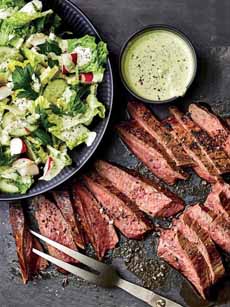
    [1] Green Goddess dressing for the salad, with a main of flank steak. Here’s the recipe from Cooking Light.

    Green Goddess Dressing
    [2] The salad dressing is also a dip. Here’s the recipe from Martha Stewart.

    Green Goddess Dressing
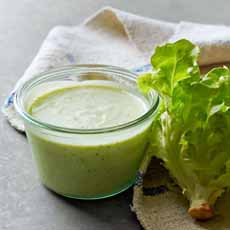
    [3] Even a simple lettuce salad gets a lift from Green Goddess. Here’s the recipe from Williams-Sonoma.


    Springtime makes us think of Green Goddess salad dressing, colored pale green from the high proportion of fresh herbs.

    Who was the eponymous green goddess? She was a deity, worshipped in her temple in a small fictional kingdom in the Himalayas. A small plane carrying three Brits crashes locally, and sets off the story (more about it).

    The recipe is below, and the original Palace Hotel recipe is here.

    > August 25th is National Green Goddess Day.

    > Check out 18 more dressing and sauce holidays.
     
     
    THE HISTORY OF GREEN GODDESS DRESSING

    The history of modern Green Goddess dressing places its origins in 1923, at the Palace Hotel in San Francisco.

    As the story goes, actor George Arliss was starring in a hit play called The Green Goddess.

    The hotel’s executive chef, Philip Roemer, created the dressing to honor the play and the actor. It, too, became a hit.

    The original dressing was a base of mayonnaise blended with anchovies, chives, parsley, scallions, tarragon, and tarragon vinegar.

    It’s a variation of a dressing created by a chef in the kitchen of King Louis XIII of France, called sauce au vert (green sauce). Food historians note that the basic recipe is probably from the Near East and at least 2,000 years old. Roman legionaries brought it to Italy, from where it traveled to France and Germany (source).

    Since the ingredients are common, numerous cuisines developed their own recipes for green sauce, or salsa verde.

    As recipes evolved (or originated independently), cooks incorporated avocado, basil, capers, Dijon mustard, garlic, onion and Worcestershire sauce.

    Some combine buttermilk with mayonnaise. Others use a vinaigrette base instead of mayonnaise.

    Some recipes, like the one used at Panera Bread, substitute yogurt for mayonnaise.

    In the early 1970s, Seven Seas, a company that made salad dressing (since purchased by Kraft Foods), launched bottled Green Goddess dressing. It raised the awareness of Green Goddess nationwide, and spurred the many variations.
     
     
    RECIPE: GREEN GODDESS DRESSING

    Ingredients

  • 1 extra-large egg yolk
  • 1 cup grapeseed oil
  • 1 cup flat-leaf parsley leaves
  • 1 cup packed watercress, cleaned, tough stems removed
  • 2 tablespoons tarragon leaves
  • 3 tablespoons minced chives
  • 1 clove garlic, chopped
  • Juice of 1 lemon
  • Salt and freshly ground black pepper to taste
  • 1 teaspoon champagne, white wine, or tarragon vinegar
  • Optional: 2 anchovies fillets, 2 teaspoons capers
  •  
    Preparation

    1. PLACE the egg yolk in a bowl and whisk in the 1/4 cup of the oil, a drop at a time, until the mixture thickens to mayonnaise.

    2. PURÉE the parsley, watercress, tarragon, chives, and garlic (plus optional ingredients) in a food processor. Add the lemon juice and ½ cup of oil.

    3. Whisk 2 teaspoons salt, herb puree, vinegar, and 1/2 teaspoon pepper into the mayonnaise. Once emulsified, whisk in the remaining ¼ cup oil in a slow, steady stream.


    CHECK OUT WHAT’S HAPPENING ON OUR HOME PAGE, THENIBBLE.COM.


    Comments off

    RECIPE: Thousand Year Old Easter Eggs

    Here’s a fusion food: thousand year old eggs*, a traditional Chinese recipe, crossed with western tradition: Easter Eggs.

    A sophisticated adult crowd will enjoy these sophisticated Easter eggs. You can:

  • Let guests peel their own and serve with a dipping sauce.
  • Leave some whole and devil some of them.
  •  
    Either way, it’s a charming variation.
     
     
    RECIPE: THOUSAND YEAR OLD EGGS FOR EASTER

    Ingredients

  • Eggs, to boil
  • Steeped black tea, to cover the eggs
  • 1 star anise
  • Soy sauce to taste
  • Optional: ponzu dipping sauce
  •   Chinese Tea Eggs

    Thousand Year Old Eggs are beautiful to look at, and can be served whole or deviled (photo courtesy Teatulia).

     
    Preparation

    1. STEEP strong black tea. Add star anise and soy sauce to taste.

    2. HARD-BOIL the eggs in using your usual method. Here’s a good technique, if you need one.

    3. CRACK the eggs carefully. Roll them on the counter, gently cracking them all over but keeping the shells on.

    4. PLACE the eggs in the tea mixture and refrigerate overnight.

    5. GENTLY PEEL the eggs to reveal a spectacular cracked marble appearance.

    You can serve the eggs whole, with an optional ponzu dipping sauce.

    Or, slice them in half lengthwise, remove the yolks, and prepare them as for deviled eggs.
     
     
    DEVILED EGG RECIPES

  • Bacon Cheddar Deviled Eggs
  • BBQ Deviled Eggs
  • California Roll Deviled Eggs
  • Deviled Eggs With Smoked Okra
  • Gourmet Deviled Eggs
  • Green Deviled Eggs for spring
  • Luxury Deviled Eggs with caviar, smoked salmon and sturgeon
  • Spring Pea Deviled Eggs
  • ________________

    *American versions of Thousand Year Old Eggs simply focus on the visual experience of mottling the exterior by steeping in tea. In China, a very different process is used, for a very different result. Here’s the scoop on authentic Thousand Year Old Eggs.


    Comments off

    Recipe: Beans In Your Salad Dressing Add Protein

    Salad Hummus Dressing
    [1] A Mediterranean salad with hummus added to vinaigrette (photo courtesy Bush’s Best).

    Cannellini Beans
    [2] Cannellini beans (photo courtesy Food To Live). Beans vary by size and flavor nuances.

    Marrow Beans
    [3] Marrow beans (photo courtesy Veggie Belly).

    Navy Beans

    [4] Navy beans, the smallest of the white beans (photo courtesy Gourmet Food World).


    If you dine at Japanese restaurants, you likely have come across a carrot-ginger vinaigrette on your salad—a recipe so good we don’t understand why we don’t find it everywhere.

    But salad dressings have advanced in another direction. Both hummus and tahini have become popular additions to vinaigrettes (see the tahini dressing recipe below).
     
     
    BEAN PURÉES CREATE CREAMY-STYLE DRESSINGS

    Chickpeas, the base of hummus, are beans: garbanzo beans. Now that the bean barrier has been broken, anyone who likes a creamy-style dressing (photo #1) can use bean purée instead of dairy products to make it.

    According to Flavor & The Menu, salad chains are leading the charge.

    Sweetgreen, for example, offers a cucumber tahini yogurt dressing and a carrot chili vinaigrette.

    “Salads have seen a renaissance [of ingredients], so it makes sense that the most integral component—the salad dressing—should see the next area of culinary innovation,” says Rob Corliss, consulting chef for Bush’s Best.

    He suggests three ways to add bean purées to salad dressings:

  • Add hummus to Caesar dressing for a creamy hummus Caesar dressing.
  • Add a purée of cannellini beans (photo #2) to a tomato-Parmesan dressing.
  • Make a Green Goddess‡‡ dressing with a base of blended Great Northern beans and Greek yogurt.
  •  
    We suggest: Use white beans so the dressing looks creamy white—unless you want a red color (kidney beans), black color (black beans), or other shade.

    White beans include the Boston bean, cannellini (a.k.a. white kidney bean), great northern bean, marrow bean (photo #3), navy bean (photo #4), and Yankee bean.

    The different varieties are different sizes but can be substituted for one another in a purée. Each variety has a slightly different flavor. The marrow bean, for example, has a subtle flavor of bacon.

    A bonus: beans add protein and some vitamins* to the dressing.
     
     
    RECIPE: BEAN-BASED SALAD DRESSING

    Here’s a template using a hummus salad dressing. Substitute puréed beans of choice for the hummus.
     
    Ingredients

  • 1/2 cup hummus or bean purée
  • 1/4 cup plus 2 tablespoons extra-virgin olive oil
  • 2 tablespoons fresh lemon juice
  • 2 tablespoons water
  • 1/2 teaspoon za’atar
  • 1/4 teaspoon sugar
  • Salt and freshly ground black pepper to taste
  •  
    Preparation

    1. WHISK the hummus with the other ingredients in a medium bowl. Season with salt and pepper.

    2. SERVE or refrigerate. If the dressing separates, just whisk it.
     
     
    RECIPE: TAHINI VINAIGRETTE

    Ingredients

  • 1/2 cup olive oil
  • 1/2 cup apple cider vinegar or substitute
  • 1 tablespoon tahini
  • 1 clove garlic
  • 1 teaspoon salt
  • 1 teaspoon Italian seasoning†
  • 1/2 teaspoon ground black pepper
  • 1 teaspoon to 2 tablespoons honey‡
  •  
    Preparation

    1. BLEND all ingredients until smooth. Pour into a container, cover with plastic wrap, and refrigerate for an hour or longer so the flavors can meld.
     
     
    HUMMUS DRESSING

    Here’s how one cook created hummus salad dressing in three different ways.

    Get a can of beans and head to the food processor: You’re ready to purée.

    Add the purée to taste to a vinaigrette (3 parts oil to 1 part vinegar or lemon/lime juice).

    ________________

    *Per tablespoon, beans have 2.6g protein plus hits of calcium, iron, magnesium, and vitamins B6 and C. Typical salad dressings are carbs and fats, with zero protein.

    †You can purchase an Italian seasoning blend or make your own: Combine two tablespoons each, of basil, marjoram, oregano, rosemary, and thyme. Store in an airtight container away from light and heat.

    ‡Personally, we don’t like a sweet dressing. We use 1 teaspoon of honey for balance, but that’s it. You can also add 1/2 teaspoon of agave or a large pinch of sugar.

    ‡‡Green goddess is a salad dressing, typically containing mayonnaise, sour cream, chervil, chives, anchovy, tarragon, lemon juice, and pepper.


    CHECK OUT WHAT’S HAPPENING ON OUR HOME PAGE, THENIBBLE.COM.


    Comments off

    TOP PICK OF THE WEEK: Maddy & Maize Artisan Flavored Popcorn

    We were thrilled to receive sample bags of Maddy & Maize, small batch gourmet popcorn handmade in St. Paul, Minnesota.

    More accurately, we were thrilled when we tasted them. Could they be the best flavored popcorns anywhere?

    The line is all-natural, which means no artificial flavors and color, no HFCS, non GMO, peanut-free. And most flavors are vegan.

    But none of that would mean much to us if it weren’t so very delicious. We couldn’t stop eating it (justifying to ourselves that popcorn is a whole grain).

    The popcorn is sold in four-ounce bags for $6.00, and worth every cent. For party favor boxes, custom wraps are available for wedding, corporate gifts and other occasions.

    The only challenge is where to start.

    As a professional taster, we always recommend the sweet-to-savory transition. By the time you’ve had enough sweetness, you need the savory to balance it out.

    And while we don’t want to single out a particular flavor because all are stellar, the Bourbon & Barbecue is the best BBQ popcorn we’ve ever had. It has a touch of heat that makes it memorable.

    Similarly, Lemon Raspberry Layer Cake won the sweet flavors for us; but as we often say, it’s like the Miss America pageant. Any one of them could be the winner.
     
     
    MADDY & MAIZE: GLORIOUS FLAVORS

    Sweet Flavors

  • Birthday Cake*, vegan and gluten-free
  • Cookies & Cream, vegan and gluten-free
  • Dark Chocolate Caramel, gluten-free
  • Lemon Raspberry Layer Cake, vegan and gluten-free
  •  
    While the Dark Chocolate Caramel corn has the drizzles you’d expect, the other sweet flavors have a drizzle of icing that truly is, the icing on the [popcorn] cake.
     
    Savory Flavors

  • Aged White Cheddar, gluten-free
  • Bourbon Barbecue (With Sweet Heat), vegan and gluten-free
  • Thai Coconut Curry, vegan and gluten-free
  •  
    ________________

    *While the bag ingredients say only “natural flavor,” which is par for the course, we picked up a flavor that we could swear is rum extract. It’s more complex than the typical “birthday cake” flavor: tasty for adults, probably not right for kids.

    Maddy & Maize is available at retail largely on its home turf, Minnesota. But it deserves to be everywhere.

    Until then, order it online at MaddyAndMaize.com.
     
     
    WHAT’S IN OUR EASTER BASKET?

    Bunnies and eggs, plus Maddy & Maize!

    The colorful bags and happy flavors fit right in.


    Maddy & Maize Popcorn
    [1] Lemon Raspberry Layer Cake Popcorn. The fruit flavors are so fresh, the popcorn can substitute for a slice of cake. (photo @TheCuratedLiving | Maddy & Maize | Instagram).

    Maddy & Maize Popcorn
    [2] The lineup, taken at the Golden Globes, shows bright and cheery packages that are ready to go into an Easter basket (photo courtesy Maddy & Maize).

    Maddy & Maize Popcorn
    [3] Birthday Cake popcorn, with icing and sprinkles (photo People And Things Magazine).


    Comments off

    The Nibble Webzine Of Food Adventures
    RSS
    Follow by Email


    © Copyright 2005-2026 Lifestyle Direct, Inc. All rights reserved. All images are copyrighted to their respective owners.