|
Popovers have always been a special food to us.
Light and airy, they can be part of the bread basket for almost any meal.
Bread lover that we are, we can make a meal just of popovers and a pot of tea.
Eat them plain, with butter, with jam—with any type of sweet or savory toppings.
Have them at brunch or tea time.
Enjoy them British-style, as Yorkshire pudding, with roast beef, pot roast, or anything that comes with pan drippings or gravy.
The recipe is below, but first:
> National Blueberry Popover Day is March 10th.
> National Raspberry Popover Day is May 3rd.
> National Cherry Popover Day is September 1st.
> The history of popovers.
THE DIFFERENCE BETWEEN POPOVERS & YORKSHIRE PUDDING
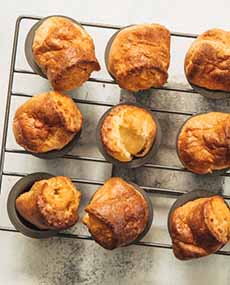
Popovers are light rolls. They are the American version of Yorkshire Pudding, a batter pudding made in England since the 17th century [source]. Both use the same egg batter.
Popovers are named for their notability to “pop over” the specialty tins in which they are baked. The wells are tall, tapered, and greased with butter.
Yorkshire puddings, baked in muffin tins, have flat tops. The wells are greased with the drippings (beef fat) from the roast they are accompanying.
WHY DON’T WE EAT MORE POPOVERS?
For something so delicious and easy to make, why don’t we eat more of them? Is it because they (in theory) require a special pan?
Even our Mom, a baker extraordinaire who had more bakeware than one could count, didn’t have popovers in her repertoire.
Instead, she relished them at Sunday brunch and afternoon tea at a restaurant that brought a heaping basket of them to the table.
How the sight of that basket full of hot popovers filled our hearts!
Over the years, we delighted in finding restaurants that made popovers.
One of our favorite neighborhood places served them with strawberry butter. It didn’t get better than that. But oh, the line of people waiting for tables.
And then, alas, they lost their lease and closed (R.I.P., beloved Popover Café).
The Harvard Club in New York City makes them, and we’ve wangled as many lunch invitations as we can from friends who are members.
But now, the choice is obvious:
BUY A PAN!
One day we wandered into Williams Sonoma on one of those “just browsing” visits—the kind that that end in a large bill for impulse purchases.
It was there that we encountered our popover pan. Soon, we were churning out our own popovers.
They are so easy to make, that we figuratively kicked ourself for the years we went without popovers.
Why buy a 6-cup pan over a 12-cup pan?
While the first answer is, how many do you need, there is also the size of the popover.
The 12-cup pans have slightly smaller wells.
For example, the Chicago Metallic 6-up has wells of 2.75 inches by 2.25 inches; the 12-cup wells are 2.25 inches by 2 inches.
There are also larger pans, but these tend to be foodservice quality (and price).
Don’t worry about having too many popovers.
Leftover popovers can be reheated in a 425°F oven for 8 minutes.
They can also be frozen after baking and reheated frozen in a 425°F oven for 10 minutes.
Along the same lines, you can make the popovers ahead of time, then reheat them in a 425°F oven for 8 minutes.
DO YOU REALLY NEED A POPOVER PAN?
Can’t you use a muffin tin?
Sure, a muffin pan will bake popovers just fine. But…
A popover pan will give you taller popovers with a more defined “mushroom” top.
The popovers from a muffin tin will taste the same, but the popovers will have flat tops and won’t be dramatic-looking.
See additional uses for a popover pan, below.
RECIPE: TENDER POPOVERS
“Watching popovers ‘pop’ is always a thrill,” says Vermont Creamery, which provided this recipe.
“Just don’t open the oven door!”
Vermont Creamery’s popover recipe is particularly easy because it doesn’t have the long and complicated resting time in the fridge.
Prep time is 10 minutes. Bake time is 35-40 minutes.
Ingredients For 12 Popovers
1/4 cup Vermont Creamery Sea Salt Cultured Butter 82% Butterfat* or substitute, melted
6 large eggs, room temperature
2-1/2 cups whole milk, room temperature
2-1/2 cups all-purpose flour
1/2 teaspoon salt
Optional: 1 tablespoon fresh herbs of choice
Condiments for serving: bacon jam, honey, preserves, softened butter (plain or compound [flavored] butter),
Preparation
1. PREHEAT the oven to 450°F; place the rack in the middle. Pour the melted butter into wells of 12 popover pan cups.
2. BEAT the eggs in bowl at high speed, scraping the bowl often. Beat for 2 minutes or until foamy, light and lemon-colored. Add milk and; continue beating for 1 minute. Add the flour and salt; beat until well mixed.
3. POUR the batter into the prepared popover pan. Bake on the middle oven rack for 15 minutes.
4. REDUCE the oven temperature to 350°F. Do not open the oven door! Continue baking for 20-25 minutes or until the popovers are a deep golden brown.
5. REMOVE from the oven. Insert a knife into each popover to allow steam to escape. Serve immediately with condiments of choice.
OTHER USES FOR A POPOVER PAN
Meatloaf. Individual meat loaves cook faster than a whole loaf, and look cute on the plate.
Yorkshire Puddings. Serve them with your roasts. All you need to do to be “authentic” is to grease the popover pan wells with the drippings. We add minced fresh herbs.
Make it easy by keeping rendered beef and chicken fat drippings in the fridge to add flavor wherever appropriate. We also keep a jar of bacon grease.
Profiteroles: Slice the popovers in half and fill them with ice cream, berries and sauce (caramel, chocolate, fruit). It’s faux profiteroles!
Individual Charlottes. Line the wells with buttered bread (brioche is ideal) or ladyfingers, fill with a fruit and custard, top with more bread and bake.
Individual Quiches. Also, individual “anything” you’d like to try.
> THE HISTORY OF POPOVERS
> THE DIFFERENT TYPES OF BREAD
|
|

[1] Buttery, brown popovers, ready to eat. This 12-cup popover pan is from Chicago Metallic (photo © #1 and #3 Chicago Metallic Bakeware).
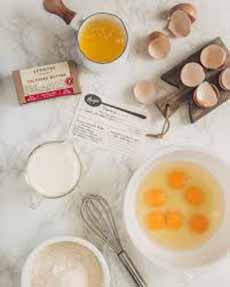
[2] The simple ingredients to make popovers (photo © Vermont Creamery).
[3] A 6-cup popover pan from Chicago Metallic.
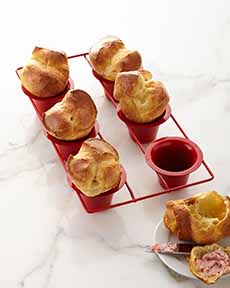
[4] A popover pan with bright red swagger, from Neiman Marcus (photo © Neiman Marcus).
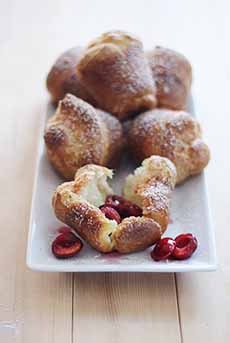
[5] Here’s a recipe for cherry popovers. In the off season, you can make them with frozen cherries or other frozen berries (photo © Elephantine BLog [now closed]).
[6] Food fun: These popovers are turned into a deconstructed version of the classic British dish, Roast Beef With Yorkshire Pudding (photo © Betsy Live | Salt & Honey Caterers).
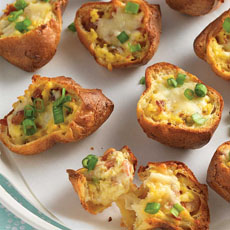
[7] Twice-baked popovers are baked, cut open and filled with bacon and scrambled eggs. Then, they—re baked some more (photo © King Arthur Flour, recipe no longer available).
[8] You can flavor popovers with herbs, and add grated cheese, too (photo © Nordicware).
|