THE NIBBLE BLOG: Products, Recipes & Trends In Specialty Foods


Also visit our main website, TheNibble.com.

TIP OF THE DAY: How To Make The Best Roasted Vegetables

Roasting vegetables is easy.

You can toss pretty much any vegetable with olive oil and seasoning and roast it in the oven.

The happy result: a low-calorie, nutritious and delicious side (or a vegetarian main with some protein).

But sometimes the results are less than perfect.

There are a few guidelines to guarantee your veggies will be caramelized and divine—not overcooked and soft.

You need to get three things right: the right temperature, the right oven placement, and the right timing.

“Each type of vegetable has a sweet spot,” says Good Eggs, a premier purveyor of fine foods in the San Francisco Bay area.

“So we tested and tested again to find that perfect combination of temperature, placement and timing for each of our favorite fall vegetables.”

They compiled that information into the infographic below, and allowed us to share it with you.

Read their full article for details on how to slice, dice and season six favorite fall veggies.

Go veggies! Go roasted veggies! Go make some now!


Roast your favorite fall veggies to perfection (photo and infographic © Good Eggs).


Comments off

TIP OF THE DAY: Know Your Balsamic Vinegar (It’s Balsamic Vinegar Of Modena Day)


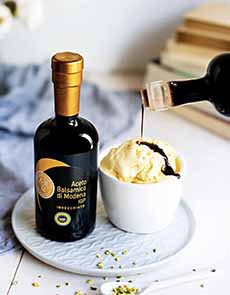
[1] Two types of Balsamic Vinegar of Modena you should know: regular and invecchiato, which is aged in barrels for three years or more (all photos © Balsamic Vinegar Of Modena).


[2] There are several uses for balsamic below, but one you might not have thought of is on ice cream!


[3] The EU’s Protected Geographic Indication seal (PGI) assures that you are buying authentic Balsamic Vinegar of Modena.


[4] As balsamic vinegar ages, it becomes thicker and more concentrated.

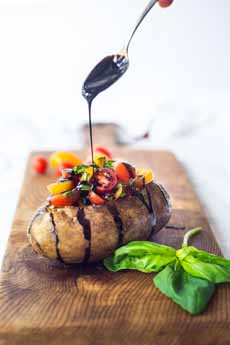
Stuffed Baked Potato With Cherry Tomatoes & Basil
[5] Spruce up a baked potato with balsamic-marinated cherry tomatoes. Here’s the recipe (photo © Idaho Potato Commission).

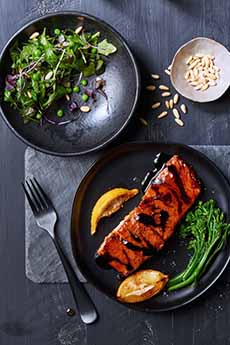
Baked Salmon With Balsamic Glaze
[6] Balsamic glazed salmon. Here’s the recipe, and more about how to use balsamic glaze (photo © DeLallo).


The Consorzio Aceto Balsamico di Modena (Consortium of Balsamic Vinegar of Modena) has declared a new food holiday: November 1st Balsamic Vinegar of Modena Day.

Balsamic vinegar is one the most important Italian food products—and also one of the most knocked-off.

There is a lot of balsamic vinegar sold that is imitation balsamic. It hasn’t been made according to the rules and regulations of the Consorzio

Some inexpensive supermarket or big chain balsamics are simply cheap red wine vinegar colored and flavored with caramel.

If it’s inexpensive, it’s imitation!

With so many bottles on the shelves, it’s not always easy to locate the authentic Balsamic Vinegar of Modena. be To certain:

  • Check for the EU’s Protected Geographic Indication logo (PGI) on the bottle (photo #3).
  • In Italian, the acronym is IGP, Indicazione Geografica Protetta.
  •  
    The things to look out for follow, but first:

    > Here’s more about imitation balsamic.

    > The different types of balsamic vinegar.

    > The different types of vinegar: a photo glossary.

    > The history of vinegar.

    Below:

    > The history of balsamic vinegar.

    > Favorite ways to use balsamic vinegar.

    > The year’s 6 vinegar holidays.
     
     
    WHAT IS AUTHENTIC BALSAMIC VINEGAR

    Today, the authentic balsamic vinegar of Modena, Italy—Aceto Balsamico di Modena—is still made under the same very strict conditions that have guided it for centuries.

    Balsamic Vinegar of Modena specifications require that:

  • The raw materials (grapes), processing, maturation and aging must take place in the provinces of Modena and Reggio Emilia.
  • The grape musts come from seven specific varieties of grapes: Lambrusco, Sangiovese, Trebbiano, Albana, Ancellotta, Fortana and Montuni. These grapes have just the right concentrations of sugar and acidity.
  • Wine vinegar, a minimum of 10%, is added to the must, along with some aged vinegar that is at least 10 years old.
  • Next, a minimum 60-day maturation period takes place in barrels, vats or casks. These containers must be made from specific precious woods: Chestnut, Mulberry, Sessile Oak or Juniper.
  • After 60 days the balsamic can be bottled and released (photo #1). But it can continue to age.
  • If the maturation phase in the barrels lasts more than three years, the finished product is classified as (invecchiato, aged.
  •  
    If the product is aged for 3 years or more it is labeled “invecchiato” (aged).

    But that’s not all! In order for the product to be certified as Balsamic Vinegar of Modena, analytic and organoleptic tests by expert technicians and tasters are performed on the vinegar while it’s still in barrels.

    If it passes the test finished product is then packaged into glass, wooden, ceramic or terracotta containers of varying sizes. The European logo of the “Protected Geographical Indication” guarantees the authenticity of the product to the consumers.
     
     
    BEYOND INVECCHIATO

    The oldest and most complex balsamics are the “traditional” balsamics, Aceto Balsamico Tradizionale di Modena. These are aged for a minimum of 12 years. Extra Vecchio (Extra Old) balsamics are aged for a minimum of 25 years.

    The older they get, the more the vinegar evaporates in the barrel, the more concentrated and syrupy the vinegars becomes. You can find balsamics aged 50, 75 years, and older, costing hundreds of dollars for just 3.4 ounces.

    These precious balsamics are not used in cooking, but as garnishes: dribbled by the drop onto Parmigiano-Reggiano or other fine cheese, foie gras, seafood, ice cream…or as a digestif at the end of the meal, served on a little spoon.
     
     
    FAVORITE USES FOR BALSAMIC VINEGAR

    Whether invecchiato or younger, any balsamic can be used in:

  • Braises (for depth of flavor)
  • Cocktails (try this Balsamic Negroni)
  • Drizzles (garnishes for meat, poultry and fish/seafood, even ice cream with balsamic [photo #2])
  • Glazes, both sweet and savory (here’s more about balsamic glaze)
  • Marinades (for depth of flavor)
  • Pan Sauces (ditto—how to deglaze a pan)
  • Soups (ditto)
  • Vinaigrettes
  • Splashes—add a splash of balsamic to just about anything, from charcuterie and white pizzas to risotto to strawberries, fruit tarts and savory tarts
  •  
    Here’s more about each of these uses.

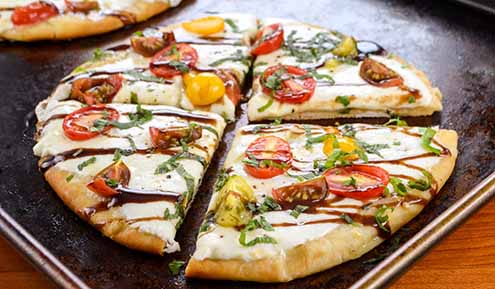
    White Pizza-Flatbread  With Balsamic Glaze
    [7] Caprese flatbread with balsamic glaze. Here’s the recipe (photo © For The Love Of Cooking).


    THE HISTORY OF BALSAMIC VINEGAR

    Balsamic Vinegar of Modena’s origin dates back to ancient Rome, when grape must* was cooked down into a syrup used as a sweetener and condiment—and as a medicine, too.

    Production of balsamic vinegar became linked with the Italian city of Modena during the 11th century.

    Toward the end of the 13th century, the art of vinegar production was cultivated at the court of the Dukes of Este in Modena. But it was not until 1747 that the adjective “balsamic” appeared in the registers of the cellars of the dukes.

    In the 19th century, Balsamic Vinegar of Modena became known and appreciated abroad.

    Since then, the bitter-sweet balanced flavor, with its intense deep brown color and luscious aroma, has become a favorite with connoisseurs worldwide.

    Here’s more of the history of balsamic vinegar.

    Here’s more about how balsamic vinegar is made.
     
     
    THE YEAR’S 6 VINEGAR HOLIDAYS

  • May: National Vinegar Month
  • June, 1st Friday: National Fish And Chips Day
  • June 16: National Vinegar Day†
  • September 23: National Apple Cider Vinegar Day
  • November 1: National Balsamic Vinegar Of Modena Day
  • November 1: National Vinegar Day†
  •  
    Plus:

  • The year’s 9 pickle holidays
  • March: National Sauce Month
  • ________________

    *Grape must (from the Latin vinum mustum, young wine ) is freshly crushed grape juice that contains the skins, seeds, and stems of the fruit.

    †There are two National Vinegar Days. June 16th is been mentioned in some older newspaper archives, but November 1st is the date more commonly associated with the holiday.


    CHECK OUT WHAT’S HAPPENING ON OUR HOME PAGE, THENIBBLE.COM.


    Comments off

    RECIPE: Make Fried Clams For National Deep Fried Clams Day

    November 1st is National Fried Clams Day.

    Fried clams is a dish that we always eat at restaurants, because cleaning, shucking and deep fat frying is a lot of work.

    It’s especially more so because a recipe like the following yields just 12 fried clams. That’s enough for one hearty eater.

    But if you’re game, here’s a recipe from an authentic Down Easter, Tim Connolly of Freeport, Maine.

    The recipe is courtesy of Taste Of Home magazine.

    One thing about eastern-style fried clams is that they’re made with the whole claim, and a cornmeal-based batter. Plus:

  • Clam belly. They’re made with clam belly, the most tender part of the clam (the soft, round center of the clam).
  • Clam strip. A clam strip, a cheaper cut, is usually a sliced-up surf clam. It is the type used in frozen fried clams (a 6″ surf clam can weigh 2 pounds!). The surf clam is too tough to be eaten raw, so it is sold breaded and frozen, canned, used for sauces and chowders.
  • Clam strips were first developed as a food source in the 1950s, for Howard Johnson’s (the scoop).
  • Clam neck. The neck is the chewy part that protrudes outside of the clam. To cook it (or eat raw clams), slip off the outer skin (membrane) and discard.
  •  
    Below you’ll find:

    > A recipe for great fried clams.

    > The year’s 5 clam holidays.

    > The history of fried clams.

    Elsewhere on The Nibble:

    > The year’s 56 fish and seafood holidays.

    > The history of clams.

    > Clams 101: what you need to know about buying and preparing clams.
     
     
    RECIPE: DEEP FRIED CLAMS

    You can fry the clams in an electric skillet, a deep-fat fryer, or other pot you use for frying.

    The recipes for cocktail sauce and tartar sauce are in the footnotes below.

    Ingredients

  • 1-1/2 cups yellow cornmeal, divided
  • 1/2 cup cake flour, divided
  • 2/3 cup water
  • 12 fresh cherrystone clams, shucked
  • Canola or peanut oil for deep-fat frying*
  • 1/2 teaspoon salt
  • Optional garnish: fresh parsley
  • For serving: lemon wedges, tartar sauce†, seafood cocktail sauce‡, ketchup (National Tartar Sauce Day is the first Friday after Lent begins)
  •  
    Preparation


    [1] Fried cherrystone clams. The recipe is below (photo © Taste Of Home).


    [2] Fried Ipswich clams (photo © Arch Rock Fish [alas, permanently closed]).


    [3] Serve the clams with tartar sauce (above), cocktail sauce, ketchup, or simply fresh lemon wedges: The choice is yours. The recipes for tartar and cocktail sauces are in the footnotes below (photo © Taste Of Home).

     
    1. COMBINE 3/4 cup cornmeal and 1/4 cup flour with the water in a shallow bowl, forming a batter. In another bowl, combine the remaining cornmeal and flour.

    2. DIP the clams in the batter and shake off the excess. Coat with the cornmeal mixture.

    3. HEAT the oil to 375°F. Fry the clams, a few at a time, for 4-5 minutes or until golden brown. Drain on paper towels. Sprinkle lightly with salt.

    4. SERVE immediately with lemon and sauce(s)—recipes are below in the footnotes. While frozen fried clams need some added flavor, fresh fried clams don’t need a dipping sauce. A lemon wedge will do.
     
     
    THE YEAR’S 5 CLAM HOLIDAYS

  • January 21: National New England Clam Chowder Day
  • February 25: National Clam Chowder Day
  • March 31: National Clams on the Half Shell Day
  • July 3: National Fried Clam Day‡
  • November 21: National Deep Fried Clams Day‡
  •  
    Plus

  • Lent, 1st Friday: Friday Fish Fry Day
  •  
     
    THE HISTORY OF FRIED CLAMS

    While clams had been cooked for millennia, in New England Americans had traditionally baked them (the Native Americans taught clambakes to the Pilgrims) or cooked in chowders. But modern fried clams were created by restaurant owner Lawrence “Chubby” Woodman of Essex, Massachusetts. Part of the Cape Ann peninsula, (distinct from Cape Cod), Essex is known for its antique shops, shipbuilding history, and beautiful beaches, attracting tourists.

    Woodman and his wife Bessie had a clam shack, selling freshly dug steamer clams, ice cream, and homemade potato chips. As the story goes, on July 3, 1916, he had on hand a vat of hot oil for his potato chips and a large quantity of clams harvested from the mud flats of Essex. A visiting fisherman friend suggested that he try frying some clams in the oil. Following the first batch, some tweaking perfected the recipe, and the modern fried clam was born: a salty, crunchy-crisp coating with a soft, briny clam underneath.

    Woodman developed the technique of shucking soft-shell clams (he used local Ipswich clams), dipping them in evaporated milk and a cornmeal/flour batter, and deep-frying. His deep-frying technique was quick, efficient, and perfect fare for a roadside stand; he effectively transformed clams into fast-food.

    While this may seem like a no-brainer to us, Woodman’s fried clams were a new, public sensation. Before Woodman, fried clams might have been made using hard-shell clams or different coatings, but Woodman’s specific recipe and commercial approach established the beloved New England classic. Other restaurants adopted the practice and eventually inspiring the creation of clam strips by others, bringing fried clams to the masses.

    The next leap forward in fried clams were clam strips, invented around 1932 by Thomas N. Soffron, a clam digger and restaurateur from Ipswich, Massachusetts (just 3-6 miles from Essex). Seeking a more durable, easily transportable alternative to the traditional soft-shell fried, he sliced the “foot” off of hard-shell clams and fried them. His clam strips became popular nationwide through an exclusive deal with the Howard Johnson’s restaurant chain.

    Woodman also came up with the idea of mobilizing the traditional New England clam bake. He loaded a truck with food (clams, lobster, potatoes, corn), boilers, and wood and brought it to the customer’s preferred location. The family business, founded in 1914, is still growing strong: a large employer in the area with more than 200 staff during the summer months. Here’s more about it.
     
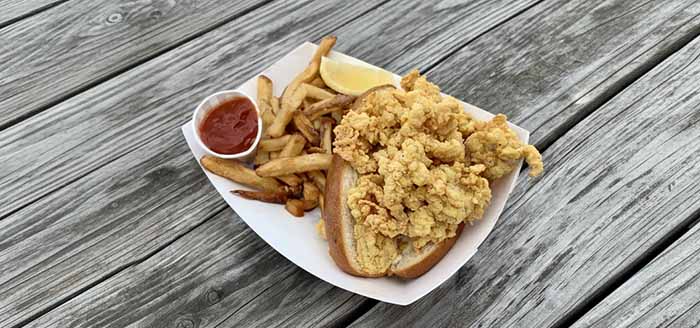
    Clam Roll With French Fries
    [4] Clam strips make it easy to enjoy a clam roll (photo © Ant DM | iStock Photo).
     
    ________________

    *Canola oil and peanut oil are ideal for deep frying, because of their high smoke points

    †Tartar sauce recipe: Combine 3/4 cup mayonnaise, 1/4 cup sour cream, 2 teaspoons sweet pickle relish, and 1 teaspoon lemon juice. Optionally add capers and finely minced shallot or chives, and more pickle relish to taste. You can substitute 4 tablespoons of Dijon mustard for the sour cream.

    ‡Cocktail sauce recipe: Combine 1/2 cup ketchup, 2 tablespoons horseradish, juice from 1 lemon wedge, several dashes of Worcestershire sauce, and optional hot sauce to taste.

    ‡‡July 3rd, National Fried Clam Day, commemorates the creation of the modern fried clam by restaurant owner Lawrence “Chubby” Woodman of Essex, Massachusetts, in 1916. November 1st, National Deep Fried Clams Day, is a similar observance whose specific origin is unclear. But with two different days to celebrate fried clams, who’s complaining?


    CHECK OUT WHAT’S HAPPENING ON OUR HOME PAGE, THENIBBLE.COM.


    Comments off


    © Copyright 2005-2026 Lifestyle Direct, Inc. All rights reserved. All images are copyrighted to their respective owners.