THE NIBBLE BLOG: Products, Recipes & Trends In Specialty Foods


Also visit our main website, TheNibble.com.

HALLOWEEN CANDY: Childhood Treats In Gourmet Chocolate From Theo

Our favorite Halloween candies were mini Almond Joys, Mounds, Reese’s Peanut Butter Cups and Skor bars.

But our palate has since progressed beyond their childhood charms.

Thank goodness for Theo’s artisan chocolates. Theo has brought these and more into the quality-chocolate universe.

  • Coconut Bites (an upgrade of Mounds)
  • Coconut Bites Salted Almond (an upgrade of Almond Joy)
  • Milk Chocolate Peanut Butter Cups
  • Dark Chocolate Peanut Butter Cups
  • Dark Chocolate Salted Almond Butter Cups
  •  
    There are also:

  • 55% Dark Chocolate-Covered Salted Toffee Bar (an upgrade of Skor)
  • 85% Pure Chocolate Bar (an upgrade of Hershey’s Dark Chocolate)
  • 70% Salted Dark Chocolate Bar (ditto)
  •  
    The line is Certified USDA Organic, plus:

  • Fair For Life
  • Gluten-Free
  • Kosher (Star K – Dairy)
  • Non-GMO Project Verified
  • Organic
  • Vegan
  •  
    So eat all you want: It’s Halloween, and it’s socially responsible chocolate.

    You can also load up on stocking stuffers.
     
     
    >>>Head to TheoChocolate.com<<<
     
     
    THE HISTORY OF HALLOWEEN
     
    THE HISTORY OF THE JACK O’LANTERN
     
    THE HISTORY OF CANDY CORN
     
    THE HISTORY OF TRICK-OR-TREATING


    [1] Theo’s organic Peanut Butter Cups (both photos © Theo Chocolate).


    [2] Theo’s Salted Toffee Bar.


    Comments off

    Pumpkin Cheesecake Recipes & Pumpkin History

    Pumpkin Cheesecake
    [1] Pumpkin Ricotta Cheesecake, less heavy than a cream cheese recipe (photo © Chef Marisa Churchill).

    Pumpkin Mousse Cheesecake
    [2] No Bake Pumpkin Cheesecake. Here’s the recipe (photo © Kenwood World).

    [3] Pumpkin Cheesecake Pie. Here’s the recipe (photo © King Arthur Flour).


    [4] Pumpkin Cheesecake Ice Cream. The recipe is below (photo © Taste Of Home).


    [5] Or, buy this limited-edition Pumpkin Cheesecake Ice Cream, with a graham cracker swirl, from Ben & Jerry (photo © Ben & Jerry’s).

    Orange Pumpkins & White Pumpkins On A Tray
    [6] Assorted pumpkins: Thanks for everything (photo © Starling Farm)!


    October 21st is National Pumpkin Cheesecake Day. Here’s the history of cheesecake. The history of pumpkins is below.

    With Halloween in 10 days and Thanksgiving and Christmas following (sooner than we’d like), it’s perfect timing.

    There are different styles of pumpkin cheesecake, from the dense New York style with two pounds of cream cheese to a lighter ricotta cheesecake, to pumpkin mousse cheesecake.

    Here are some recipes from our collection.

  • Cheesecake Crust Variations
  • Ginger Pumpkin Pie With Pumpkin Seed Crust
  • Mocha Pumpkin Cheesecake Perfectly Pumpkin Cheesecake With A Mocha Glaze (Christina Ferrare)
  • No Bake Pumpkin Cheesecake (photo #2)
  • Pumpkin Cheesecake Pie (photo #3)
  • Pumpkin Cheesecake With A Gingersnap & Nut Crust
  • Pumpkin Cheesecake With A Pecan Crust (Chef Terrance Brennan)
  • Pumpkin Cupcakes With Pumpkin Cheesecake Frosting
  • Pumpkin Mousse Cheesecake With A Gingersnap Crust
  •  
    Plus:

  • Cranberry Cheesecake
  • Pumpkin Cream Cheese Danish
  • Sweet Potato Cheesecake
  •  
    Plus:

    > The year’s 16 cheesecake holidays.

    > The year’s 8 pumpkin holidays are below.
     
     
    RECIPE: PUMPKIN CHEESECAKE ICE CREAM

    Don’t want cake? How about some pumpkin cheesecake ice cream?

    Many pumpkin cheesecake recipes do not include cream cheese, relying simply on the cream and spices to simulate cheesecake flavors.

    Ben & Jerry’s sells a perfectly charming Pumpkin Cheesecake Ice Cream.

    But this recipe, from Taste Of Home, is the real deal with cream cheese and egg yolks, just like a cheesecake.

    Ingredients

  • 2 cups heavy whipping cream
  • 1 package (8 ounces) cream cheese, cubed
  • 3/4 cup packed brown sugar
  • 5 large egg yolks
  • 1 teaspoon salt
  • 1 teaspoon ground cinnamon
  • 1/2 teaspoon ground ginger
  • 1/2 teaspoon ground nutmeg
  • 1 cup canned pumpkin
  • 1 teaspoon vanilla extract
  •  
    Preparation

    1. HEAT 1-1/2 cups cream, the cream cheese, and 1/2 cup brown sugar in a large heavy saucepan, until bubbles form around the sides of the pan. Meanwhile…

    2. WHISK the egg yolks, salt, spices, and the remaining cream and brown sugar in a small bowl. Whisk a small amount of the hot mixture into the eggs. Return all to the pan, whisking constantly.

    3. COOK and stir over low heat until the mixture is thickened and coats the back of a spoon. Quickly strain through a fine-mesh sieve into a bowl; place in ice water and stir for 2 minutes.

    4. WHISK in the pumpkin and vanilla. Continue to whisk until the mixture is completely cooled.

    5. FILL the cylinder of the ice cream maker two-thirds full; freeze according to the manufacturer’s directions. When the ice cream is frozen, transfer it to a freezer container. Freeze for 2-4 hours or overnight.
     
     
    THE HISTORY OF CHEEESECAKE
     
     
    THE HISTORY OF PUMPKINS

    Pumpkins and other squash types originated in the Americas. They are among America’s oldest cultivated crops.

    Pumpkin seeds have been found at archaeological sites in the American southwest dating back six thousand years, as well as at sites throughout Mexico, Central and South America, and the eastern United States [source].

    It is believed that the seeds of the wild pumpkin were the only part consumed, as the flesh of most varieties was too bitter to eat.

    Once cultivation and breeding eliminated the bitterness, Native Americans ate not just the flesh and seeds, but the flowers, leaves, and in the case of zucchini and yellow squash, the skin.

    Varieties of all sorts could be baked or roasted whole in the fire, cut up and boiled, or added to soup. Strips were also dried into a type of pumpkin jerky.

    The outer shells were dried and used as water vessels, bowls, and storage containers.

    European explorers to the New World found squash varieties growing in profusion from East to West, from South America to Canada.

    Brought back to Europe by Spanish explorers in the 16th century*, the name was derived from the Greek word pepon, large melon.

  • In French, the word became pompon.
  • The English changed “pompon” to pumpion.
  • In the American colonies, where the fruit was a Native American staple, the word became pumpkin.
  •  
    When Pilgrims arrived, they added pumpkin to everything from soups and stews to pies.

    They also turned the pumpkin into a vessel to make a type of pudding. They sliced off the top, removed the seeds and pith, and filled the cavity with milk, honey, and spices. They baked it in the hot ashes of the fire.

    Pumpkins were fermented into beer and grown as fodder for livestock.

    By the 19th century, however, the pumpkin had diminished into a minor crop. Now, it is largely a “fourth quarter crop,” mostly eaten during the holiday season.

    But only because we have so many other seasonal foods to eat during the other seasons!
     
     
    THE YEAR’S 8 PUMPKIN HOLIDAYS

  • October: National Pumpkin Month
  • October 1: National Pumpkin Spice Day
  • October, 1st Wednesday: National Pumpkin Seed Day
  • October 21: National Pumpkin Cheesecake Day
  • October 26: National Pumpkin Day
  • October 30: National Pumpkin Bread Day
  • November 21: Pumpkin Pie Day†
  • December 25: National Pumpkin Pie Day†
  • October 31: Carve A Pumpkin Day, Halloween
  •  
    Plus:

  • Thanksgiving!
  •  
     
    ________________

    *Along with pumpkins and other squash varieties, Spanish explorers brought back cacao beans, corn, peanuts, peppers, pineapples, potatoes, sweet potatoes, tomatoes, and other food items.

    *There appear to be two different pumpkin pie days: November 21st and December 25th. The December 25th observance has some documentation going back to the late 1990s in Chase’s Calendar, a well-known reference book for tracking special days and observances. The November 21st date is more obscure, but can be found on several calendar websites. Both are unofficial food holidays, i.e. without any formal governmental or organizational proclamation. The former can simply been “proclaimed” by anyone online and registered with different calendar websites.


    CHECK OUT WHAT’S HAPPENING ON OUR HOME PAGE, THENIBBLE.COM.


    Comments off

    Prunes, Delicious At Every Meal: Prunes Uses & History

    National Prunes Day is June 17th. October 17th is Four Prunes Day. It may sound like a funny name for a food holiday.

    Some people say “meh” to prunes, but for centuries it was based on medical advice that four to nine prunes a day would help with “digestive regularity.”

    We love the flavor prunes and prune juice. But many Americans steer clear of them, perhaps because of their long association with regularity (and hence, National Prunes Day was founded).

    A campaign launched by prune producers in 2001 promoted a name change from prunes to “dried plums” (which is what prunes are), to make them more appealing.

    It was not successful in moving the needle, and “prune” has returned to common use.

    But as anyone who has ever made a pork or chicken roast with stuffed prunes knows, the dried fruits are delicious on their own.

    One of our favorite hors d’oeuvre is prunes stuffed with chicken liver mousse (you can marinate the prunes in Cognac overnight before stuffing them).

    The 21st-century view of healthy prunes should be as a high-antioxidant fruit, full of fiber, potassium, and magnesium.

    A clinical study currently underway indicates that prunes may have the ability to reduce bone loss in postmenopausal women and may help fight osteoporosis.

    While dried fruits such as prunes are easy to tote around for a healthy snack, Sunsweet Growers has made it even easier with Sunsweet Ones, which are individually wrapped.

    One prune contains just 23 calories.

    > The year’s 4 prune holidays.

    Below:

    > The history of prunes.

    > Prune nutrition.

    > Enjoying prunes all day.
     
     
    PRUNES AT EVERY MEAL

  • Breakfast: breakfast bars, cottage cheese, oatmeal, pancakes, scones and muffins, smoothies, yogurt
  • Lunch: green salads, chicken salad, grilled cheese, shaved root salad, turkey/chicken lettuce cups or wraps
  • Appetizers: bacon-wrapped prunes, cheese board, crostini, skewers
  • Dinner: chili, meatloaf, stews, stuffed chicken breasts, stuffed pork roast, Tuscan Chicken,
  • Sides: carrot salad, glazed vegetables,rice and grains, stuffed or cubed squash, stuffing
  • Dessert: brownies, cookies, fruit and nut bark, mousse/prune whip, prune cake, prune flan/clafoutis
  •  
    There are so many recipes in each of these categories. Check out:

  • California Prunes
  • Sunsweet.com
  •  
    You’ll find everything from every day to creative recipes (don’t knock Prune Pizza until you’ve tried it).

    And one of our favorite easy desserts: Soak prunes in Cognac, Grand Marnier, prune liqueur, or orange liqueur for several hours or overnight. Then use them to top vanilla ice cream.

    You can even flambé them, like Cherries Jubilee.
     
     
    PRUNE NUTRITION

    Prunes have been appreciated for thousands of years due to their nutritional, dietary, and medical properties, and were prescribed by Greek, Roman and Arab doctors.

    Today, we know that they are:

  • High in antioxidants, including vitamin C.
  • High in soluble fiber, which helps normalize blood sugar levels.
  • High in insoluble fiber, which helps with lower cholesterol and regularity.
  • As a snack, the fiber may help keep hunger pangs at bay.
  • Their high beta-carotene content can help prevent cancer and help slow the aging of the brain and body.
  •  
    In addition to nutrition, prunes are fun to eat: sweet, flavorful, and moist, and with a sticky, chewy texture.
     
     
    THE HISTORY OF PRUNES

    A prune is a dried plum of any cultivar, mostly the European plum (Prunus domestica).

    More than 1,000 plum cultivars are grown worldwide for drying; an additional 1,000 or so are grown for plum fruit (different cultivars are created to do better in particular environments).

    The Greeks and Romans were very fond of both variations of the fruit.

    Wild plums originated in China and were cultivated from sour plums into sweet fruit.

    Plums came to the Middle East along the Silk Road, and plum trees flourished all over the Mediterranean basin.

    The plums were dried in the sun or in bakers’ ovens, transforming them into prunes.

    Because they are highly nutritious and have a long shelf life, prunes and other dried fruits were ideal for travelers, and to store in case of poor harvests.

    From the Mediterranean to Northern Europe:

    The Romans planted the first variety of plum in Gaul near the town of Agen, which is still famous for its delicious prunes.

    In the 12th century, Benedictine monks returning from the Third Crusade brought new varieties of plums from Syria and grated them onto the local rootstock to create new varieties.


    [1] Pork roast stuffed with prunes. Here’s the recipe from Leites Culinaria (photo © Leites Culinaria).


    [2] Asian noodles with prune-ginger sauce. Here’s the recipe from California Prunes (photo © California Prunes).


    [3] Farro (substitute grain of choice) with prunes, butternut squash and pecans. Here’s the recipe from California Prunes (photo © California Prunes).


    [4] Brownies with chopped prunes. Here’s the recipe from A Taste Of Madness (photo © A Taste Of Madness).


    [5] Prune clafoutis, in custard. Here’s the recipe from Papilles Et Pupilles (photo © Papilles Et Pupilles).


    [6] Whole, pitted, bite-size, diced, individually wrapped for grab-and-go: Sunsweet makes it easy to cook and bake with prunes (photo © Sunsweet).

     
    Known as Pruneaux d’Ente (grafted prunes), this was the prune that made its way to California, in 1850.

    It was brought by a man from the Agen area, who grafted it onto local wild plum trees.

    While these California prunes were growing, so was the U.S. consumer demand for European prunes.

    By the 1870s, there were enough imports to catch the eye of farmers, who began planting plum trees from the California stock.

    Today, California is America’s source of prunes. They’re available year-round.

    Try some sooner, rather than later.
     
    Bowl Of Prunes
    [7] Fresh plums and the prunes that result when they’re dried (photo © California Prunes).


    CHECK OUT WHAT’S HAPPENING ON OUR HOME PAGE, THENIBBLE.COM.


    Comments off

    SEASONAL GARNISH: Fall Harvest Soup Topper Recipe


    [1] Soup with a fall popcorn garnish (both photos © Popcorn Board).


    [2] Add the garnish to chili and more.


    Here’s a fun garnish for fall: for soups, vegetables, grains, proteins, even plain yogurt.

    Combine seasoned popcorn (recipe below) with dried cranberries and pepitas, and top with fried sage leaves (here’s the recipe—it’s worth the effort).

    You can also use the mixture as a trail mix-type snack, perhaps with the addition of chocolate chips?

    And, if you don’t want a garnish, just enjoy the seasoned popcorn as a snack.
     
     
    RECIPE: FALL HARVEST SOUP TOPPER & GARNISH

    Ingredients For The Popcorn

  • 4 cups air-popped popcorn
  • Cooking spray: Butter or Original flavor
  • 1/4 teaspoon Cajun Creole seasoning or chili powder
  • 1/4 teaspoon dried basil
  • 1/4 teaspoon dried oregano
  • 1/4 teaspoon parsley flakes
  • 1/4 teaspoon thyme
  •  
    Mix-Ins

  • 1/4 cup dried cranberries
  • 1/4 cup pepitas (pumpkin seeds)
  •  
    Preparation

    1. SEASON the popcorn. Place it in a large, clean paper bag.

    2. SPRAY the popcorn lightly with cooking spray: about 5 quick sprays.

    3. SPRIKE with the herbs: Cajun Creole/chili, basil, oregano, parsley, thyme. Close the bag and shake to distribute the seasoning. Add the mix-ins and give it another shake.


    Comments off

    Sugar Free Candy Apples & Caramel Apples Recipes

    You can find sugar-free Halloween candy like Hershey’s Miniatures, Jolly Rancher, Reese’s Miniature PB Cups and Twizzlers Licorice.

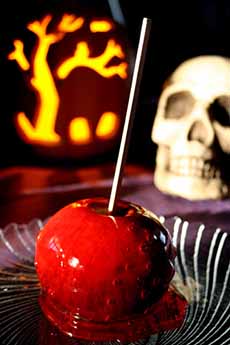
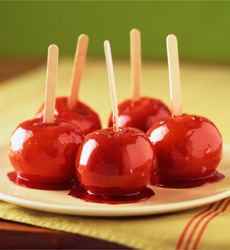
    But what we really look forward to every Halloween is a crunchy red candy apple and a chewy caramel apple.

    If you can’t have sugar, worry not: We have recipes for sugar-free/no sugar added candy and caramel apples.

  • Sugar Free Candy Apples Recipe
  • Sugar Free Caramel Apples Recipe
  •  
    We couldn’t find a sugar-free candy corn to decorate, which isn’t surprising because candy corn is mostly corn syrup.

    But there are sugar-free gummy bears from Albanese—not Halloween-y but fun.

    Plus:

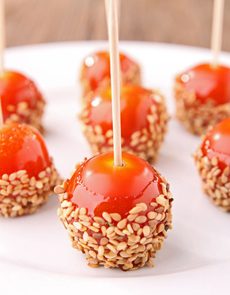
  • You can decorate the apples with chopped nuts—all protein, no added sugar (photo #2).
  • You can also decorate with sugar-free chocolate chips or shaved chocolate.
  • Don’t forget sprinkles and confetti. Here’s how to make a sugar-free version.
  •  
    October 21st is National Caramel Apple Day.
     
    THE HISTORY OF HALLOWEEN
     
    THE HISTORY OF THE JACK O’LANTERN
     
    THE HISTORY OF CANDY CORN
     
    THE HISTORY OF TRICK-OR-TREATING


    [1] Apples dipped in chocolate. Get sugar-free milk chocolate or white chocolate. The latter can be tinted with food color for a green or orange apple (photo © All Recipes).

    Caramel Apples With Nuts
    [2] Use chopped nuts, like these apples from Mrs. Prindables (photo © Mrs. Prindables).


    Comments off

    The Nibble Webzine Of Food Adventures
    RSS
    Follow by Email


    © Copyright 2005-2026 Lifestyle Direct, Inc. All rights reserved. All images are copyrighted to their respective owners.