THE NIBBLE BLOG: Products, Recipes & Trends In Specialty Foods


Also visit our main website, TheNibble.com.

FOOD FUN: Peanut Butter Bacon Cheeseburger Recipe

Will a peanut butter bacon cheeseburger catch up in popularity with the long-loved bacon cheeseburger?

This burger is topped with bacon, cheese and peanut butter!

It was developed to offer diners something new and different.

Chef John Franke, on behalf of the Boulder-based SRG Culinary Council, set out to develop some new approaches to classic burger garnishes.

One of the winners was this PB&B Burger (peanut butter and bacon).

The burger is comfort food; the added ingredients offer new palate excitement with a delicious combination of flavors—a combination that most home cooks would never think up on their own.
 
 
RECIPE: PEANUT BUTTER BACON CHEESEBURGER

The base of two beef patties goes onto a King’s Hawaiian hamburger bun, layering on:

  • Creamy peanut butter
  • Sweet-tart blueberry jam
  • Caramelized onions
  • White American cheese*
  • Pepper bacon
  •  
    Chef Franke makes his own blueberry jam from scratch, and it adds a unique and delightful flavor impact.

    “The jam adds a tangy, cooling contrast against the peppery bacon and savory beef, and the peanut butter lends a softer flavor,” he says.

    You don’t have to make jam from scratch. Just buy a good brand and counter the sweetness with some balsamic vinegar.

    Or, buy fig jam, which is naturally less sweet.

    Have fun with it!
     
     
    By the way, a small drive-in burger stand in the Sedalia, Missouri, introduced a peanut butter–slathered hamburger at an early date—we just don’t know exactly when.

    Known as the guberburger (for goober, a nickname for peanuts), The Wheel Inn topped a burger with peanut butter, mayonnaise, lettuce, and tomato.

    The Wheel Inn was opened from the 1940s until 2007, when it had to close for a highway expansion project. Here’s more about it.
     
     
    > HAMBURGER HISTORY
     
     
    > PEANUT BUTTER HISTORY
     
    ________________

    *We’re not fans of processed American cheese slices in any color. Upgrade the flavor with Cheddar, Gruyère, Jarlsberg or anything else!


    [1] Two patties topped with a creative combination of five ingredients (photo © U.S. Highbush Blueberry Council).

    Jar Of Creamy Peanut Butter
    [2] Creamy peanut butter is required here. Crunchy just doesn’t work with the texture (photo © P.B. & Co.).

    Blueberry Jam
    [3] With blueberry jam on the burger as well, this is like a PB & J burger. Here’s the recipe for this two-ingredient blueberry jam (photo © A Pretty Life In The Suburbs).


    Comments off

    RECIPE: Fried Eggs & Polenta For Brunch & Lunch


    [1] Comfort food: warm, creamy polenta topped with a fried egg and sautéed cherry tomatoes (photo © Good Eggs).


    [2] Cherry tomatoes are sauteed into a jammy sauce, called “burst tomatoes” (photo © Barilla).

    Box Of DeLallo Instant Polenta
    [3] Buy a box of polenta. You can use it at any meal of the day (photo © Delallo).

    Ancient Harvest Polenta
    [4] An easy hack is to buy a tube of polenta, ready made. The difference is you’ll serve it sliced or diced, not in a creamy porridge form (photo © Ancient Harvest).


    When was the last time you made polenta?

    It’s such a warming comfort food, we’re surprised that we don’t make it more often. And it’s gluten-free*.

    So for brunch this weekend, we’re making this yummy recipe from Good Eggs.
     
     
    WHAT IS POLENTA

    Polenta—which is both the Italian word for cornmeal and a cooked dish made from it—has become familiar in America through Italian and Continental restaurants.

    But it’s not new to America. For the first two centuries on the continent, American diets contained much cornmeal: in bread, as breakfast porridge, as a side starch, and in other recipes.

    Paradoxically, corn, which is native to the Americas, was shipped to Europe, where Italians turned it into polenta.

    Back in the Americas, except for the Southern region, cornmeal was gradually replaced in American diets by refined wheat flour (note that while corn is a whole grain, milled polenta is not).
     
     
    RECIPE: FRIED EGGS & POLENTA WITH BURST CHERRY TOMATOES

    As with oatmeal, you can find instant polenta as well as long-cooking polenta.

    You can also take a shortcut with this recipe by purchasing ready-made polenta in a roll form, and cooking slices instead of making porridge-style polenta from scratch.

    Ingredients For 3 Servings

  • 1 cup dry polenta
  • 1 cup milk or water
  • 1 tablespoon olive oil
  • 1 teaspoon salt
  • 1 pint cherry tomatoes
  • 1 shallot, sliced
  • 2-3 garlic cloves, chopped
  • Basil butter
  • 3 eggs
  • Grated Parmesan cheese
  • Salt and freshly ground pepper
  • Olive oil
  •  
    For The Basil Butter

  • 1/2 cup butter, softened
  • 4 teaspoons minced fresh basil
  • 1-1/2 teaspoons minced fresh parsley
  • Optional:
     
    Preparation

    1. MAKE the basil butter. In a small bowl, combine the ingredients and beat on medium-low speed until combined. Set aside. (You can make this a few days in advance and wrap tightly in the fridge, until you’re ready to soften it.)

    1. BRING 3 cups water and a pinch of salt to a simmer in a small pot.

    2. COMBINE in a bowl, 1 cup polenta, 1 cup milk or water, and a pinch of salt. Let it soak. When the water is simmering, whisk in the polenta, along with the soaking liquid. Turn down the heat to low, cover, and simmer until tender, stirring occasionally, about 10 minutes. Remove from the heat and whisk in 1 tablespoon olive oil and 1 teaspoon salt. Meanwhile…

    3. REMOVE the tops from the tomatoes. Slice the shallot and chop the garlic. Set the basil butter on the counter, and let it come to room temperature.

    4. WARM 1 tablespoon olive oil in a nonstick frying pan over medium heat. Add the shallot and sauté until soft, 2 minutes. Add the garlic and stir until fragrant, 30 seconds. Transfer to a bowl.

    5. RETURN the pan to the heat, and add the tomatoes. Sauté until the tomatoes burst, sink down, and start to turn jammy, 10 minutes.

    6. RETURN the shallot and garlic to the pan, add 1 tablespoon of the basil butter, and stir until melted. Season to taste with salt and pepper. Transfer to the bowl and set aside and keep warm.

    7. WIPE out the pan, return it to the heat, and warm 1 tablespoon olive oil. Crack 3 eggs into the pan and fry until the whites are set but the yolks are still runny, about 3 minutes for sunny-side up.

    8. SPOON the polenta into bowls, dollop with the basil butter, and swirl to melt. Add the cherry tomatoes, and slide the fried eggs on top. Sprinkle with the cheese, grind with pepper, and serve.
     
     
    > MORE POLENTA RECIPES

  •  
    ________________

    *Polenta is naturally gluten-free (the only grains that do naturally contain gluten are barley, rye and wheat). Since so many other grains are processed in facilities that also handle these latter grains, however, some varieties of polenta may become contaminated with trace amounts of gluten. Some brands of polenta print “gluten-free” directly onto their product labels for easy identification. Others don’t.


    Comments off

    SEASONAL RECIPE: Chocolate Chip Pumpkin Bread

    If you’re looking for something to bake this weekend, how about Chocolate Chip Pumpkin Bread?

    “This pumpkin bread is autumn in loaf form,” says Pete & Gerry’s, fourth-generation family farmers of organic eggs (see more about them below).

    “Like any quick bread, it comes together in a flash and stays tender and moist right out of the oven and beyond.”

    The recipe lets you choose any and all mix-in ingredients, from chocolate chips of any and all colors, nuts, crystallized ginger, toffee chips, whatever!

    The recipe says “optional,” but we say they’re “necessary.”

    Serve the pumpkin bread for brunch, coffee break, or dessert—with an optional scoop of ice cream.
     
     
    RECIPE: CHOCOLATE CHIP PUMPKIN BREAD

    This recipe makes two loaves. You can freeze the second loaf if you don’t plan to use it within a few days.

    Prep time is 10 minutes, cook time is 75 minutes.

    Ingredients For 2 Loves

  • 1 fifteen-ounce can pure pumpkin puree*
  • 1 cup butter†, melted
  • 4 large Pete and Gerry’s Organic Eggs
  • 2/3 cup water
  • 2 teaspoons vanilla extract
  • 1 cup sugar
  • 1-1/2 cups brown sugar
  • 3-1/2 cups all-purpose flour
  • 2 teaspoons baking soda
  • 1-1/2 teaspoons salt
  • 4 teaspoons ground cinnamon
  • 3/4 teaspoon ground ginger
  • 3/4 teaspoon ground nutmeg
  • Optional: 2 cups mix-ins (chocolate chips, chopped nuts, crystallized ginger, toffee chips
  •  
    Preparation

    1. PLACE the oven rack in the middle of oven and preheat to 350°F. Grease two 9” x 5” x 2.5” loaf pans, if using mix-ins. To make a plain loaf, 8” x 4” x 2.5” pans will work.

    2. COMBINE all wet ingredients (pumpkin purée, melted butter, eggs, water, and vanilla) in a large bowl. Use a mixer on low speed until or whisk by hand until well blended. Then stir in both sugars until well combined.

    3. MIX together in a separate bowl the flour, baking soda, salt, cinnamon, ginger and nutmeg. Add the dry ingredients to the wet ingredients and mix until the batter is well combined and smooth.

    4. ADD the mix-ins, and stir until evenly distributed. Divide the mixture equally between the two loaf pans, and shake the pans to roughly level out the batter.

    5. BAKE the loaves for 60-75 minutes, gently rotating the pans in the oven halfway through baking. The loaves are ready when the top cracks, the surface feels firm and set, and a toothpick inserted into the center of the loaf comes out clean. (If the top begins to get too dark during baking, you can carefully tent it with foil to prevent further browning).

    6. REMOVE the loaves from the oven, and allow them to cool for at least 15 minutes before turning them out on a wire rack to cool to room temperature.
     
     
    ABOUT PETE & GERRY’S ORGANIC EGGS

    Should your eggs come from small family farms, or from faceless factory farms?

    With the news coverage of recent years about the horrible lives lived by caged hens, or even “cage free” hens crammed onto barn floors, so crowded that they can’t move, we switched to humanely produced eggs.

    Pete & Gerry’s have been selling high-quality organic eggs for more than 60 years.

    As pioneers of humane and environmentally sustainable egg production, Pete & Gerry’s produced many of the first organic and free-range eggs available in supermarkets. They were the first Certified Humane egg farm in the country.

    The hens, and their eggs, are free of antibiotics, hormones, pesticides, GMO feed or animal byproducts. So these eggs not only taste good: They make you feel good. No hens were mistreated.
     
    Discover more at PeteAndGerrys.com.
     
     
    > CHECK OUT THE DIFFERENT TYPES OF EGGS. How many have you had?

    ________________

    *Be sure to use pumpkin purée and not pumpkin pie filling, which contains added seasonings.

    You can substitute another oil—coconut, corn, grapeseed or vegetable—if you prefer.


    [1] Add chocolate chips and anything else you like to this pumpkin bread (photo © Pete & Gerry’s Eggs).

    A measuring cup of Chocolate Chips
    [2] You can use dark, milk or white chocolate chips, or a combination (photo © Bella Baker).


    [3] If you want to add nuts, our favorite for this recipes is pecans (photo © American Pecan Council).


    [4] Don’t want mix-ins? Bake a plain loaf (photo © Levain Bakery).


    [5] Want to dress up a plain loaf? Add a meringue topping (photo © Tartine Bakery).


    Comments off

    RECIPE: Baked Cheddar Cheese Fries With Bacon & Scallions

    Loaded Bacon & Cheddar French Fries
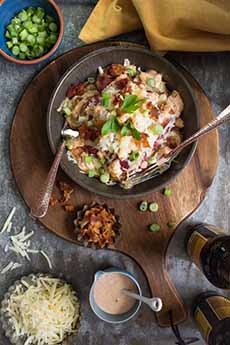
    [1] Who can resist cheese fries? (photo © Idaho Potato Commission)


    [2] Crinkle-cut fries are baked from frozen fries (photo © Walmart).


    [3] Sharp cheddar from Wisconsin (photo © Wisconsin Cheese).


    October is National American Cheese Month*, so how about some cheese fries, made with a fine American Cheddar†?

    You don’t even have to fry the potatoes!

    This easy-to-make dish uses frozen, baked Grown In Idaho crinkle-cut fries.

    Once they’re golden brown in the oven, top them with shredded sharp cheddar cheese, bacon, scallions, and sour cream (or ranch dressing).

    Some want theirs with a big squirt of ketchup, others as is.

    But you may want to make a double batch. These fries will quickly disappear.

    In addition to National American Cheese Month, September is National Potato Month, April 20th is National Cheddar Fries Day, and National French Fry Day is celebrated annually on the second Friday in July.

    Below:

    > Cheese fries recipe with bacon and scallions.

    > The history of cheese fries.

    Elsewhere on The Nibble:

    > The history of French fries.

    > The different types Of French fries: more than 40!

    > The history of the potato.

    > The different types of potatoes: a photo glossary.

    > The year’s 30 potato holidays.

    > The year’s 30 cheese holidays.
     
     
    RECIPE: CHEESE FRIES WITH BACON & SCALLIONS

    Ingredients For 4 Servings

  • Cooking spray
  • 1 package (28 ounces) frozen Grown in Idaho® brand (or substitute) crinkle-cut French fries
  • 1½ cups shredded sharp cheddar cheese (or a flavored Cheddar†)
  • 6 slices thick-cut bacon, cooked and roughly chopped
  • ¼ cup sour cream or ranch dressing
  • 2 scallions, sliced, green parts only
  • Ketchup, for serving
  •  
    Preparation

    1. PREHEAT the oven to 425°F.

    2. GREASE a rimmed baking sheet or a large cast-iron skillet with cooking spray. Spread out the crinkle-cut fries in an even layer on the sheet. Bake for 25 to 30 minutes, until crispy and golden brown.

    3. SPRINKLE the fries evenly with the shredded cheese. Bake for 3 to 5 minutes until the cheese is melted. Remove from the oven and sprinkle with the bacon.

    4. DRIZZLE with the sour cream or ranch dressing, then sprinkle with the sliced green onions. Serve immediately with ketchup on the side.


    THE HISTORY OF CHEESE FRIES

    For something so recent, the origin of cheese fries is lost to history. What we do know is that the seem to have appeared in the U.S. after Cheez Whiz was introduced in 1952.

    Yet Dictionary.com dates the phrase as “first recorded in 1970–75.” It’s hard to believe that it took 20 years to make it into print.

    Snuffer’s in Dallas states their Cheddar fries were “first created in 1978.”

    While good restaurants today will use good cheese for cheese fries:

  • Concession stands use “stadium cheese” for nachos and pretzels, a pasteurized process cheese sauce product served from a pump.
  • Casual restaurants use American cheese on their burgers and cheese fries.
  • Higher-end casual restaurants that serve “loaded Fries” often use shredded natural cheese, usually Sharp Cheddar, Monterey Jack, or Pepper Jack, typically melted under a broiler/salamander.
  • Good chefs may use a Mornay sauce—a classic French béchamel (butter, flour, milk) with shredded cheese folded in—because natural cheese can get oily or “break” when melted alone. This is the best variation: real cheese flavor with the creamy texture of a sauce.
  •  
    When we see “cheese fries” on a menu, we inquire about the cheese. We want Cheddar, not American cheese, Cheez Whiz, or Velveeta.
     
    Baked Bacon Cheese Fries
    [3] Bacon cheese fries with red chile peppers. Here’s the recipe (photo © Taste Of Home).
     
    ________________

    *American cheese refers to any cheese made in the U.S., the least interesting is the processed, pasteurized “cheese product” (it doesn’t qualify are real cheese) popularized by Kraft.

    Cabot Cheddar is a great choice, and comes in 10 varieties, so you can layer on more flavors: Chipotle, Cracked Peppercorn, Everything Bagel, Garlic & Dill, Habanero, Horseradish, Hot Buffalo Wing, Smoky Bacon, Spicy Jack, and Tuscan. See them here.
     

    CHECK OUT WHAT’S HAPPENING ON OUR HOME PAGE, THENIBBLE.COM.


    Comments off

    TIP OF THE DAY: Try A New Cheese (How About Crescenza?)

    If you’re a true cheese lover, you know that there are “so many cheeses, so little time.”

    But we can cut down on the list a bit, because it’s National American Cheese Month.

    The American Cheese Society says that, “American Cheese Month is a celebration of North America’s delicious and diverse cheeses, and the farmers, cheesemakers, retailers, cheesemongers and chefs who bring them to your table.”

    So how about trying a different new-to-you, made-in-America cheese for American Cheese Month?

    How about trying something new?

    There are so many great artisan cheesemakers. We don’t mean to exclude anyone, but check out the websites of:

  • Beecher’s Handmade Cheese (cheddar- and jack-style cheeses)
  • Beehive Cheese (cheddar-style cheeses)
  • Belle Chevre (goat cream cheese)
  • Cypress Grove Chevre (goat cheeses)
  • Cowgirl Creamery (different varieties)
  • Fiscalini Farmstead (cheddar)
  • Grafton Village Cheese Company (cheddar)
  • Jasper Hill Farms (different varieties)
  • Mozzarella Company (Italian-style cheeses)
  • Old Chatham Sheepherding Creamery (sheep cheeses)
  • Point Reyes Farmstead Cheese Co. (blue cheeses)
  • Rogue Creamery (blue cheeses)
  • Uplands Cheese Company (cow’s milk cheeses)
  • Vermont Creamery (goat cheeses)
  •  
     
    HOW ABOUT CRESCENZA CHEESE?

    Crescenza, sometimes known as stracchino, is a staple in the Italian kitchen.

    Says Mozzarella Company of Dallas, “Crescenza is one of those cheeses that no one has ever heard of but everyone loves when they taste it. It is a soft, fresh Italian cheese with a tart, clean flavor.

    It is similar recipe to stracchino. The difference is that crescenza is made from whole milk or semi-skimmed milk and aged for 5-10 days, while stracchino is made only from whole milk and it aged for 20 days.

    “Whenever we serve Crescenza at cheese tastings, this is the cheese that people invariably buy to take home.”

    O.K…we’re in, we said, and we placed an order. It is as promised: delicious.

    While the cheese is Italian in origin, there are a number of American cheese makers who make it; both artisan and factory producers.

    Crescenza (creh-SEN-za) is made from cow’s milk. It is a young, soft cheese, aged for just a couple of weeks before it is sold.

    Eaten very young, it has no rind and a very creamy texture. It is typically square in shape.

    It is a great cheese for expressing the natural flavor and aromatics of a good quality milk, a showcase for the wonderful fresh flavors and aromas of the milk.

    The Crescenza from Mozzarella Company:

  • Has a slightly tart, clean, somewhat yeasty flavor.
  • Is very soft and creamy and spreadable.
  • Melts beautifully.
  •  
    How To Serve Crescenza

    Beyond antipasto and appetizers, focaccia, sandwiches, melting on grilled cheese or other recipes (casseroles, ravioli, whatever).

  • For breakfast or a snack, spread on toast with a honey drizzle.
  • Melted over pasta to add a rich, tangy touch; or used for stuffed pastas.
  • As a dessert cheese, with berries.
  • For snacking or a cheese plate, The cheese was first made in Lombardy, Italy and areas adjacent to this northern Italy city where it is commonly served as a snacking or appetizer cheese with fruit,
    For a cheese plate, pair crescenza with bread and:

  • Charcuterie and olives.
  • Sweet chutneys or fruit pastes.
  • Fresh and dried fruits and nuts.
  • Lighter and more acidic wines (there are many, but for starters, Chablis, Gewürztraminer, Muscat, Pinot Grigio/Pinot Gris, Riesling, Sauvignon Blanc, Vinho Verde).
  •  

    CRESCENZA CHEESE HISTORY

    Crescenza and stracchino have long been made in Northern Italy, regions of Liguria, Lombardy, Piedmont, Romagna and Veneto.

    There’s a legend, of course.

    Most cheeses are historically made in the spring and summer, when the pastures are lush and green, the days are long and the milk is as fresh as can be.

    Crescenza and stracchino were traditionally made during the autumn and winter months, after the cows had descended from the mountain pastures.

    The physical exertion of the hike increased the butterfat content of the milk, making a richer cheese.

    The cows were tired after the long season and their descent; hence, tired cows.

    For stracchino, the name of the cheese derives from the Lombard adjective stracco, meaning tired.

    The origin of the name Crescenza comes from the Italian crescere, which means “to grow.” If kept in a warm place, the cheese tends to increase in size, just like rising bread!
     
     
    > THE HISTORY OF CHEESE


    [1] Humboldt Fog goat cheese from Cypress Grove Cheese, with the signature line of ash running through the center (photo © Cypress Grove Cheese).


    [2] An assortment of cheeses from Cowgirl Creamery, from cows happily grazing in Marin and Sonoma Counties (photo © Cowgirl Creamery).

    Crescenza Cheese[/caption]
    [3] Artisan crescenza cheese, made in small batches by Mozzarella Company (photo © Mozzarella Company).


    [4] Spread it on bread or crackers (photo © Wisconsin Cheese).


    [5] Snack on it with raw vegetables (photo © Arrigoni Formaggi).


    [6] An appetizer of prosciutto-wrapped crescenza cheese. Here’s the recipe (photo © BelGioioso Cheese).


    [7] Crescenza and peach crostini. You can substitute apples, pears, even grapefruit and oranges Here’s the recipe (photo © BelGioioso Cheese).


    Comments off

    The Nibble Webzine Of Food Adventures


    © Copyright 2005-2026 Lifestyle Direct, Inc. All rights reserved. All images are copyrighted to their respective owners.