THE NIBBLE BLOG: Products, Recipes & Trends In Specialty Foods


Also visit our main website, TheNibble.com.

Ivy’s Reserve Vintage Cheddar From Somerset, England

We first learned about Ivy’s Reserve Vintage Cheddar‡‡‡ when Wyke Farms, the U.K.’s largest independent cheese producer and producer of renewable energy, wrote to tell us that its prize-winning Ivy’s Reserve Vintage Cheddar has been certified as the world’s first carbon-neutral Cheddar. The certification shows consumers that a company has measured and offset its entire carbon footprint, and that it’s working to reduce future emissions*.

First, hats off to Wyke Farms. Producing carbon-neutral food is one thing that manufacturers can do to fight climate change, and you’ll be seeing more brands jumping on the rather-essential bandwagon.

For sheer deliciousness, Ivy’s Reserve Vintage Cheddar is also our Top Pick Of The Week.

Since 1861, Wyke Farms has been making cheese and butter with milk from grass-fed cows grazing the lush pastures of the Mendip Hills† in the center of the Cheddar making region in Somerset, England.

The milk used to produce their Cheddar is cultured with vegetarian rennet and is hormone- and rBST-free.

Their cheeses have won more national awards in the U.K. than any other farmhouse Cheddar.

What’s the difference between farmhouse Cheddar and simply, Cheddar?

What distinguishes farmhouse Cheddar from the mass-produced Cheddar (a.k.a. “factory Cheddar”) starts with the raw ingredients. The best producers use milk from grass-fed cows that produce good levels of fat and protein.

Such producers stop using the cows’ milk for their farmhouse cheese once cows are brought indoors for wintering on silage.

The company chose its flagship Ivy’s Reserve Vintage Cheddar as the first product to be certified carbon neutral. It also is shipped in vacuum-packed containers that do not require refrigeration.

> The history of Cheddar cheese.

> The history of cheese.

> The different types of cheese.
 
 
ABOUT IVY’S RESERVE VINTAGE CHEDDAR

Do you like your Cheddar strong and full-flavored, with crunchy calcium lactate** crystals?

Then you’ll want to get your hands on some Ivy’s Reserve Vintage Cheddar as soon as possible.

Made in the prime Cheddar-making region of Somerset, England, this beautiful Cheddar is aged up to 18 months. The result is creaminess, tiny bits of crunchiness (tyrosine crystals†), complexity of flavor, and a nutty, rounded finish.

The award-winning Cheddar is named after Grandmother Ivy, who founded the dairy with her husband in 1861. Beyond the care taken to produce the company’s other Cheddars, Ivy’s Reserve is made with a secret recipe.

Grandma Ivy wrote it down—and thank goodness, since for most of human history, and even into the last century, recipes were only memorized. That’s because most people could not read and write. Ivy’s recipe is now kept locked in a safe on the farm.

For many years, this special cheese was only made as Christmas gifts for family and friends. But demand grew, and ultimately, it was made commercially.

Not surprisingly, demand continues to grow—which you’ll understand as soon as you taste it.

Ivy’s Reserve is matured for 18 months under wood†† to bring out an unmatched “rounded” flavor profile.

Slightly sweet, nutty, and complex, the rich flavor and sharp tang are followed by a lasting mellowness. This award-winning Cheddar cheese is everything that a Cheddar from Somerset, the home of Cheddar, should be.

We love the tiny white crunchy bits in the paste of the cheese. They’re calcium lactate crystals, which can form as the cheese ages and can also appear as a white film or white deposits on the outside of the cheese**. Less experienced cheese eaters often mistakenly identify it/them as mold. They are completely harmless when eaten and are considered a sign of a quality, well-aged cheese with good flavor.
 
 
WHERE TO FIND IVY’S RESERVE VINTAGE CHEDDAR

Distribution is expanding as we write. Ivy’s Reserve is available in packs of 1.1lb (500g) in some branches of Costco and Sam’s Club. But you can purchase it online at iGourmet. Check with other cheese purveyors.

Grandmother Ivy used to say, “if you look after nature then nature will look after you.” She had the deepest respect for nature and a love for the countryside. Ivy’s Reserve is produced respectfully adhering to her century-old principles.

She would undoubtedly be very pleased with the carbon-neutral (PAS 2060) certification. And you will undoubtedly be very pleased with Ivy’s Vintage Reserve Cheddar.
 
 
ABOUT WYKE FARMS

Wyke Farms Ltd is a family run company set in the heart of England’s Somerset County in South West England, long known for its fine Cheddar cheeses. It contains the village of Cheddar, which gave its name to the cheese.

The mild Somerset climate, with long summer days and rain showers, creates lush grass. That grass, in turn, helps to make the local milk particularly rich and creamy.

In Somerset, the art of traditional cheese making has been practiced by the Clothier family since 1861, started by Ivy and Tom Clothier and a family recipe for Cheddar.

Three generations later, grandsons Richard and Tom run the cheese-making operations with their father John, while grandsons David and Roger run the family dairy farming operations.

Today, Wyke Farms is one of the largest independent cheese makers and milk processors in the U.K., producing more than 16,000 tons of Cheddar per year. Wyke Farms Cheddar is sold throughout the U.K. and in 160 countries worldwide.

Different types of Cheddar—Mature, Extra Mature, Vintage, and Ivy’s Vintage Secret Recipe—have been made using the same award-winning 160-year-old recipe. (Wyke Vintage Reserve is matured for 15 months, not to be confused with the 18-month-matured, carbon-neutral Ivy’s Vintage Reserve Cheddar).

The cheese is aged in wooden maturing boxes†† and is constantly monitored by a master cheese grader until it is ready for release.

Wyke Farms has worked closely with Carbon Trust, the world’s leading independent certification body for carbon footprints, to meet the British PAS 2060‡ requirements to qualify for carbon neutral status.

For more information visit WykeFarms.com.

________________

*Companies purchase carbon offsets to achieve carbon neutrality. Here’s more about it.


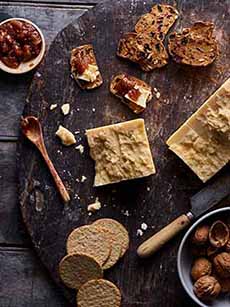
[1] Look for this beautiful cheese, Ivy’s Vintage Cheddar, at some Costco and Sam’s Club stores, online at iGourmet, and fine cheese purveyors (photos #1 through #4 © Wyke Farms).


[2] Ivy’s Vintage Cheddar with apples, pickled onions, and great crackers.


[3] Ivy’s Vintage Cheddar with tomato chutney, walnuts, and raisin crisps. Yum!


[4] Another pairing: tomato chutney and rosemary water biscuits.


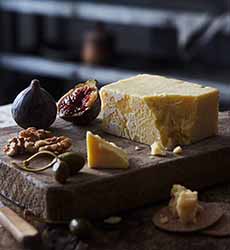
[5] Or, serve fresh figs, walnuts, and caperberries. Look closely and you can see the white coating on the rind: calcium lactate crystals**, a sign of a well-agedd cheese.


[6] One of the logos for carbon neutral certification (image © SCS Global Services).


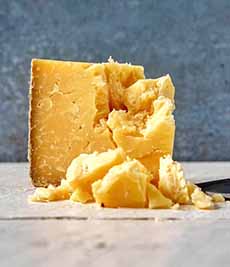
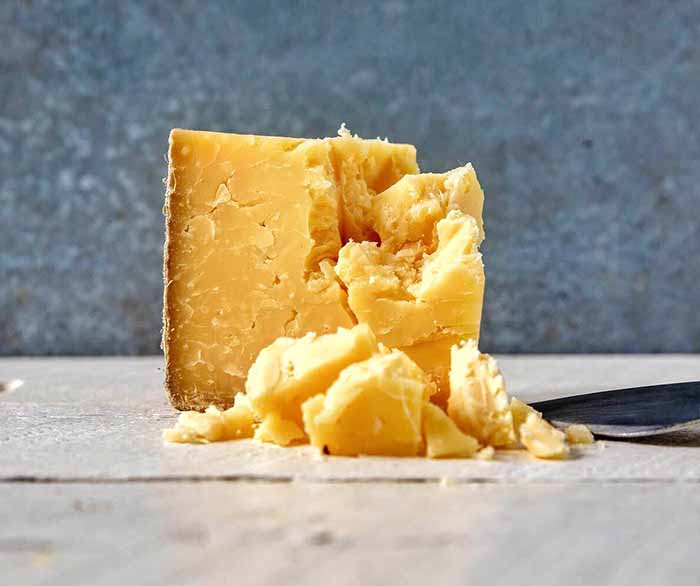
[7] Look closely at this American-made Cavemaster Reserve Stockinhall Cheddar and you’ll see the calcium lactate and tyrosine crystals**. The cheese was named Best Of Show over thousands of cheeses at the 2019 American Cheese Society Awards. We’ve appended a larger photo to the end of this article (photo © Murray’s Cheese).

 
†The caves of the Mendip Hills were settled during the Palaeolithic Period, some 2.58 million years ago. The onset of the Paleolithic Period coincides with the first evidence of tool construction and use by man. The Mendip Hills caves contain extensive archaeological sites. Bones from one cave have been dated to 12,000 B.C.E., and a complete skeleton, known as Cheddar Man, dates from 7150 B.C.E. [source].

**Calcium lactate crystals cause the powdery white “film” or “smear” on the surface of fully aged, mature cheeses including Cheddar. Tyrosine crystals are the tiny white crunchy bits in the paste of the cheese. They form when proteins in the cheese break down and begin to unravel during the aging process. Amino acids called tyrosines are released and cluster together into hard crystals. Here’s more about them.

‡The PAS 2060 is an internationally recognized specification for carbon neutrality and sets requirements for quantification, reduction and offsetting of greenhouse gas emissions for organizations, products and events.

††For centuries or longer, artisan cheeses have been placed onto wooden boards in an aging room. Many kinds of cheese—including Beaufort, Cheddar, and Parmigiano Reggiano—are aged this way. Sometimes, wooden molds or boxes are used as well. During the aging process, distinctive flavors and textures develop; and for most cheeses, a rind forms. These developments are abetted by benign bacteria that grow and contribute to the cheese’s flavor.

‡‡‡Why is Cheddar capitalized? Because it’s the name of a village in England. Those geographic locales that give their name to products are capitalized—Asiago, Brie, Edam, Gouda, Gorgonzola, Munster, Stilton, etc. American cheese is, naturally, capitalized. If the cheese is generic, e.g. blue cheese, feta, goat cheese, mozzarella.


[8] A close look at the calcium lactate and tyrosine crystals in this Cavemaster Reserve Stockinhall Cheddar. This American-made Cheddar, created at Cornell University’s College Of Agriculture and Life Sciences for Murray’s Cheese, uses milk from Old Chatham Creamery in New York State (photo © Murray’s Cheese).


CHECK OUT WHAT’S HAPPENING ON OUR HOME PAGE, THENIBBLE.COM.


Comments off

Popcorn Breakfast Cereal For National Cereal Day & The History of Cereal

Popcorn Breakfast Cereal
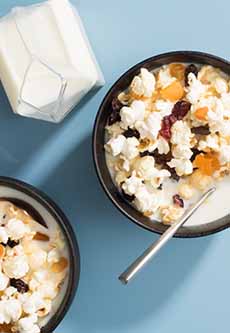
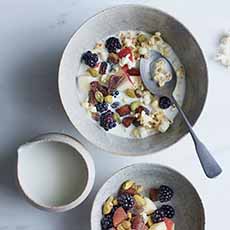
[1] Pop the corn, grab the milk, and enjoy a bowl of cereal. The recipe is below (photo © National Popcorn Board).

Strawberry White Chocolate Popcorn
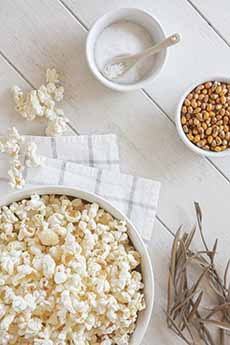
[2] It’s easy to reach for the sugar bowl, but consider brown sugar, demerara (raw) sugar, or maple syrup as alternatives (photo © Eduardo Casajus Gorostiaga | Unsplash).


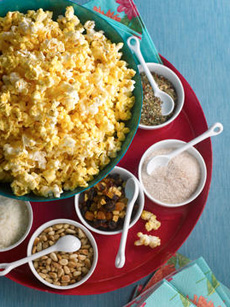
[3] Fun for brunch: Set up a breakfast bar with popcorn and different toppings (photo © National Popcorn Board).


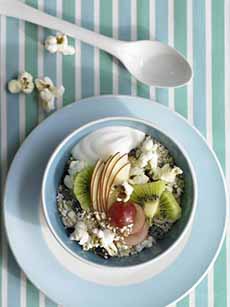
[4] Popcorn atop a whole-grain “granola” of amaranth, buckwheat, oats, and sesame, topped with fresh fruit. Here’s the recipe (photo © Eat Smarter).


[5] Popcorn kernels. Popcorn, Zea mays var. everta), is the only corn that will pop (photo © Markus Winkler | Unsplash).


[6] Breakfast popcorn and milk. Here’s the recipe (photo © John Kernick | Food And Wine).


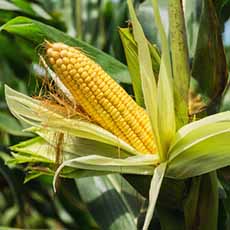
[7] Popcorn in the field. Here’s how to grow your own popcorn (photo © Espoma).


March 7th is National Cereal Day. Cereal is what Americans eat for breakfast, but in the bigger picture, cereal refers to a group of grasses that are grown for their edible components: grains composed of the endosperm, germ, and bran. They include barley, kamut, maize (corn), millet, oats, rice, rye, sorghum, spelt, teff, triticale, and wheat. Cereal grains are the seeds of the grasses.

All are members of the Poaceae family, also called the grasses. It includes the cereal grasses, bamboos, and the grasses of natural grassland and species cultivated in lawns and pasture (the latter two are commonly referred to collectively as grass).

The edible cereals divide from the family level into different tribes, genuses, and species.

Edible grains from other plant families, such as buckwheat, chia, quinoa, and wild rice, are referred to as pseudocereals.

Most cereals are annual plants; one planting yields one harvest. They divide into cool-season cereals (barley, oats, rye, spelt, triticale, and wheat) that cease to grow in and warm-season cereals that are tender and prefer hot weather (maize, millet, rice, sorghum, teff).

Below:

> Popcorn cereal bowl recipe.

> The history of cereal.

Elsewhere on The Nibble:

> The history of cold breakfast cereal.

> The history of porridge.

> The year’s 15 cereal holidays.

> The year’s 12+ popcorn holidays.

> The year’s 116 breakfast holidays.
 
 
STAPLE FOODS FOR THE WORLD

Cereal grain crops are grown in greater quantities and provide more food energy worldwide than any other type of crop, and are one of the key staple crops*. About 80% of the protein and 50% of the calories consumed by humans and livestock come from cereal grains. The U.S. is a major supplier of cereal grains to the rest of the world [source].

In their natural, unprocessed, whole grain form, cereals are a rich source of vitamins, minerals, carbohydrates, fats, oils, and protein. When processed by the removal of the bran, and germ, the remaining endosperm is mostly carbohydrates. (Here’s more about whole grain cereals.)
 
 
RECIPE: POPCORN CEREAL BOWL

Popcorn is made from a particular variety of maize (Zea mays var. everta) which expands and puffs up when heated. It’s well-known to Americans as a snack, but Americans also ate it as a breakfast cereal in the 19th century (see below.

Not only is freshly popped popcorn a delicious breakfast cereal; it’s also a whole grain—and it’s food fun, to boot!

A recipe follows, as does the history of grains.

There are a variety of choices for the topping. Truth to tell, we were out of berries but we had a bag of trail mix. That was our first topping, until we replenished our supply of berries.

Thanks to the National Popcorn Board for this recipe. Check their website for many more popcorn recipes.
 
Ingredients

  • Plain poopcorn
  • Milk
  • Optional sweetener (cane sugar, light brown sugar, demerara (raw) sugar, nancaloric sugar substitute)
  • Dried fruit toppings: dried fruits (apples, currants, dates, raisins)
  • Fresh fruit toppings: bananas, blueberries, raspberries, strawberries
  • Nut toppings: peanuts, pecan pieces, pine nuts, sliced almonds, toasted walnuts,
  • Tropical toppings: coconut flakes, dried papaya and pineapple pieces, fresh mango
  •  
    Preparation

    1. PLACE the popcorn in a bowl and add cold milk, just like any breakfast cereal.

    2. SPRINKLE with the optional sugar and top with your choice of stir-ins. Dig in!
     
     
    THE HISTORY OF CEREAL

    Cereals were the foundation of human civilization. Most archaeologists and paleoanthropologists agree that agriculture began around 10,000 B.C.E., when nomadic people living near the Tigris and Euphrates Rivers in Mesopotamia (the “Fertile Crescent,” which is modern-day Iraq) settled into villages and began cultivating and breeding wheat. Some believe that the desire for a fixed residence for the growing of wheat was based on the demand for beer.

  • By 8000 B.C.E., people in Central Asia† were cultivating millet and rice. Emmer wheat, einkorn wheat, and barley were three of the so-called Neolithic founder crops in the Fertile Crescent. Around the same time, millet and rice were starting to be cultivated in East Asia†. Sorghum and millets were being domesticated in sub-Saharan West Africa.
  • By 7000 B.C.E., people in what is now Greece were cultivating not only wheat but barley and oats.
  • By 6000 B.C.E., farmers were milling their cereal grains by hammering them with stone pestles and were toasting the milled grains.
  • By 3000 B.C.E., people in South America, and probably Central America as well, were cultivating maize.
  • Before 2500 B.C.E., ancient Egyptians were cultivating wheat and barley and fermenting them to make beer.
  • By 12000 B.C.E., hand mills for grinding grain appeared and continued in use in most 17th-century American colonies for processing cereal grains [source].
  •  
    Pursuant to this article on popcorn: corn was domesticated about 10,000 years ago in what is now Mexico. The archaeological record shows that people have known about popcorn for thousands of years. Fossil evidence from Peru suggests that corn was popped as early as 4,700 B.C.E. [source].

    Agriculture produced food that enabled the support of increased populations, leading to larger societies and eventually the development of cities. Since agriculture bred immobility, it led to the accumulation of material goods.

    And cereals determined how large, and for how long, an army could be mobilized [source].

    The word “cereal” is derived from Ceres, the Roman goddess of harvest and agriculture. and grain. The Romans credited her with the discovery of spelt, an ancient strain of wheat, and with the knowledge of how to grow, fertilize and harvest cereal crops.

    By the early 1700s, the rice and oats had been imported to America from the Old World and were found to be hardy grains for the terrain and climate. Europe’s staple grain, wheat, did not fare well on the East Coast of the continent; wheat flour had to be imported.

    Maize, which was grown by the Native Americans, became an everyday part of the American diet for bread, breakfast cereal, corn pudding, johnnycakes, and more—even pound cake. The steamroller mill subsequently made it possible to quickly process wheat before it decayed.

     
    In the early 19th century, Swedish immigrants began settling in the Midwest, planting wheat and eventually turning the area into a major wheat producer. In 1874, Russian immigrants brought seeds for Turkey Red Wheat to Kansas. It was drought resistant and became a source for many varieties of dwarf wheat grown in the U.S.

    In 1834 the mechanical revolution in farming began when Cyrus McCormick introduced his mechanical reaper, which allowed two field hands to do the work that had previously taken five to do. In 1847, he patented another important farm implement, a disk plow that facilitated the planting of even rows of cereal grasses.

    In the 1890s, combine harvesters were introduced. Soon, they would be powered by internal combustion engines and a single farm could harvest almost 20 times as much land as could have been harvested at the outset of the 19th century. That led to efficient corporate farming possible, and the amount of wheat available for the U.S. to export worldwide [source].

    While man had boiled cereal grains into porridge since the earliest times, the growth in corn, oat and wheat production led to the packaged breakfast cereals that people worldwide enjoy today.

    The U.S. is also the world’s top popcorn producer [source].
     
     
    Popcorn As A Breakfast Cereal

    While a tale exists that Native Americans brought popcorn to the first Thanksgiving in 1621, the fact is that the corn grown in New England at the time (Northern Flint corn) has a hull too thin to pop effectively. No archaeological evidence of popcorn has been found at these sites.

    The idea of popcorn as breakfast cereal likely stems from a real Victorian-era trend. By the 1800s, newer varieties of popable corn from South America had been introduced to the U.S..

    Famous authors of the 19th and early 20th centuries, such as Laura Ingalls Wilder in Farmer Boy (set in the 1860s), wrote about eating popcorn in milk. This led later readers to assume the practice went all the way back to the Pilgrims.

    In reality, it was a relatively modern “novelty” food at the time she was writing.

    While popcorn with milk might be the spiritual ancestor of cereals like Corn Pops, it wasn’t the first breakfast cereal.

    The first ready-to-eat breakfast cereal was Granula, invented in 1863 by James Caleb Jackson—roughly 100 years after the Colonial period ended.

    > Here’s the history of cold breakfast cereal.

    Boiling grains for porridge dates to ancient times. The practice of boiling grains and starches into a mash is one of humankind’s oldest culinary traditions, far predating the invention of agriculture.

    According to recent archaeological findings, the practice is at least 32,000 years old, although evidence suggests humans may have been processing starchy plants for much longer.
     
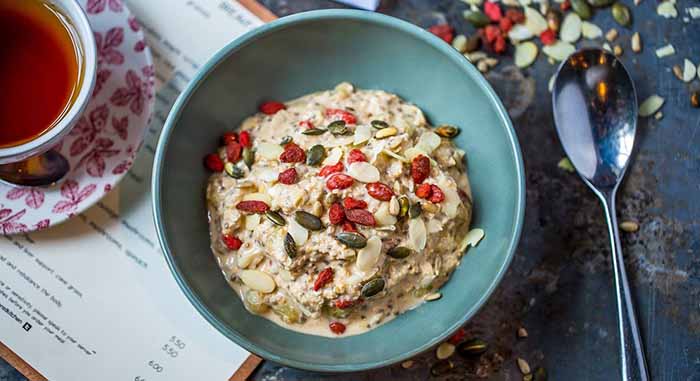
    Bowl Of Oatmeal With Goji Berries & Nuts
    [8] The practice of boiling grains is at least 32,000 years old (photo © Gordon Ramsay Group).
     
    ________________

    *A food staple is a food that makes up the dominant part of a population’s diet. They are eaten regularly—some are eaten daily—and supply a major proportion of the populations’ energy and nutritional needs. Cassava, maize, plantains, potatoes, rice, sorghum, soybeans, sweet potatoes, wheat, and yams are some of the leading food crops around the world [source].

    †Central Asia is a region in Asia that stretches from the Caspian Sea in the west to China and Mongolia in the east, and from Afghanistan and Iran in the south to Russia in the north. The region consists of the former Soviet republics of Kazakhstan, Kyrgyzstan, Tajikistan, Turkmenistan, and Uzbekistan.

    East Asia is the eastern region of Asia, which comprises the modern states of China, Japan, Mongolia, North Korea, South Korea, and Taiwan.
     

    CHECK OUT WHAT’S HAPPENING ON OUR HOME PAGE, THENIBBLE.COM.


    Comments off

    Home Dough Frozen Cookie Dough: Great Cookies From Your Freezer

    Are there days when you pace around the kitchen, wanting a special treat—maybe a fresh, warm cookie? But you don’t have the will to bake from scratch, so you keep searching. And then you give up and eat some Nestle’s morsels from the bag or some teaspoons of preserves from the jar? Not satisfying, but it has to do.

    We’ve been there. And even if you can’t relate to this tale, how about this one:

    You keep some packages of Home Dough gourmet frozen, individually shaped cookie dough on hand. Then whether you want just one cookie or an assortment, you just remove the required number from the package.

    Then, melty, gooey, mouthwatering cookies are just 10 minutes away!

    With Home Dough in your freezer, you can easily bake cookies at the last minute: unexpected guests, visiting the neighbors, movie night, or general sweet cravings.
     
     
    TAKE A BITE!

    Home Dough currently has three flavors:

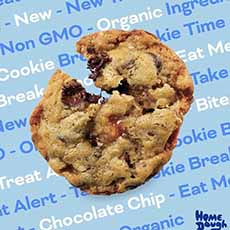
  • Chocolate Chip Cookies (photos #1, #5, and #6)
  • Molasses Ginger Cookies (photo #3)
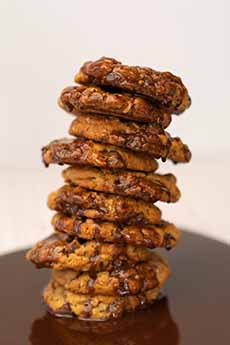
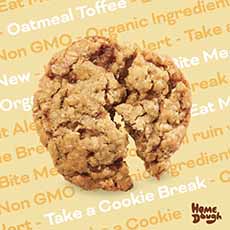
  • Oatmeal Toffee Cookies (photo #4)
  •  
    Each is a delight, with a shout-out to Molasses Ginger because…where can you find a good molasses ginger cookie?

    Gluten-free versions are coming soon.

    Founder Jami Changaris launched Home Dough after spending more than 50 years fine-tuning cookie recipes for her five children and their friends, classmates, teammates, and teachers.

    Because of the high demand, she crafted her cookie dough in balls to be frozen in advance, ready to go into the oven whenever cookies called.

    Unlike refrigerated, store-bought cookie doughs, Home Dough is preservative-free (that’s why it needs to be frozen).

    Why is it “gourmet” cookie dough?

    All of the ingredients are first-class: all-natural, mostly organic, and Non-GMO Project Verified.

    All that’s left is for you lay in a store of them. The bags of eight ready-to-bake dough balls don’t take up much space in the freezer, so there’s no reason to wait.

    > ORDER YOUR HOME DOUGH TODAY.<

    And consider sending a variety pack to your favorite cookie-lover!
     
     
    > The history of cookies.

    > 30 cookie holidays to celebrate below.
     
     
    THE HISTORY OF FROZEN COOKIE DOUGH

    The idea to sell refrigerated cookie dough was born in the 1950s, an era time when women were largely homemakers who made almost all of the family’s food from scratch.

    Nestlé and Pillsbury introduced the first commercially-available premade cookie dough in supermarkets [source].

    Nestle sold refrigerated logs of chocolate chip cookie dough, and Pillsbury Slice ‘N Bake Cookies were launched in four flavors: Butterscotch Nut, Crunchy Peanut, Sugar Cookie, and Toasted Coconut.

    Otis Spunkmeyer introduced retail frozen cookie dough to grocery stores in 1990 (previously it was available commercially to foodservice operations) [source].

    Don’t Eat Raw Cookie Dough

    Whether packaged or home-made, Americans learned to love to eat raw cookie dough.

    But eating raw cookie dough can pose a serious health risk, namely the foodborne illnesses of salmonella and E. coli, which can arise from uncooked flour and eggs.

    The U.S. Food and Drug Administration (FDA) strongly discourages the consumption of all food products containing raw eggs or raw flour, and Home Dough includes the warning on its bags of dough.

    So tempting though it is, don’t eat untreated cookie dough in its uncooked state.

    Yes, there are brands of edible cookie dough—including the chunks added to ice cream—that avoid these hazards by using pasteurized eggs and heat-treated flour.
     
     
    COOKIE HOLIDAYS

    Brownies and other bar cookies are included in this list. Bars are cookies because they are eaten with the fingers, as opposed to cake, which requires a fork.

  • January 6: National Shortbread Day
  • January 16: National Fig Newton Day
  • January 22: National Blonde Brownie Day
  • February 8: National Molasses Bar Day
  • March 18: National Lacy Oatmeal Cookie Day
  • April 9: National Chinese Almond Cookie Day
  • April 30: National Oatmeal Cookie Day
  • May 9: National Butterscotch Brownie Day
  • May 15: National Chocolate Chip Day
  • May 31: National Macaroon Day
  • June 5: National Gingerbread Day
  • June 12: National Peanut Butter Cookie Day
  • June 26: Maine Whoopie Pie Day
  • July 1: National Gingersnap Day
  • July 3: National Chocolate Wafer Day
  • July 9: National Sugar Cookie Day
  • July 20: National Fortune Cookie Day
  • August: National Brownies at Brunch Month
  • August 10: National S’mores Day
  • August 26: National Bake It Yourself Day
  • September 14: National Black And White Cookie Day
  • September 29: National Biscotti Day
  • October: National Cookie Month
  • October 1: National Homemade Cookie Day
  • October 15: National Lemon Bar Day
  • November 21: National Gingerbread Cookie Day
  • December First Full Week: National Cookie Cutter Week
  • December 4: National Cookie Day
  • December 8: National Brownie Day
  • December 22: National Cookie Exchange Day
  •  


    [1] Fresh from the oven: a stack of chocolate chip cookies (all photos © Home Dough).


    [2] Keep the packages in the freezer until you’re ready for a warm, aromatic cookie.


    [3] We were thrilled with Molasses Spice, a cookie flavor often overlooked.


    [4] Oatmeal Toffee is a nice switch from the conventional Oatmeal Raisin cookie.


    [5] America’s favorite cookie flavor: Chocolate Chip.


    [6] In just 10 minutes, frozen balls of cookie dough become irresistible snacks.


    [7] A stack of all three flavors. Bring on the milk!


    CHECK OUT WHAT’S HAPPENING ON OUR HOME PAGE, THENIBBLE.COM.


    Comments off


    © Copyright 2005-2026 Lifestyle Direct, Inc. All rights reserved. All images are copyrighted to their respective owners.