|

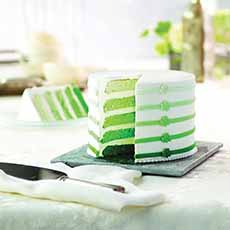
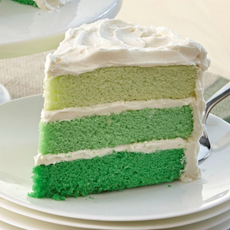
[1] It may look formidable with 5 colored layers and fondant icing, but here’s the recipe if you’re up for the challenge (photos #1 and #3 © Wilton).
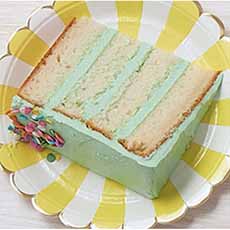
[2] Making just three layers with stabilized whipped cream frosting is much easier. Here’s the recipe (photo © McCormick) .
[3] Easier still: a simple layer cake (two layers or more) with green buttercream frosting.
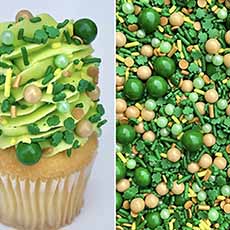
[4] Green buttercream frosting plus themed sprinkles make any cake or cupcake holiday-ready. We found these sprinkles on Amazon (photo © Man Vs. Cakes).
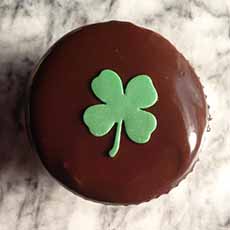
[5] Chocolate ganache icing offset by a shamrock for a St. Patrick’s Day cupcake (photo © Georgetown Cupcake).
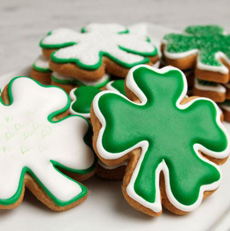
[6] Royal icing hardens to a shine, and is popularly used to decorate cookies (photo © Eleni’s Cookies).
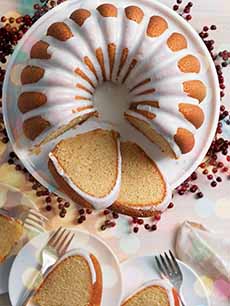
[7] A lemon bundt cake with lemon icing. Here’s the recipe (photo © King Arthur Baking).
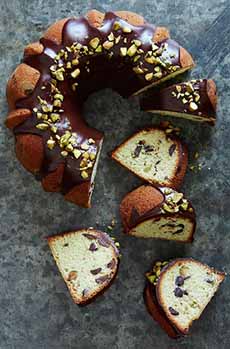
[8] A chocolate glaze on a pistachio chocolate chip pound cake. Here’s the recipe (photo © King Arthur Baking).
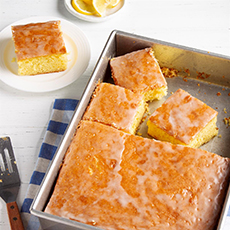
[9] A lemon cake made with a box mix, with a thin lemon glaze. Here’s the recipe (photo © Taste Of Home) .
|
|
Do you have the energy to take on a five-layer ombre cake for St. Patrick’s Day? If so, here’s the recipe (photo #1). But there are other ways to make a cake…or a cupcake…or a cookie, to celebrate the occasion.
As we looked at our collection of recipes, we realized this was a good occasion to discuss frosting versus icing. So many online articles and recipes just get it wrong.
The words icing and frosting are used interchangeably, which is not correct, typically by calling frosting by the name of icing.
But check this out, and you’ll know better. Also, see the footnote* below.
> Here’s a source of recipes for many of these cake toppings.
But the big challenge is deciding exactly which frosting, icing, or glaze you want on your cake.
The history of confectioners or powdered sugar, which enabled the first icings, is below.
FROSTING VS. ICING VS. GLAZE: THE DIFFERENCES
1.WHAT IS FROSTING?
Frosting is made with granulated sugar (table sugar), while icing is made with confectioners sugar*.
Frosting is typically thicker than icing.
Frosting is fluffy and can be used to fill cakes in addition to frost them.
Different types of frosting include:
Buttercream frosting or American buttercream: (photos #3 and #4) Made with sugar, butter or other fat (margarine, shortening) and vanilla or other extract. Substituting brown sugar creates brown sugar frosting (sometimes called penuche frosting).
Cooked frosting: Cream or milk is simmering with flour until thickened, then cooled and blend with creamed butter and sugar.
Cream cheese frosting: Cream cheese is added to basic buttercream ingredients of butter, sugar, and vanilla; the cream cheese provides a bit of a tang. It’s become the go-to frosting for carrot cake and red velvet cakes.
Ermine frosting: Also known as boiled frosting or flour buttercream, ermine buttercream cooks flour with sugar and milk, then blends the flour-thickened milk with butter and sugar (no eggs). It tastes similar to cream cheese frosting although it does not contain cream cheese [source].
Foam Frosting: A meringue of whipped egg whites combined with a flavored syrup added (marshmallow is popular, as are chocolate and vanilla). The result is soft and fluffy.
French buttercream frosting: Similar to custard or pastry cream, it’s made with pasteurized egg yolks (instead of egg whites like Italian and Swiss versions) and sugar. This makes the taste particularly rich and creamy, while still staying light in texture. Like most “foreign” buttercreams, it’s not as sweet as traditional American buttercream.
Fudge frosting: A buttercream with added cocoa powder, more complex recipes use both butter and shortening, plus corn syrup, for a thicker result.
German meringue buttercream frosting: Here’s a custard-based buttercream with egg yolks (à la French buttercream), that also adds cooked flour (à la ermine buttercream). It’s very rich and smooth, and is also less sweet than American buttercream.
Italian meringue buttercream frosting: The style is similar to Swiss meringue buttercream but in different proportions. As with the Swiss version, here the egg whites lighten the texture, but the Italian version is a bit sturdier.
Meringue frosting: a thick, fluffy, and marshmallow-y frosting made with egg whites, sugar, corn syrup, and a bit of water.
Swiss meringue buttercream frosting: This style is made with standard buttercream ingredients plus cooked egg whites to lighten the texture. The egg white is whipped into a meringue, but, as opposed to the Italian version, it’s whisked over a bain marie (double boiler) with sugar instead of using a hot sugar syrup. It’s silkier and typically less sweet than American buttercream.
Vegan buttercream frosting: Made with vegan butter, sugar, almond or soy milk and vanilla extract.
Whipped cream frosting: (photo #2) For frosting, stabilized whipped cream is used. It’s regular whipped cream with added gelatin. Chantilly cream or crème Chantilly is whipped cream with up to twice as much sugar. It is used as a frosting and a filling.
2. WHAT IS ICING?
Icing is made with confectioners sugar (also called icing sugar and 10x sugar).
Icing is glossy: It has more shine and a smoother consistency than frosting.
Icing is generally not spreadable like frosting. It tends to set quickly and harden when dry. It needs to be poured, spooned, or drizzled over the baked good.
Icing is thicker than glaze.
Icing types include:
Cookie icing: A product typically purchased in a bottle with a nozzle that makes cookie decoration easier than from-scratch royal icing. It doesn’t dry as hard as royal icing does, so it’s great for spreading over cookies or piping designs into wet icing.
Flat icing or water icing: The basic, made with confectioners sugar and water. Sometimes called glacé icing.
Boiled icing: Made by gradually pouring a hot sugar syrup over stiffly beaten egg whites.
Fondant: (photo #1) Simply sugar and water, with either glucose or cream of tartar used to produce the proper crystallization to give it a smooth, almost porcelain look. Rolled fondant has the consistency of Play-Doh, and is rolled into thin sheets and draped over the cake to give a flawless finish. It is most often used on wedding cakes and other fancy cakes as a smooth covering. Rolled fondant is much thicker than poured fondant, a liquid cake icing that’s poured over cakes to create a glossy finish.
Ganache: (photo #5) A blend of chocolate stirred into simmering cream. A basic recipe is equal parts of each; for a thicker recipe, two parts of chocolate are mixed with one part cream.
Royal icing: (photo #6) Also called decorator’s icing, royal icing is flat icing with added raw egg whites that dries extra-hard (brittle) and shiny. Often used to decorate fancy cookies, used primarily for decorative additions to cakes and sugar sculptures.
3. WHAT IS GLAZE?
Glazes are thinner, more watery versions of flat icings with additional confectioners sugar; the consistency is “drippable.”
The first ones were transparent coatings for baked products, to give them shine and protect them from drying out, thus extending the shelf life.
Flavors were subsequently added via fruit juice instead of water (photo #9), and some versions were made thicker with melted chocolate, gelatin, or additional fat (photos #7 and #8).
Glazes are brushed or poured over cakes and pastries, but don’t harden like icing.
A glaze will sink into the cake or pastry, flavoring it.
Glazes are usually made with a fruit flavor, e.g. lemon or orange glaze on a pound cake. Chocolate and coffee are also popular.
Glazes can be made in a variety of consistencies, from thick to thin. These dry in varying degrees of stiffness, so a thick glaze made with extra sugar can cause a shell on the surface of the cake.
Some different types of glaze:
Chocolate ganache glaze: (photo #8) A version of the chocolate ganache icing that varies the chocolate-to-cream ratio so as to be pourable over cakes. When you see beautiful chocolate drip effects, it is likely chocolate ganache glaze.
Mirror glaze: White chocolate, condensed milk, glucose syrup, and gelatine combine to create an extra-shiny gloss.
________________
*Note that some bakers will substitute confectioners sugar in a frosting recipe and call it icing. Is it or isn’t it? If it comes out fluffy and spreadable, then it’s frosting, not icing. Some recipes, like this brown sugar frosting, use brown sugar and confectioners sugar.
|
THE HISTORY OF CONFECTIONERS SUGAR / POWDERED SUGAR & ICING
Sugar cane has been around for millennia; the cane juice was widely used in India and China from the 4th century B.C.E. Refined sugar appears around 500 B.C.E., when residents of what is now India determined how to crystallize the juice into granulated sugar by boiling it down. Here’s more of the history of sugar cane and granulated sugar.
Confectioners sugar, also known as powdered sugar and 10x sugar (because it is milled 10 times smaller than granulated sugar), came later.
In the colonial period, both refined white sugar and brown sugar were commercially available in the shape of cones or loaves. The cane juice was boiled down into a thick, crystalline syrup, and poured into cone- or loaf-shaped molds to harden (here’s an illustration).
The cones or loaves had to be broken down with a hammer and chisel. For the dining room and tea table, you needed to nip the sugar into neat lumps with sugar nippers (like tongs—here’s a photo) to reduce to usable pieces [source 5].
The cone-shaped sugar loaf was common until the later 19th century. Today, piloncillo and other types of unrefined sugar are still sold in cones.
When powdered sugar was called for in a recipe, the cook had to use a mortar and pestle or a spice mill, to grind it from pieces of the loaf.
The earliest form of powdered sugar, used from the 16th century to the 18th century, was sugar that was grated from the loaves or cones—the way that sugar was sold in that period—and sifted.
Sugar was grated for use in recipes (sugar bowls contained lumps, as in “one lump or two?”), but the grated sugar could then be sifted. The finest grains that fell through the sieve were the first form of powdered sugar [source 1].
The earliest known appearance of the verb “to ice,” referring to cakes, dates from around 1600; the noun “icing” dates from 1683 [source 2].
In all likelihood, the term derived from the blanket of white grains of powdered sugar topping a cake, looking like wintery ice.
Covering cakes with powdered sugar or other decoration seems to have been introduced in the 17th century. According to one source, the first documented record of frosting or icing appears around 1655, made with eggs, sugar, and rosewater. The icing was applied to the cake then hardened in the oven. The frosted wedding cake appeared about 100 years later [source 3].
One source claims that the word “frosting” comes later, in 1750 [source 2]—doubtlessly, the vision of winter frost led to the name.
Yet a third reference [source 3] says that the first published recipe for frosting is found in The Experienced English Housekeeper by Elizabeth Raffald, published in 1769. However, this source further notes, frosting is thought to have been around a least 200 years before the publication.
Tired of using that mallet and tongs to break down the sugar cone? In the 1800s, grocery stores had portable mills to grind lumps of sugar into granules [source 4].
With the advent of the Industrial Revolution (1760-1840) came machine-milled granulated sugar. Powdered sugar, similar to what is available today, was available to the confectionery industry by the end of the 18th century.
As the technology for processing sugar advanced, powdered sugar became affordable to home cooks in the 19th century. It became easy to create icings for cakes [source 1].
Buttercream came later. The first buttercream frosting was made in Germany in 1915 [source 3].
CHECK OUT WHAT’S HAPPENING ON OUR HOME PAGE, THENIBBLE.COM.
|