|

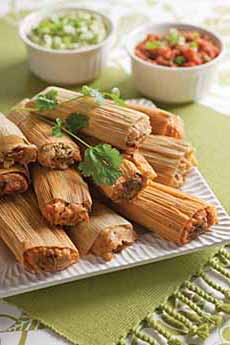
[1] You can have these tamales shipped to you: Beef Tenderloin, Ancho Chile Pork, and Chicken Tomatillo (photo © Mackenzie Limited).
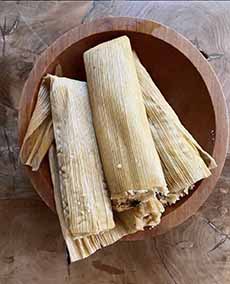
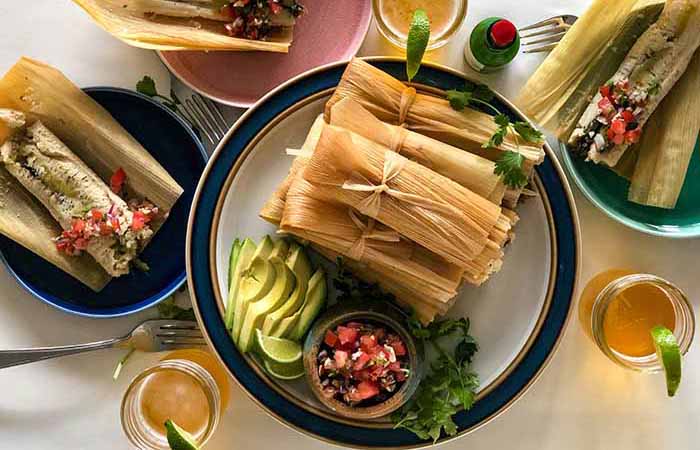
[2] The masa filling is wrapped in a corn husk or banana leaf. In a pinch, in the old days, even tree bark was used (photo © Broken Spanish | Los Angeles).
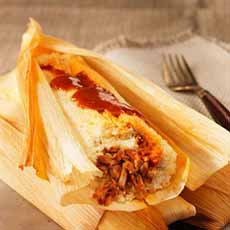
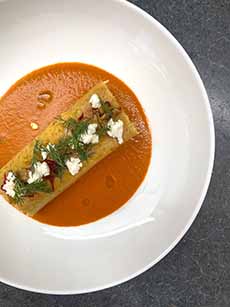
[3] Open the husk and savor the aroma. These pork tamales with red chile guajillo sauce are among the most popular varieties (photos #3 and #4 © Allen Brothers).
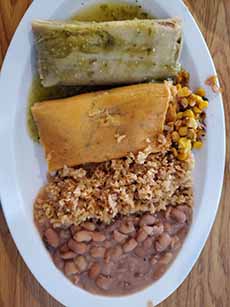
[4] A chicken tamale with a side of green mole sauce.
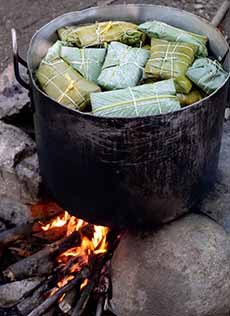
[5] Cooking tamales old-school (today we personally use the microwave (photo © Adolfo Teran Teller | CC0 Public Domain).
[6] Two vegan tamales at CDT Cocina in Fresno, California (photo © Kat D. via Yelp).
[7] Chicken poblano tamale from CDT Cocina in Fresno, California (photo © CDC Cocina).
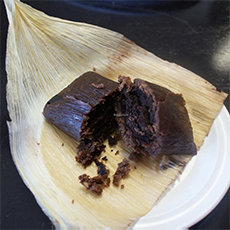
[8] A chocolate tamale from CDT Cocina in Fresno, California (photo via Happy Cow).
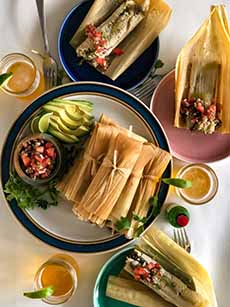
[9] What’s for dinner? Tamales (photo © Andy Hay | Unsplash)!
[10] “Gourmet” tamales at an upscale Mexican restaurant (photo © Broken Spanish | Facebook) .
|
|
March 23rd is National Tamale Day, and if we had to pick, tamales might be our favorite Mexican food. And what an ancient food it is! Tamales originated in Mesoamerica as early as 8000 to 5000 B.C.E. The history of tamales follows, but first:
What exactly is a tamale? It’s a firm dough filling of masa, which is nixtamalized corn*. The ground masa is mixed with water, and other ingredients can be mixed in or used as toppings (photos #3 and #4).
The masa is then wrapped in corn husks (or banana leaves) and steamed.
In fact, the tamale gets its name from the word tamalli, a Náhuatl (Aztec language) word meaning wrapped.
Language lesson: Tamales is plural. One is a tamal in Spanish, although we Americans call it a tamale.
Below:
> Basic tamales: an introduction.
> The history of tamales.
> Tamales today: modern fillings including vegetarian, vegan, and dessert.
Elsewhere on The Nibble:
> The year’s 25+ Mexican and Tex-Mex food holidays.
> The top 10 most Googled foods in the U.S. (Mexican is #2).
Plus:
> How to reheat tamales.
TAMALE FILLINGS
Beans, cheeses, fish and seafood, meat and poultry, vegetables, chiles, herbs, and spices—just about anything that suits the tastes of the cook and her family.
Pork tamales with red chile sauce are one of the most popular, but beef, black beans, and chicken are also menu favorites.
Different types of sauces are typically served with tamales—enchilada sauce, green and red chile sauces, mole, or whatever the cook wants to pair with the particular filling.
Other toppings are those used for much Mexican and Tex/Mex cuisine: cotija/queso fresco, guacamole, marinated onions, pickled jalapeños, pico de gallo and other salsas, sour cream, and queso.
There are also tamales dulces, sweet tamales. These are made with masa tinted pink with vegetable coloring. The most common recipe simply adds sugar and raisins to the masa.
But sweet tamales can be made with berries and other fruits, chocolate, and many fillings accented with anise seed, cinnamon, or other sweet spices.
Filling types can vary from family to family and from region to region.
Both the filling and the cooking liquid of tamales may be seasoned (source).
> Check out some modern-style tamale fillings below.
THE HISTORY OF TAMALES
Tamales were the first dish made from corn in Mesoamerica. Evidence of tamales dates back to the ancient civilizations of [what is now] Mexico, as early as 8000 B.C.E. but certainly by 5000 B.C.E. This makes them one of the oldest known prepared foods in the Americas.
Although the exact beginnings are not known for certain, many historians believe that tamales were first made by the Aztecs. In the millennia preceding cookware, tamales were cooked over hot ashes in a buried fire.
Tamales are thus thought to predate the tortilla, which requires a griddle.
In the pre-Columbian era, Aztecs filled their tamales with whatever foods were available: beans, fish, flamingo, frog, fruits, gopher, honey, rabbit, salamander, turkey, turkey eggs, and squash [source]. Sometimes the masa was eaten plain, with no added filling.
The Aztec and Maya civilizations, as well as the Olmec and Toltec before them, valued tamales as easily portable food. They ate them at the home hearth, of course, but also packed them for hunting trips, for traveling, and for their armies.
Maize was the most important food source in Mesoamerica, and still is a large part of the Central American diet in the form of tamales and tortillas.
Tamales were also considered sacred, the food of the gods. Tamales played a large part in rituals and festivals, offered as religious sacrifices.
For thousands of years, the Mayans worshiped the maize god, Hun Hunahpu. According to the Maya creation story, mankind was actually created from maize dough [source].
Aztec, Maya, Olmeca, and Tolteca civilizations all considered themselves to be “people of the corn.” Corn still plays an important religious and spiritual role in the lives of the Maya people.
Enter The Spanish
When the Spanish conquistadors reached Mexico in the early 1500s, they brought new ingredients like pork, lard, olives, and raisins, which were incorporated into tamale fillings.
They also brought pots and pans, and steaming the husk-wrapped tamale packets became a more reliable method of cooking.
They also documented tamale-making in indigenous communities, showing its deep cultural roots. Over time, tamales evolved differently in various regions:
Mexico: Tamales vary by state, with common fillings including pork, chicken, mole, and cheese.
Guatemala: Guatemalan tamales are often larger and wrapped in banana leaves, sometimes including rice in the masa.
South America: In places like Venezuela (hallacas) and Peru (humitas), tamales take on different names and styles, sometimes incorporating local ingredients.
Later, tamales became a key part of Tex-Mex and Mexican-American cuisine, especially in the southwestern U.S. before spreading nationwide.
Tamales Head North Of The Border
Tamales were first brought to the U.S. in the 19th century, primarily through Mexican migration and cultural exchange—and much earlier in territories that were part of Mexico, such as Arizona, California, New Mexico, and Texas.
The U.S. annexed these parts of Mexico following the Mexican-American War (1846–1848).
From the late 19th to early 20th centuries, tamales gained popularity beyond Mexican communities.
One historian writes that tamales entered the country in 1948, with U.S. soldiers returning from the Mexican American War.
Around the 1890s, Mexicans came to the Southwest for agriculture, mining, and other work, bringing their tamales with them.
The tasty, convenient, and affordable food spread across the southern states. In the Mississippi Delta, African American food vendors sold a unique Delta-style hot tamale, believed to have arrived with Mexican migrants who came to pick cotton[source].
In the early 1900s in major cities from San Antonio and Los Angels to Chicago and beyond, tamales were sold by street vendors, often in pushcarts. The “Tamale Man” became a common sight in urban areas [source].
In the latter half of the 20th century, Mexican cuisine moved to the northern part of the U.S. Thankfully, there are tamales for everyone, every day!
TAMALES TODAY
With the movement towards more plant-based foods, vegetarian and vegan tamales are on the rise. The menu at CDC Cocina (formerly Casa de Tomales) in Fresno, California features:
The Classics
Chicken Tomatillo, with green sauce, served with roasted corn salsa on the side.
Creamy Chicken Poblano, with potatoes and casero† cheese, stuffed in jalapeño masa and topped with creamy tomatillo sauce.
New Mexico Pork, with red sauce and grilled pineapple salsa.
Fusion Flavors
Smoked Brisket & Black Garlic: Toss shredded smoked brisket in a sauce made from rehydrated ancho chiles and fermented black garlic. Add a tablespoon of miso paste to your lard/shortening when whipping the masa. It deepens the corn flavor significantly.
Sweet & Spicy Shrimp: Sauté shrimp briefly in a miso-honey butter with red pepper flakes and ginger. Use a lighter oil (like avocado oil) instead of lard. It will let the delicate seafood flavor shine.
Nuevo Goat Cheese: Cut aged goat cheese (chèvre) into carrot stick-width slices, and pair with strips of roasted poblano peppers (or jarred pimentos). Sprinkle with a pinch of dried culinary lavender or a drizzle of lavender or thyme honey. Add a handful of fresh corn kernels to the masa for great texture.
Blackberry Cheesecake: Beyond the classic dessert tamales (tamales dulces) like pineapple and raisin, blend sweetened whipped cream with blackberry purée. Infuse the water for the masa with chai spices (cardamom, cinnamon, clove, and black tea).
|
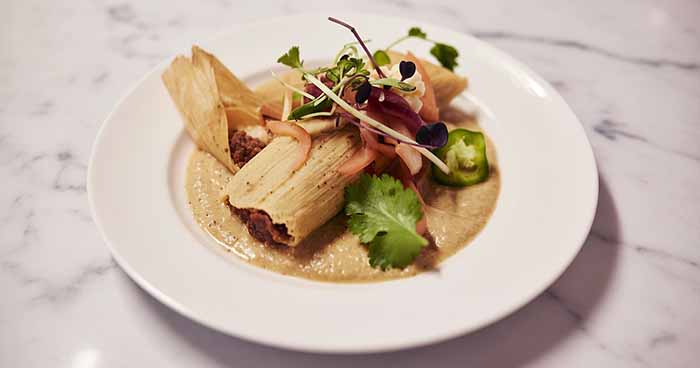
[11] Think beyond the cantina and plate your tamales like a top chef. Here, a beef tamale rests atop green chile sauce, garnished with a slice of jalapeño and cilantro leaves and microgreens (photo Niman Ranch | Facebook).
More Ideas
Crunch: Add toasted pepitas or sunflower seeds to any filling.
Crema: Serve with a side of crema infused with the brightness of calamansi or yuzu (lime works, too). The tartness brightens the flavors of the fillings.
Masa: Use blue or purple corn.
Seasonality: In the fall, for example, blend pumpkin puree with cinnamon, nutmeg, cloves, and ginger. As a dessert tamale, serve it with a scoop of vanilla ice cream garnished with crumbled graham crackers. Here’s a recipe.
Vegetarian Tamales
Blueberry & Cream Cheese, filled with fresh blueberries, stuffed in blueberry masa, and topped with whipped cream.
Jalapeño & Cheese, topped with tomatillo sauce, stuffed in a red chile masa.
Savory Sweet Corn, topped with green tomatillo sauce, casero† cheese, fresh avocado, and cream.
Sweet Corn, topped with chipotle honey.
Vegan Tamales
Farmers Market, a mix of carrots, kale, cauliflower, and zucchini, topped with tomatillo sauce.
Portobello, Asparagus & Broccoli, sautéed with guajillo chiles, filled in red chile masa, and served with corn salsa.
Spinach & Artichoke, with potatoes, in a creamy vegan sauce, in a red chile masa, served with roasted corn.
Beyond National Tamale Day, consider yourself inspired to create tamales any day of the year.
[12] The feast begins! Happy National Tamale Day (photo © Andy Hay | Unsplash).
________________
*Nixtamalization is a process that prepares the maize/corn, in which the grain is soaked and boiled in an alkaline solution, usually limewater (calcium hydroxide), and hulled. The nixtamalized corn becomes softer and more flavorful, and when ground, the masa or dough has binding properties that make for great corn tortillas or tamales. Nixtamalization provides several nutritional benefits including increased bioavailability of vitamin B3 niacin, which reduces the risk of pellagra disease. It also engenders increased calcium intake, due to its absorption by the kernels during the steeping process [source 1][source 2].
†Casero cheese is a queso fresco, a soft, moist, crumbly, fresh cheese.
CHECK OUT WHAT’S HAPPENING ON OUR HOME PAGE, THENIBBLE.COM.
|