|
The Hatch Chile Festival, celebrating the famous Hatch green chile (photo #2), is held annually in Hatch, New Mexico on Labor Day weekend, (in 2025, August 30th-31st). It’s a major event for chile lovers, attracting up to 30,000 people each year.
If you have FOMO (fear of missing out), there are plenty of recipes you can make at home—in fact, you’ve got time to schedule a Hatch Chile Potluck for Labor Day Weekend.
You can feast on everything and anything and everything from Hatch Bloody Marys, New Mexican stews and casseroles, and “Hatched” chocolate chip cookies and more.
So have your own festival! Hatch-based foods are great company for burgers, franks, steaks, corn, and other traditional Labor Day fare.
Recipes. You can search for recipes online or purchase and download Melissa’s Hatch Chile Cookbook here here (photo #6).
You can find the hardcover version on Amazon.
And there are dozens of free Hatch pepper recipes on Melissa’s website (see photos #9 through #13 for starters).
Hatch Products. You can buy fresh Hatch chiles from Melissa’s, too, and other online purveyors. Check your local specialty stores in August and September. We’ve even found them at Costco, and markets nationwide have Hatch roasts in their parking lots (and sell the fresh chiles).
Melissa’s also sells Organic Hatch Pepper Polenta, Hatch Salsa, Hatch Pepper Avocado Salsa, Hatch Pecans, and more spicy stuff.
And there are plenty of Hatch salsas, chile powders, and whole roasted canned chiles available on Amazon and elsewhere.
Below:
> What are Hatch chiles.
> The history of Hatch chiles.
> Why chiles are called peppers.
> Recipe: Tres Leches Bread Pudding With Hatch Chiles.
> The year’s 12 hot and spicy food holidays.
> The year’s 24 pudding holidays.
Elsewhere on The Nibble:
> The history of chile peppers.
> The different types of chiles: a photo glossary.
> The year’s chile pepper holidays.
> The history of bread pudding.
> The history of Tres Leches Cake.
ABOUT HATCH CHILES
Celebrated for their smoky, earthy, and slightly sweet flavor, green Hatch chiles are celebrated fresh roasted in late August and September.
The green chiles (photo #2) are also diced and frozen for year-round sales. Whole, ripe, red Hatch chiles (photo #5) are dried and available year-round. They’re also ground into Hatch chile powder.
Hatch chile season typically runs from early August through late September, with some variation depending on the weather and growing conditions in southern New Mexico. The peak harvest is mid-August to early September.
Fresh Hatch chiles are often available in markets across the Southwest and increasingly nationwide—especially during August when many grocery stores hold roasting events. You can stock up and freeze them for the rest of the year.
Hatch chiles can be hotter, milder, or the same heat level as jalapeños. The heat varies greatly depending on the specific variety, ranging from mild (around 1,000 Scoville Heat Units [SHU] to quite hot (up to 8,000 SHU or more—jalapeños typically range from 2,500 to 8,000 SHU).
There’s more about them below.
RECIPE: TRES LECHES BREAD PUDDING WITH HATCH CHILES
Here’s a different spin on that creamy comfort food, bread pudding. The recipe contains Hatch chiles, grown in the Hatch Valley of New Mexico, where the unique soil and climate create their signature flavor. (If you can’t find fresh Hatch chiles, substitute frozen or dried red Hatch chiles.)
Prep time is 15 minutes and bake time is 1 hour.
The bread pudding uses bolillo, Mexico’s most popular bread (photo #3). If you can’t find good bolillos and don’t want to bake your own, substitute French bread (baguette or batard) or Italian bread. Brioche or challah may be too rich and eggy for this recipe, and white sandwich bread is too soft.
Whatever bread you use, for best results it should be day-old/slightly stale. In this state the bread absorbs the custard better without getting mushy.
For a planned celebration, National Bread Pudding Day on November 13th, May 1st is Bread Pudding Recipe Exchange Day, and May 1st-7th is Bread Pudding Recipe Exchange Week. See all the pudding holidays below.
Many thanks to Melissa’s for the recipe. As specialty produce purveors, they have many custom recipes to make with their fruits and vegetables.
For a photo of the inspiration for this recipe, see photo #8, Tres Leches Cake.
Ingredients For 8-10 Servings
4 bolillos, torn into bite-sized pieces
1 can (12 ounces) evaporated milk
1 can (14 ounces) sweetened condensed milk
1 cup heavy cream
3 Hatch chile peppers, peeled and seeded
8 eggs
1 teaspoon ground cinnamon
½ cup sugar
Optional garnish: strawberries, raspberries, or a mix
For The Tres Leches Topping
1 cup evaporated milk
1 cup sweetened condensed milk
1 cup heavy cream
2 Hatch peppers, peeled and seeded
Preparation
1. PREHEAT the oven to 350°F.
2. COMBINE in a blender the Hatch chiles, evaporated milk, and condensed milk. Blend until smooth. Strain into a large bowl.
3. ADD the heavy cream, eggs, ground cinnamon, and sugar. Whisk until fully incorporated.
4. LAYER the torn bolillo pieces into a baking dish. Pour the Hatch chile custard mixture over the bread and let soak for 10 minutes.
5. PLACE the baking dish in a water bath and bake for 1 hour.
6. MAKE the topping: Blend the evaporated milk, condensed milk, and Hatch chiles until smooth. Strain into a saucepan and stir in the heavy cream. Bring to a simmer, then remove from the heat.
7. POUR the warm topping over the bread pudding immediately after removing it from the oven. Let it soak in before serving warm. Garnish as desired.
THE HISTORY OF HATCH CHILES
Hatch chiles, a type of New Mexican chile pepper, are named after the growing area of Hatch, New Mexico. It’s in southern New Mexico in the Mesilla Valley, just north of Las Cruces.
The valley, which stretches along the Rio Grande’s southernmost bend before crossing into Texas and Mexico, is covered with row after row of green, leafy Hatch chile plants for most of the summer.
Every year, after the harvest, there are formal and informal Hatch chile festivals, the big one taking place in Hatch itself over Labor Day Weekend.
In towns throughout New Mexico, the aroma of roasted chiles fills the air, along with the sounds of the Hatch chiles popping and crackling as they roast in propane-powered roasters.
They’re roasted in grocery store parking lots, on street corners and seemingly everywhere and just about everyone enjoys the seasonal treat.
Experts say that the intense sunlight, hot days and cool nights in the valley result in a uniquely flavored chile.
Hatch chiles are descended from chiles cultivated for thousands of years in Central and South America.
Capsicum annuum‡ was domesticated in Mexico at least 6,000 years ago. It is the most widely cultivated and economically important species of the Capsicum genus, and includes popular peppers like Anaheim, banana, bell, Hungarian Wax peppers, jalapeños, cayenne, paprika, pimiento, poblano peppers, serrano, shishito, and many others.
Spanish settlers and missionaries brought chile seeds northward into the American Southwest in the late 1500s. There, the Pueblo peoples and other Native American groups were already cultivating and adapting chiles to the arid climate.
Modern Cultivation
The modern Hatch chile developed in the late 1800s to early 1900s. Mexico’s Mesilla Valley, which includes the village of Hatch, became a fertile region for chile cultivation due to its hot days, cool nights, and volcanic soil.
In the period from 1907 to 1921 Dr. Fabián García, a horticulturist at New Mexico State University (then called New Mexico College of Agriculture and Mechanical Arts), began to selectively breed chile peppers to create uniform, thick-walled, and flavorful peppers as a crop for local farmers. His NuMex No. 9 variety, released in 1913, is considered the ancestor of modern Hatch chiles.
Later in the 20th century, additional NuMex (for New Mexico) varieties were developed for flavor, size, and heat. These included:
NuMex Big Jim, mild heat and extra-large pods.
NuMex Sandia, medium-hot, often used for red chile powder.
NuMex Joe E. Parker, a versatile roasting chile.
Hatch, New Mexico became the center of commercial chile production, and the term “Hatch chile” evolved as a regional brand—it’s not a single botanical variety.
Thus, “Hatch chile” refers to any New Mexican-style chiles grown in the Hatch Valley, rather than to one specific cultivar.
Hatch Chiles Become Hot (i.e., Popular)
The annual Hatch Chile Festival, begun in the 1970s, helped to popularize the chile pepper nationwide.
The concept of a Hatch chile roast spread nationwide, with roasting events held in grocery store parking lots across the U.S. in late summer.
Thus was Hatch chile season turned into an American culinary ritual.
THE YEAR’S 12 SPICY FOOD HOLIDAYS
There is no Hatch Chile Day (yet), but here are 14 chile pepper holidays.
So we’re taking this opportunity to presenting the 12 hot and spicy food holidays.
January 14: National Hot Pastrami Sandwich Day
January 16: International Hot and Spicy Food Day
January 22: National Hot Sauce Day
May: National Salsa Month
May 6: National Salsa Day
July: National Horseradish Month
August 2: National Jamaican Patty Day
October, 2nd Week: National Curry Week
November: National Pepper Month
November 8: Cook Something Bold & Pungent Day
November 14: National Spicy Guacamole Day
November 15: National Spicy Hermit Cookie Day
For more heat, check out the 11 ginger-related holidays.
THE YEAR’S 24 PUDDING HOLIDAYS
While there is a National Bread Pudding Day on November 13th, and two more bread pudding holidays in May, we’re taking this opportunity to present all the pudding holidays. We like to plan ahead!
> Here’s how American pudding is different from British pudding. Both types listed.
> Have a pudding party! Here’s how to set up a pudding buffet.
January 23: International Sticky Toffee Pudding Day
February, 1st Sunday: British Yorkshire Pudding Day*
February 12: National Plum Pudding Day
April 3: National Chocolate Mousse Day
April 3: National Frozen Custard Day
May: National Chocolate Custard Month
May 1: Bread Pudding Recipe Exchange Day
May 1-7: Bread Pudding Recipe Exchange Week
May 3: National Chocolate Custard Day
May 22: National Vanilla Pudding Day
June 26: National Chocolate Pudding Day
June 28: National Tapioca Day†
July 15: National Tapioca Pudding Day†
July 27: National Crème Brûlée Day
August 9: National Rice Pudding Day
August 27: National Pots De Creme Day
September 19: National Butterscotch Pudding Day
October 3: National Caramel Custard Day
October 13: National Yorkshire Pudding Day*
November: Banana Pudding Lovers Month
November 9: British Pudding Day
November 13: National Bread Pudding Day
November 13: National Indian Pudding Day
November 30: National Mousse Day
|
|

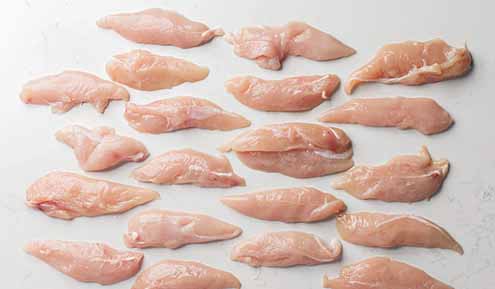
[1] Hatch bread pudding, adding a kick to a creamy comfort food. The recipe is below (photos #1, #2, #4, #6, and #9 through #13 © Melissa’s Produce).
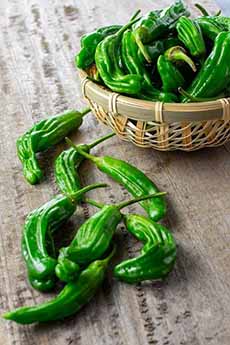
[2] Fresh, green Hatch chiles. When left to ripen, they produce sweeter red chiles (see photo #5).
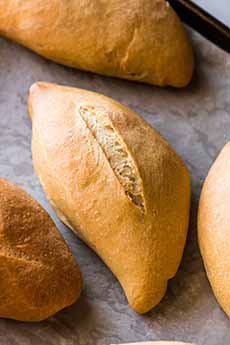
[3] A bolillo (boh-LEE-yoh) is a crusty white oblong roll. The flavor is very similar to a baguette: the outside crusty and chewy while the inside is soft and fluffy. It’s used for tortas (sandwiches) and everything else. Here’s a recipe to bake your own (photo © Isabel Eats).

[4] A Hatch chile pizza with fresh basil. You can add pepperoni, too. Here’s the recipe.
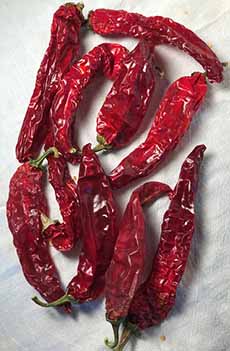
[5] Dried Red Hatch Chiles are available year-round. They’re also ground into Hatch chile powder (photo © Otis Acres Micro Farm).

[6] You can purchase and download the cookbook here, or buy a hardcover copy on Amazon.
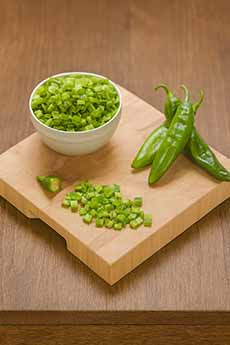
[7] Dice Hatch chiles for fresh salsa. Here’s a recipe (photo © Hatch Chile Store—check out their Hatch chile products).
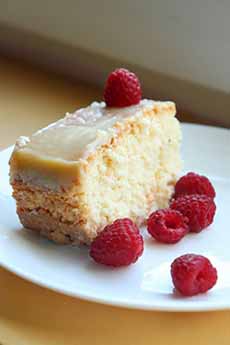
[8] A slice of Tres Leches Cake, which is made with three milks: condensed, sweetened condensed, and whole milk (photo © Ivana M. | Unsplash).
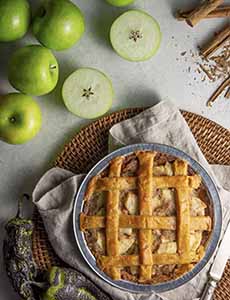
[9] How about a slice of Hatch chile apple pie? Here’s the recipe.
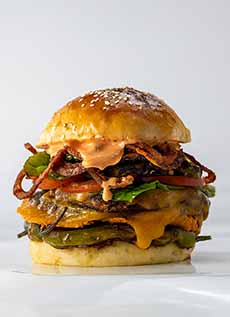
[10] A plant-based burger deluxe with Hatch chiles (substitute your patty of choice). Here’s the recipe.
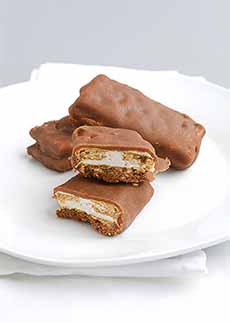
[11] Food fun: Hatch chile s’mores. Here’s the recipe.
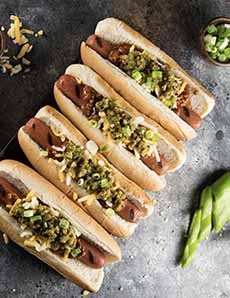
[12] Hatch chile pepper dogs. Here’s the recipe.
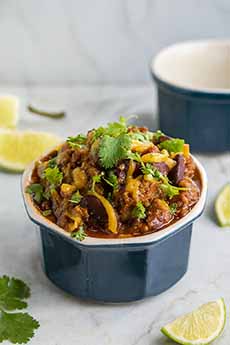
[13] Last but not least: Hatch chile! You can also add some Hatch salsa to the optional sour cream topping. Here’s the recipe.
|
WHY CHILES ARE CALLED PEPPERS
Chiles were “discovered” in the Caribbean by Christopher Columbus, who called them “peppers” (pimientos in Spanish) because of their fiery similarity to the black peppercorns he was familiar with—although there is no botanical relationship between the two plants, or with the Szechuan pepper.
That’s why calling chiles “peppers” is a misnomer. The term “pepper” (pimiento) is not used to describe them in the Spanish language.
But that’s why chiles are called peppers by many Americans. (The Nibble calls them either chiles or chile peppers [so people who only call them peppers can relate], and we only use “peppers” when referring to bell peppers.)
The Aztec (Nahuatl language) word is chilli, which the Spanish spelled chile.
The British spelling “chilli” results from how the word traveled from Spanish to English and was influenced by English spelling conventions of the 17th–19th centuries.
So why do Americans call their dish chili instead of chile?
In 19th‑century Texas and the Southwest, the Mexican “chile con carne” became “chili con carne” in cookbooks and newspapers. Reasons given include that “chile” could be read as Chile, the country.
By the late 1800s, “Texas chili” was a distinct American frontier dish. The Anglicized “chili” reinforced it as a local specialty rather than just referring to the Spanish chile pepper.
If you want a bit more chile history:
The first chiles were brought to Spain in 1493 by Diego Álvarez Chanca, a physician on Columbus’ second voyage to the West Indies. He first wrote about their medicinal effects in 1494. From Europe, chiles spread rapidly to India, China, and Japan.
In Europe, they first were grown in the monastery gardens of Spain and Portugal as botanical curiosities, but the monks experimented with their culinary potential and discovered that their pungency offered an inexpensive substitute for black peppercorns.
Peppercorns, imported from southeast Asia, were so costly that they were used as legal currency in some countries!
What we call “heat” or ”fire” of the chile is known in the industry as the pungency level. The pungency is the result of both the plant’s genetics and the environment in which it grows. Although plant breeders can produce a chile with a certain amount of relative heat by varying water amounts and temperature levels, genetic control is not yet fully understood.
The heat is due to capsaicin, an alkaloid, and four related chemicals, collectively called capsaicinoids. Each capsaicinoid has a different effect on the mouth, and variation in the proportions of these chemical is responsible for the differing sensations produced by different varieties.
Capsaicin causes pain and inflammation if consumed to excess, and can even burn the skin on contact in high concentrations (habaneros, for example, are routinely picked with gloves). It is also the primary ingredient in pepper spray.
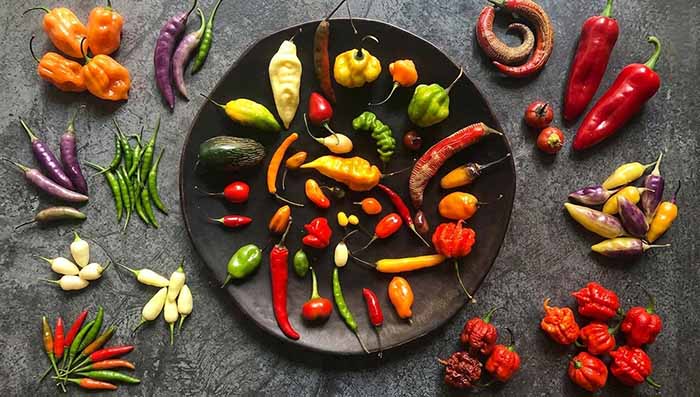
[14] So many chiles, so little time (photo Honey Badger | Brooklyn | Gemini).
________________
*There are two Yorkshire Pudding holidays. British Yorkshire Pudding Day is observed each year in the United Kingdom on the first Sunday in February. National Yorkshire Pudding Day on October 13 was begun in the U.S. and is recognized in North America and elsewhere.
†Why two tapioca holidays? June 28th is a broader National Tapioca Day celebration, July 15th celebrates tapioca pudding specifically. There’s no clear explanation for why there are two similar days so close to each other.
Other uses for tapioca: Tapioca is a popular gluten-free flour substitute used in baking, creating chewy textures in bread. It helps to bind ingredients as a thickening agent for gravies, sauces, and soups.
Cassava flatbreads and crackers are dietary staples in many Caribbean and South American countries. Brazilian is known for its savory and sweet tapioca crêpes, beiju de tapioca. Various Asian noodles and crispy snacks are made from tapioca starch.
The cassava root vegetable can be boiled, fried, or roasted as a potato substitute. These culinary uses, along with industrial uses, make tapioca one of the most versatile plants.
‡The other significant species of Capsicum include Capsicum frutescens, known for small, pungent chiles (bird’s eye, Tabasco, Thai), Capsicum chinense, an extremely hot species (Carolina Reaper, ghost pepper, Habanero, Scotch bonnet), and Capsicum baccatum, chiles with fruity flavors, best known for the aji amarillo.
CHECK OUT WHAT’S HAPPENING ON OUR HOME PAGE, THENIBBLE.COM.
|