THE NIBBLE BLOG: Products, Recipes & Trends In Specialty Foods


Also visit our main website, TheNibble.com.

New Zero Sugar Oreo Cookies: They Taste Just As Delish

A Package Of Zero Sugar Oreos
[1] If you’ve given up your beloved Oreos to cut back on sugar, there’s a new Zero Sugar Oreo waiting for you (all photos © Mondelez except as noted).

An Oreo Zero Sugar Cookie
[3] Look closely: The cookie says “Zero Sugar.”

Oreos With Peanut Butter
[3] Add some protein to your snack: Spread a layer of peanut butter on top of the creme center (photo © Peanut Butter & Co).

Chocolate Layer Cake With Oreo Filling
[4] With a sugar-free cake mix, you can make this Oreo layer cake. Or, mix big chunks of crushed Oreos into sugar-free ice cream for an Oreo ice cream cake. Here’s the recipe (Abacus Photo).

Zero Sugar Oreos With A Glass Of Milk
[5] Grab a glass of milk and take a break.

A glass of Oreo milk with Oreo cookies
[6] Oreo milk. Drink it, or use it to make the best Oreo ice cream. Here’s the recipe (photo © Kate The Baker).


Oreos, the most popular packaged cookie in America, has innovated often with special flavors and the ability to design your own Oreos. But we’re most excited about this innovation:

After four years in development, Mondelez, the parent company of Oreos, has just launched Zero Sugar Oreos.

In both Original and Double Stuf Zero Sugar varieties, they will be available permanently nationwide.

Finally!

Current food trends point to consumers’ desire for “mindful indulgence”:

  • 66% of Americans are reportedly trying to limit sugars in their diet in 2024 [source: Statista].
  • 75% say they are trying to limit or avoid sugars in their diet [source: International Food Information Council].
  • Only 25% say they are not trying to limit or avoid sugar in their diet.
  •  
    Details follow; but first, elsewhere on The Nibble:

    > The history of Oreos.

    > The history of cookies.

    > The year’s 44 cookie holidays. (National Oreo Day is March 6th.)

    > The 10 basic styles of cookies (Oreo is a sandwich cookie).

    > The different varieties of of cookies: a photo glossary.

    > Recipes with Oreos.
     
     
    THE SKINNY ON ZERO SUGAR OREOS
     
    Or, as Oreo says, here’s “a quick dunk in the details.”

    Oreo Zero Sugar Cookies:

  • Taste just as good as the originals. Most people won’t notice a difference‡.
  • The non-caloric sweetener blend is a skillful combination of maltitol, polydextrose, sucralose, and acesulfame potassium (Ace-K). It’s aspartame free (see the different types of non-caloric sweeteners).
  • They’re individually packaged for grab and go and portion control. There are two cookies in a packet (total 90 calories).
  • A bag of 20 cookies, 10 packets, has a MSRP of $5.29.
  •  
    Calorie Comparison

  • One sugar-free Oreo has about 45 calories and zero sugar.
  • A regular Oreo cookie is about 53 calories but 4.6 grams of sugar, about the equivalent of a teaspoon.
  •  
    > If you can’t find Zero Sugar locally, you can order them online.
     
     
    THE U.S. COOKIE MARKETPLACE

    Oreos are by far the most popular packaged cookie in the U.S., with 19% of the cookie market share. That equates to more than $675 million in annual revenue. And it doesn’t include sales in the rest of the world!

    Americans consume a staggering amount of cookies—billions of pounds annually. Cookies are one of the most popular snack foods in the U.S.

    According to Virtue Market Research, Americans consume more 2 billion cookies annually—that’s roughly 300 cookies per person!

    How can that be? Well…according to Mintel, more than 1 in 10 Americans consume cookies multiple times daily.

    The average American eats 26 cookies during the holiday season alone [source].

    Top 10 brands or brand groups in the U.S. based on market share and sales:

  • Oreo: 19% market share (Nabisco/Mondelēz International)
  • Chips Ahoy: 11% market share (Mondelēz International)
  • Milano (Pepperidge Farm/The Campbell Soup Company)
  • Nutter Butter (Nabisco/Mondelēz International)
  • Nilla Wafers (Nabisco/Mondelēz International)
  • Fudge Stripes (Keebler/The Ferrero Group)
  • Famous Amos (Kellogg’s/The Ferrero Group
  • Chewy Chips Ahoy (counted separately, Mondelēz International)
  • Little Debbie (McKee Foods)
  • Keebler Sandies (Keebler/The Ferrero Group)
  •  
    Runners up include:

  • Girl Scout Cookies* (Girl Scouts USA), Pepperidge Farm Chessmen (Pepperidge Farm/The Campbell Soup Company), Vienna Fingers (Keebler/The Ferrero Group, and Lorna Doone (Nabisco/Mondelēz International).
  •  
    Despite the dominance of big brands like these, homemade cookies (especially chocolate chip) remain deeply tied to American cookie culture.
     
     
    What About Homemade Cookies?

    According to the American Baking Association, 9 in 10 Americans—nearly 300 million people—bake cookies at Christmastime, and 83% make homemade cookies† throughout the year. And those who bake don’t consume more cookies:

    Research has found that people who bake cookies from scratch consume 10% fewer cookies throughout the day than those who did not bake any, but were offered the already-baked cookies [source].
     
     
    Cookie Triva
     
    The American English word “cookie” comes from the Dutch “koekje” (KOOK-ya), meaning “little cake.”

  • The British use the term “biscuits” (derived from Latin) for what Americans call cookies.
  • What Americans call biscuits, Brits call scones—which are not equivalent to American biscuits.
  • Brits don’t serve a basket of biscuits, rolls, or other breads with meals. Rather, bread and butter or plain rolls are served with appropriate foods (e.g. a bowl of soup, meat with gravy), and there’s toast with butter and jam for breakfast.
  • The rich variety of American biscuits developed outside of the British culinary tradition. The different types of American biscuits.
  •  
    Oreos & A Cup Of Coffee
    [7] You can’t eat the whole stack, but a two-cookie packet with black coffee is a 90-calorie snack. Add a shot of milk for another 18 calories.
    ________________

    *Girl Scout Cookies collectively generate about $800 million annually, but are only sold January through April. They are owned by the Girl Scouts of the USA (GSUSA), a non-profit organization, but are commercially produced under license by two main baking companies. The Girl Scout cookie program is uniquely American and has become a cultural institution, with people having fierce loyalty to specific varieties and waiting eagerly for cookie season to arrive each year.

    Baked-from-scratch cookies are a lower percentage than more convenient options like prepared cookie doughs and mixes.

    Die-hard Oreo consumers: Don’t quibble over this if you do taste a difference. We taste food for a living, have a wine writer’s palate, and detected nothing artificial with Zero Sugar vis-a-vis standard Oreos.


    CHECK OUT WHAT’S HAPPENING ON OUR HOME PAGE, THENIBBLE.COM.


    Comments off

    Who Wouldn’t Celebrate National Champagne & French Fries Day?

     
    National Champagne and French Fries Day, January 10th, is holiday celebrated by a wine blogger* to celebrate what she determined to be the perfect pairing of bubbly white wine and salty French fries.

    Why?

    The acidity and bubbles of dry Champagne cut through the richness of the fried potatoes, cleansing the palate. Here’s where to start:

    Pair Dry: Dry, crisp sparkling wines work better than sweeter styles; although of the latter is your preference, go for it!

    Don’t Stress: Champagne is pricey, so substitute a different dry, crisp, sparkling wine. You’ll enjoy it just as much (and maybe even more, if the toasty quality of Champagne is not your thing):

  • Asti Spumante, Moscato d’Asti*, or Prosecco from Italy.
  • Cava from Spain.
  • Crémant from France.
  • Espumante from Portugal.
  • MCC from South Africa‡.
  • Sekt from Germany.
  • Sparkling wines from Austria, England, New Zealand, South Africa, the U.S. and other countries.
  •  
     
    TYPES OF FRIES

    If you’d like something different than standard julienne fries, try:

  • Truffle fries
  • Parmesan fries
  • Purple potato fries
  • Sweet potato fries
  •  
    The history of Champagne follows. Elsewhere on The Nibble, you’ll find related content:
     
    > The different styles of Champagne.

    > The different types of fries: a photo glossary.

    > The history of Champagne is below.

    > The different types of Champagne.

    > The history of the Champagne resealer/recorker.

    > The year’s 9+ Champagne and other bubbly holidays.

    > The year’s 30 potato holidays.

    > The history of toasting to your health.
     
     
    THE HISTORY OF CHAMPAGNE

    Vineyards have existed in the Champagne region since Roman times, sometime between the 1st to 5th centuries C.E. The name of the region actually derives from the Latin Campania, a region in southern Italy (Naples is its capital).

    In Roman times it was called Campania felix. They bestowed the name on the French region because of its physical resemblance to Campania in Italia (which remains the country’s name today).

    So the Romans had vineyards and made wine, but it was still (i.e. not sparkling) wine. Bubbly didn’t appear for another 1,600 years,

    Just about every story of the history of Champagne cites Dom Pérignon as its “inventor” (although based on chemistry, it likely invented itself). The truth may lie elsewhere.

    Dom Pérignon (1638-1715) was a Benedictine monk and cellar master at the Abbey of Hautvillers in Champagne. He actually spent much of his career trying to prevent bubbles in wine, as they were seen as a flaw at the time.

    However, on August 4, 1693, his is credited with having tasted a bottle and called to his brothers, “Come quickly, I am drinking the stars.”

    This much is true: Dom Pérignon made an huge contribution by developing the technique that finally produced a successful white wine from red wine grapes—something vintners had been trying to accomplish for years.

    For this a major step toward the development of the modern Champagne technique, credit is due. He also improved blending techniques, and took a cue from the English by using stronger bottles (so they wouldn’t explode under the pressure of the wine inside) and cork stoppers (to stop leakage and keep the bubbles in).

    Sparkling wine certainly existed before Dom Pérignon accidentally came aross it, although its earliest forms would be not bear a resemblance to Champagne.
     
     
    The English Were First!

    The English were actually producing sparkling wine from Champagne grapes before the French were intentionally making it bubbly. The English market preferred sweeter, sparkling wines and were deliberately creating them decades before the French.

    How did the English make sparkling wine?

    They imported still wine in barrels from Champagne. The wine would be bottled, often while fermentation was still incomplete or dormant due to cold weather during transport.

    Then, the necessary secondary fermentation took place. The English would sometimes add sugar (see third bullet below) and the wine would re-ferment in the bottle, creating carbonation.

  • English bottle-makers had coal-fired furnaces that could produce stronger glass bottles capable of withstanding the pressure of carbonation.
  • They had access to quality cork stoppers via Portuguese trade routes, that sealed the bottles properly (prior to then, wood stoppers and wax were used).
  • In 1662, Christopher Merret, an English physician and scientist presented a paper to the Royal Society describing how to add sugar to wine to make it sparkle—essentially inventing the méthode champenoise, still used today.
  •  
    The history continues below.

       
    Champagne & French Fries
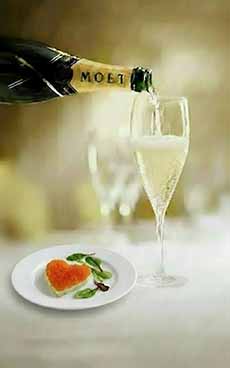
    [1] A tulip glass of Champagne with a side of julienne fries: perfect for today’s celebration (Abacus Photo).

    Pommes Paille (Straw Potatoes)
    [2] The most elegant fries are pommes paille (straw potatoes), the thinnest cut. Here’s the recipe (photo © Recipe Tin Eats).

    Rose Champagne
    [3] If you prefer rosé Champagne, by all means use it in your pairing (photo © Bureau du Champagne USA | Facebook).

    French Fries In A Silver Bowl
    [4] Regular fries look special in a fancy bowl (photo © Strip House | Las Vegas).

    Sweet Potato Fries With Dipping Sauce
    [5] Sweet potato fries are a tasty option (photo © Good Eggs).

    A Vineyard In Champagne
    [6] A vineyard in Champagne (photo © Comité Champagne).

    Champagne & French Fries
    [7] Are you ready to celebrate (Abacus Photo)?
     
     
    The 18th & 19th Centuries

    By the early 1700s, winemakers in Champagne realized that bubbles in wine were desirable, not a defect.

  • Great houses of Champagne (grandes marques) emerged during this period. Ruinart (1729), Moët & Chandon (1743), Lanson (1760), Veuve Clicquot (1772), and Louis Roederer (1776) established the foundation of the modern Champagne industry.
  • Madame Clicquot (Barbe Nicole Clicquot Ponsardin) of Veuve Clicquot revolutionized the industry in 1816 by inventing the riddling table (remuage). This allowed sediment to be removed from bottles, producing a clear Champagne that was more appealing to consumers.
  • By the 19th century, Champagne had become synonymous with luxury and celebration. In the 1830s, the precise measurement of the dosage (adding sugar after disgorgement) by pharmacist Jean-Baptiste François allowed Champagne houses to tailor sweetness levels to different markets (the British preferred theirs dry, the Russians preferred theirs sweet, e.g.).
  • In the 1860s, phylloxera, a vine disease that devastated European vineyards, decimated the vineyards of Champagne. The vineyards were subsequently replanted with American rootstocks. The new vines required three years to mature before producing fruit of high enough quality for winemaking.
  •  
     
    The 20th Century

  • Both World Wars devastated Champagne; the region became a battlefield in World War I. The famous chalk cellars served as bomb shelters. Despite this, houses like Pol Roger were able to maintain production.
  • In 1941, the Appellation d’Origine Contrôlée (AOC) system gave Champagne protected status, strictly defining where Champagne could be produced and how it must be made. Then, only sparkling wines from the Champagne region, made using the traditional method, could legally be called “Champagne.” However, Champagne houses continue to vigorously defend their name against producers of sparkling wine elsewhere who try to use the term.
  • As with other industries, the late 20th century saw major consolidation, with luxury conglomerates like LVMH acquiring multiple champagne houses (Dom Pérignon/Moët & Chandon, Krug, Veuve Clicquot), turning what had been grower-producers (vignerons) into a global luxury brands.
  •  
     
    The 21st Century

    The Champagne region produces roughly 300 million bottles annually, and maintains its position as the world’s most prestigious sparkling wine.

    While France remains the largest consumer, export markets continue to grow. The U.S. is a major market, and emerging markets in Asia are increasingly important.

    There’s increased consumer interest in small-producer Champagnes (noted as Récoltant-Manipulant or RM on labels), similar to the artisan/craft movement in other industries.

    Many houses are pursuing organic and biodynamic viticulture, with some aiming for carbon neutrality.

    The main challenge faced by the industry is climate change. While it has benefited Champagne from the standpoint of more consistent ripening, though warmer temperatures may cause the wines to lose their signature acidity and elegance in future decades.

    __________________

    *The holiday was created by wine blogger Anna Maria Kambourakis of Unravelling Wine, and friend Kleopatra Bright. It’s one of her favorite pairings, and the date is her birthday. (What holiday would you like to create for yours? See if it already exists.)

    Asti Spumante and Moscato d’Asti: the difference. Both wines hail from the area around the town of Asti in Piedmont, in northwest Italy. Both wines have the DOCG classification. Both have an alcohol by volume (A.B.V.) of 5.5% (11 proof). To put that into perspective, the average bottle of wine has 12% A.B.V. (24 proof). For this reason, both are good choices for light drinkers.

    Asti Spumante has lower, residual sugar but often seems sweeter than the Moscato d’Asti because great care is taken in the harvest and production so the sweet, sugary taste dominates the pronounced fruity Muscat character of the grape. Asti Spumante is made with the Charmat method: After the first fermentation, the wine undergoes a second fermentation in a sealed tank where the bubbles are created. The fermentation therefore takes longer than the fermentation of the Moscato d’Asti, which results in the lower residual sugar content [source].

    With Moscato d’Asti, the grapes are immediately pressed when harvested. The juice is then filtered and stored in a cool place, and fermentation is only done when there is a wholesale demand for the wine (this way best preserves the fresh and fruity flavors and aromas). Fermentation takes place in a closed tank so that the carbon dioxide cannot escape and the wine gets its bubbles. When the wine has reached 5.5% alcohol, the fermentation is stopped by cooling, but part of the sugars in the grapes have not yet fermented. This is how Moscato gets its natural sweetness.

    MCC, or Méthode Cap Classique, is South Africa’s premium sparkling wine, made using the traditional French Champagne method.


    CHECK OUT WHAT’S HAPPENING ON OUR HOME PAGE, THENIBBLE.COM.


    Comments off

    Bergamot Oranges For Lovers Of Earl Grey Tea

     
    January is National Citrus Month, a good time to introduce you to a different citrus.

    If you’re an Earl Grey tea drinker, you may know about the bergamot orange, a Sicilian orange whose peel gives that special aroma and flavor to the tea.

    The oranges are in season through the end of this month—a chance for you to get hold of some if you’re inclined.

    Below you’ll find:

    > An overview of bergamot oranges.

    > How to use the juice and rind.

    > Where to buy bergamots.

    > The history of bergamot oranges.
     
     
    Elsewhere on The Nibble:

    > The year’s 13 orange and mandarin holidays.

    > The difference between oranges and mandarins.

    > The history of oranges.

    > The history of Earl Grey tea.

    > The history of tea.

    > The different types of tea: a photo glossary.

    > The year’s 23 tea holidays.
     
     
    AN INTRODUCTION TO BERGAMOT ORANGES

    Bergamot oranges are quite distinct from oranges that are eaten. They’re inedible as fresh fruit, notable for being extremely sour and bitter.

    The size of a small oranges, they can be globular (round) or have a slightly ovoid (pear-like) shape. Their rind is smooth and turns from green (photo #2) to yellow (photos #1 and #3) when ripe. They never turn bright orange.

    They grow on bushy trees that can reach up to 10 feet in height (photo #4).

    Some 90% of the world output is grown in Calabria, a peninsula at the foot of the Italian mainland, due to its ideal microclimate. Small amounts are grown elsewhere, including California.

    They’re relatively juicy and low in seeds, but the most in-demand part of the fruit is the rind, or zest, which is bursting with aromatic oils (the very oils used to flavor Earl Grey).

    The oil contains unique compounds that give it that distinctive floral notes mixed with slightly spicy citrus undertones.

    In fact, the oil is so highly regarded that it received a Protected Designation Of Origin (PDO, DOP) in 2001 to protect the standard of quality of the oil from Calabria, Italy.

    The rind can be dried and added to homemade tea blends. But there’s more to be done with the bergamot:

  • The zest and juice can add delicate flavor to baked goods like shortbread, biscuits and scones.
  • The flesh and rind are ideal for making marmalade.
  • The aromatic oil is widely used in soaps, perfumery and cosmetics, as well as in aromatherapy for stress relief and promoting well-being.
  •  
     
    USING THE JUICE & ZEST OF BERGAMOTS

    While you can’t eat the flesh of the bergamot, you can use its juice and zest to great effect, with its unique, citrusy, floral aroma.

  • Beverages. cocktails, homemade lemonades, hot and iced tea, spritzes, and syrups.
  • Condiments: flavored sugars or salts, jams and marmalades, marinades (for fish or chicken), mayonnaise, vinaigrettes.
  • Baking and Desserts: biscuits, cakes, custards, cookies, ice cream, muffins, puddings, and scones.
  •  
    Squeeze it onto avocados, citrus salad, creamy pastas, guacamole, roasted vegetables, and seafood (including sashimi/sushi), along with fresh herbs like basil, dill, and tarragon. Use it as a substitute for vinegar.

    Like all citrus, the juice balances richness by cutting through fats in creamy dishes or fried foods; lifts dull or flat flavors; and prevents oxidation (browning) on cut surfaces of fruits .
     
     
    GET YOUR BERGAMOTS!

    Bergamots have a rather short harvesting season, typically from October through February.

    Get yours from Melissa’s Produce.

    The fruits will keep for up to two weeks when stored in the refrigerator.

    You can also squeeze and freeze the juice.
     
     
    THE HISTORY OF THE BERGAMOT ORANGE

    The fragrant citrus fruit, most likely a natural hybrid of a bitter orange (Citrus aurantium) and citron (Citrus medica) or lime, is believed to have originated in Italy’s Calabria region—still the world’s largest producer of bergamots (Citrus bergamia).

    Some sources claim its origin as Southeast Asia, instead. What is currently believed is that, while its parent citrus came from Southeast Asia, the bergamot fruit itself originated as a seedling in Calabria*.

    Citrus species are known for cross-pollinating naturally when grown near each other. If bitter orange trees and lemon trees were growing in proximity in Calabrian orchards or gardens, bees and other pollinators could easily create hybrid seeds without any human intervention.

    If someone planted seeds from fruit that was unknowingly a cross-pollinated hybrid, it grew into a tree with this unusual aromatic fruit. Someone recognized its valuable oil properties and began propagating it through grafting.

       
    Bergamot Oranges
    [1] They may look like lemons, but they’re bergamot oranges (photo © Melissa’s Produce).

    Unripe Bergamot Oranges
    [2] Not-yet-ripe bergamots (Abacus Photo).

    Ripe Bergamot Oranges
    [3] Ripe and ready (Abacus Photo).

    Bergamot Orange Tree
    [4] A bergamot orange tree in Riverside, California (photo © Identification Technology Program).

    Vinaigrette
    [5] Substitute bergamot juice for vinegar in any recipe (vinaigrette photo © Hannah Kaminsky | Bittersweet Blog).

    Grilled Trout With Israeli Couscous
    [6] Squeeze onto seafood, including sushi and sashimi (photo © Society Cafe | New York City).

     
    Of course, it’s possible that Arab traders or Crusaders brought the bergamot to the Mediterranean, but the first records, from Calabria, appear in the 1600s (the 17th century).

    So while we can’t know for certain without historical records, the bergamot was most likely a happy accident of nature…in Calabria.

    For most of its history, bergamot cultivation has been almost exclusive to Calabria due to the unique microclimate.
     
     
    1600s or 1700s?

    The evidence is split between whether Calabria began cultivating bergamots in the 1600s or 1700s. The discrepancy likely reflects the difference between anecdotal presence versus documented cultivation.

    For the 1600s, we know that:

  • In 1676, Paolo Feminis used bergamot oil to create what became the first eau de cologne†.
  • We also know that it was grown as an ornamental in French courts. At Versailles in the 1600s, the Sicilian pastry chef Procopio turned the essence into “bergamot water.”
  •  
    However, this doesn’t mean for certain that the oil came from Calabria.

    On the side of the 1700s:

  • The first European botanical documentation was in 1646 by Giovanni Battista Ferrari, with more detailed illustrations in 1708.
  • Multiple sources mention Venetian traders introducing bergamots to Italy in the early 1700s.
  • The earliest reliable cultivation date found to date is 1750, when Niccolo Parisi planted bergamot in Calabria.
  •  
    Thus, the 1646 botanical documentation by Ferrari suggests bergamot existed somewhere by the mid-1600s, but whether it was already established in Calabria or just being documented elsewhere is unclear.

    While the 1750 date by Niccolo Parisi is described as the “first reliable” planting date, it may be that earlier claims are less well-documented.

    Arguably, bergamot was likely present in Calabria by the late 1600s, with more certain evidence if cultivation by the mid-1700s.
     
     
    What Does “Bergamot” Mean?

    The etymology is a uncertain, but there are two contenders:

  • The Turkish bey armudu, meaning prince’s pear, and possibly referring to the fruit’s pear-like shape.
  • The Italian town of Bergamo, an early trading location for the fruit.
  •  
    A Cup Of Earl Grey Tea
    [ ] A cup of Earl Grey tea. This blend, from Tucson Tea, adds blue cornflower petals. They make the loose tea look pretty, but don’t add flavor.
     
    ________________
     
    *The understanding of plant breeding was rudimentary at best when the bergamot appeared in the early 1700s. Gregor Mendel’s work on heredity didn’t appear until the 1860s. While gardeners knew that plants could be grafted and that seeds sometimes produced interesting variations, deliberate controlled hybridization wasn’t really practiced until the 20th century.

    Many other citrus varieties arose the same way, as chance seedlings that were then preserved through vegetative propagation. The navel orange, for instance, arose as a spontaneous mutation in Brazil in the 1820s, and the Cara Cara orange was first discovered in 1976 growing on a navel orange tree.

    Paolo Feminis (1666-1736) moved from a small northern Italian village near Santa Maria Maggiore to Cologne, Germany, where he invented eau de cologne, using bergamot along with other ingredients like neroli oil, lavender, and rosemary. The formula was later passed on to Giovanni Maria Farina, who refined and commercialized the formula in 1709.
     

    CHECK OUT WHAT’S HAPPENING ON OUR HOME PAGE, THENIBBLE.COM.


    Comments off


    © Copyright 2005-2026 Lifestyle Direct, Inc. All rights reserved. All images are copyrighted to their respective owners.