|
Since it was invented in the 1860s, Eggs Benedict has been a posh addition to the breakfast-lunch-brunch menu. It was created by the chef at a tony New York restaurant, Delmonico’s, for a wealthy customer, Mrs. LeGrand Benedict (here’s the history of Eggs Benedict).
The original recipe topped two toasted English muffin halves with round-cut slices of ham, poached eggs; and Hollandaise sauce. Over the years, the more conveniently-shaped Canadian bacon replaced the trimmed ham.
The ham substitutions continued, gaining momentum among creative chefs in modern times. Why not create your own reinvention of Eggs Benedict for Mother’s Day or other special occasion? Select your options from the ingredients that follow.
Below:
> Eggs Benedict ingredient substitutions.
> The history of brunch.
Elsewhere on The Nibble:
> The history of Eggs Benedict.
> 15 Eggs Benedict recipe variations.
> The different types of eggs: a photo glossary.
> The year’s 10 egg holidays.
EGGS BENEDICT INGREDIENT SUBSTITUTES
Instead Of The English Muffin
Brioche (photo #5)
Buttermilk biscuits
Corn cakes
Croissants
Crumpets
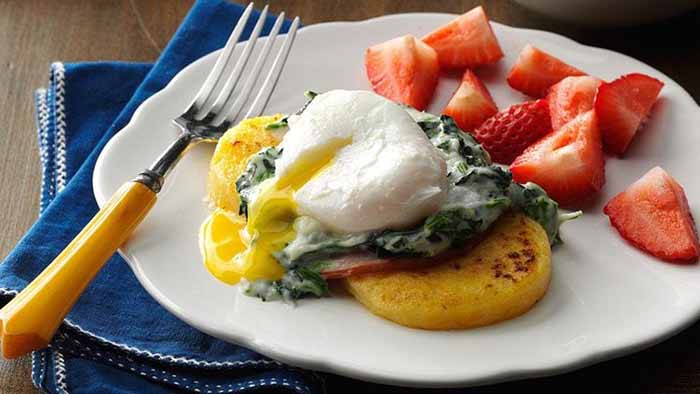
Polenta rounds (photo #6)
Popovers
Portabello mushrooms (recipe)
Potato pancakes
Rustic country bread
Waffles
Whole wheat English muffins
Note: You need a type of bread that will soak up the egg yolk. Pita, for example, doesn’t work here. Steer clear of regular pancakes and waffles. They take what should be an elegant dish to McGriddles territory.
Instead Of The Canadian Bacon Or Ham
Artichoke hearts, asparagus, avocado, broccoli rabe, grilled portabella mushrooms (recipe), grilled tomato slice, creamed or wilted spinach
Corned beef hash (recipe)
Crab cakes (photo #2)
Lobster tail, shrimp, scallops (alone or in combination—photo #5)
Pâté de foie gras
Poached chicken
Poached salmon
Prosciutto or serrano ham
Smoked salmon or gravlax
Steak tartare
What about everyday bacon strips? Eggs Benedict should be a special dish. By all means, serve poached eggs with bacon—just not on an English muffin with Hollandaise sauce.
Similarly, fried eggs, sausage and gravy should remain their fine casual selves, and not be adapted into a Benedict-style variation.
Instead Of The Hollandaise Sauce Substitute
Béchamel Sauce, a white sauce that can be flavored with just about anything (recipe)
Dill Sauce (béchamel with dill or other herb/herb blend)
Mornay Sauce (béchamel with cheese)
Mushroom Sauce
Sriracha-Accented Hollandaise Sauce (spicy)
Truffled Hollandaise Sauce
Consider how you can flavor a basic béchamel to match the ham substitute. For example, add dill to the sauce for lobster, horseradish and lemon zest for crab cakes.
Garnish Options
Chives are the most common garnish, but here’s a more inclusive list:
Baby arugula
Basil, chiffonade
Caviar
Chives, snipped
Microgreens
THE HISTORY OF BRUNCH
The term, a combination of breakfast and lunch, was coined in the U.K. in 1895 to describe “a Sunday meal for Saturday-night carousers.” This first reference in print was an article in Hunter’s Weekly (source).
Brunch eliminated the need to rise early for breakfast. Instead of the conventional post-church early Sunday dinner, the new meal, served around noon, started with a course of toast, marmalade, tea. coffee and other breakfast foods before moving on to some heartier fare.
And the rest is delicious history.
|
|
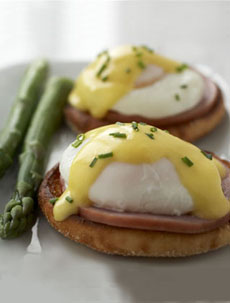
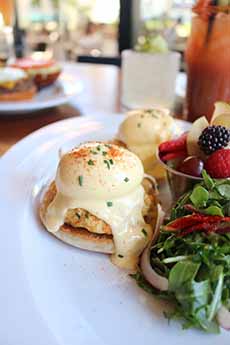
[1] Classic Eggs Benedict: poached egg and Canadian bacon on an English muffin with Hollandaise sauce. (photo © American Egg Board).

[2] Crabcake Eggs Benedict (photo © Ocean Prime | NYC).
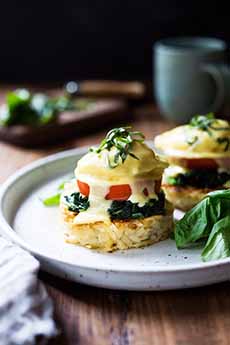
[3] Hash Brown Eggs Benedict: all vegetarian and gluten-free, with a base of hash-brown potatoes instead of the English muffin or other bread. Here’s the recipe (photo © Idaho Potato Council).
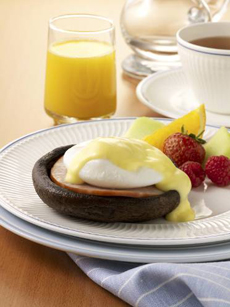
[4] Portabella Eggs Benedict: low carb, with a mushroom base. The recipe is below (photo © Mushroom Council).
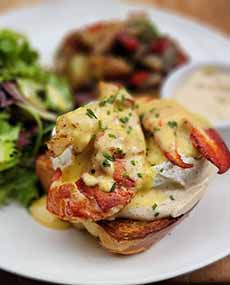
[5] Lobster Eggs Benedict (photo © Raclette | NYC).
|