|
Updated August 2026
Love bananas? According to the USDA, bananas rank #1 among America’s favorite fresh fruit, edging out apples in per-capita consumption. The data further relays that Americans consume nearly 27 pounds per person annually!
August 27th is National Banana Lovers Day, and we’ve created a variety of content from serious (the history of bananas) to fun (banana holidays, banana trivia).
Below:
> America’s favorite banana foods.
> The history of bananas.
> The stages of ripening.
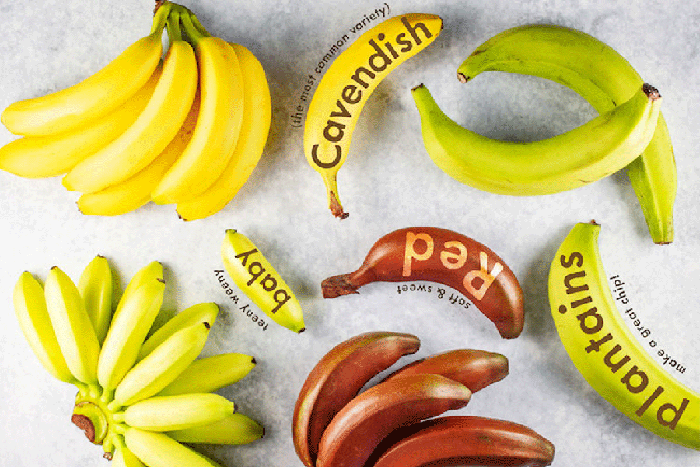
> A photo comparison of the 4 top commercial banana varieties.
> Bananas vs. plantains: the difference.
> The year’s 9+ banana holidays.
> Bananas trivia (they float in water!).

[12] Bananas grow upside down. And these aren’t trees; they’re giant herbs, and the bananas are their berries (photo © The Nibble).
1. AMERICA’S FAVORITE BANANA FOODS
Beyond hand fruit (fruit that’s normally eaten from the hand), here are America’s favorite ways to eat bananas:
Banana bread
Banana pudding
Banana cream pie
Banana topping on cereal
Bananas Foster
Banana pancakes
Banana split
Banana ice cream
Banana smoothies
Banana cupcakes and muffins
Banana chips
Let this be inspiration to whip up some of your favorites.

[13] Grab a Sharpie and have some fun (photo © Creazilla).
2. THE HISTORY OF BANANAS
In The Beginning
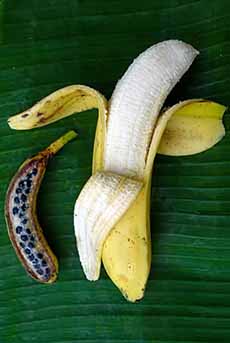
The original, wild, banana was tiny and filled with large seeds the size of peppercorns (photo #4).
Bananas were first domesticated in Southeast Asia and Papua New Guinea, by at least 5000 B.C.E. and possibly as far back as 8000 B.C.E.
It’s thus not surprising that Southeast Asia has the largest diversity of banana species, followed by Africa, indicating a long history of banana cultivation in those regions (source).
Many wild banana species can still be found in China, India and Southeast Asia, in the areas south of China, east of India, west of New Guinea and north of Australia. They require a tropical or sub-tropical climate.
More than a thousand varieties of banana exist worldwide. The vast majority are not cultivated: Their bunches are too small, their skin is too thin, or their pulp is too bland.
But travel around the world and you can find bananas whose skins are bubblegum pink; green-and-white striped bananas with pulp the color of orange sherbet; bananas that, when cooked, taste like strawberries, for starters (photo #5).
Note that many of these varieties are plantains, which are starchy and inedible until cooked (there’s more on plantains below).
The Original Banana
If you haven’t yet looked at the bananas in photo #4, take a look. Would you want to eat the original wild banana?
Over millennia, bananas were bred into the fleshy fruits (botanically, they’re not fruits, but the berries* of herbs) we know today.
Alexander the Great introduced bananas to what is now Western Europe in 327 B.C.E. They were brought back from his campaigns in Asia, including India.
It took centuries after that—around 800 C.E.—for bananas to make their way to the Middle East.
By the 10th century, the banana appears in texts from Palestine and Egypt. From there it diffused into North Africa and Muslim Iberia (southern Spain). During the Medieval Ages, bananas from Granada were considered among the best in the Arab world [source].
[14] This is what the industry calls stage 6 ripeness: full yellow with no green remaining. It’s considered the peak eating stage for those who prefer firm, sweet fruit to the riper, sweeter stage 7. See the different stages of ripeness below (photo © Good Eggs).
Bananas Come To The Americas
Bananas were introduced to the New World in the 16th century via Portuguese sailing ships, which carried them from West Africa to South America.
The fruit’s name comes from a West African language [Wolof, the major language in what is now Senegal] where banan means finger.
In 1870, a Cape Cod fishing-boat captain named Lorenzo Dow Baker imported 160 bunches of bananas from Jamaica to Jersey City, New Jersey: the first bananas in the U.S.
Shopkeepers hung the bunches and cut off the number of bananas requested by the customer.
By 1900 Americans were consuming 15 million bunches of bananas annually; 40 million by 1910.
Twenty years later, Baker’s company was renamed United Fruit, today called Chiquita Brands.
By the 1960s, United Fruit controlled nearly seven hundred million acres of land and 90% of the American banana market.
If you’ve had bananas in other countries and find our American imports to be bland in comparison, that’s because the original species Baker imported, the Gros Michel, has long since been replaced by the Cavendish—a blander variety that travels more easily.
[15] The Gros Michel banana hasn’t disappeared from the planet, just from large-scale commercial production. Smaller farmers still grow it. These are from Hawaii (photo © Farm Link Hawaiʻi).
The Loss Of The Gros Michel Banana
Many thanks to Wayne Ferrebee for much of this information.
Over millennia, farmers hybridized wild species of bananas and selectively bred the different strains into varieties called cultivars.
The most delicious exportable cultivar was Gros Michel (Fat Michael, Musa acuminata AAA)—so ideal for farming, transporting and retailing that it became more than 80% of bananas cultivated worldwide (here’s more about the variety).
A half a century ago, the Gros Michel banana was the principal banana variety imported to the U.S (photo #5, below). They were/are far tastier than the current Cavendish variety: creamier with a tropical fruit taste.
The ripened bananas had a much longer shelf life, and could be sold ripe and ready to eat.
In the 1950s, a blight, the fungus Fusarium oxysporum (“Panama disease”), attacked the Gros Michel banana and wiped out entire plantations in Africa and South America.
All Gros Michel bananas were clones (to achieve desired characteristics and eliminate negative ones, such the seeds—but do not have Darwinian resistance), so the contagion spread unchecked. There were years where there were almost no bananas available to send to Europe, Africa, and the Americas (and worse, to support the local banana workers and others up and down the chain). Entire banana empires turned to rot, and groves needed to be burned to disinfect the soil.
Banana growers re-planted with a new banana variety, the Dwarf‡ Cavendish, which was nowhere near as tasty but was resistant† to the fungus.
Gros Michel ceased being grown commercially. It still grows in its ancestral homeland, Thailand, where it is ubiquitous in home gardens (photo #8). So if you’re going there, eat the bananas! [source]
The Rise Of The Cavendish Banana
The world’s current major banana crop, the Cavendish banana, was grown by a gardener of William Cavendish, 6th Duke of Devonshire, in 1830. He was president of the Royal Horticultural Society.
Using a specimen from a lot sent to the Duke by a colleague in Mauritius, the Duke’s head gardener, Joseph Paxton nurtured it and, five years later, the plant flowered and bore fruit. He named the varietal Musa cavendishii, after the family name of the Dukes of Devonshire, Cavendish. He himself became Sir Joseph Paxton for his contribution to England (the Latin botanical “cavendishii” is now obsolete).
Cavendish plants were sent with missionaries to Samoa and other South Sea islands, the Pacific and the Canary Islands [source].
When the Gros Michel was wiped out, banana growers turned to the Cavendish. It was a smaller and less tasty fruit, but it was immune to the fungus, able to grow in infected soils, and traveled well. Practically all bananas exported to foreign markets were Cavendish.
For decades, practically all bananas exported to foreign markets—China, Europe, North America, etc.—are clones of the first Cavendish plant.
Alas, Panama disease has mutated into a new, deadlier strain (Race IV) that not only kills off the Cavendish, but also numerous local breeds of banana around the world. The world is currently in a banana crisis. You can find more information about it online, starting here.
|
|
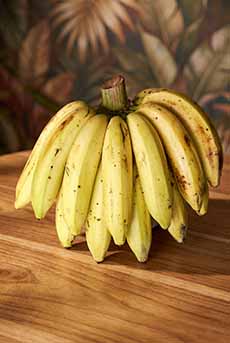
[1] The modern banana we know and love is a variety called the Cavendish (photo © The Nibble).
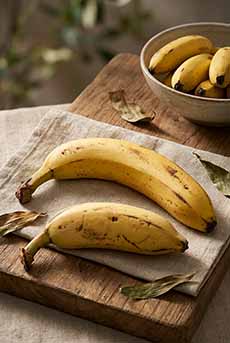
[2] Its predecessor was the more flavorful, longer-shelf-life Gros Michel [Fat Michael] variety. What happened to this superior banana? See below (photo © Bananas.org).
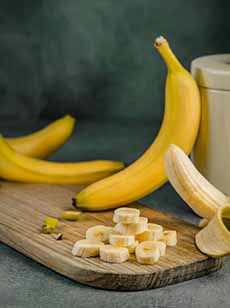
[3] Celebrate National Banana Lovers Day, one of nine banana holidays (photo © Eiliv Aceron | Unsplash).
[4] The original wild banana was very small and filled with large seeds the size of peppercorns—probably not such pleasant eating (photo © A. D’Hont | CIRAD).
[5] The peel is red, but the flesh is the same color as a yellow banana. Alas, bananas in eye-catching colors don’t travel well so few are exported. Tip: When you’re in a foreign country, seek out the local banana varieties (photo © Gardening World).
[6] Harvesting bananas (photo © Simon Maina | Food and Agriculture Organization of the United Nations).
[7] Another comparison of the Cavendish (top) and the Gros Michel. Here’s a story by Ketsanee Seehamongkol, who writes an excellent story on her “discovery” of the Gros Michel (photo The Nibble).
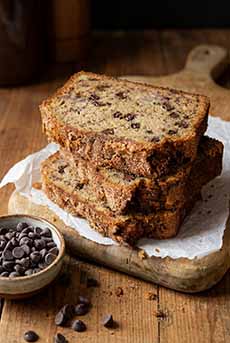
[8] Banana bread is America’s favorite banana dish. This one has a bonus: chocolate chips. Here’s the recipe to enjoy (photo The Nibble).
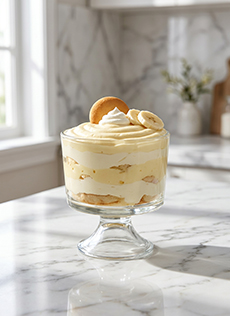
[9] A favorite comfort food: banana pudding with Nilla wafers. Here’s the recipe (photo The Nibble).
[10] Banana cream pie. Here’s the recipe (photo © Taste Of Home).
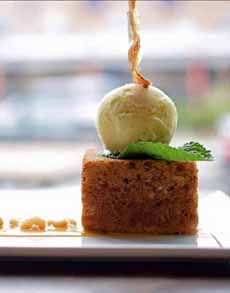
[11] Get as fancy as you like! Take a look at our delicious banana recipes (photo © Good Food On Montford | Charlotte, NC).
|
[16] The stages of banana ripening (chart © Fine Cooking).
3. THE STAGES OF RIPENING
The produce and agricultural industries use an official standardized 7-Stage Banana Ripening Scale (originally developed by the USDA and major fruit distributors like Chiquita and Dole) to track color changes, sugar conversion, and firmness.
Stage 1: Solid Green — Completely unripe, firm, and starchy; ideal for initial shipping and harvesting.
Stage 2: Light Green / Breaking — Traces of yellow begin to appear as the ripening process kicks off.
Stage 3: More Green than Yellow — Underripe, with significant green areas remaining.
Stage 4: More Yellow than Green — Turning ripe; predominantly yellow with distinct green tips and seams.
Stage 5: Yellow with Green Tip — Standard retail presentation; firm texture with emerging sweetness.
Stage 6: Full Yellow — Peak eating stage for those who prefer firm, sweet fruit with no green remaining.
Stage 7: Yellow with Brown Flecks (Sugar Spots) — Fully ripe to overripe; soft texture, maximum sweetness, and highly aromatic.
Beyond Stage 7, bananas transition into flecker or overripe/browning stages, where the starches have completely converted to simple sugars, making them ideal for baking rather than fresh eating.
[17] Bananas (at left) are for eating and plantains (at right) are for cooking. The plantain is a subspecies of bananas. Botanically, they are close relatives: different species in the same genus (photo © The Nibble)
4. BANANAS VS. PLANTAINS: THE DIFFERENCE
Plantains, native to India, are used worldwide in ways similar to potatoes. They are very popular in Western Africa and the Caribbean countries, typically fried or baked.
Since popular brands like Dole put their stickers on bananas and plantains alike, here’s how to make sure you’re buying what you want.
Use: Bananas are eaten as a sweet fruit. Plantains are cooked like a starchy vegetable.
Size: Bananas are shorter with thinner skin; plantains are longer with thicker skin.
Color: Bananas are green when not fully ripe, yellow when ripe and black when overripe. Plantains are green or black when ripe. They also have natural brown spots and rough areas, a dead giveaway compared to the smooth skin of the banana. See the comparison of ripe varieties in photo #7.
Both are members of the botanical order Zingiberales, the family Musaceae, and the genus Musa, but diverge in their genomic hybrid classifications.
The scientific name for banana bestowed by botanist Carl Linnaeus in 1759 was Musa sapientum, which means fruit of the wise men, a term now obsolete.
Cultivated sweet bananas are now classified under Musa acuminata, which is also the name of their wild parent. Because of the complexity of the many hybrids, individual cultivars use their cultivar name.
The botanical classification for the Gros Michel banana is Musa acuminata (AAA Group) ‘Gros Michel’. For the Cavendish, it’s Musa acuminata (AAA Group) ‘Dwarf Cavendish’ or ‘Grand Naine’.
The plantain, Musa × paradisiaca, is a hybrid of two wild species, Musa acuminata and Musa balbisiana.
Musa is a Latinization of the Arabic name for the fruit, mauz; muz is the Turkish and Persian name for the banana [source].
Now, on to the fun stuff.
5. THE YEAR’S 9+ BANANA HOLIDAYS
There are nine “official” days plus the whole month of February to celebrate the banana.
February: National Avocado and Banana Month
February 23: National Banana Bread Day
March 2: National Banana Cream Pie Day
April 6: National Bananas Foster Day
April, 3rd Wednesday: National Banana Day
August 25: National Banana Split Day
August 27: National Banana Lovers Day
October, 1st Tuesday: National Fruit At Work Day
November: Banana Pudding Lovers Month
Related Holidays:
September 26: National Pancake Day
December 2: National Fritters Day
6. GO BANANAS: BANANA TRIVIA
From Chiquita Brands:
Bananas don’t grow on trees: The plants are giant herbs. The trunk of a banana plant is not made of wood, but of sheaths of tightly overlapping leaves.
The fruit of the banana plant is botanically a berry.
To bear fruit, banana plants need at least fourteen consecutive months of frost-free weather, which is why they are not grown commercially in the continental United States.
The banana plant reaches its full height of 15 to 30 feet in about one year.
An individual banana is called a finger. A bunch of bananas is called a hand.
The bananas we eat are sterile. Domesticated banana plants produce fruit without fertilization.
Ancient Egyptian hieroglyphs depict people with bananas.
The small country of Ecuador is the world’s biggest exporter of bananas.
Bananas are one of the few foods to contain the 6 major vitamin groups.
If you peel a banana from the bottom up you won’t get the string things, called phloem (pronounced flow-em).
And finally…
Bananas float in water (as do apples and watermelons).
[18] Four of the most commercial bananas. Here’s the article from Melissa’s Produce (photo © Melissa’s).
________________
*Berries do not always refer to the sweet fruit we eat. Botanically, a berry is a fleshy fruit produced from a single ovary, without a stony pit. Peppercorns are berries. There are many inedible berries, such as the red berries of the holly plant.
†Alas, fungus persists. Recently these, too, have come under attack by the Race IV fungus, Fusarium oxysporum.
‡The Dwarf Cavendish is so called because the plant itself grows to a shorter height.
|