|

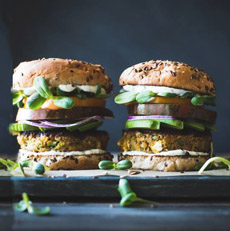
[1] Party time! Check out this article (photo © Sally Roeckell | Heinen’s).
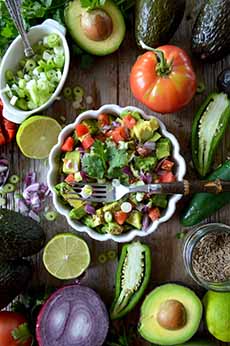
[1] Provide a plain bowl of chopped avocado and let guests pile on the toppings (photo © Nadine Primeau | Unsplash).
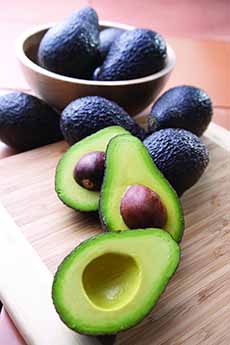
[2] Hass is the best avocado for creamy guacamole (photo © Hass Avocado Board).

[3] You don’t have to mix or mash. Diced avocado can be served in bowls, with toppings piled on top (photo © California Avocado Commission).

[4] At Frontera Grill in Chicago: crab, guacamole, bacon, toasted pumpkin seeds, queso fresco, tomatoes (photo © Frontera Grill).
|
|
National Guacamole Day is September 16th, and we wondered: If there are salad bars and frozen yogurt bars, cereal bars, baked potato bars and chili bars*, why not a guacamole bar? Who doesn’t love the opportunity to customize their foods?
Individual bowls and an array of ingredients enable each person to start with a base of smashed avocado, and pile on the fixings. They can then be mixed in or eaten as is—a mountain of flavors and textures.
Whether for a general party or drinks, we like to include a crunchy salad base, to make a more substantial dish. We prefer shredded cabbage, a.k.a. coleslaw mix. You end up with “guacamole coleslaw” at the bottom of the dish.
National Guacamole Day is September 16th and November 14th is National Spicy Guacamole Day.
> The history of guacamole is below.
> Ways to use guacamole beyond chips.
> The year’s 25+ Mexican food holidays.
INGREDIENTS FOR A GUACAMOLE PARTY BAR
To encourage creativity, mix some non-traditional items (bacon? mint? pineapple?) with traditional ones.
Avocado: mashed, smashed or diced†
Cheese: crumbled cotija, goat cheese, queso blanco, queso fresco or queso oaxaca; shredded cheddar or jack
Diced veggies: bell pepper, carrot, cucumber, green and/or red onion, jicama, radish, tomatillo, tomato/sundried tomato
Seasonings: cayenne, chili powder, cumin, garlic powder and/or minced garlic, hot sauce, lemon and/or lime wedges, paprika, salt/seasoned salt, Worcestershire sauce
Heat: chile flakes, hot sauce, sliced jalapeño, minced chipotle‡
Herbs: chives, cilantro, mint, parsley
Salad base: arugula, chicory, escarole, iceberg, radicchio, romaine, shredded cabbage, watercress
Toppings: bacon, corn, crushed pineapple, diced mango, olives, salsa, seeds (pumpkin, sunflower), sour cream or plain yogurt, toasted nuts
Plus:
Chips and dippers: celery sticks, crostini (toasted or grilled baguette slices), endive leaves, pita chips, plantain chips, tortilla chips, flatbread
Drinks: beer, Margaritas, white wine (Sauvignon Blanc or other crisp, medium-body white wine), white sangria
Set the dishes on a table or buffet in this order: bowls, salad, avocado, veggies, heat, seasonings and toppings; include serving utensils with each option.
At the end of the table, place the forks and spoons for blending and napkins, and dinner plates for the individual bowls and chips. Place large bowls of chips or other dippers on the tables.
___________________________
*More food bar ideas: Breakfast & Brunch Bar, Lunch & Dinner Bar and Dessert Bar.
†Hass avocados are preferred. While other varieties are larger, the Hass variety is creamier, a desired characteristic for guacamole.
‡To accommodate those who just like a little heat, have two bowls of jalapeño: one minced and served as is, one with the heat-carrying seeds removed before mincing.
___________________________
THE HISTORY OF GUACAMOLE
Mesoamericans cultivated the avocado in what we now call Central America for millions of years. The conquering Aztecs** called them ahuacatl; the “tl” is pronounced “tay” in Nahuatl, the Aztec language (so, ah-hwa-cah-tay). Guacamole was compounded in a molcajete, a mortar and pestle carved from volcanic stone.
When the Spanish conquistadors arrived in 1519 under Hernán Cortés, they heard ah-hwah-cah-tay as “aguacate,” the spelling and pronunciation they adopted.
The name guacamole comes from Mexican Spanish via the Nahuatl “ahuacamOlli,” a compound of ahuacatl [avocado] + mOlli [sauce]. The chocolate-based mole sauce comes from that same word, mOlli.
Ahuacatl means “testicle.” Aztecs saw the avocado as resembling testicles and ate them as a sex stimulant. According to Linda Stradley on the website WhatsCookingInAmerica.com, for centuries after Europeans came into contact with the avocado, it carried its reputation for inducing sexual prowess. It wasn’t purchased or consumed by anyone concerned with his or her reputation.
American avocado growers had to sponsor a public relations campaign to dispel the myth before avocados could become popular. After then, their dark green, pebbly flesh also earned avocados the name, “alligator pear.”
_____________
**The Aztecs, who probably originated as a nomadic tribe in northern Mexico, arrived in Mesoamerica around the beginning of the 13th century.
FUN FACTS
Avocados been cultivated for over 10,000 years.
Avocados have more potassium that a banana, plus many other health benefits (here are the more health benefits of avocado).
Leaving the pit in to keep it from browning doesn’t really work.
The largest-ever serving of guacamole weighed 2,669.5 kg (5,885.24 lbs), created by the Municipality of Tancítaro Michoacan in Tancítaro, Mexico, on April 4th 2013. (But how many tortilla chips were needed?)
During festivities for the last Super Bowl, 104.2 million pounds of avocados were consumed nationally, mostly as guacamole.
|