THE NIBBLE BLOG: Products, Recipes & Trends In Specialty Foods


Also visit our main website, TheNibble.com.

TIP OF THE DAY: Murasaki Japanese Sweet Potatoes

Murasaki Japanese Sweet Potato
[1] Murasaki sweet potatoes from Japan, a variety now grown in California (you can buy seeds from Burpee).

Murasaki Oven Fries
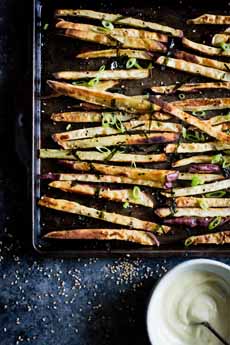
[2] Murasaki oven fries with wasabi aïoli. Here’s the recipe from Bonjon Gourmet.


“As sweet as sugar.” That’s what we thought when we first tasted murasaki sweet potatoes.

The next day we ran out to buy some (at Trader Joe’s).

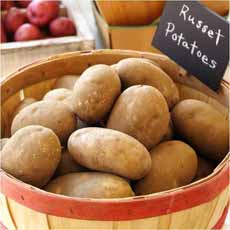
With an attractive violet-colored skin (murasaki is Japanese for violet) and a pure white interior [photo #1] we didn’t realize we were eating mashed sweet potatoes (they were peeled) until the first bite.

If we had been cooking, we’d have added the peel for a new take on skin-on mashed potatoes.

The murasaki, which is grown in California, has a sweet, nutty, full-bodied flavor.

  • The texture is somewhere between waxy and floury—an all-purpose potato (the different types of potatoes).
  • The soft white flesh is loaded with vitamin C and dietary fiber.
  •  
    You can cook murasaki in every way a potato can be cooked:

  • Baked whole
  • Boiled
  • Hash brown
  • Mashed
  • Oven fried [photo #2]
  • Pan-fried
  • Roasted
  • Sautéed
  • Stir-fried
  •  
    MURASAKI NUTRITION

    A medium potato (five inches long) is 120 calories, and is fat and cholesterol free.

    It has 500% DV of vitamin A, 40% vitamin C, 18% of potassium, 16% dietary fiber, 6% iron, 4% calcium and 2% sodium.

    If kept dry and cold, murasaki potatoes will remain fresh in the fridge for three weeks.
     
     
    THE DIFFERENT TYPES OF POTATOES

    STOKES PURPLE FLESH SWEET POTATOES

    THE HISTORY OF POTATOES


    Comments off

    Have You Tried Different Cheeses On Pizza?

    Updated September 2026

    Pizza is one of America’s favorite foods, tied at the top with burgers, depending on the survey. In the U.S., there are more than 64,000 pizzerias (some sources say 75,000 to 76,000).

    A visit to a typical pizzeria will get you a layer of mozzarella on top of the crust, plus toppings of choice.

    But what if your toppings of choice included additional types of cheese? If you’re a real cheese lover, you owe it to yourself to experiment.

    September 5th is National Cheese Pizza Day. What more appropriate day to try?

    We had the “opportunity of a lifetime” a few years ago, when we went to the annual trade show for pizzeria owners (it was pizza paradise!).

    A large cheese company had set out all of its cheeses, and would top a slice with the cheese(s) of your choice.

    We tried blue cheese, Cheddar, colby, goat cheese, pepperjack, and Swiss (and then we had to sit down and rest).

    It was fun, delicious, and lamentable that we couldn’t go into a real pizzeria and do the same on a regular basis.

    So for National Cheese Pizza Day, don’t let convention stop you from trying some of these options.

    You don’t have to give up the mozzarella. Just layer a second cheese on top.

    Below:

    > What is a cheese pizza?

    > Conventional pizza cheeses.

    > Creative pizza cheeses.

    > Other interesting choices.

    > Why are some cheese names capitalized but not others?

    Elsewhere on The Nibble:

    > 40 different types of pizza, including Detroit, Grandma, and Sushi pizzas.

    > The history of pizza.

    > The year’s 16 pizza holidays.

    > The year’s 30 cheese holidays.
     
    A three-cheese pizza with burrata, goat cheese, and mozzarella.
    [10] While the photos/recipes at the right do show toppings on the pizzas, we present this three-cheese pizza recipe to show we obeyed the letter of the law on National Cheese Pizza Day. The cheeses are burrata, goat, and mozzarella (photo © DeLallo).
     
     
    1. WHAT IS A CHEESE PIZZA?

    Things are never as simple as they appear. As we contemplate “cheese pizza” on National Cheese Pizza Day, we realize that “cheese pizza” is a broad category. Some people would interpret it to mean a pizza topped primarily with tomato sauce/tomatoes and cheese, usually mozzarella.

    Traditionally oregano, grated Parmesan, even chili flakes can be shaken on top without violating the “strictly cheese” mandate.

    But what if it’s a white pizza (pizza bianca)?

    Olive oil and garlic are brushed directly onto the dough, and are topped with a combination cheeses: mozzarella, dollops of ricotta, and salty grated Parmesan or Pecorino Romano.

    Some Americanized variations use a creamy white sauce like béchamel or Alfredo instead of an oil base.

    Herbs like basil or oregano can be added with impunity—they’re seasonings. It’s still a cheese pizza (although a topping of spinach or sliced tomatoes would violate the “cheese only” specification).

    Is a Margherita pizza a cheese pizza?

    Yes: It’s tomato sauce and mozzarella sprinkled with herbs, in this case fresh basil.

    But not every cheese pizza with basil would necessarily be a Margherita; for example, if it uses several cheeses, dried basil, or a nontraditional preparation (e.g. grilled instead of oven-baked).

    If you’re still up for celebrating National Cheese Pizza Day, we present an entire cheese case of options for your consdideration.
     
     
    2. CONVENTIONAL PIZZA CHEESES

    The most popular pizza cheeses are mozzarella, Parmesan, provolone, ricotta, and yes, Cheddar.

    Mozzarella Cheese Pizza

    Mozzarella, creamy and stretchy, is the basic cheese option for Italian pizza. The classic Margherita pizza is simply red sauce, mozzarella and fresh basil.

    If your pizzeria is high end, you may get bufala mozzarella—Americans spell it buffalo—a richer version. If it’s ultra-gourmet, you’ll find burrata on top of the mozzarella.

    Things to know about mozzarella:

    • You can use freshly-made mozzarella, the kind that is handmade and should be used within a day of being made. Because of its high-moisture content, it creates a true soggy-in-the-middle Neapolitan pie that Italians love. You might be tempted to spend more for that ball of mozzarella, but wait until the next bullet.
    • Commercial mozzarella is low-moisture and salted for a longer shelf life. Thus, it’s saltier and more flavorful than high-moisture mozzarella, and melts more easily. Most of us use this to make pizza; and the pizzerias buy it in bulk. If you have a choice, go for full-fat mozzarella. It’s much more luxurious than the part-skim or skim versions: The higher the fat, the better the melt.
    • Smoked mozzarella has even less moisture than fresh mozzarella. It melts, but not as well. Add it sparingly on top of conventional mozzarella, in a proportion of about 25%. If you like the smokiness, you can add more next time.
    • Here’s more about mozzarella.


    Cheddar Cheese Pizza

    Every cheese-eater is familiar with Cheddar, which is made in different levels of sharpness, plus orange or white color (the orange color is the addition of annatto).

    • While you may not think of pairing Cheddar and pizza, it’s an ingredient in a lot of pizza cheese blends.
    • Cheddar is also commonly used on specialty pies like buffalo chicken, cheeseburger and chicken bacon ranch.
    • Since Cheddar has low elasticity, it doesn’t melt as easily as mozzarella. Use it on top of the mozzarella.
    • White Cheddar will surprise people who bite into it, not expecting the sharp flavor. Orange cheddar adds color to the pie.
    • You can add whatever you like as a topping. Photo #1 is orange Cheddar topped with roasted vegetables; photo #5 is a white cheddar pizza with bacon and walnuts.
    • For fun, make a ham and cheese pizza or a cheeseburger pizza with crumbled cooked ground beef or little meatballs.
    • Here’s more about Cheddar.


    Parmesan Cheese Pizza

    Parmesan, or Parmigiano-Reggiano for the authentic Italian cheese, is a “finishing cheese,” meaning that it’s added when the pie comes out of the oven.

    • This hard grating cheese, and/or other aged Italian hard cheeses like Asiago and Grana Padano, can be shaved or grated atop the pizza.
    • Never blend parmesan into a cheese mix: It’s too dry to melt in the oven, and heat ruins its umami taste.
    • Here’s more about Parmigiano-Reggiano and how it differs from generic Parmesan.


    Provolone Cheese Pizza

    Provolone is a semi-hard Italian cheese and the cheese that’s most often blended on a pizza with mozzarella. You’ll find it in a shredded mix, although you can shave or shred it on top of the mozzarella or the toppings (provolone doesn’t grate well).

    Provolone can be mild or strong, depending on how long it’s been aged. Start with a younger provolone: It’s sweeter, creamier and less expensive.

    • If you like the result, try it with an aged provolone, which is sharper.
    • Or, buy some of each and use half and half on your pizza.
    • Here’s more about provolone.


    Ricotta Cheese Pizza

    Ricotta is the base cheese used for white pizza, but can also garnish red sauce pizza (photo #2). The ricotta is typically blended with mozzarella, or, for a deeper flavor, with fontina, gorgonzola or Gruyère.

    • Some people like their white pizzas topped with standard toppings—sausage and vegetables, for example, or fresh tomatoes and pesto.
    • Go one step further and add caramelized onions; or sliced tomatoes, basil and other herbs, shallots, cracked red pepper plus mozzarella and parmesan cheeses (here’s a recipe).
    • Because the ricotta base is bland, you can add anything to the canvas: chicken, shrimp, smoked salmon, the works. Our favorite is sliced potato, smoked salmon and red caviar (added after baking).
    • Here’s more about ricotta.


    3. UNCONVENTIONAL PIZZA CHEESES
     
     
    Gorgonzola Or Other Blue Cheese Pizza


    Cheddar Cheese Pizza
    [1] Cheddar cheese pizza with roasted vegetables. Here’s the recipe (photo © A Latte Food).

    Ricotta Sausage Pizza
    [2] Ricotta is used as the base for white pizza, but can also top a red pizza. Here’s the recipe for this ricotta and sausage pizza (photo © Emily Bites).

    Gruyere Pizza
    [3] Gruyère pizza with new potatoes, caramelized onions and rosemary. Here’s the recipe (photo © Domestic Gothess).

    Greek Pizza With Feta
    [4] Greek pizza, with feta cheese and other Greek salad ingredients. Here’s the recipe (photo © Cooking Classy).

    A feta-spinach pizza with a glass of red wine.
    [5] This white pizza tops mozzarella with feta and dollops of spinach. Tip: Try seasoning the spinach with nutmeg (photo © The Nibble).

    Pizza topped with steak, blue cheese, and sauteed mushrooms.
    [6] Gorgonzola, steak, and mushrooms turn pizza into a hearty meal. Here’s the recipe from Taste Of Home.

    Buffalo chicken pizza on a cutting board.
    [7] Turn wings into pizza: Buffalo chicken pizza with blue cheese, mozzarella and hot sauce. Add some sliced celery if you like. Here’s the recipe (photo © The Optimalist Kitchen).

    Smoked Gouda Pizza
    [8] Gouda and chorizo pizza. Here’s the recipe (photo © Vikalinka).

    Goat Cheese & Onion Pizza
    [9] Goat cheese and grilled onion pizza (photo © Urban Accents).

    When we had our first slice of blue cheese pizza, it was made with average-quality cheese and and the flavor was underwhelming. When we sprang for pricey Roquefort at home, we used too much and it was way too “blue.” The lesson: Sprinkle rather than slather the pie with it. Try:

    • Buffalo chicken pizza with diced chicken, sliced celery, crumbled blue cheese and a drizzle of ranch dressing or hot sauce.
    • Pear, walnut and Gorgonzola is an elegant combination. Or, add caramelized onion and fresh rosemary.
    • Try the Gorgonzola, steak, and mushroom pizza recipe in photo #6.
    • Here’s more about blue cheese.


    Feta Cheese Pizza

    Like Greek salad? Make a Greek pizza (photo #4).

    • Add red onion, bell peppers, cherry tomatoes and pitted Kalamata olives.
    • If you want to add the lettuce component, garnish with some shredded lettuce when the pizza comes out of the oven.
    • Don’t forget the oregano and thyme.
    • Here’s more about feta cheese.


    Goat Cheese Pizza

    Goat cheese lovers can enjoy it on top of a red or white pie. Although goat cheese doesn’t melt flat like mozzarella and provolone, it softens up when baked.

    Cut circles from a log of fresh goat cheese, or use a spoon to pull it into small chunks. Place either option across the top of the pie.

    • Pair goat cheese with fresh tomatoes and, when it comes out of the oven, fresh basil and a drizzle of balsamic glaze.
    • For a more gourmet pizza, add caramelized onions and sliced figs.
    • Sundried tomatoes are another favorite.
    • Here’s more about goat cheese.


    Gouda Cheese Pizza

    This semi-hard Dutch cheese is a good complement to pizzas with barbecue chicken, pulled pork or sausage. It’s available in traditional or smoked. Pick the variety that goes best with the toppings (photo #8).

     
    Gruyère Cheese Pizza

    Gruyère is the highest form of what American think of as Swiss cheese (along with Emmentaler). It’s a good melter and adds nutty and earthy flavors.

    Almost any topping works with a Gruyère pizza:

    • Sliced waxy or fingerling potatoes, cooked (photo #3), with picholine olives and rosemary and/or thyme.
    • Prosciutto, serrano or Bayonne ham, for a ham-and-cheese pizza.
    • Caramelized onions or plain mushrooms and sausage.
    • Green veggies: asparagus, broccoli, zucchini, etc.
    • Here’s more about Gruyère.


    Hispanic Melting Cheeses

    Several Hispanic cheeses that are commonly available in the U.S. are great melters, and can be used on pizza. Look for asadero, queso manchego, queso oaxaca, queso de papa and queso quesadilla.

     
    Pizza topped with Brie, walnut, bacon, and arugula.
    [11] Brie, bacon and walnuts are topped with arugula and a drizzle of honey. Here’s the recipe (photo © Stonefire Naan).


    4. OTHER INTERESTING CHOICES

    Soft-Ripened Cheeses: Cheese board favorites like Brie and Camembert have naturally runny centers. They also have subtle mushroomy notes, so are delicious topped with sautéed mushrooms on pizza or a burger. Soft-ripened cheeses are uncooked, unpressed cheese, which, as a result, are creamy or even runny when fully ripe. They melt very easily. You don’t need to trim off the rind—it’s considered a choice part by cheese connoisseurs.

    Semisoft Cheeses: These cheeses, springy to the touch, melt easily. Some we’ve already mentioned.

    Brick, fontina and port salut are popular examples, as are blue cheeses, butter käse, edam, young Gouda, Havarti, limburger, some monterey Jacks, muenster, young provolone, teleme and some tilsits.

    More Cheeses To Try

    Colby, Edam and Emmental, along with Cheddar, Gruyère, mozzarella and provolone, are recommended based on a scientific study of the perfect combination of cheeses based on each type’s elasticity, free oil, moisture, water activity and baking temperature.

    Here’s the scoop.

    Thanks to Webstaurant Store for some of these recommendations.
     
    A Margherita pizza on a cutting board.
    [12] A Margherita pizza elevated with cherry tomatoes and pesto (photo © Dima Solomin | Unsplash).
     
     
    5. WHY ARE SOME CHEESE NAMES CAPITALIZED BUT NOT OTHERS?

    Why is Cheddar capitalized? It’s the proper name of the town it was named for, i.e., where it originated. You wouldn’t have a cheese named san francisco or boston, would you? Similarly:

    • Asiago is the name of a town and plateau in the Venetian Alps of Italy.
    • Brie is a historic region located in north-central France, primarily within the Île-de-France region (the area surrounding Paris).
    • Camembert is a village (commune) located in the Orne department of Normandy.
    • Colby is named after the town of Colby, Wisconsin, where it was created.
    • Edam originated in the town of Edam in the Netherlands.
    • Gorgonzola hails from a town near Milan, Italy.
    • Fontina comes from the Fontin pasture (Montagne Fontin), a historic alpine mountain pasture located in the Aosta Valley (Valle d’Aosta) of northern Italy.
    • Gouda is named for the Dutch city of Gouda.
    • Grana Padano is named after Pianura Padana (the Po River Valley) in Northern Italy.
    • Gruyère originated in the town of Gruyères in Switzerland.
    • Havarti is named after the Havartigaard farm in Denmark.
    • Limburger comes from the historical Duchy of Limburg (now parts of modern-day Belgium, Germany, and the Netherlands).
    • Manchego is made from the milk of Manchega sheep, and produced exclusively in the La Mancha region of central Spain.
    • Munster comes from the town of Munster in France. It’s a pungent, washed-rind cheese. The cheese made in America called muenster is mild and unrelated.
    • Parmigiano Reggiano is from Parma, Italy (Parmesan is a non-regulated version that can be produced anywhere but still owes its name to Parma).
    • Port Salut originated in the Abbaye du Port-Salut in France.
    • Roquefort originated in the village of Roquefort-sur-Soulzon, located in the Aveyron department in southern France.
    • Tilsit comes from a historical city of that name in East Prussia, now Sovetsk, Russia.

     
    Note that when a cheese is named for its location of origin, it’s likely that the name is trade-protected with a Protected Designation of Origin (PDO) or Protected Geographical Indication (PGI) designation. See the *footnote.

    Otherwise, cheeses not named for a specific locale—like blue cheese, cream cheese, feta, goat cheese, mozzarella, provolone, and ricotta—are not capitalized.

    Editor’s note: The Nibble takes a different approach than The Associated Press Stylebook and the Chicago Manual of Style. They believe that generic food items derived from proper nouns are written in lowercase, whereas terms like Swiss and American cheese remain capitalized. Thus, they would lowercase brie, camembert, colby, cheddar, and manchego, and the like. Better to be consistent, we opine.

    However, culinary writing and many dictionaries often capitalize them as proper nouns because they are named after specific regions or towns.

    Here’s a puzzler: While Monterey Jack is capitalized, its offspring, pepper jack (or pepperjack), is generally not capitalized in standard lowercase usage, though “Jack” retains a capital letter in some style guides. (Editor’s note: Better to leave it all lowercase.)
     
    ________________
     
    *The primary EU trade protection and quality designations for agricultural products, foods, and drinks include:

    Protected Designation of Origin (PDO): Applies to products with the strictest territorial link, where every part of the production, processing, and preparation must take place within the specific defined geographical region using local raw materials. Example: Parmigiano Reggiano cheese or Kalamata olive oil.

    Protected Geographical Indication (PGI): Focuses on a relationship between the product and the region where a specific quality, reputation, or characteristic is attributable to its geographical origin, requiring at least one production or processing stage to occur in the area. Example: IGP-certified / PGI French poultry or Scotch Beef. (IGP and PGI are the exact same certification; IGP (Indication Géographique Protégée) is the French acronym, while PGI (Protected Geographical Indication) is the official English translation used across the European Union.)

    Traditional Speciality Guaranteed (TSG): Highlights traditional composition or traditional methods of production (such as a classic recipe) rather than a specific geographical link, meaning it can be produced anywhere as long as the traditional specifications are strictly followed. Example: Traditional mozzarella or pizza Napoletana.
     

    CHECK OUT WHAT’S HAPPENING ON OUR HOME PAGE, THENIBBLE.COM.


    Comments off

    TIP OF THE DAY: K-Cup Coffee Club


    [1] Try Illy’s K-cup line of Medium and Dark Roast blends, and the new single origin Colombia and Brasile (photo courtesy Illy).

    Nespresso Compatible Capsules
    [2] Six varieties of Nespresso-compatible capsules from Rosso Caffe (photo courtesy Rosso Caffe).

    Java House Cold Brew K Cups
    [3] There’s liquid cold brew inside these K-cups. Use them in the machine, or pour over cold water and ice for iced coffee (photo courtesy Java House).


    Boxes of K-cups for single-serve coffee makers are not inexpensive. You may be buying the same variety over and over again, because you don’t want to risk $10 or $12 on a box of K-cups you may not like as much (or up $38 on a box of Nespresso capsules).

    Here’s an idea for picky palates: Create a K-cup club with a group of friends or co-workers. At regular intervals (monthly? quarterly?), a different selection of K-cups are purchased, the pods divided, and the cost split among participants.

    With 10 K-cups in a box, each box can be split in half, among five people, or any other way you want to apportion.

    If you want to try Illy’s new single origin coffees, for example, but aren’t sure if you’d prefer Columbia or Brasile, the group can try both—or perhaps, all four options, adding in the medium roast and dark roast blends.

    You can have a “theme month,” for example, trying different brands of pumpkin or spice coffees, or all the Christmas blends.

    It’s also an opportunity to try your regular pod variety across brands; for example, the dark roasts of Green Mountain, Illy, Starbucks, etc.

    You decide how often it makes sense to meet or otherwise exchange. If you meet only quarterly for most of the year, it may make more sense to meet more often during the fall season, when so many specialty flavors are stocked.

    How you structure your exchange is as simple as “whatever works for you.” Get the group members together and decide.

    The goal remains: Try more varieties of coffee with minimized financial outlay. And the related benefit: Discover new favorites you wouldn’t have purchased on your own.
     
    AN INNOVATION IN K-CUPS: COLD BREW FROM JAVA HOUSE

    We’d also like to suggest an innovative K-Cup, Java House Cold Brew.

    The brand recently launched new Dual-Use Liquid Cold Brew Coffee Pods [photo #3]. The pods hold cold brew concentrate instead of the conventional coffee grounds.

    Cold brew, as its fans well know, creates a less bitter, less acidic, smoother cup of coffee. Now, cold brew buyers will be able to make their coffee in single-serve machines.

    The all-natural concentrate is available in Columbian medium roast, Ethiopian light roast, Sumatran dark roast, and decaf medium roast..

    Get yours at JavaHouse.com.
     
     
    FOR MORE ABOUT COFFEE, CHECK OUT OUR COFFEE GLOSSARY
     
    THE HISTORY OF COFFEE


    Comments off


    © Copyright 2005-2026 Lifestyle Direct, Inc. All rights reserved. All images are copyrighted to their respective owners.