THE NIBBLE BLOG: Products, Recipes & Trends In Specialty Foods


Also visit our main website, TheNibble.com.

TIP OF THE DAY: Drupes, a.k.a. Stone Fruits

Note: Before calling attention to the Prunus genus of delectable summer fruits, there’s a botany lesson. We love brief glimpses of botany in food writing!

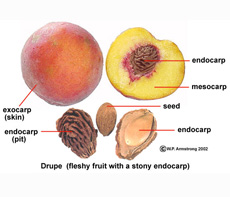
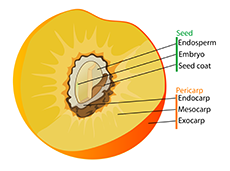
In botany, a drupe—the botanical name for stone fruit—is a fruit in which an outer fleshy part (exocarp, or skin; and mesocarp, or flesh) surrounds a shell (called the pit, stone, or pyrene) of a hardened endocarp with a seed (kernel) inside.

A picture is worth a thousand words, so check out the third photo.

There are two main classes of fleshy fruits: drupes and berries.

  • Drupes are characterized by having a fleshy mesocarp but a tough-leathery or bony endocarp. They are said to have “stones” or “pits” rather than seeds (example: peaches). A drupe usually has a single seed.
  • Berries, to the contrary, are characterized by having a fleshy endocarp, as well as mesocarp, and may have more than one seed.
  •  
    Yet, you can’t assume too much. Avocado is a berry: It does not have a stony endocarp (the pit or stone) covering the seed—as those who have tried growing a plant from the seed are well aware.

    Drupes are members of the Rosaceae family, also called the rose family. The family includes both ornamental shrubs and trees and those with edible fruits.

    Drupes are members of the genus Prunus. Strawberries are cousins from another genus; apples, pears, and quince from another; and loquats from yet another.
     
     
    DRUPES YOU’VE EATEN

    Drupes are popular fruits in the U.S. and Europe. The family includes:

  • Hand fruits: apricot, cherry, damson, nectarine, peach, plum and hybrids like apriums, plumcots and pluots
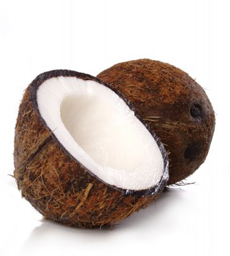
  • Tropical fruits: coconut, mango
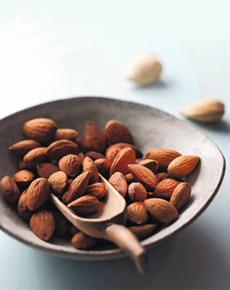
  • Surprise drupes (typically not eaten raw): almonds*, coffee†, hickory nuts*, olives, pecans*, most palms (including date, sabal, coconut, and oil palms), pistachios*, walnuts*
  • Exotic (in the U.S.): jujube, white sapote
  •  
    Let’s move on, leaving drupes behind in favor of stone fruits, the genus’ common name.
     
     
    DIG IN NOW!

    Stone fruits are summer treats. You’ve got another month to enjoy them fresh off the tree.

    Beyond eating them as hand fruit, use them to make:

  • Drinks.
  • Ice creams and sorbets.
  • Pastries, pies, shortcakes, and tarts.
  •  
    Or:

  • Grill, poach, or stew them as sides or desserts (Alone? With ice cream? With pound cake?.
  • Pickle them. Poach and stew them to serve alone or with ice cream and or pound cake.
  •  
    In earlier times, fruits like these were “put away” in cans and jars and made into jams to enjoy until the next year’s crops came in.

    Now, when you see peaches and other stone fruits in the colder months, they most likely come from Chile or elsewhere below the equator, where the seasons are reversed.
     
     
    STONE FRUIT RECIPES

    You can fine droves of stone fruit recipes all over the web. Some specialty sites include:

  • California Cherries
  • California Fresh Fruit Association
  • Choose Cherries
  • Georgia Peach Growers
  • Northwest Cherries
  • Oregon Cherry Growers
  • Washington Cherry Growers
  • Washington State Fruit Commission
  •  
     
    __________________

    *These tree nuts are the seeds of the fruits of the tree: With these species of drupes, we eat the seed inside the pit instead of the fruit surrounding it. They are not true nuts.

    †The cherries from the coffee tree enclosed the seeds, which are roasted to become coffee beans.

       
    Apricots
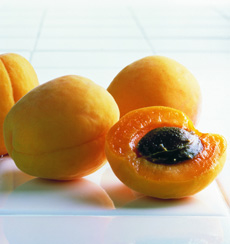
    [1] Apricots showing a pit, a.k.a. stone. All drupes have a hard stone-like pit at the center (photos #1 and #2 © Washington State Fruit Commission).

    Plums In Bowl
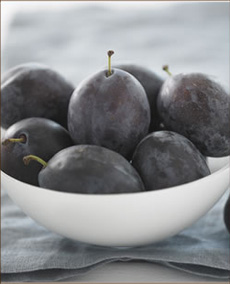
    [2] A bowl of plums.

    Peach Anatomy
    [3] The anatomy of the peach and other drupes (illustration © W.P. Armstrong).

    Anatomy Of A Peach (Drupe)
    [4] A close-up on the anatomy of a peach, perhaps the most popular drupe (illustration © Lady Of Hats | Wikipedia`).

    Bowl Of Almonds
    [5] Almonds (and pistachios) are stone fruits, not true nuts (photo © Niederegger Marzipan | Facebook).

    Coconut Halves
    [6] Surprise drupes: (photo © Baldor Specialty Foods).


    CHECK OUT WHAT’S HAPPENING ON OUR HOME PAGE, THENIBBLE.COM.


    Comments off

    RECIPES: National S’mores Day Cocktail

    Combine chocolate liqueur, marshmallow vodka and graham cracker crumbs into a special cocktail for National S’mores Day, August 10th.

    Numerous recipes abound, but we had fun with this one, adapted from ACocktailLife.com.

    You can also use chocolate vodka and marshmallow syrup, or a cream liqueur in any combination.

    You can use a simple rim of graham crackers and a single marshmallow garnish, or go over the top.

    Serve in a Martini glass or other stemmed glass (you can use a wine glass).
    RECIPE: S’MORES COCKTAIL

    Ingredients Per Drink

  • 2 ounces marshmallow vodka (Pinnacle and Smirnoff make it)
  • 1 ounce chocolate liqueur
  • 1 ounce creme de cacao
  • 2 ounces cream or half & half
  • Ice
  • Garnish: 2 standard marshmallows
  •  
    For The Rim

  • Chocolate sauce (fudge sauce)
  • 1 crushed graham cracker
  •  
    Substitutions

  • No marshmallow vodka? Use vanilla.
  • No creme de cacao? Double the chocolate liqueur.
  • No cream? Use milk (the drink will be less rich).
  • Alternative garnishes: chocolate-covered marshmallow, pick of mini marshmallows, Mallomar
  •  
     
    Preparation


    Smores Cocktail

    Smores Cocktail
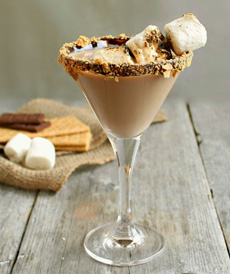
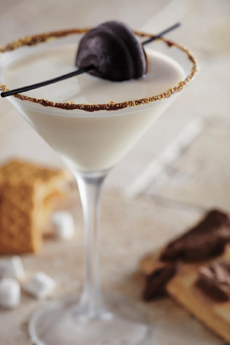
    [1] What’s a S’mores celebration without a S’mores cocktail? Photo and recipe courtesy ACocktailLife.com). [2] More subtle, this variation uses white chocolate liqueur (from Carrabba’s Italian Grill | Facebook).

     
    1. CREATE the rim. Crush the graham cracker into crumbs on a plate or in a shallow bowl. Place the chocolate sauce into a shallow microwavable bowl and microwave for 30 seconds or until melted. Dip the rim of the glass into the chocolate, then into the graham cracker crumbs. Set aside to set.

    2. COMBINE the marshmallow vodka, chocolate liqueur, creme de cacao and fresh cream to a cocktail shaker. Fill with ice, shake well and pour into the prepared glass.

    3. TOAST the marshmallow garnish. Place the marshmallows at the end or in the center of a skewer. Use at the end to set the skewer into the drink, use the center to lie the skewer across the rim. Hold the skewer over an open flame to lightly toast (if your skewers are bamboo, soak them first). Add the skewer to the drink and serve.
      

    Comments off

    TIP OF THE DAY: Toast To National S’mores Day With Bubbly & Truffles

    S'mores Truffles

    S'mores Truffles Recipe
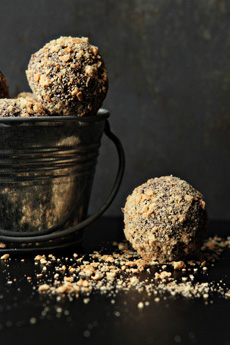
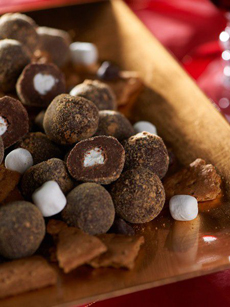
    [1] This sophisticated S’mores truffles recipe from My Baking Addiction uses Smirnoff’s marshmallow-flavored vodka. [2] A down-home version from QVC’s David Venable. The recipe is  .

      August 10th is National S’mores Day.

    A couple of weeks ago, we suggested a gourmet S’mores party with a buffet of everything S’mores, including fondue, fudge, grilled banana S’mores and ice cream—along with numerous other adaptation of the popular campfire cookie sandwich.

    If you don’t want the whole spread, just invite people over for easy-to-make S’mores Truffles with a glass of sparkling wine (our wine suggestions are below).

    RECIPE: S’MORES TRUFFLES

    This recipe from chef David Venable of QVC is very easy to make. You can delegate the task to kids who like to cook.

    Ingredients

  • 1 can (14-ounces) sweetened condensed milk
  • 1 tablespoon instant espresso coffee granules
  • 1 tablespoon vanilla extract
  • 14 ounces (2 cups) semisweet chocolate chips
  • 1 cup graham cracker crumbs, divided
  • 62–64 mini marshmallows*
  •  
    Preparation

    1. POUR the condensed milk, instant coffee and vanilla into a 3-quart saucepan over low heat. Cook for 3 minutes, stirring constantly.

    2. ADD the chocolate chips and continue to stir until the chips are completely melted and the mixture is lukewarm, about 3–4 more minutes. Remove the saucepan from the heat, add 2/3 cup graham cracker crumbs, and stir until fully incorporated.

    3. POUR the mixture into a small shallow dish (8″ x 8″ baking pan or a 9″ round cake pan). Cover the dish with plastic wrap and let it sit at room temperature until the mixture has cooled completely, about 2–3 hours.

    4. PLACE the remaining 1/3 cup of graham crumbs into another shallow dish. To form the truffles, scoop 1 tablespoon of the chocolate mixture and make a well in the center. Place the marshmallow in the well, pinch the tops closed (to enclose the marshmallow), and roll the chocolate in your hands until a uniform ball forms.

    5. ROLL the ball into the graham cracker crumbs until completely coated. Repeat the same process to form each truffle.
     

    __________________
    *One intrepid baker counted There are 571 mini marshmellows in a 16-ounce bag. Really? Another counts 35 standard marshmallows in a 10-ounce bag, with the advice that 1 standard marshmallow = 3 mini marshmallows. If you conduct your own count, let us know!


    SWEET WINES TO PAIR WITH CHOCOLATE & DESSERTS

    Some sparkling wines are made in a sweet style, just to go with dessert. In the sparkling category, the terms dry, sec and demi-sec (dry and semi-dry in French) are used for these wines.

    Why dry? It’s an anomaly that began in the Champagne region of France. Here’s an interesting comparison of the different sweetnesses of Champagne.

    Sweet Sparkling Wines

  • Amabile and Dolce sparkling wines from Italy
  • Asti Spumante from Italy (sparkling moscato)
  • Brachetto d’Acqui (a rosé wine) from Italy
  • Demi-Sec and Doux sparkling wines from France (including Champagne)
  • Dry Prosecco (a.k.a Valdobbiadene) from Italy
  • Freixenet Cordon Negro Sweet Cuvée and Freixenet Mía Moscato Rosé from Spain
  •  
    We also like two sweet sparklers from the U.S,:

  • Sparkling Gewürztraminer from Treveri Cellars in Washington
  • Schramsberg Crémant Demi-Sec from California
  •  
    Sweet Still Wines

    Take advantage of the celebration to try one or more of these:

  • Banyuls from Roussillon in the south of France
  • Late Harvest Zinfandel from California
  • Lustau Muscat Sherry Superior “Emlin” fom Spain
  • Recioto Amarone from Veneto, Italy (not Valpolicella, a dry wine from the same region)
  • Ruby Port from Portugal
  • Vin Santo from Tuscany, Italy
  •  
    Liqueurs also work.

    And how about that Fluffed Marshmallow Vodka from Smirnoff?

      Red Wine & Chocolate

    Champagne & Chocolate
    [1] Certain red wines—still or sparkling—are perfect pairings for chocolate (photo courtesy Taza Chocolate). [2] Prefer bubbly? Make sure it’s a sweet style (photo courtesy Delysia Chocolate).

    S’MORES HISTORY

    Since the Girl Scouts popularized S’mores long ago (the first published recipe is in their 1927 handbook), it has been a happy tradition around the campfire. A stick, two toasted marshmallows, a square of chocolate and two graham crackers get you a delicious chocolate marshmallow sandwich.

    The heat of the toasted marshmallow melts the chocolate a bit, and the melted quality is oh-so-much-tastier than the individual ingredients (per Aristotle, the whole is greater than the sum of its parts). The name of the sweet sandwich snack comes from its addictive quality: you have no choice but to ask for “some more.”

    But you don’t need a campfire, or even all of the classic ingredients, to celebrate with s’mores, as the recipe above and our other S’mores recipes show.


    Comments off

    Cookie Dough For Dessert & How To Pasteurize Raw Eggs

    Raw Chocolate Chip Cookie Dough
    [1] One of our favorite treats. No need to turn on the oven: We’ll have it raw (photo courtesy Geraldine | Wikipedia).

    Cookie Dough
    [2] For dessert or snacking: a few spoons of raw cookie dough (photo © Edoughble).
    Davidson's Pasteurized Safe Eggs
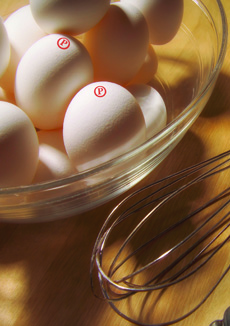
    [3] Buy pasteurized eggs, or pasteurize your own at home—instructions are below (photos #4, #5, and #6 © Davidson’s Safe Eggs).

    Davidson's Safe Eggs Carton
    [4] A carton of pasteurized Davidson’s Safe Eggs.


    Eating raw cookie dough is no doubt as old as baking cookies. It’s different than, but equally as delicious, as the baked cookies.

    We know: Every time we make a batch of chocolate chip cookie dough, we end up with just 2/3 of the yield, and the rest of the raw dough nibbled away during prep.

    Sometimes we mix up a batch just for the dough. You can wrap individual portions of dough and freeze them for future snacking.

    In fact, make a few different flavors at your leisure, shape them into individual balls, and freeze them, and you’ll have an “instant” chocolate cookie dough dessert. You can wrap individual balls, or place them in ice cube trays.

    Edoughble, a company that sells raw, ready-to-eat cookie dough (second photo), makes a selection of flavors: birthday cake, chocolate chip, chocolate peanut butter, cookies and cream, oatmeal chip, peanut butter banana chip, red velvet, s’mores, snickerdoodle, and seasonal flavors (it’s orange creamsicle this summer).

    You can serve it on spoons, as in the photo; in a sundae dish with fresh fruit; with a side of graham crackers; or as a mini banana split.

    Make your own cookie dough ice cream. Just roll small balls of cookie dough and blend them into a softened pint of vanilla ice cream.

    It doesn’t have to be chocolate chip cookie dough. Oatmeal cookie or sugar cookie dough works just fine.
     
     
    THE HISTORY OF COOKIE DOUGH ICE CREAM

    Chocolate chip cookie dough was created by accident by Ruth Wakefield, an inn owner on Cape Cod, in 1937. It took almost 50 years for it to become a favorite ingredient in ice cream.
     
    The first record of cookie dough ice cream credits Fabulous Phil’s Gourmet Ice Cream in Lanesborough, Massachusetts, a small local business that existed from 1982 to 1983. The flavor was invented by owner Philip S. Kampe, using homemade cookie dough, in 1984.

    Phil’s flavor was followed by one from the far-better-known Ben & Jerry’s in Burlington, Vermont, which got the idea from a customer suggestion (perhaps a customer of Fabulous Phil’s?). B&J bought cookie dough from a distributor, working with the company to make dough with the right consistency for a mix-in (known in the trade as an inclusion).

    After the deadliest* Salmonella outbreak in history in 1985 traced to a dairy in the Midwest, the U.S. Food and Drug Administration (FDA) strongly discouraged consumption of it in everything from Caesar Salad to Steak Tartare and other popular recipes†. Many companies reformulated recipes to eliminate raw eggs or use pasteurized raw eggs, in which the bacteria have been eliminated.
     
     
    GOOD NEWS: YOU CAN PASTEURIZE RAW EGGS AT HOME

    First, a disclaimer: If you have a health condition or general concern*, consult with your physician before eating anything raw.

    The easy way to make safer cookie dough is to buy commercially pasteurized eggs.

    Look for Davidson’s Safe Eggs, pasteurized raw eggs. You can tell they’re pasteurized from the red “P” stamped onto each egg. If your grocer does not carry them, ask the manager to bring them in. Learn more at SafeEggs.com.

    Pasteurized eggs undergo an all-natural pasteurization process that kills harmful bacteria without altering the consistency or texture of the eggs.

    They look and act just like raw eggs while eliminating the risk of salmonella. Unlike processed liquid eggs, they deliver the fresh flavor delivered by raw eggs.

    So you can enjoy the brownie batter, cookie dough, and other raw egg foods† with the gusto they deserve.


    RECIPE: HOW TO PASTEURIZE RAW EGGS

    Home pasteurization doesn’t provide the 100% guarantee that commercially pasteurized eggs do, but it will significantly reduce any risk. (Also note that, as with many products, other ingredients can be contaminated including flour and nuts.)

    Preparation

    1. HEAT a pot of water over medium heat to 145°F. Monitor the temperature with a probe thermometer.

    2. PLACE fresh, room-temperature eggs in the pot; the water must completely cover the eggs. Lower the heat and maintain the 145°F temperature. Do not let the temperature reach 160°F or you’ll start to cook the eggs.

    3. REMOVE the eggs after 3-1/2 minutes, or 5 minutes for extra-large and jumbo eggs. Then use or refrigerate. They’ll stay even fresher because the bacteria have been killed off.
     
    __________________

    *Salmonella generates more illnesses than fatalities but can be fatal for risk groups, such as young children, the elderly and infirm. Here’s more from Web M.D.

    †Brownie/bar and cake batter, Caesar salad, cookie dough, cold/frozen soufflés, chiffons, French custard ice cream, eggnog, egg smoothies, egg white cocktails, homemade mayonnaise, mousse, steak tartare and others.


    CHECK OUT WHAT’S HAPPENING ON OUR HOME PAGE, THENIBBLE.COM.


    Comments off

    TIP OF THE DAY: The Pasta For Summer, Zucchini “Pasta,” Enhanced

    August 8th is National Zucchini Day. Last year, we featured the Spiralizer, a gadget that started the zucchini noodle craze by making it easy to make long pasta-like strands from firm vegetables, along with a recipe for Zucchini Pasta With Crab.

    The concept took off in the media and in kitchens across the country. Who wouldn’t like a better-for-you pasta experience? At 20 calories per cup of zucchini and 40 calories for a half cup of tomato sauce, one could have a big plate of “pasta” of better-for-you complex carbs for 100 calories—including the grated Parmesan.

    Some people, though, still longed for the toothsome texture and flavor of Italian pasta. So today’s tip is:

    Mix the two noodles together: half standard pasta noodles (wheat) and half zucchini noodles.

    The concept is very versatile: the combination of starch and vegetable lends itself to many more sauces than standard pasta sauces.
     
    SAUCES

    You can use any pasta sauce, or turn to global cuisines for another approach.

    Asian sauces work particularly well here, but there are plenty of other options including:

  • Chimichurri sauce
  • Compound or plain butter sauce
  • Garlic and olive oil sauce
  • Fresh or cooked tomato sauce
  • Mushroom sauce
  • Parsley sauce
  • Ponzu or teriyaki sauce
  • Thai peanut sauce
  • Yogurt sauce
  •  
    PASTA TOPPINGS

  • Brined vegetables (capers, olives)
  • Cheeses: boconccini (mozarella balls), crumbled goat or feta, shaved Parmesan
  • Cherry tomatoes
  • Cooked vegetables (edamame, peas, etc.)
  • Fresh herbs
  • Spiraled beet, carrot, cucumber, green papaya or other raw garnish
  • Seafood: anchovies, sardines, shrimp (boiled, grilled, sautéed)
  •  
    RECIPE: MIXED NOODLE PAD THAI

    Match the zucchini size to the pasta size you buy, e.g., linguine (thin) or pappardelle (wide).

  • You can mix green and yellow squash. You can also make this recipe with 100% zucchini or 100% pasta noodles.
  • You can serve the dish hot/warm, room temperature or chilled.
  • Also check out our recipe for mixed zucchini and pasta noodles with crab.
     
    Ingredients For 4 Servings

  • 2 cups raw zucchini “noodles”
  • 4-6 ounces wheat or rice noodles
  • 2 tablespoons olive oil
  • 1 clove garlic, minced
  • 2 large eggs
  • 1-1/2 tablespoons soy sauce
  • Juice from 1 lime (about 2 tablespoons)
  • 1 tablespoon brown sugar
  • 1 teaspoon fish sauce (substitute Worcestershire or a bit of anchovy paste)
  • 1/8 teaspoon red pepper flakes
  • 3 green onions (scallions), sliced
  • 1/4 bunch fresh cilantro leaves, roughly chopped (substitute flat-leaf parsley)
  • 1/4 cup chopped peanuts (the standard is unsalted, but you can use whatever you have, including honey roasted or flavored)
  • Optional protein: grilled shrimp or chicken
  • Optional garnish: lime wedge
  •  
     
    Preparation

       
    Zucchini Pasta

    Zucchini Noodles

    Zucchini Noodles

    Zucchini Pad Thai
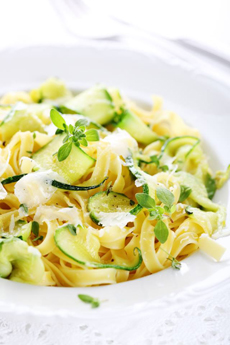
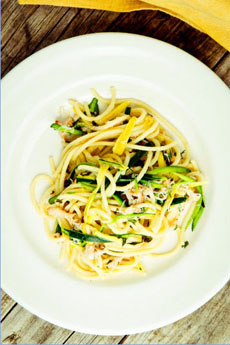
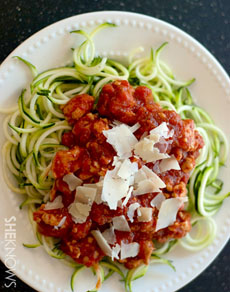
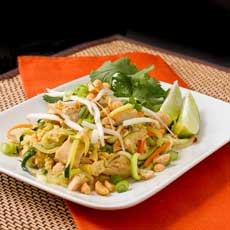
    [1] Zucchini and fettuccine noodles with shaved Parmesan cheese (photo courtesy Elegant Affairs Caterers. [2] Zucchini and linguine noodles in olive oil-garlic sauce (photo courtesy Good Eggs). [3] Zucchini noodles with Bolognese sauce (here’s the recipe from SheKnows.com). [4] Chicken Pad Thai with zucchini noodles (here’s the recipe from ImBored-LetsGo.com).

     
    1. BRING a pot of salted water to a rolling boil. Add the wheat noodles and cook for 7 to 10 minutes or until tender. SCOOP the noodles out with a mesh strainer, reserving the water; add them to a large bowl and set aside.

    2. ADD the zucchini noodles to the water and bring to a boil. Lower to a simmer and test after 5 minutes. Do not overcook. When ready, drain, reserving a bit of the pasta water and add to the wheat noodles. Stir to combine.

    3. HEAT the oil in a large skillet over medium heat. Add the garlic and cook for 2 minutes, until tender.

    3. WHISK the eggs lightly with a fork or mini-whisk; add them to the skillet and lightly scramble. Cook the eggs until they just solidify but are still moist. Remove the skillet from the heat and set aside on a trivet or other counter protector.

    4. MAKE the sauce: In a small bowl combine the soy sauce, lime juice, sugar, fish sauce and red pepper flakes. Add the sauce into the scrambled eggs in the skillet. Pour/scrape into the noodle bowl and toss to coat. At this point, if you want to serve the dish hot or warm, microwave briefly before adding the garnishes.

    5. ADD the green onions, cilantro, and peanuts over the noodles. Toss lightly to combine and serve.


    WonderVeg Spiralizer
    Beyond zucchini, the WonderVeg Spiralizer can transform any hard vegetable into long strands for “pasta” or for raw vegetable salads and garnish. Consider beet, carrot, cucumber, turnip and zucchini, plus others such as green papaya (photo courtesy WonderVeg.com).
     

    ZUCCHINI HISTORY

    Zucchini, Cucurbita pepo, is a member of the cucumber and melon family, Cucurbitaceae. It originated in Central and South America, where it has been consumed for thousands of years. It grew in different shapes, including round balls that can still be grown from heirloom seeds. But the variety most of us are familiar with was developed at the end of the 19th century near Milan, Italy.

    The word squash comes from Narraganset language of the Native Americans of Rhode Island, who used askutasquash, “a green thing eaten raw. The Pilgrims had difficulty pronouncing the whole word, and shortened it to squash. Either way, it was an extremely valuable source of food for both peoples, and one that we also heavily rely on as a source of nutrition for a large part of the season.

    The word zucchini comes from the Italian zucchino, meaning a small squash (zucca is the word for pumpkin). In the wonderful world of food fusion, the word squash comes from the Indian skutasquash meaning “green thing eaten green.” Christopher Columbus originally brought seeds to the Mediterranean region and Africa.

     
    The French turned their noses up at zucchini (courgettes) for a long time until cooks learned to choose small fruits, which are less bland and watery. The same tip still applies: the smaller, the better.

    While a botanical fruit*, zucchini is treated as a vegetable. With the exception of zucchini bread and zucchini muffins, both made with sugar, it is typically cooked as a savory dish or accompaniment. has its ancestry in the Americas. However, the varieties of squash typically called “zucchini” were developed in Italy, many generations after their introduction from the Americas.
     
    __________________
    * Zucchini is a fruit, as are all squash, cucumbers and other members of the Cucurbitaceae family. It is the swollen ovary of the zucchini flower; zucchini blossoms are also eaten, stuffed and sautéed.
      

    Comments off

    The Nibble Webzine Of Food Adventures


    © Copyright 2005-2026 Lifestyle Direct, Inc. All rights reserved. All images are copyrighted to their respective owners.