|
August 1st is National Spritz Day, and we’re going to have an Aperol Spritz. (August 13th is National Prosecco Day, when we’ll have another one.)
While we’d always perused the specialty cocktail menu at restaurants for some interesting combination of ingredients (the type of recipe you’d never thought to put together), our colleague Rowann has always ordered an Aperol Spritz, an apéritif created in northern Italy.
One day we tasted hers, and yum! We’ve now become an Aperol Spritz enthusiast.
So what’s an Aperol Spritz?
It’s an easy-to-make glass of deliciousness. Here’s the recipe.
There are different types of spritz drinks. So:
> What’s a spritz, and the history of the Aperol Spritz, are below.
> Beyond the Aperol Spritz: A Blood Orange Mimosa x Aperol Spritz Mashup.
> The year’s 49 cocktail holidays.
> The year’s 22+ white wine holidays.
> Trivia: Why is Prosecco capitalized? It’s the name of the village of Prosecco, in the province of Trieste, Italy, where the wine was first made.
RECIPE: APEROL SPRITZ
Ingredients
3 parts Prosecco
2 parts Aperol (see below)
1 splash of soda water/club soda
Ice cubes
Garnish: orange slice*
Optional garnish†: chamomile, chervil, lavender, rosemary savory, tarragon, thyme
Preparation
With these instructions, you don’t even have to measure.
1. FILL a wine glass (substitute a rocks glass, but a wine glass is traditional) with ice. Pour the Prosecco a tad more than halfway up the glass.
2. POUR the Aperol halfway to halfway between the Prosecco and the rim of the glass. Pour it in this order so the Aperol won’t settle to the bottom.
3. TOP off with a splash of soda water. Garnish with a slice of orange and serve. While an herb garnish is not traditional, if you have the right kind of herb—delicate without strong aromatics—feel free to add a sprig.
(You can use this recipe to make a spritz with any apéritif you happen to have: Campari, Cynar, Dubonnet, Lillet, vermouth, etc.).
Since Prosecco has an A.B.V. of 12%‡ (24 proof), the combination of the Prosecco and Aperol (11% A.B.V. – 22 proof) yields a low-alcohol drink.
According to Drinks International 2019, in The World’s Best-Selling Classic Cocktails 2019, the Aperol Spritz ranks ninth on the list of the world’s best-selling cocktails.
WHAT’S A SPRITZ?
A spritz is a wine-based cocktail made with Prosecco, a bitter liqueur such as Aperol, Campari, or Cynar, and sparkling soda water.
It is often called a spritzer in the U.S. (e.g., “I’ll have a wine spritzer”), but spritz is correct.
THE HISTORY OF APEROL & THE APEROL SPRITZ
Before the Aperol Spritz came the spritz, Here’s more about it.
The apéritif Aperol was launched in 1919 in Padua, in the Veneto region of northern Italy. It was created by brothers Luigi and Silvio Barbieri, who had inherited a liqueur company from their father five years earlier.
It is bitter as opposed to dry white wine, such as Lillet. A bitter, or bitters, is an alcoholic preparation flavored with botanicals (herbs, flowers, roots) to create a beverage characterized by a bitter, sour or bittersweet flavor.
Aperol has:
A bright orange color, from the infusion of bitter and sweet oranges.
A proprietary mix of herbs and roots, including gentian, rhubarb, and cinchona, among others.
A low A.B.V.: 11% alcohol by volume, compared with 40% for spirits
In the 1950s, the Aperol Spritz became a popular alternative to the wine spritzer, a mix of white wine and soda popularized in Venice.
It remained known largely to Italians, however, until 2003, when Gruppo Campari bought the Aperol brand from the family business. That engendered a worldwide campaign promoting the Aperol Spritz.
Although it tastes and smells similar to Campari, Aperol is less bitter and has half the alcohol contact. Campari has higher sugar content.
For more information visit Aperol.com.
WHAT IS AN APÉRITIF &
THE HISTORY OF APÉRITIFS
Derived from the Latin verb aperire, which means “to open,” an apéritif (ah-PAY-rih-TEEF) is an alcoholic drink consumed prior to a meal (i.e., the “opening act” for lunch or dinner).
It was believed to whet the appetite and “prepare the taste buds” for the meal to come. (An alcoholic drink served after the meal, to aid digestion, is a digestif [dee-jes-TEEF].)
The exact origin of the apéritíf is not known, but we do have a reference from the 5th century from a Christian ascetic, Diadochos of Photiki, who referred to them as “those artificial concoctions which are ‘apéritifs’—presumably because they open a way to the stomach for the vast meal which is to follow.”
(Source).
We know that a few centuries later, in medieval times, a concoction of bitter herbs and fruity wines was served prior to meals to improve digestion.
For centuries in Spain, apéritifs have been a staple at tapas bars.
|
|
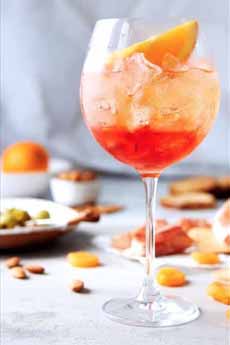
[1] An Aperol Spritz is typically served in a wine glass, but any glass will do (photo © DeLallo).

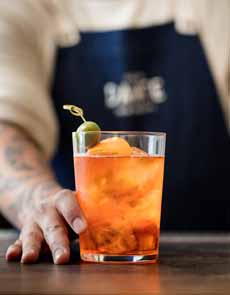
[2] This creative Aperol Spritz substitutes a salty olive for the sweet orange garnish (photo © Dante Restaurant | NYC).
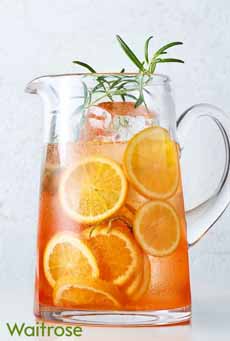
[3] A great idea from Waitrose: Make them by the pitcher (photo © WaitroseWaitrose).
[4] How about an Aperol Spritz ice pop? Here’s the recipe from Palm Springs Style).
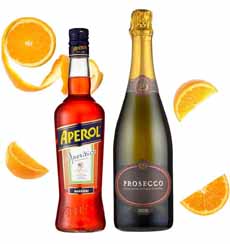
[5] Send a DIY Aperol Spritzer gift to summer hosts, with this duo from Think Liquor (photo © Think Liquor).
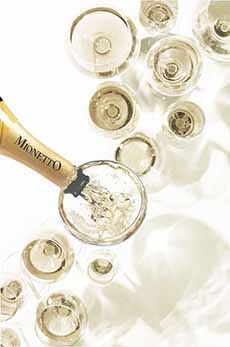
[6] Prosecco is an affordable bubbly and a great mixer for cocktails. Here’s more about it. Also check out the different types of sparkling wine (photo © Mionetto)
|
Apéritifs were already widespread in 19th century Italy, where they were being served in fashionable cafés in Turin (where the Aperol Spritz was born), Genoa, Florence, Milan, Rome and Venice.
Apéritifs became very popular in Europe in the late 19th century. The popularity in Europe crossed the Atlantic and by 1900, they were also commonly served in the U.S.
An “apéritif ritual” born in Venice in the 19th century, served traditional snacks called cicchetti (chih-KET-tee) with the drink. It continues to this day.
Small dishes similar to tapas, cicchetti include tiny sandwiches, plates of olives, and tiny portions of local dishes (source).
Apéritifs became very fashionable across Europe in the late 19th century, and by 1900, were also popular in the U.S.
In the early 1970s in the U.S., the concept of “Happy Hour” emerged to encourage more people to stop by for a drink after work (although the term predates that).
Happy Hour included complimentary appetizers—cheese, crostini, crudités, mini egg rolls, pigs in blankets, Swedish meatballs, and more—served buffet-style with the purchase of a drink. There were often reduced-price drinks such as beer on tap and certain well drinks.
While apéritifs originated as light-bodied alcoholic beverages such as vermouth, these days, an “apéritif” can be anything that people want to drink, from wine to beer, or cocktails.
The particulars vary by country and region: The Spanish and Italian favorite, vermouth, is the most popular apéritif wine in the world.
Try it as a brunch drink, instead of a Bellini or a Mimosa.
HOW ABOUT AN APEROL SPRITZ ICE POP?
There are frozen drinks which are liquids, and then there are drinks that are frozen solid like these Aperol Spritz ice pops (photo #4).
Here’s the recipe from Palm Springs Style.
________________
*While a standard navel orange slice is typically used, if you can buy a blood orange, go for it. It’s more colorful, and (hopefully) more flavor.
†These are sweet herbs with tiny leaves.
‡Alcohol By Volume.
CHECK OUT WHAT’S HAPPENING ON OUR HOME PAGE, THENIBBLE.COM.
|