|

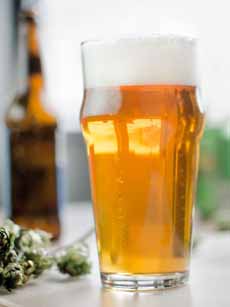
[1] A refreshing glass of IPA. The flowers to the left of the glass are hops (photo © Homebrewers Association).
[2] For IPA fanatics, there’s a special glass engineered to highlight the flavors and aromas of IPA (photo © Kegworks).
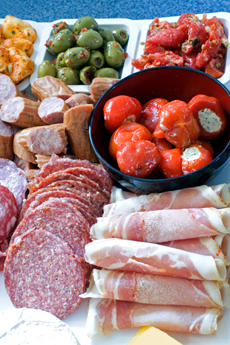
[3] On a summer day, enjoy a cold IPA with an antipasto plate (photo © Terrasprite | iStock Photo).
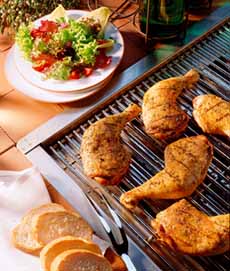
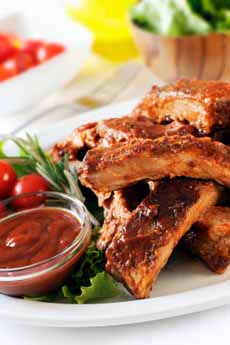
[4] IPA is a great pairing with ribs, or anything that comes off the grill (photo © Jack Jelly | iStock Photo).
[5] Steak on the grill, ready for an IPA (photo © Freeze Frame Studio | iStock Photo).
[6] Some people’s idea of a great meal with IPA: barbecue ribs (photo © EZForyu | iStock Photo).
|
|
The first Thursday in August—today—is National IPA Day, celebrating India Pale Ale, a highly-hopped style, more alcoholic beer.
There’s Saison Day, Stout Day, and even Barrel-Aged Beer Day, but we guarantee none of those beers have achieved the trend status of IPA.
A BRIEF HISTORY OF IPA
The pale ales of the early 18th century were lightly hopped. But a need for more hops and higher alcohol evolved.
In the 19th century, the British living in India drank ale from England, largely because the Indian water supply had microbes that caused digestive problems to people not raised on it.
But not all beer could hold up on the long journey in the hot hold of a ship. IPAs were created to have a level of alcohol (7%-8%) and hops (which act as a preservative) to withstand the voyage of up to six months.
In modern times, the transportation challenge has been eliminated and there’s plenty of bottled water for travelers abroad. But IPAs retained their popularity in the U.K.
Here are details on the history of IPA.
IPA IN THE USA
IPA wasn’t much brewed in the U.S. prior to the groundswell of the last 10 years. During this time, IPA has become the darling of American craft brewers and drinkers.
In fact, craft brewers are so focused on IPA that in 2018, The Brewers Association officially established three new substyles (types) of IPA, based on how the treatment of hops creates tropical aromas and flavors.
The three new styles are Juicy & Hazy Pale Ale, Juicy & Hazy IPA and Juicy & Hazy Double IPA. Here’s what defines hazy and juicy IPAs.
The Best Beers In America Poll
In this year’s “Best Beers in America” poll by Zymurgy* Magazine, six of the top 10 “best beers” are IPAs.
Here are the winning IPAs. If you’re a fervent IPA fan, track them down and hold your own competition.
The Great American Beer Festival
Not surprisingly, for more than a decade IPA has also reigned at the Great American Beer Festival (GABF).
American-Style IPA was the most-entered category at the annual GABF competition, only to be unseated in 2018 by its sibling—a new substyle of IPA called Juicy or Hazy India Pale Ale (see the difference in the styles below).
IPA FLAVORS & STYLES
IPAs brewed in the U.S.—called American IPAs—have flavors and aromas defined by their hops. American hops have citrus-like, piney or resinous hop character.
American IPAs are all about hop flavor, hop aroma and hop bitterness. Instead of floral and spicy European hops, American hops, grown in the Pacific Northwest, provide distinctively different flavor notes.
There are many varieties, bred for specific flavors such as:
Earthy spiciness with citrus, from Willamette hops.
Fruit explosion—orange, mango, passion fruit, peach and pineapple, from Citra hops; blueberry, tangerine, peach, pineapple and pine from Mosaic hops.
Grapefruit, from Cascade hops, and grapefruit-and-floral, from Centennial hops.
Herbaceous, providing notes of pine resin, from Columbus, Tomahawk and Zeus hops.
Orange blossoms from Amarillo hops.
Pine and citrus, from Chinook hops.
Combination: grapefruit, pine, sweet onion and tropical fruit, from Simcoe hops.
There are many different hops from which brewers can choose, not just for IPA but all styles of beer.
In addition to Europe, Australia, New Zealand and other areas grow still more species of hops. Here’s more about them.
AMERICAN IPA STYLES
Within a category even as narrow as American IPA, different styles can be achieved by using different brewing techniques, particular strains of yeast, varieties of hops, the timing of adding the hops, and adjusting the chemistry of the water, and more.
Among American IPA brewers, three main styles have evolved. Although the style has become popular in the region, it need not be brewed in that region. Nor must any brewer in a particular region subscribe to a particular style.
East Coast IPA, a style favored by some craft brewers, is less hoppy than a West Coast IPA. It has a greater malt presence that balances the intensity of the hops. According to Wikipedia, West Coast breweries tend to use hops from the Pacific Northwest, while East Coast breweries tend to favor spicier European hops and specialty malts.
New England India Pale Ale or Northeastern Pale Ale is a style invented in Vermont in the early 2010s. It is characterized by juicy, citrus, and floral flavors, with a more subtle and less piney hop taste than typical IPAs; sometime it’s called Juicy IPA. It also has a hazy appearance, and is sometimes called Hazy IPA.
West Coast IPA, a style invented in California,is known for bracing bitterness, intense hop aromas and higher-than-average A.B.V.
And now, the Milkshake IPA! Really!
This new style introduces lactose† into the brewing process, often with the addition of a fruit and a vanilla bean. It has a lighter appearance and a thicker body—hazy like New England IPAs. The biggest difference between the two is the addition of lactose.
As in any hot category, expect even more innovation coming down the pike.
PLUS, if you like high-alcohol IPA, look for Double IPA from the U.K.
Also called Imperial IPA, hey are a stronger, very hoppy and high-alcohol IPA style (the beers typically have alcohol content above 7.5% A.B.V.).
PAIRING IPA WITH FOOD
Serve an IPA with robust food: red meat and strong cheeses.
For summer, barbecue, brats and other grilled foods—including burgers and hot dogs—and antipasto plates welcome pairing with an IPA.
For winter, any hearty food will do: roasts, sausages, soups, stews, etc.
|