|
September 26th is National Dumpling Day. Since National Apple Dumpling Day on September 17th, it begged the question: What are dumplings? Depending on the part of the world, the answer is different. In this article you’ll learn:
What are dumplings?
The different types of dumplings.
An idea for a dumpling party.
The history of dumplings.
And for an explanation of why it’s so difficult to classify dumplings in our food system, see the ‡footnote.
WHAT ARE DUMPLINGS?
What is universal is that a dumpling made from some type of dough, cooked and usually served warm or hot.
It can be filled or not filled; i.e., simply a ball of dough—like suet dumplings*, gnocchi, knödel and a variety of sweet dumplings.
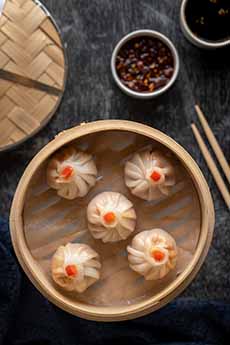
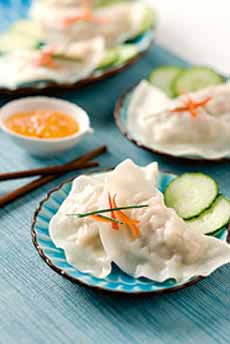
One unique type is the Chinese soup dumpling, a flour dough filled with broth and then steamed.
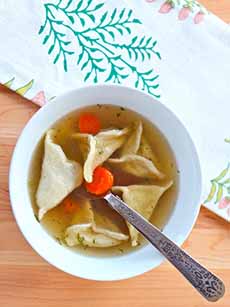
Other “soup dumplings,” like Chinese wontons, Eastern European kreplach (photo #6) and matzo balls, Italian tortellini and Polish pierogi (photo #2), are filled with meat or vegetables and served, boiled, in broth (they can also be prepared in other ways beyond soup).
So: We’ll agree that a dumpling is a small mass of soft dough that is cooked using different methods.
Sometimes the dough is rolled out to encase a filling; other times it’s formed into a ball or similar shape and cooked as is.
Plus:
A dumpling is most often bite-size.
It can be savory (cheese, fish/seafood, meat, vegetables) or sweet (bean paste, fruit, nuts, sweetened cheese).
It can be in a simple dough or a more complex flaky pastry.
The dough can be made from a variety of starch sources, including bread, corm and potatoes.
If filled, the dough can be crimped or folded and sealed to make an enclosed pocket.
It can then be baked, boiled, deep-fried, pan-fried or steamed.
It can be served as an hors d’oeuvre, a snack, an appetizer, a side dish, a garnish for soups and stews, a dessert.
It is found in cuisines around the world, on the six of the seven continents (we couldn’t find them in Antarctica).
The lines determining what a dumpling is, or isn’t, can cross over. For example, we may think of ravioli as a pasta, but it’s also a type of dumpling.
Is a tamale a dumpling? It’s fits the criteria above: an outer layer made with dough (here corn-based), filled, completely enclosed and then steamed.
Then there filled bread buns, such as Chinese steamed pork buns. Are they dumplings as well as buns? Well…yes.
How about a knish? Isn’t it a savory pastry? Yes, and it’s also a baked dumpling.
Here’s a discussion of the topic.
DUMPLINGS OF THE WORLD
If you’re a dumpling lover, chances are that you can’t get enough of them. How about having a dumpling party? Invite your favorite cooks to prepare different recipes, whether from cookbooks or from their ancestral homelands. Those who can’t cook can get Chinese or Japanese take-out.
We wish we could illustrate the following with photos, but space does not allow. Instead, we’ll focus on expanding this article for next year’s National Dumpling Day, with descriptions and links to recipes.
Before we list the dumplings, here’s a bit of trivia:
In China, the birthplace of the dumpling, there are so many different types of dumplings that there isn’t just one word to describe them all—i.e., no word in Cantonese, Mandarin for “dumpling.”
Try to look it up, and you’ll find jiǎozi, a style folded to look like a gold or silver Chinese ingot (here’s more about them). But there are different shapes and folds of Chinese dumplings, each with a different name.
Here are just some of the world’s delicious dumplings.
Savory Dumplings
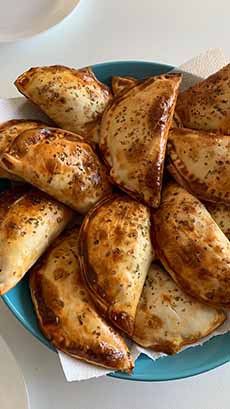
Argentina: empanadas
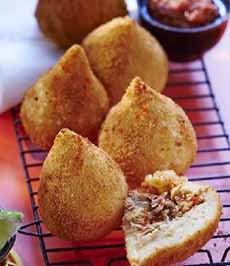
Brazil: coxinhas (photo #8)
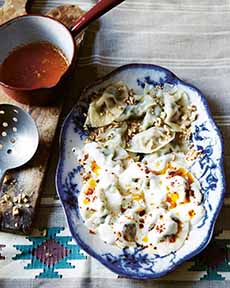
Central Asia & Middle East: chuchvara (also called dushbara, joshpara and shishbarak), manti (photo #9)
China: cha siu bao (steamed pork buns) guo tie (fried crescents, a.k.a. potstickers—photo #4), har gow (shrimp in a transparent skin), jiaozi, shui jiao (boiled crescents), shu mai (shrimp and pork blend), siu mai (open-top round baskets shape), xiao long nao (soup dumplings—photo #1), wonton and numerous others
Czech Republic: svestkove knedlíky
Denmark: aebleskiver
Eastern Europe: knish, kreplach (photo #6), matzo balls
Ethiopia: tihlo
France: boulette
Georgia: khinkali
Germany: Knödel, Maultasche, Nockerl, Spaetzle
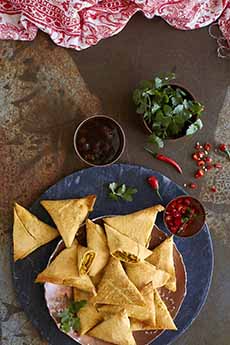
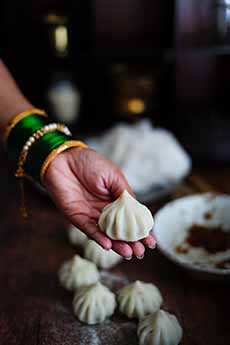
India: gujia, malai kofta, modak (photo #7), pitha, samosa
Italy: pillow pasta: agnolotti, gnocchi, ravioli, tortellini
Japan: gyoza
Jewish: matzoh balls
Korea: mandu
Latin America: pasteles (in Colombia, the Dominican Republic, Panama, Puerto Rico, Trinidad and Tobago
Lithuania: koldūnai,virtiniai
Malta: pastizzi
Nepal & Tibet: momo (also India)
Poland: kluski, pierogi (photo #2), uszka
Portugal: empanadas, rissóis
Russia: pelmeni (photo #10)
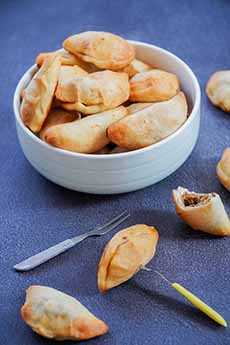
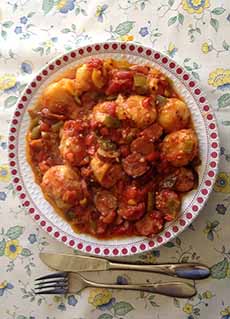
Spain: empanadas (photo #3)
Sweden: kroppkaka
Thailand: sticky rice dumplings
Ukraine: varenyky
USA: Drop dumplings and numerous others (see †footnote)
Vietnam: bahn bot loc
Sweet Dumplings
Fruit Dumplings (USA): fruit dumplings (usually apples or berries) baked in pastry.
Cho Muang (Thailand): A rice and tapioca flour wrapper with sweet or savory filling, colloquially known as the Thai flower dumpling.
Daifuku (Japan): Made with glutinous rice flour and a sweet filling.
Gok Zai/Yau Gok (Cantonese): Fried Dumplings filled with sweetened coconut, peanuts, and sesame, a New Year’ staple.
Gulab Jamun (India): Fried milk-based dessert balls soaked in rose water syrup.
Tang Yuan (Southern China): Glutinous rice dumplings with peanuts or other sweet fillings.
READY TO PARTY?
So get ready for that dumpling party. Dumplings can be your appetizer, main course and dessert.
They’re great with beer, black tea (no milk or sugar) and wine.
It should be quite a party!
DUMPLING HISTORY
Dumplings were invented in China, the world’s oldest extant civilization and one that created so many things that are an essential part of our lives.
There are so many it would have taken too long to count them. But just a few: bronze (1700 B.C.E.), the compass (1100 C.E.), gunpowder (1000 C.E.), iron smelting (1050 B.C.E.), the kite (invented for military purposes, 1000 B.C.E.), the mechanical clock (725 C.E.), moveable type printing (960 C.E.), paper (105 C.E.), paper money (9th century C.E.), porcelain (1600 B.C.E.), row crop farming (6th century B.C.E.), the toothbrush (1498 C.E.) the umbrella (1500 B.C.E.) and—no surprise—acupuncture (300 B.C.E.), silk (4000 B.C.E.) and tea production (2737 B.C.E.) [http://china.usc.edu].
So the dumpling may seem a bit of an anticlimax.
The Dumpling Is Born
Its invention is attributed to Zhang Zhongjing, who lived in the Eastern Han Dynasty, the second imperial dynasty of China (206 B.C.E. to 220 C.E.) [source].
He was a pharmacologist, physician, inventor, and writer—one of the most eminent Chinese physicians during the later years of the Han dynasty.
He established medication principles and is considered the seminal founder of traditional Chinese medicine. Here’s more about him.
The story says that, returning to his home town after a long absence, during a difficult winter (and long before central heating), he noticed many people suffering from frostbite, especially around the ears. To he
To administer aid, Zhongjing took mutton, herbs and chiles, wrapped them in scraps of dough and folded them to look like ears (crescents) and voilà: jiaozi (potstickers).
He then steamed them to create something warm, nutritious, and may we add, delicious and comforting.
The herbs helped to improve blood circulation and prevent frostbite and the villagers loved the taste so much that they kept making the dumplings long after spring began [source].
The Dumpling Goes Global
The concept spread across the globe—not just as a tasty dish for keeping warm, but as a way to extend a limited amount of meat by mixing it with chopped vegetables or stale bread before boiling.
The first known dumpling recipe is found in “De Re Coquinaria” (“The Art of Cooking,” also “De Re Culinaria,” “On The Subject Of Cooking). It’s the the oldest surviving cookbook, thought to be be compiled in the 1st century C.E.
While its author is given as Apicius, likely it was compiled by different writers and named in honor of a well-known Roman gourmet, Marcus Gavius Apicius, who lived in the 1st century.
You can take a look at it here. It’s also available on Amazon in the original Latin, as well as in German and Italian translations.
The Word “Dumpling” First Appears
It wasn’t until the early 17th century that dumplings got their English name.
One authority dates the word to 1600, in the Norfolk dialect of Great Britain.
According to the Oxford Languages Dictionary, the first use of “dumpling” appears to be derived from the adjective “dump,” “of the consistency of dough.”
Another source claims “uncertain origin, perhaps from some Low German word or from obsolete noun dump “lump.’ However, the object it denotes—a small and usually globular mass of boiled or steamed dough—no doubt existed long before that.” Dampf is a German word for steam (so how about steaming the lump of dough?) [source].
Bring on the dumplings!
________________
*The American version of British suet dumplings are the biscuit dumplings in the dish Chicken and Dumplings. The dumplings are made of biscuit dough, which is a mixture of flour, shortening, and liquid. They are then dropped into chicken broth and boiled. Chicken and dumplings is a soup that consists of a chicken cooked in water, with the resulting chicken broth being used to cook the dumplings by boiling.
Other American dumplings are rolled and cut into strips or squares before being added to soup or are hand-shaped (cornmeal dumplings, potato dumplings). There are even bread dumplings, made from stale bread mixed with eggs and seasonings.
|
|

[1] Xiao long bao: Chinese soup dumplings (photo © Shardar Tarikul Islam | Unsplash).
[2] Pierogies from Poland. Add some sour cream! (photo © Karolina Kolodziejczak | Unsplash).
[3] Empanadas, original from the Galicia region of Spain and from Portugal, which is immediately south of it (photo © Mary Locuaz | Pexels).
[4] Chinese guo tie, called potstickers in the U.S. These are steamed but they can also be fried (photo © Chesapeake Bay Crab Cakes)
[5] Samosas from India (photo © The Fry Family Food Co. | Unsplash).
[6] Kreplach is a dumpling most often made to serve in the chicken soup of Jewish cuisine. Here’s the recipe (photo © Tori Avey).
[7] Modak, from India (photo © Prachi Palwe | Unsplash).
[8] Coxinhas, Brazilian dumplings, are deep-fried and can also be considered croquettes. The starch used is mashed potato Here’s a recipe (photo © Kroger).
[9] Manti, from Central Asia and the Middle East, here made with ground lamb and served with yogurt and mint. Here’s the recipe (photo © Delicious Magazine).
[10] Russian pelmeni are often served in soup or with sour cream. Here, a fusion approach: tomato sauce (photo © JaBB | CC-BY-NC-ND 2.0 License).
[11] Apple dumplings. Baked in pastry, they can be served as dessert with a sauce, or as a side with stews and other savory dishes (photo © Kevin K. | Unsplash). |