THE NIBBLE BLOG: Products, Recipes & Trends In Specialty Foods


Also visit our main website, TheNibble.com.

Fat Miilk Vietnamese Coffee, A Robusta Experience


[1] Vietnamese iced coffee. A swirl of sweetened condensed milk makes it as sweet as you like (photo © Demi Deherrera | Unsplash).


[2] You can drink Vietnmese coffee hot, of course (remaining photos © Fat Miilk).


[3] Three of the four blends of Fat Miilk beans.


[4] A phin is the Vietnamese equivalent of the pour-over cone for American drip coffee.


[5] These charming phins are available in four colors, to match the colors of the bean packages.


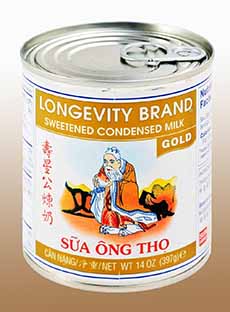
[6] You can use any brand of sweetened condensed milk, but we like the Longevity brand from Vietnam. It’s made with whole milk for extra creaminess, and as a result, lightens coffee much better than most other brands. It also has a fuller flavor, more distinctly “condensed milk” than American brands (photo © Sun Hing Foods).


October 1st is International Coffee Day, and we’ve got an international brand for you: Fat Miilk, from Vietnam. Unlike the arabica coffee beans used in most of the coffee consumed in the U.S., Fat Milk is made from the robusta varietal, a bean with twice the caffeine and twice the antioxidants. The result is “coffee more robust than your everyday joe,*” says the brand. The beans are sourced ethically and directly from Vietnamese farmers.

Vietnam is the world’s number-one producer of robusta beans, and it’s the coffee drunk throughout Vietnam.

If you’ve never had robusta, you’re in for a special taste experience: nutty, chocolatey, bold, and full of character.

The strong and robust flavor is best achieved by dripping the coffee, through a device called the phin drip (photo #4).

The company’s goal is to introduce Vietnamese coffee culture, tradition, and flavor to the U.S., and to show that robusta beans, which are often portrayed as inferior to robusta beans, deserve a place in our own coffee culture.

One of the founders knows Vietnamese coffee as well as anybody: Her family has a coffee farm in the Central Highlands of Vietnam.
 
 
THE FAT MIILK LINE

There are currently four roasts:

  • The Blue Roast: full-bodied with flavors of bittersweet chocolate, molasses and toasted almond.
  • The Red Roast: a single origin dark roast, with flavors of dark milk chocolate and roasted cashews.
  • The Yellow Roast: a medium roast with light acidity and notes of almonds and smoked caramel.
  • The Humility Blend: a smooth, well-balanced blend of arabica and robusta beans, with medium acidity and notes of roasted cashews, black tea and citrus (this is the only roast with arabica beans).
  •  
    Buy them online at FatMiilk.com.

    The line is also available at stores in Chicago, Missouri and New York.

    Here’s a store locator.
     
     
    HOW TO BREW A CUP OF FAT MIILK

    You can purchase whole or ground beans and brew them as you currently brew coffee. But the best Vietnamese coffee brewing employs a combination of drip (pour-over) and French press methods.

    And before we get into the details, let us say that these are a terrific gift for coffee lovers.

    Traditional Vietnamese brewing uses a device called a phin, which sits on top of the cup.

  • As with a pour-over, the coffee grounds in the phin are dampened with a splash of hot water.
  • Then, the phin is filled to the top with water.
  • Next comes the top of the phin, which presses down on the grounds like a French press.
  • Within 5 minutes, your cup is ready to drink—with or without the addition of sweetened condensed milk.
     
    Use the sweetened condensed milk, and your drink will be rich, creamy and sweet—almost a dessert drink.

    Use your regular milk of choice, or no milk at all, and you’ll still have a great cup of coffee.

    There’s a procedure guide to brewing on the Fat Miilk website. It’s easy to brew; and after the first try, you’ll be a pro.
     
     
    THE HISTORY OF VIETNAMESE COFFEE

    In the mid-19th century, during the rule of French Indochina, the French introduced coffee to Vietnam.

    The soil, climate and elevation were ideal for coffee farming. The Vietnamese became prolific producers and exporters of the beans.

    Vietnam is now the world’s second-largest producer of coffee, behind Brazil.

    The drink of choice in Vietnam is iced coffee with sweetened condensed milk, or cà phê sũ’a đá. The addition of the canned milk was inspired by the French, when fresh milk was hard to procure.
     
     
    WHAT ABOUT THE WATER BUFFALO LOGO?

    The water buffalo is an integral part of agriculture in Vietnam. They are a symbol of strength, loyalty, and prosperity. They’re treated as family, and are often a farmer’s most valued possession.

    The water buffalo in Fat Miilk’s logo embodies the animal’s faithful spirit to humanity and tenacious work ethic. It gets quite poetic:

  • The head represents the traditional slow-drip phin.
  • The coffee leaves make up the ears.
  • The beans are depicted as the eyes and nose.
  •  
    Every element is carefully crafted to honor a treasured member of the family.

    Ah, if only we Americans waxed poetic about our own beloved family members.


    > The History Of Coffee
     
    > The Different Types Of Coffee
     
    > The Different Types Of Espresso


    ________________

    *Cup of Joe, or Joe for short, was named after Admiral Josephus “Joe” Daniels (May 18, 1862 – January 15, 1948), Chief of Naval Operations, who outlawed alcohol on board ships and ordered coffee as the beverage of service. The term, “Cup of Joe” followed; and because sailors wanted their cup of joe hot, Hot Joe was shortened to Hojo. But according to Snopes, this is a myth. Read the Snopes article for three other theories.

    Josephus Daniels was a newspaper editor and publisher from North Carolina who was appointed by President Woodrow Wilson to serve as Secretary of the Navy during World War I. He was also a close friend and supporter of President Franklin Roosevelt and served as his Ambassador to Mexico from 1933 to 1941. Daniels banned alcohol from United States Navy ships in June 1914. This led to the folk etymology that a “cup of joe,” referring to a cup of coffee derives from Daniels’ name. However, this appeared to be a myth, rather than the truth.


    @fatmiilk

    Comments off

    National Coffee Day & The Pumpkin Spice Latte History

    Sixty-two percent of Americans drink coffee every day [source]. So de facto, millions of Americans will be celebrating National Coffee Day, September 29th. (International Coffee Day is October 1st).

    There are more fun coffee stats below. But first, in honor of fall, let’s give some time to the Pumpkin Spice Latte.

    The drink is available in 50 countries worldwide, and an estimated 424 million have been sold. That’s an estimated $1.4 billion in sales since its launch in 2003!

    > The history of the Pumpkin Spice Latte follows.

    > Also, Pink House Alchemy, a higher-quality PSL syrup.

    Elsewhere on The Nibble:

    > The pumpkin spice latte recipe.

    > The year’s 25 coffee holidays. National Latte Day is February 11th, and National Pumpkin Spice Day is October 1st.

    > The different types of espresso drinks.

    > The different types of coffee and coffee drinks.

    > The history of coffee,

    > The history of espresso.
     
    Pumpkin Spice Latte In A Glass Cup
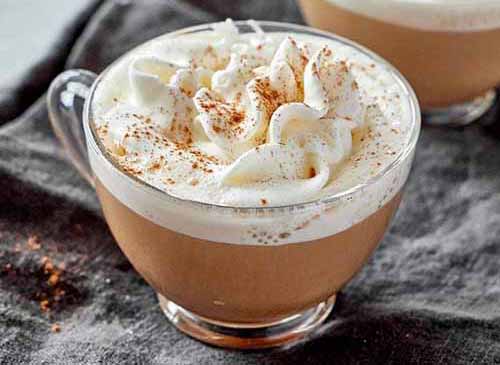
    [6] PSL in a fancy cup (photo © Taste Of Home).
     
     
    THE HISTORY OF THE PUMPKIN SPICE LATTE

    The PSL was conceived on a spring day in 2003 by a Starbucks product development team. The team had developed the recipes for seasonal favorites such as Eggnog Latte and Peppermint Mocha, and were looking for a new beverage to add to the fall lineup.

    They brought in kitschy fall decorations and pumpkin pies, and began to explore ideas for a pumpkin-inspired espresso beverage. They would sample a forkful of pumpkin pie, followed by a sip of hot espresso. Slowly they teased out which flavors from the pie best complemented the coffee.

    Over the next three months, the team tasted and re-tasted different versions of the beverage. They settled on a recipe that used pumpkin spice sauce with cinnamon, clove and nutmeg, made with espresso and steamed milk. The drink was topped off with whipped cream and a dash of pumpkin pie topping.

    In the fall of 2003, the beverage was introduced at 100 Starbucks stores in Vancouver and Washington, D.C. It was an immediate hit. A new fall tradition was begun.

    One of the original name ideas was Fall Harvest Latte. Then we’d have had an FHL instead of the PSL. By the way, PSL was the original beverage code for Pumpkin Spice Latte, written by baristas on the cups. It soon became the drink’s nickname [source].

    In the fall of 2004, Pumpkin Spice Latte rolled out across the company’s U.S. stores. It is now available in nearly 50 countries throughout the Americas, Europe, the Middle East and Africa. It’s Starbucks’ most popular seasonal beverage.

    It has become more than a fall tradition. This year, Starbucks introduced the PSL in August!

    Did you know there is no pumpkin in Pumpkin Spice Latte?

    The flavor is created from pumpkin pie spices, a blend of all or some of the following: allspice, cinnamon, cloves, ginger and nutmeg.

    In fact, most pumpkin spice syrups do the same thing.
     
     
    PINK HOUSE ALCHEMY, ALL-NATURAL SYRUPS

    Pink House Alchemy is an artisan maker of syrups, bitters and shrubs.

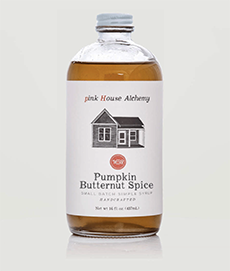
    Their Pumpkin & Butternut† Spice Syrup has the familiar autumn aromas and flavors.


    Cup Of Coffee with a Spoon
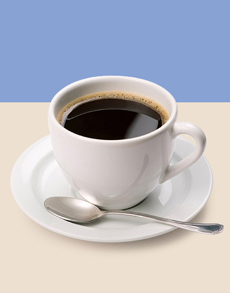
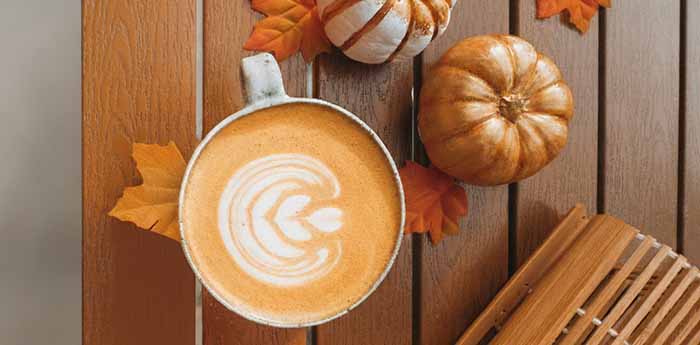
    [1] For National Coffee Day, we’re celebrating with something more festive than black coffee.


    [2] There is no pumpkin in a Pumpkin Spice Latte. It’s flavored with pumpkin pie spices (photo © Starbucks).


    [3] Pumpkin Butternut Spice Syrup from Alchemy House actually is made with real pumpkin purée (photo © Pink House Alchemy).

    Pumpkin Spice Latte Popcorn Recipe
    [4] Pumpkin Spice Latte popcordn. Here’s the recipe (photo © National Popcorn Board).

    Pumpkin Spice Latte Ice Pops
    [5] Pumpkin Spice Latte Pops. Here’s the recipe (photo © Zoku).

     
    But unlike most other syrups you’ll come across, this is made from actual fruit* purées: pumpkin purée and butternut purée‡. The syrup is spiced with cardamom and maple and sweetened with brown sugar.

    It’s a great gift for anyone who has ever said, “I need a pumpkin spice latte!”

    Just to give a shout-out to the other flavors: Blackberry Sage, Cardamom, Dark Cherry Grenadine, Ginger, Hazelnut, Herbalicious (lavender, mint, rosemary, thyme), Hibiscus Rose, Lavender, Mexican Chile, PH Delight (cinnamon, honey, vanilla), Sarsaparilla, Simple Syrup, Strawberry, Toasted Caramel, Tonic Syrup (to pair with gin cocktails), Vanilla Bean and Winter Mint.

    Use any of them in cocktails, non-alcoholic drinks hot and cold, to make sodas and flavored seltzers, as a dessert syrup, even to toss with popcorn.

    > Check them out at PinkHouseAlchemy.com.
     
    Pumpkin Spice Latte
    [7] Pumpkin Spice Latte (Gemini Photo).
     
    ________________

    *Squash (of which pumpkin is one) are fruits, not vegetables. Here’s the difference between fruits and vegetables.

    †In case you’re wondering why a syrup made of purée is clear, not cloudy, it undergoes a proprietary filtration process.

    ‡Why butternut squash? Much of the canned pumpkin in stores is not pumpkin at all. It’s a blend of other winter squash types, including Boston Marrow, butternut, Golden Delicious, and Hubbard. These squash varieties are less stringy than pumpkin, with more natural sweetness and deeper color than pumpkin.
     

    CHECK OUT WHAT’S HAPPENING ON OUR HOME PAGE, THENIBBLE.COM.


    Comments off

    Caviar Ice Cream Cone & More Fun Caviar Recipes


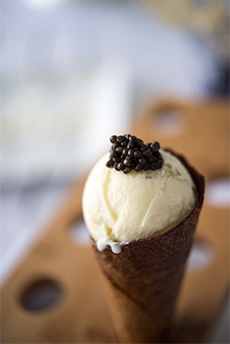
    [1] Yes, it’s ice cream with caviar—or to be precise, unsweetened Greek yogurt gelato (photo © Pointy Snout).

    Container Of FAGE Greek Yogurt
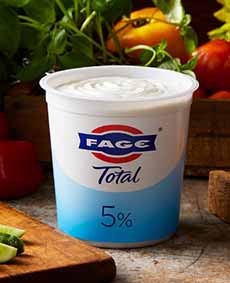
    [2] Use 5% Greek yogurt to make ice cream: It’s whole milk yogurt (photo © FAGE USA).


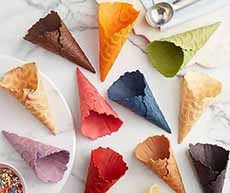
    [3] Artisan ice cream cones from The Konery (photo © The Konery).

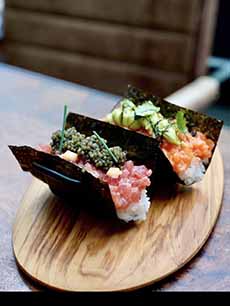
    Fancy Sushi Hand Rolls - Temaki
    [4] Smoked salmon and caviar “tacos,” with diced tuna, sushi rice, and nori [dried seaweed sheets]* (photo © L T Bar & Grill | Hackensack, NJ).


    July 18th is National Caviar Ice Cream Cone Day, but we didn’t want to wait that long to share this photo of a caviar-topped ice cream cone. It was developed at the behest of Pointy Snout Caviar, and it sounds delicious.

    The “ice cream” is gelato made from plain (unsweetened) Greek yogurt by Chef David Standridge of Cafe Clover in New York City (alas, closed due to the pandemic).

    The artisanal cone was made by Jeff Thompson, Executive Chef at the Wheatleigh Hotel in Pittsfield, Massachusetts.

    And to top it off, sustainable caviar from Pointy Snout.

    Is our mouth-watering? You bet!

    We’re getting ready to put some Greek yogurt into our ice cream machine and order some groovy artisanal cones from The Konery.

    We’ll enjoy them with vodka, or maybe Champagne.

    If your budget doesn’t allow sturgeon caviar for your food fun, here are 16 types of more affordable caviar, along with the history of caviar.

    And while we’re at it, here’s:

  • The history of the ice cream cone.
  • The history of ice cream.
  • The difference between ice cream and gelato.
  • The different types of ice cream and other frozen desserts.
  •  
     
    FUN CAVIAR RECIPES

  • Baby Potato Bites With Salmon Caviar
  • Bacon-Infused Caviar
  • Beggar’s Purses
  • Caviar & Smoked Salmon Sandwich
  • Caviar Cigar
  • Caviar Cocktail Garnish
  • Chocolate Caviar Tartlet
  • Christmas Sushi & Sashimi With Caviar
  • Cocktail Omelets With Trout Roe
  • Corn Pancakes With Smoked Salmon & Caviar
  • Deluxe Deviled Eggs
  • Empty Crab Legs With Caviar
  • Lobster Roll With Caviar
  • Lobster-Topped Guacamole With Caviar
  • Oysters & Pearls
  • Raw Scallops & Caviar
  • Red Caviar Hearts
  • Salmon Caviar Bagel
  • Scallops, Beets & Caviar
  • 7-Layer Bites With Caviar & Smoked Salmon
  • Soft-Boiled Eggs With Caviar
  • Steak & “Eggs”
  • Tobiko Caviar Garnish
  • Quail Egg & Caviar Croustades
  •  
     
    ________________

    *The other “taco” is diced salmon topped with sliced avocado and cilantro.


    CHECK OUT WHAT’S HAPPENING ON OUR HOME PAGE, THENIBBLE.COM.


    Comments off


    © Copyright 2005-2026 Lifestyle Direct, Inc. All rights reserved. All images are copyrighted to their respective owners.