THE NIBBLE BLOG: Products, Recipes & Trends In Specialty Foods


Also visit our main website, TheNibble.com.

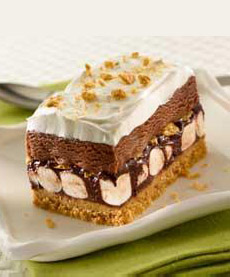
RECIPE: S’mores Ice Cream Cake

August 10th is National S’mores Day, a cookie sandwich first popularized in the 1920s by the Girl Scouts.

The love of the gooey treat has led to many other recipes combining the three ingredients: chocolate, graham crackers and marshmallow.

Today we present a S’mores Ice Cream Cake, with more luscious recipes below.

The recipe was developed by Country Crock. Prep time is 20 minutes, freeze time is 5 hours.
 
 
RECIPE: S’MORES ICE CREAM CAKE

Ingredients For 16 Servings

  • 2 cups graham cracker crumbs
  • 1/2 cup unsalted butter or Country Crock Spread, melted
  • 1/3 cup sugar
  • 1 package (12 ounces) semi-sweet chocolate chips
  • 4 cups mini marshmallows, divided
  • 1 cup 2% milk
  • 1 cup graham crackers,crumbled
  • 1.5 quart rectangular container chocolate ice cream (e.g. Breyers)
  • 1 container (8 ounces) whipped topping or stabilized whipped cream
  • Optional garnish: graham cracker crumbs or mini chocolate chips
  •  
    Preparation

    1. MAKE the crust. Combine the graham cracker crumbs, melted butter and sugar in medium bowl. Press into a 13 x 9-inch glass or ceramic baking dish.

    2. COMBINE the chocolate chips, 2 cups of the marshmallows and the milk in a small, microwave-safe bowl. Microwave at HIGH for 4 minutes or until completely melted, stirring once.

    3. COOL for 10 minutes, then stir in the remaining 2 cups marshmallows. Spread over the crust; freeze for 1 hour or until firm.

    4. TOP the chocolate layer with the crumbled graham crackers.

    5. CUT the carton from the ice cream with scissors. Place the rectangle on its side, then cut crosswise into 4 slices. Arrange the slices in baking dish, pressing to form an even layer. Cover and freeze 4 hours or overnight.

    6. FROST with the whipped cream or whipped topping just before serving. Garnish as desired. Cut into rectangular slices with a knife dipped in hot water.


    /home/content/p3pnexwpnas01_data02/07/2891007/html/wp content/uploads/smores ice cream cake countrycrock 230
    [1] S’mores ice cream cake (photo © Country Crock).

    Chocolate Ice Cream Quart
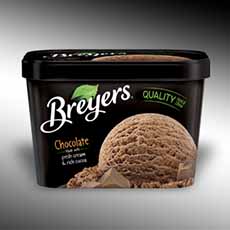
    [2] Chocolate ice cream (photo © Breyers).

    Dandies Mini Marshmallows
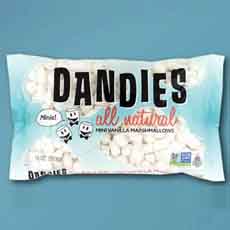
    [3] Mini marshmallows. These are vegan, and taste even better than the major brands (photo © Dandies).

     
    MORE S’MORES RECIPES

  • Caramel S’mores
  • Cinnamon S’mores With A Cappuccino Cocktail
  • Creative S’mores Recipes
  • Fancy S’mores
  • Gourmet Marshmallow S’mores
  • Grilled Banana S’mores
  • Ice Cream S’mores
  • S’mores Baked Alaska
  • S’mores Brownies
  • S’mores Cookie Bars
  • S’mores Fondue
  • S’mores Ice Cream Cake
  • S’mores Ice Cream Pie & Cupcakes
  • S’mores Ice Cream Sundae
  • S’mores Made With Other Types Of Cookies
  • S’mores Mason Jars
  • S’mores Party Bar
  • S’mores Truffles
  • Triscuit S’mores
  •  
     
    S’MORES FOOD HISTORY
    The History of Chocolate
    The History Of Graham Crackers
    The History Of Marshmallows
    The History of S’mores
      

    Comments off

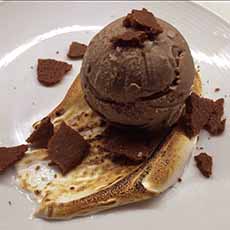
    FOOD FUN: S’mores Ice Cream Sundae Recipe

    S'mores Sundae
    [1] Turn the s’mores recipe into an ice cream sundae (photo © Bamboo Sushi | Portland).

    Smores Ingredients
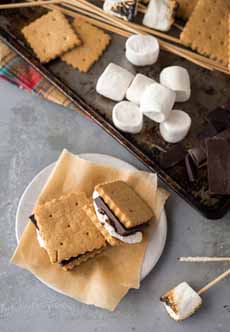
    [2] The classic S’mores cookie sandwich (photo © Dandies).


    Bamboo Sushi in Portland, Oregon does more than turn out great sushi:

    It creates smashing desserts like this S’mores Sundae.

    This one is so easy to make. National S’mores Day is August 10th, so gather the three ingredients you need for this sundae and make a “test” version.

    We tried several test versions—we couldn’t stop “testing.”
     
     
    RECIPE: S’MORES SUNDAE

    Ingredients

  • Chocolate ice dream
  • Marshmallow Fluff (or substitute)
  • Graham crackers, broken up (Trader Joe’s are the best!)
  •  
    Preparation

    1. SPREAD the Fluff on a plate in an artistic swirl. Use the broiler or a kitchen torch to brown the top.

    2. ADD a scoop or two of ice cream on top of the Fluff.

    3. TOP with graham cracker pieces.
     
     
    MORE FOOD FUN

    We love knowing where our favorite foods come from: What part of the world? An accidental mutation or a deliberate invention?

    The ingredients for S’mores—and the cookie sandwich itself—were all deliberate creations.

  • Graham Cracker History
  • Ice Cream History
  • Marshmallow Fluff-Marshmallow Cream History
  • S’mores History
  •  


    Comments off

    Searching At The Farmers Market & The History Of Apples

    When was the last time you ate something new?

    Most of us pursue a familiar grocery list, week in and week out.

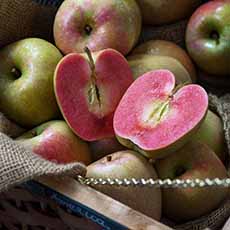
    But a trip to the farmers’ market always yields new discoveries. It may be an apple; but it’s an apple you’ve never seen before, like the Pink Pearl apples in the photo.

    So go browsing this weekend. Ask the booth clerk about heirloom varieties, or simply try a fruit or vegetable you rarely eat. Loganberries? Turnips?

    Here’s what’s in season in summer, although you’ll find other fruits and vegetables not on this list.

    While you’re at the market, pick up an artisan bread for sandwiches.

    Below:

    > The history of apples.

    > Is it really “as American as apple pie?

    Elsewhere on The Nibble:

    > The year’s 19 apple holidays.

    > How new apple varieties are created, and the Top 10 apples in the U.S.
     
     
    THE HISTORY OF APPLES

    Apples, which may seem to some to be an all-American fruit, originated in Central Asia: in southern Kazakhstan, Kyrgyzstan, Tajikistan, and Xinjiang, China.

    Its wild ancestor, Malus sieversii, can still be found growing wild today—although the fruit of the tree won’t appeal to humans.

    Apples have been grown for thousands of years in Asia and were brought to other regions by botanists, colonists, and traders.

    As a result, apple trees (Malus domestica) are cultivated worldwide. Sweet fruit varieties are grown for eating, and sour varieties are grown for cider or other alcoholic beverages.

    The center of diversity (breeding) of the genus Malus is in eastern present-day Turkey. The apple tree may have been the earliest tree that humans cultivated [source].

    There are more than 7,500 known cultivars of apples, bred for specific characteristics. Even among sweet apples, different cultivars are bred for hand fruit and cooked fruit (applesauce, pies), with many varieties in each.
     
     
    Apples Come To America

    Apples were introduced to North America by colonists in the 17th century. The first apple orchard on the continent was planted in Boston in 1625 by Reverend William Blaxton in 1625. (The only apples native to North America are crab apples.)

    The colonists primarily used the apples for cider, which was preferred to water with its potentially harmful microorganisms.

    Cider was also easier to make than beer.

    Cider apples are different from varieties meant to be eaten rather than turned into a drink. John Chapman, a.k.a. Johnny Appleseed, spread cider apples across the country, not apples for pie.

    But by the 1800s, American farmers were growing a staggering 14,000 varieties of apple, many of which had been bred domestically. Apples also cross-pollinate, creating new breeds themselves [source].

    So, assuming you’re not making cider, which apple would you rather have a Delicious, a Fuji, a Gala, a Granny Smith, a Honeycrisp, or the scores of other varieties within your reach?

    Perhaps your farmers market scouting will yield some heirloom varieties, such as Black Oxford, Cameo, Gravenstein, and Newtown Pippin, a yellow apple with olive green and red spots, that was grown by Thomas Jefferson at Monticello for cooking.

    Every region grows different varieties, so whenever you’re visiting a different area, ask for the nearest farmers market.

    It’s a fun—and potentially delicious—voyage of discovery.
     
     
    AS AMERICAN AS APPLE PIE?

    America has no claims to the origin of apple pie. the first recorded recipe for apple pie was written in 1381 in England and called for figs, raisins, pears, and saffron in addition to apples.

    Dutch recipes for apple pies appear as far back as 1514.

    Those early apple pie recipes generally didn’t include sugar, and their pastry crust was “coffin” pastry—a stiff, inedible dough that was used because baking pans were not common*.

    Meats and other foods were also baked in coffins. By the time society developed inn America, metal cookware was available.

    So why is it “as American as apple pie?” Because Americans loved apple pie. It’s that simple.

    Today, the expression might be, “as American as a cheeseburger and fries.

    Check out the history of pie and the history of pastry.


    Pink Pearl Apples
    [1] Pink Pearl apples. Like many heirloom varieties, they have a short season. That’s one reason some varieties of fruits and vegetables aren’t grown commercially; some others are disease-resistant, drought-resistant, and are hardy once harvested (photo © Good Eggs).


    [2] Surprise! The inside of rose apples is all rosy pink (photo © Melissa’s Produce).

    A Bowl Of Opal Apples, A Yellow Variety
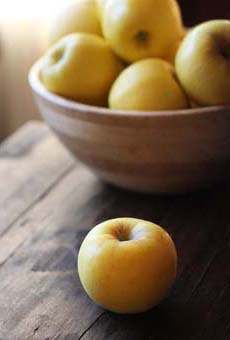
    [3] Opal apples are a newer breed. Here’s more about them (photo © Golden Sun Marketing).

    Heirloom Cucumbers
    [4] These are not apples…but would you have thought these items were heirloom cucumbers? We’ve included a large size of the photo below so you can see more detail. It’s in this apple article because we want food lovers to know that not all cucumbers are long and green (photos © Baldor Food).

    An Apple Pie With A Big Slice Cut Out Of It
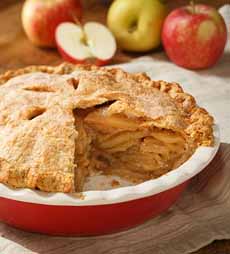
    [5] As American as apple pie (photo © U S Apple).

    _______________

    *By the 17th century, it was common for a Western kitchen to contain a number of skillets, baking pans, a kettle, and several pots, along with a variety of pot hooks and trivets. Brass or copper vessels were common in Europe and Asia; iron pots were common in the American colonies. Improvements in metallurgy during the 19th and 20th centuries engendered pots and pans from metals such as steel, stainless steel, and aluminum to be economically produced.
     
    Heirloom Cucumber Varieties
    [6] An expanded view of photo #3. If you saw these uncut, would you have guessed they were cucumbers? Another great farmers’ market find.


    CHECK OUT WHAT’S HAPPENING ON OUR HOME PAGE, THENIBBLE.COM.


    Comments off


    © Copyright 2005-2026 Lifestyle Direct, Inc. All rights reserved. All images are copyrighted to their respective owners.