THE NIBBLE BLOG: Products, Recipes & Trends In Specialty Foods


Also visit our main website, TheNibble.com.

TIP OF THE DAY: Heirloom Tomatoes

Heirloom tomatoes get a lot of press in the summer. July and August are the peak months to pick these most flavorful tomatoes.

Are they worth the extra cost? And what exactly are heirloom tomatoes?
 
 
WHAT ARE HEIRLOOMS TOMATOES

Heirloom produce—fruits and vegetables—are old varieties, typically with superior flavor, that have been bypassed by commercial growers.

They are produced by family farms and other small-scale growers, and found at farmers markets (see the note below about “fake” heirloom tomatoes).

They have been passed by by the commercial agriculture industry that grew up after World War II, in favor of hybrids that were more profitable to grow.

They are grown from seeds used harvested in past centuries and prewar decades, which have been passed down within families.

Farmers select the seeds from plants that have produced fruits with the most desirable traits, like flavor, juiciness and crack resistance.

They will also select size, shape or color, but these take the back seat to flavor. These are non-hybrid, naturally pollinated fruits.

These precious seeds are what make an heirloom tomato an heirloom tomato.

They are traded at seed meet-ups among farmers and home growers, to help their diversity survive.

There are hundreds of heirloom tomato varieties grown worldwide. Different regions have a heritage of different varieties.

But all growers want the same thing: the robust flavors of “real” tomatoes, be they standard size or cherry.

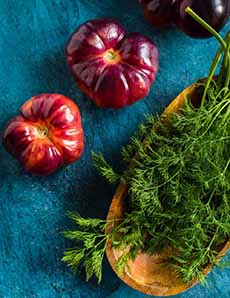
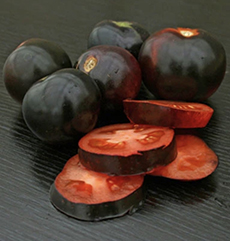
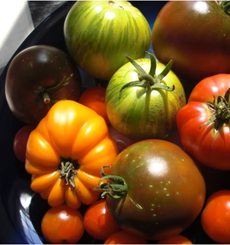
They aren’t always solid red, but are black, brown, green, orange, pink, purple, yellow, and sometimes, striped.

And the consumers who love them don’t care that the tomatoes are misshapen, or have dark fissures that must be cut out for an attractive presentation.

Some varieties sold by seed companies include:

  • Amana Orange (orange beefsteak)
  • Azoychka (yellow/orange beefsteak)
  • Black Cherry (purple/black)
  • Black Krim (purple/black beefsteak)
  • Brandywine, OTV (red beefsteak)
  • Brandywine, Sudduth Strain (pink beefsteak)
  • Cherokee Chocolate (mahogany beefsteak)
  • Chocolate Stripes (red/green striped)
  • Sunset’s Red Horizon (red beefsteak)
  •  
     
    WHY HEIRLOOMS ARE NOT A STANDARD TOMATO

    Why aren’t heirloom tomatoes grown commercially, in large enough quantities to be sold in every store?

    Commercial growers and retailers seek to maximize profit.

    Thus, tomatoes have evolved to meet the demands of both consumers and stores, which means great flavor has given away to easy-to-grow, lower-cost tomatoes.

    Commercial varieties have been bred for:

  • Beauty in shape and color.
  • Faster growing cycle.
  • Resistance to disease, pests and drought.
  • Higher yield.
  • Hardness for harvesting and shipping.
  • Longer shelf life.
  •  
    While commercial tomatoes look great and are very productive, the heirloom varieties have the taste and look of the quality tomatoes that our great-grandparents enjoyed.

    Tourists who experience fabulous tomatoes during trips to Greece, Italy and other European countries exclaim that they’re so much better abroad. That’s because they’re heirloom tomatoes.

    People who eat heirlooms marvel at their flavor and texture know how different they are from hard, mealy supermarket tomatoes and relish the summer treasure.

    The same is true with animal crops. For example, commercial chickens and turkeys are one breed, that are bred to:

  • Grow to maturity quickly, thus saving money on feed.
  • Have the large breast that consumers want.
  •  
    By the way, there is no regulation around the term “heirloom.” Anyone can call tomatoes heirloom.

    Larger growers can use the term for what are actually genetically modified seeds, inferior tomatoes that may have been transported from far away.

    That’s why we confine our purchases to farmers markets, where small growers grow the tomatoes locally.

    When you see a table of heirloom tomatoes of different varieties, you’ll quickly see how they differ from commercial tomatoes.
     
     
    WAYS TO ENJOY HEIRLOOMS TOMATOES

    So, what should you do with heirloom tomatoes?

    Like extra virgin olive oil, they should be enjoyed in their natural state; i.e., not cooked.


    Cherokee Purple Heirloom Tomatoes
    [1] Cherokee Purple heirloom tomatoes (photo © Valeria Boltneva | Pexels).

    Green Zebra Heirloom Tomatoes
    [2] Green Zebra heirloom tomatoes have a delightful eye appeal (photo © Good Eggs).

    Indigo Rose Heirloom Tomatoes
    [3] Indigo Rose heirloom tomatoes. You can buy the seeds from Harris Seeds (photo © Harris Seeds).

    Indigo Blue Heirloom Tomatoes
    [4] Indigo Blue heirloom tomatoes. You can buy the seeds from Harris Seeds (photo © Harris Seeds).

    Heirloom Tomatoes
    [5] Heirloom tomatoes are rarely perfectly round (photo © Good Eggs).

    Heirloom Tomatoes
    [6] A bowl of mixed heirloom tomatoes showing a variety of colors (photo courtesy Suncadia).

     
    They’re delicious cooked, of course; but cooking with other flavors takes the focus away from the nuances of the raw tomato.

  • In green salads
  • In Caprese salad and with other cheeses
  • On burgers
  • On a BLT, grilled cheese and other sandwiches
  • On pasta, diced with a dressing of EVOO, parmesan, fresh basil and cracked pepper
  • On toast
  •  
    If you have very soft tomatoes that won’t slice well, make:

  • Gazpacho
  • Uncooked tomato sauce
  •  
    By the way, heirloom tomatoes have the same nutrition values as supermarket tomatoes—or rather, that hybrid supermarket tomatoes retain the same nutrition as their heirloom ancestors.

    These include vitamins A and C and the antioxidant lycopene, a carotenoid that gives red fruits and vegetables their color. (Green, orange and yellow tomatoes don’t have lycopene, but have higher levels of other micronutrients).

    As an antioxidant, lycopene protects against cell damage, including sun protection. It also can improve heart health and provide a lower risk of certain types of cancer.

    Tomatoes provide about 80% of the lycopene in the American diet.


    Comments off

    TIP OF THE DAY: Paella Pan Serving Plate

    Punch Bowl Desserts

    Dessert Bites
    [1 & 2] Serve appetizer or dessert bites in a paella pan (photos © Empellón Restaurant | NYC.


    Here’s an idea from Empellón Restaurant in New York City, which specializes in modern Mexican cuisine.

    Grab that paella pan, serving tray or oversize dish from its hiding place, fill it with crushed ice get ready to present an appetizer or dessert “buffet.”

    Top the ice with a variety of small bites and shot glasses of apéritifs or dessert drinks.

    It’s an idea you can use indoors or outdoors.

    We recently used the concept to serve desserts at an al fresco dinner, topping the ice with:

  • Chocolate truffles
  • Fruit skewers
  • Key lime tartlets
  • Mini mousse cups
  • Watermelon Jell-O shots (with a small dice of added watermelon)
  •  
    To drink:

  • Horchata
  • Iced espresso with coffee liqueur
  • Spiced cider
  •  
    Check out these three-ounce shooter glasses-dessert cups-tumblers that can be used for desserts and drinks. (You can see them in photo #2, filled with lavender mousse.)

    You can use them for almost anything you want to keep chilled in the ice, but not on the ice.

    For example, with appetizers:

  • Cheese and fruit picks
  • Crudités and dip
  • Shrimp or scallops and cocktail sauce
  •  
    Happy entertaining!


    Comments off

    TOP PICK OF THE WEEK: Siggi’s Lactose Free Yogurt

    You can tell that Americans suffer from lactose intolerance by the different types of lactose-free milk in stores.

    In our supermarket, there are as many varieties of lactose-free milk as conventional cow’s milk (0%, 2%, whole, chocolate, etc.).

    In fact, Prevention magazine says that 65% of the world population are officially diagnosed as lactose-intolerant. Others among us may be slightly lactose-intolerant but don’t know it.

    According to Green Valley Creamery, producer of lactose-free products, there are more lactose-intolerant and lactose-sensitive people in America than gluten-free, vegan and vegetarian people combined.

    That’s an estimated 30-50 million people, 12% of the population.

    Many members of the lactose-intolerant community just stopped eating dairy altogether. Some switched to non-dairy products made from almond milk, coconut milk, etc.

    But what if you love cow’s milk?
     
     
    LACTOSE-FREE DAIRY PRODUCTS

    Over the past several years, two companies have stepped up to serve the market for lactose-intolerant people who prefer cow’s milk:

  • Lactaid makes lactose-free cottage cheese, ice cream, milk and seasonal egg nog.
  • Green Valley makes lactose-free butter, cottage cheese, cream cheese, Greek yogurt (0%, 2% and whole milk), kefir and sour cream.
  •  
    Others participate on a smaller level. For example:

  • Breyers makes lactose-free vanilla ice cream.
  •  
    Now, there are two new lactose-free yogurts from Siggi’s.
     
     
    SIGGI’S YOGURT (SKYR)

    In 2004, Icelander Siggi Hilmarsson moved to New York City. He was disappointed that American yogurts lacked the richness of Icelandic yogurt, or skyr (pronounced skeer).

    With a recipe from his mother, Siggi began to make skyr in his kitchen: a lower-sugar yogurt that uses milk from family farms.

    When he got it onto the shelves of specialty food stores, it was an immediate hit with yogurt lovers: a luxurious, ultra-premium yogurt experience.

    Siggi’s yogurt that is even thicker than Greek yogurt. Greek yogurt is triple-strained, but skyr is quadruple-strained.

    By the way, the more concentrated (strained) a style of yogurt is, the costlier it will be because it contains more milk and less water (one cup of Siggi’s requires four times more milk than a typical American brand).

    The offset: More milk means more protein.

    Siggi’s line has since expanded to include yogurts in 0% non-fat yogurt, 2% low-fat yogurt, 4% whole-milk yogurt and 4% no added sugar yogurt.

    For those who can’t have enough richness, there’s a triple cream yogurt made even richer treat with more added cream—an Icelandic practice.

    Siggi says that the skyr his dad eats in Iceland may even have more cream than skyr!

    Siggi’s also makes whole-milk, drinkable filmjölk, a beverage similar to kefir; yogurt tubes for kids; and yogurt cups with pieces of fruits and nuts.
     
    And Now, Lactose-Free Siggi’s Yogurt

    Siggi’s new lactose-free yogurts, in Plain and Vanilla, are a whole milk product. As previously noted, in whole milk skyr recipes, that means milk plus a bit of cream.


    Yogurt With Arils
    [1] A dish of yogurt and pomegranate arils (all photos © Siggi’s).

    Siggi's Lactose Free Yogurt
    [2] Siggi’s new whole milk, lactose-free yogurts in Plain and Vanilla.

    Siggi's Yogurt With Nuts & Grapes
    [3] A nutritious breakfast: Siggi’s yogurt, peanut butter, fruit and nuts.

    Siggi's Yogurt With Smoked Salmon
    [4] On the savory side: Siggi’s plain yogurt with smoked salmon. Who needs cream cheese? Bagel optional.


    A BONUS FOR CHEESE LOVERS

    A general note about cheese products:

    As cheeses age, the lactose begins to disappear, broken down by beneficial bacteria in the cheese. Thus, highly-aged cheeses like Parmesan have much less lactose than cream cheese or goat cheese.

    However, even 1% remaining lactose can be too much for highly-sensitive people.

    The good news: Two popular cheeses, Cheddar and Jarlsberg, have zero lactose.
     
     
    ABOUT LACTOSE INTOLERANCE

    Lactose, or milk sugar, is naturally found in milk and other dairy products. All animal milk has lactose, but cow’s milk has more than others.

    When people consume lactose, the body digests it with a stomach enzyme called lactase. If a person’s stomach doesn’t produce enough lactase, the lactose remains undigested in the stomach and causes unpleasant symptoms: bloating, gas, diarrhea.

    Some people are born without enough lactase to digest milk products. Some produce enough lactase throughout their lives. And others gradually produce less lactase as they grow older.

    The most lactose-tolerant people are descended from dairying people of northern Europe.

    Certain other ethnic groups, particularly those that historically have consumed little dairy, tend to be more lactose-intolerant. Some of these groups are people of Arab, East Asian and West African, descent.

    If you believe you may be lactose intolerant, a physician can give you a simple test.

    Then, head to the grocer’s and stock up on Siggi’s lactose-free yogurt.


    Comments off


    © Copyright 2005-2026 Lifestyle Direct, Inc. All rights reserved. All images are copyrighted to their respective owners.