THE NIBBLE BLOG: Products, Recipes & Trends In Specialty Foods


Also visit our main website, TheNibble.com.

TIP OF THE DAY: Summer Soup Garnishes

Tomato Peach Gazpacho
[1] Tomato-Peach Gazpacho. Here’s the recipe from Botanica Restaurant | LA.

Cold Summer Soup
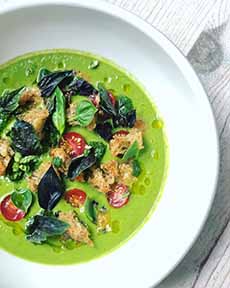
[2] Chilled Zucchini-Basil Soup from Botanica Restaurant.


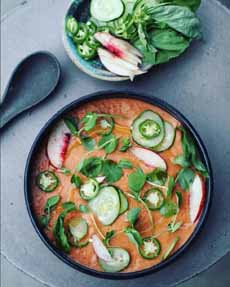
[3] Peach-Jalapeño Gazpacho garnished with cucumber, jalapeño, watercress and white peaches (all photos © Botanica Restaurant)


A bowl of soup can be more than a bowl of soup.

Botanica restaurant in Los Angeles shows us how.

You can port the concept to any soup, hot or cold.
 
 
TOMATO-PEACH GAZPACHO

Garnishes include:

  • Borage flowers
  • Pesto (substitute basil olive oil)
  • Scallions
  • Tomato strips
  • Yellow beets
  • Watermelon radish
  •  
    Here’s the recipe for the soup.

    While you’re on the website, check out the other recipes.

    And subscribe at the bottom of the page to receive regular culinary inspiration.
     
     
    CHILLED ZUCCHINI BASIL SOUP

    Garnishes include:

  • Basil leaves
  • Basil olive oil
  • Cherry tomatoes, halved
  • Homemade croutons/li>
     
     
    GAZPACHO RECIPES

    Garnish to your heart’s content.

  • Avocado Gazpacho
  • Fruit Gazpacho
  • Gazpacho Shooters
  • Gazpacho Shots
  • Gazpacho Verde
  • Gazpacho With Beer
  • Mango Gazpacho With Fromage Blanc Sorbet
  • Melon Gazpacho
  • Pineapple Gazpacho
  • Salsa Gazpacho
  • Strawberry Gazpacho
  • White Gazpacho
  • Other Chilled Fruit Soups & Vegetable Soups
  •  
     
    For more soup recipes, use the pull-down menu at the right.


    Comments off

    FOOD 101: Sushi Etiquette

    How do you eat sushi?

    Most people simply pick up the sushi with chopsticks and dip the bottom of the rice into soy sauce.

    But many Americans don’t know that there is actually a “proper” way to eat sushi. This example is on the “improper” list.

    Sushi comes with its own set of table manners. Even if you are at a casual sushi eatery in the U.S. and don’t want to mind your manners, you’ll need to learn them before a eating sushi in Japan.
     
     
    EAT SUSHI LIKE A NATIVE

    Here are some basics from Ken Sato, the sushi chef and director of restaurants for True World Foods, the leading distributor in fresh fish in the U.S.
     
    1. Can you use your hands to eat sushi?

    Yes, you can eat sushi with your hands, although—as with chicken drumsticks—not at a fine restaurant.

    Sushi was originally a food for gamblers, so they didn’t have to stop playing cards in order to eat. Then, it was a street food, which people ate with their hands.

    That’s why, at a restaurant, you receive a damp towel to clean your hands before eating sushi.
     
    2. Can you pass food with chopsticks?

    No, you should not pass food to another person with your chopsticks. It’s considered rude. Put the food on a plate and pass the plate instead.

    Reverse the chopsticks to use the clean end (the larger end) when moving food, or when taking from a communal plate. But it is considered more refined to ask for a clean set of chopsticks to transfer food.
     
    3. What is the proper way to dip sushi in soy sauce?

    In the case of nigiri, you don’t want the soy sauce to touch the rice. The reason is that sushi rice is already reasoned with sweetened vinegar.

    Instead, grasp the nigiri with chopsticks and turn it upside down. Lightly dip the fish side into the soy sauce.

    With a sushi roll, also dip the piece lightly. You don’t want the salty soy sauce to take away from the delicate flavor of the fish.

    With gunkan maki (the oval shape used to serve ikura [salmon roe] and uni [sea urchin), you cannot turn the piece upside down to dip it or the contents will fall out.

    So while Americans tend to dip the seasoned rice side (the bottom) into the soy sauce, Japanese would dip a piece of ginger in soy sauce and brush it over the top of the seafood.

    Using a lot of soy sauce is rude to the sushi chef. It’s a sign that the chef is not serving the freshest fish.
     
    4. What should I do with the ginger and wasabi?

    The wasabi can be placed directly on the fish or it can be mixed into the soy sauce.

    Wasabi and ginger were originally used to help the stomach fight off potential bacteria, in the age before refrigeration.

    In the modern era of food safety, they have become flavor enhancers and palate cleansers.
     
    5. Chopsticks Position

    Place the pointed ends of chopsticks on a chopstick rest when the chopsticks are not being used. If a rest is not provided, make a chopstick rest by folding the paper case that the chopsticks came in.

    Americans rest the chopsticks on the plate or the soy sauce dish, which is fine. The tips should be pointing to the left.

    Do not place chopsticks on the tabletop, cross them on a plate, or vertically stick them into a bowl of rice.
     
     
    PRINCIPLE TYPES OF SUSHI

  • Chirashi: Raw fish and vegetables scattered atop a bowl of rice.
  • Fukusa-sushi: Sushi ingredients wrapped in a thin egg crêpe.
  • Futomaki: Big roll/fat roll, with nori on the outside.
  • Futsu Maki: Thin roll with nori on the outside. Simply called “maki,” the generic term for roll, in the U.S.
  • Inari-sushi: A fried tofu pocket with sushi rice and other optional ingredients stuffed into the pouch.
  • Nigiri: Pads of seasoned rice topped with sliced raw fish on top.
  • Oshi-sushi: Squares or rectangles of pressed rice topped with vinegared or cooked fish, made in a wooden mold.
  • Onigiri: Handheld triangle of rice with fish, meat or vegetable inside, wrapped in nori.
  •  

    Sushi Plate
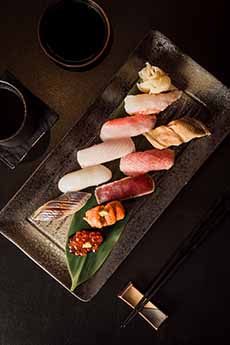
    [1] A deluxe sushi plate at Sushi Inoue (photo © Sushi Inoue | NYC).

    Sushi Plate
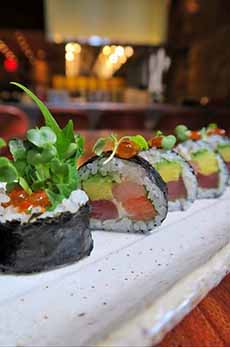
    [2] A plate of nigiri and maki. The three bottom maki are uramaki, with the rice on the outside. (photo © Sushi Takibun [now closed]).

    Vegetable Futomaki
    [3] Vegetarian futomaki—fat roll or big roll (photo © Haru Sushi).

    Futomaki
    [4] Futomaki special: salmon, tuna and yellowtail with takuwan, pickled whole daikon, with added color at Zuma | NYC (photo © Zuma).

  • Sashimi: Sliced fresh fish served with a bowl of rice.
  • Temaki: Cone-shaped hand roll of nori with rice and fish or vegetables inside.
  • Urumaki: Inside-out roll with nori on the inside.
  •  
     
    WANT TO KNOW MORE ABOUT SUSHI & SASHIMI?

    Here’s everything you need to know, in our Sushi & Sashimi Glossary.


    Comments off

    TOP PICK OF THE WEEK: Roussillon Wine

    Roussillon Wine
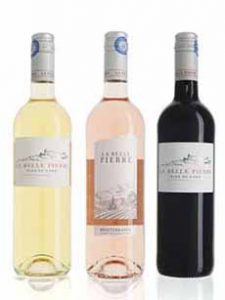
    [1] The Roussillon commune produces red, white and rosé wines, plus sweet wines (photo #2) (photo courtesy Wine Goblet).

    Vin Doux Naturel Roussilon
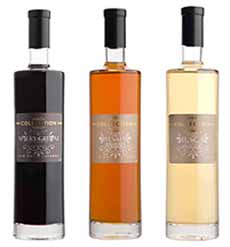
    [2] The sweet wines of Roussillon, vins doux naturels, are also available in the “three colors.” They’re often referred to by their initials, VDN, and indicate naturally sweet wines (photo courtesy Vignerons Catalans).

    Languedoc-Roussillon Map
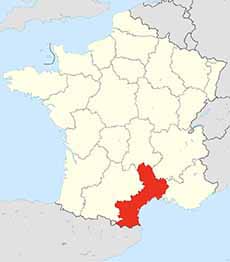
    [3] Languedoc-Roussillon, an administrative region of France that combines the communes of Languedoc and Roussillon. Compared to the small size of Roussillon, Languedoc is one of the world’s largest wine regions (photo Wikipedia Commons).


    If you’re a wine drinker, you’re no doubt familiar with the French wine communes (regions) of Beaujolais, Bordeaux, Burgundy and Champagne.

    How about Alsace and the Côtes du Rhone?

    And then there’s Roussillon (roo-see-YONE), a region not well known among American wine buyers*.

    While exports to the U.S. market are steadily increasing, and the U.S. is Roussillon’s fourth-largest export market, most people we know have yet to try a bottle—or to even know that it exists.

    That’s even though Roussillon produces delicious wines at affordable prices—many in the $18 range. Thus, our Top Pick Of The Week is the wines of Roussillon.
     
     
    THE COMMUNE OF ROUSSILLON

    The area, in southern France, is nestled between Spain, the Mediterranean Sea, and two mountain ranges: the Pyrenees and the Corbières (photo #3).

    It’s the sunniest wine region of France, with more than 320 days per year of sunlight and ideal temperature variations.

    Heavy autumn rains fill the water tables and enable the vines to find abundant moisture during the hot summer months.

    In other words, Roussillon is a land “blessed by the gods” for winegrowing.

    Roussillon is a small community of some 1,500 people, as opposed to the neighboring commune of Languedoc, another wine region with a population of some 2.5 million. (The two areas were combined into the Languedoc-Roussillon administrative region in the late 1980s.

    Roussillon’s unique geology and microclimates enables cultivation of 24 authorized grape varieties.

    The grapes produce red, white and rosé wines, both still (photo #1) and sweet (vins doux natureles, or fortified sweet wines, photo #2).

    These are quality wines: There are 15 PDO wines (Protected Designation of Origin) and 3 PGI wines (Protected Geographical Indication) wines (here’s an explanation of these designations).

    The first vines may have been planted by the Greeks as far back as the fifth century B.C.E., by Corinthian sailors who had wine-making skills [source].

    These vineyards, along with some areas of Languedoc and Provence, are among the oldest planted vineyards in France [source].
     
     
    VINS DOUX NATURELS

    You know about dry red wines and dry white wines, but how about sweet wines?

    Vins doux naturels, often referred to as VDNs, are fortified sweet wines—very high quality, and costlier than most of the still wines.

    Fortified wines, which are made in many wine-growing regions worldwide, have grape brandy added to the wines. This gives them a higher alcohol content (about 17%-20% A.B.V.†) and a longer shelf life after the bottles are opened.

    Fortified wines can be either be dry or sweet. The fortified wines of Roussillon are sweet (doux).

     
    We are huge fans of vins doux naturels: as an apéritif, with entrées like lobster, with a cheese course or as a dessert wine.

    These wines also pair beautifully with spicy international cuisines, such as the sweet-and-sour or savory-sweet dishes of Chinese, Indian and cuisines.
     
     
    HEAD TO THE WINE STORE

    The only way to get to know Roussillon wines is to head to a wine store and discuss the available options with a knowledgeable clerk.

    Red, rose, or white; still or sweet: It’s time to get to know these wines.

    Some of our favorites are below. By the way, if your store only has wines from the Languedoc, be wary. While wines are improving there, the region has long been known for average wines.
     
     
    FOR MORE INFORMATION, VISIT WINESOFROUSSSILON.COM.
     
     
    WINES WE LIKE

  • Red Wines: IGP Côtes Catalanes, Les Vignerons De Tautavel Vingrau, Le Cirque ($18); AOP Côtes Du Roussillon Villages Lesquerde, Domaine De-Bila-Haut, L’Esquerda ($26)
  • Rosé Wine: AOP Côtes Du Roussillon, Res Fortes ($23)
  • Sweet Wines: AOP Banyuls, Domaine Vial Magneres, Al Tragou ($87); AOP Rivesaltes Ambré, Terrassous, Hors D’Âge 18 Ans ($49)
  • White Wine: IGP Côtes Catalanes, Domaine Majas ($18)
  •   
    ________________

    *France’s other wine-producing regions include Jura, Languedoc, Loire Valley and Provence

    †A.B.V. is alcohol by volume. Double the A.B.V. to get the proof. For example, an 80-proof spirit is 40% A.B.V.


    Comments off


    © Copyright 2005-2026 Lifestyle Direct, Inc. All rights reserved. All images are copyrighted to their respective owners.