THE NIBBLE BLOG: Products, Recipes & Trends In Specialty Foods


Also visit our main website, TheNibble.com.

FOOD FUN: Valentine Tacos

If you can find Ortega’s Red Bell Pepper Taco Shells*, you can make Valentine Tacos (photo #1).

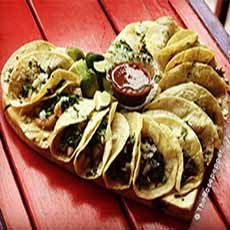
Or, arrange conventional tacos in a heart shape (photo #2).

In either case, top Valentine tortillas with your favorite red garnishes, such as:

  • Bell pepper
  • Onion
  • Radish
  • Tomato
  •  
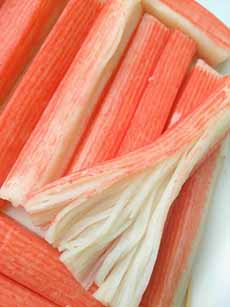
    Top fish tacos with rosy pink imitation crab leg (photo #3)—or real crab, if you’re flush.

    While many people enjoy tacos with a soft tortilla shell, for others the crunch of a hard shell is part of the taco experience.

    The hard shells are simply a soft tortilla folded into a taco shape, then fried until golden and hardened. (The hard, pre-fried corn tortilla shell is not authentic, but created in the U.S.A. See the history below.

     
    TORTILLA HISTORY

    Tortillas, a flatbread, have been a staple in Mexico for thousands of years. They were eaten plain as well as a to hold cooked foods.

    The oldest-known tortillas date back to approximately 10,000 B.C.E., made of the local staple food, corn.†

    Many thousands of years later, in 1519, Hernán Cortés and his Spanish troops arrived in the Aztec empire (modern-day Mexico) and noted that the locals ate “flat corn bread.”

    The Aztec name for the flatbread is tlaxcalli (tlox-cah-YEE); the Mexicans used the name tortilla, “little cake.”

    The original tortilla was made from nixtamalized‡ maize/corn flour. However, today’s tortillas are commonly made from less nutritious, less flavorful wheat flour. Wheat is easier to work with.

    While maize/corn tortillas have a heartier texture, flavor and better nutrition, the gluten in wheat flour tortillas enables them to be made larger and thinner without breaking.

    By the same token, corn tortillas they can be gluten free, depending on the manufacturer (Mission tortillas are gluten free).


    SUrprisingly, the Aztecs did not invent the taco; nor did anyone else, until it was created as a convenience food in the 18th century.

    According to Professor Jeffrey M. Pilcher, author of Planet Taco: A Global History of Mexican Food, tacos are not an ancient food.

    Rather, as he discusses in an article in Smithsonian Magazine, Mexican silver miners in the 1700s likely invented the taco as a hand-held convenience food.

    This new approach to tortillas was followed by taco carts and taquerías in working-class neighborhoods.

    As the taco spread throughout Mexico, each region added its own touches: different meats, spices, salsas, garnishes.

    Mexican Americans in the Southwest reinvented the tacos in their neighborhoods. As late as the 1960s, tacos were virtually unknown outside Mexico and the American Southwest.

    But in 1962, California businessman Glen Bell founded Taco Bell as a drive-up with a few outdoor tables. It grew into a mass-marketing powerhouse, serving an Anglo version with a hard shell at quick-service restaurants nationwide.


    Red Taco Shells
    [1] Valentine tacos in red taco shells (photo © Elegant Affairs Caterers).


    [2] Some people place conventional tacos in a heart-shaped baking pan. At Rosepepper Cantina in Nashville (photo © Rosepepper Cantina).


    [3] Use rosy imitation crab leg to top fish tacos (photo © Trade Korea).


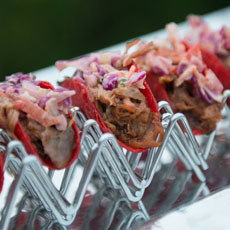
    [4] Look for red (bell pepper-colored) taco shells from Ortega.

     
    This hard, pre-fried corn tortilla shell (photo #4) is not authentic. Like the burrito, a larger wheat flour tortilla, it was born in the U.S.A.

    Authentic or not, within 50 years the United States had shipped hard taco shells worldwide, from Australia to Mongolia—redefining the taco in the eyes of millions, if not billions.

    And Taco Tuesday?

    This American event was begun in in 1982 as a successful promotion by Taco John’s. It encouraged people to go out for tacos on Tuesday nights, and offered specials like $1 fish tacos.

    ________________

    *They are available on Amazon, but the one reviewer noted that though they tasted good, many arrived broken.

    †The original varieties of corn, hybridized by the Aztecs, were far more nutritious than today’s corn, which has been bred over the years for yield rather than nutrition.

    ‡Nixtamalization is a process that prepares the maize/corn, in which the grain is soaked and cooked in an alkaline solution, usually limewater, and hulled.

    ‡‡Bell was the owner of hot dog and burger stands in southern California. In 1954, he added tacos to the menu, and based on demand, opened three Taco Tias in the San Bernardino area. He eventually sold them and opened four El Tacos with a partner in the Long Beach area. In 1962, he sold the El Tacos to his partner and opened his first Taco Bell. It grew to 868 restaurants and was sold to PepsiCo in 1978 [more].


    Comments off

    VALENTINE’S DAY: Magnum Ruby Ice Cream Bars (Real Pink Chocolate!)

    [1] Magnum’s Ruby Mini Ice Cream Bar (photo © Magnum Ice Cream).


    A few months ago we wrote about ruby chocolate, the fourth type of chocolate after dark, milk and white.

    Ruby is the first new chocolate in 80 years. The pink-colored chocolate gets its hue naturally, from a particular type of cacao bean.

    Of the three longstanding chocolate types, ruby most resembles white chocolate—but with a unique berry fruitiness that has a bit of tartness. It’s a unique chocolate experience.

    Here’s more about ruby chocolate.

    Confectioners have begun to introduce ruby chocolate in cookies and chocolate candies.

    But the first ice cream we know of—and a perfect treat for Valentine’s Day—is Magnum Ruby Mini Ice Cream Bars.

    Appropriately pink, with a cracking ruby chocolate shell, get some to treat:

  • Yourself
  • Family and friends
  • Co-workers
  •  
    Look for Ruby Minis in grocery stores nationwide. For more information, visit Magnum Ice Cream.

    Magnum Ruby Minis are a delight year-round.

    Thanks, Magnum!
     
     
    >>>Check Out Our Chocolate Glossary<<<
      

    Comments off

    VALENTINE GIFT FOR A COOK: A Peppercorn Plant (Piper Nigrum)

    Many people grow herbs at home. How about peppercorns?

    If your Valentine has a green thumb, a peppercorn plant is a different kind of gift.

    You can grow one as a houseplant (photo #1); or if you live in a semi-tropical climate, you can grow it outdoors (here’s what you need to know to grow the plant outdoors).

    When grown as a houseplant, all it needs is moderate light in an east or west window.

    Why grow a peppercorn plant at home?

  • It grows into a pretty plant with exotic clusters of berries (the peppercorns—photo #2).
  • You can harvest the berries and dry your own peppercorns.
  • It’s a novelty. Who else has one?
  •  
     
    WHO WANTS A PEPPERCORN PLANT?

  • People who grow herbs.
  • People who enjoy plants in their homes or offices.
  • Cooks who appreciate the novelty.
  •  
    You can easily find black peppercorn plants online.

    The history of black pepper follows.

    > The year’s peppercorn holidays are below.
     
     
    THE MOST POPULAR SPICE IN THE WORLD

    Black pepper is the most commonly used spice in the world. It has been used since antiquity for both seasoning and as a medicine.

    Some might have guessed that salt is the most commonly used “spice,” but:

  • Salt is a mineral, not a spice. It comes from mining salt deposits left over from extinct bodies of water; or by dehydrating sea water (salt water).
  • Spices are either the seed, or part of the bark, fruit, root or other portion of a plant (saffron, for example, is the stigma of the saffron crocus flower).
  • Herbs are the leaves, flower buds/petals, or stems of plants used for flavoring or as a garnish.
  •  
     
    The Origin Of Peppercorns

    The black peppercorn plant (Piper nigrum) is native to India and is grown in other Southeastern Asian countries.

    It is cultivated for its fruits—tiny berries with the peppercorn (the seed) inside. The berries mature from green to red (photo #2).

    The berries are dried, and the fruit on the outside is removed, leaving the seed.

  • Black peppercorns are wrinkly due to the exocarp, a skin covering the seed.
  • White peppercorns have the black exocarp removed. You can see in photo #3 that white peppercorns are not wrinkled. Their purpose in formal cooking is to provide the flavor without the black specks from the exocarp, for example to avoid specks that would mar the appearance of a pure white sauce.
  • Green peppercorns keep the green fruit in a way that retains the green color (e.g. freeze-drying).
  • Pink peppercorns are not Piper nigrum. They’re berries from the baies rose plant (Schinus molle, family Anacardiaceae), a small mastic tree related to the rose bush. It grows on the French Island of Reunion in the Indian Ocean. Authentic red peppercorns from Piper nigrum are sold pickled/brined to preserve the red fruit, but difficult to find in the U.S.
  •  
    There are numerous varieties of peppercorns.

    Check out different types of pepper in our photo glossary of peppercorns and other “pepper.”

    The spiciness of pepper is due to the organic compound piperine. (Chiles get their heat from capsaicin, an unrelated compound.)
     
     
    THE YEAR’S PEPPERCORN HOLIDAYS

    Also note the year’s 18 chile pepper holidays.

  • January 16: International Hot & Spicy Food Day
  • September 9: National Steak Au Poivre Day
  • November: National Pepper Month*
  • December 29: National Pepper Pot Day
  •  
    ________________
     
    *This was founded to refer to chile peppers, but we claim it for peppercorns as well.


    [1] Your plant (or seed pack) arrives, ready for tender loving care—and in the case of this plant, a good pruning (available at Logee’s)


    [2] Piper nigrum grown into a full, glossy plant. The peppercorn clusters ripen at different rates, thus both reddish and green on this plant (available from Eternal Cover | Amazon).

    Steak Au Poivre With A Glass Of Red Wine
    [3] Imagine growing your own peppercorns for Steak au Poivre. Here’s the recipe (photo © Certified Angus Beef).

    Black and White Peppercorns
    [4] Black and white peppercorns. The white peppercorns are the actual seed inside the black exocarp, which is removed so as not to leave black specks in elegant dishes (photo © Adam Kozlowski | iStock Photo).


    CHECK OUT WHAT’S HAPPENING ON OUR HOME PAGE, THENIBBLE.COM.


    Comments off


    © Copyright 2005-2026 Lifestyle Direct, Inc. All rights reserved. All images are copyrighted to their respective owners.