THE NIBBLE BLOG: Products, Recipes & Trends In Specialty Foods


Also visit our main website, TheNibble.com.

VALENTINE’S DAY: Magnum Ruby Ice Cream Bars (Real Pink Chocolate!)

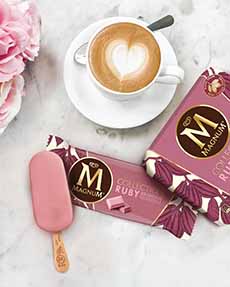
[1] Magnum’s Ruby Mini Ice Cream Bar (photo © Magnum Ice Cream).


A few months ago we wrote about ruby chocolate, the fourth type of chocolate after dark, milk and white.

Ruby is the first new chocolate in 80 years. The pink-colored chocolate gets its hue naturally, from a particular type of cacao bean.

Of the three longstanding chocolate types, ruby most resembles white chocolate—but with a unique berry fruitiness that has a bit of tartness. It’s a unique chocolate experience.

Here’s more about ruby chocolate.

Confectioners have begun to introduce ruby chocolate in cookies and chocolate candies.

But the first ice cream we know of—and a perfect treat for Valentine’s Day—is Magnum Ruby Mini Ice Cream Bars.

Appropriately pink, with a cracking ruby chocolate shell, get some to treat:

  • Yourself
  • Family and friends
  • Co-workers
  •  
    Look for Ruby Minis in grocery stores nationwide. For more information, visit Magnum Ice Cream.

    Magnum Ruby Minis are a delight year-round.

    Thanks, Magnum!
     
     
    >>>Check Out Our Chocolate Glossary<<<
      

    Comments off

    VALENTINE GIFT FOR A COOK: A Peppercorn Plant (Piper Nigrum)

    Many people grow herbs at home. How about peppercorns?

    If your Valentine has a green thumb, a peppercorn plant is a different kind of gift.

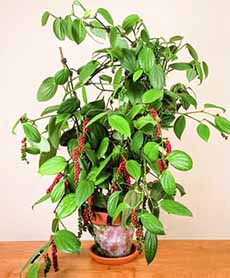
    You can grow one as a houseplant (photo #1); or if you live in a semi-tropical climate, you can grow it outdoors (here’s what you need to know to grow the plant outdoors).

    When grown as a houseplant, all it needs is moderate light in an east or west window.

    Why grow a peppercorn plant at home?

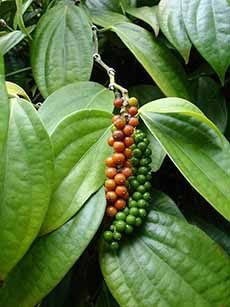
  • It grows into a pretty plant with exotic clusters of berries (the peppercorns—photo #2).
  • You can harvest the berries and dry your own peppercorns.
  • It’s a novelty. Who else has one?
  •  
     
    WHO WANTS A PEPPERCORN PLANT?

  • People who grow herbs.
  • People who enjoy plants in their homes or offices.
  • Cooks who appreciate the novelty.
  •  
    You can easily find black peppercorn plants online.

    The history of black pepper follows.

    > The year’s peppercorn holidays are below.
     
     
    THE MOST POPULAR SPICE IN THE WORLD

    Black pepper is the most commonly used spice in the world. It has been used since antiquity for both seasoning and as a medicine.

    Some might have guessed that salt is the most commonly used “spice,” but:

  • Salt is a mineral, not a spice. It comes from mining salt deposits left over from extinct bodies of water; or by dehydrating sea water (salt water).
  • Spices are either the seed, or part of the bark, fruit, root or other portion of a plant (saffron, for example, is the stigma of the saffron crocus flower).
  • Herbs are the leaves, flower buds/petals, or stems of plants used for flavoring or as a garnish.
  •  
     
    The Origin Of Peppercorns

    The black peppercorn plant (Piper nigrum) is native to India and is grown in other Southeastern Asian countries.

    It is cultivated for its fruits—tiny berries with the peppercorn (the seed) inside. The berries mature from green to red (photo #2).

    The berries are dried, and the fruit on the outside is removed, leaving the seed.

  • Black peppercorns are wrinkly due to the exocarp, a skin covering the seed.
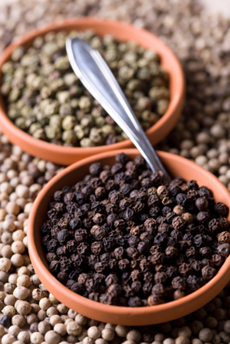
  • White peppercorns have the black exocarp removed. You can see in photo #3 that white peppercorns are not wrinkled. Their purpose in formal cooking is to provide the flavor without the black specks from the exocarp, for example to avoid specks that would mar the appearance of a pure white sauce.
  • Green peppercorns keep the green fruit in a way that retains the green color (e.g. freeze-drying).
  • Pink peppercorns are not Piper nigrum. They’re berries from the baies rose plant (Schinus molle, family Anacardiaceae), a small mastic tree related to the rose bush. It grows on the French Island of Reunion in the Indian Ocean. Authentic red peppercorns from Piper nigrum are sold pickled/brined to preserve the red fruit, but difficult to find in the U.S.
  •  
    There are numerous varieties of peppercorns.

    Check out different types of pepper in our photo glossary of peppercorns and other “pepper.”

    The spiciness of pepper is due to the organic compound piperine. (Chiles get their heat from capsaicin, an unrelated compound.)
     
     
    THE YEAR’S PEPPERCORN HOLIDAYS

    Also note the year’s 18 chile pepper holidays.

  • January 16: International Hot & Spicy Food Day
  • September 9: National Steak Au Poivre Day
  • November: National Pepper Month*
  • December 29: National Pepper Pot Day
  •  
    ________________
     
    *This was founded to refer to chile peppers, but we claim it for peppercorns as well.


    [1] Your plant (or seed pack) arrives, ready for tender loving care—and in the case of this plant, a good pruning (available at Logee’s)


    [2] Piper nigrum grown into a full, glossy plant. The peppercorn clusters ripen at different rates, thus both reddish and green on this plant (available from Eternal Cover | Amazon).

    Steak Au Poivre With A Glass Of Red Wine
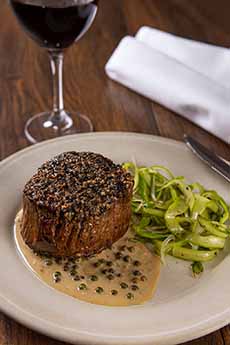
    [3] Imagine growing your own peppercorns for Steak au Poivre. Here’s the recipe (photo © Certified Angus Beef).

    Black and White Peppercorns
    [4] Black and white peppercorns. The white peppercorns are the actual seed inside the black exocarp, which is removed so as not to leave black specks in elegant dishes (photo © Adam Kozlowski | iStock Photo).


    CHECK OUT WHAT’S HAPPENING ON OUR HOME PAGE, THENIBBLE.COM.


    Comments off

    RECIPE: Pommes Aligot, A Very ‘Cheesy Potatoes’ Recipe


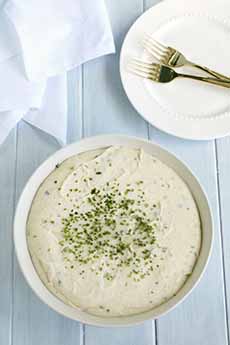
    [1] Creamy heaven, half mashed potatoes, half melted cheese. The recipe was developed by Cheryl Bennett of Pook’s Pantry (recipe and photos #1 and #2 © Idaho Potato Commission.


    [2] Pommes Aligot is stretchy, like fondue.


    [3] Laguiole, the original cheese used for Pommes Aligot. It’s difficult to find in the U.S., but there are substitutes (photo © Au Fromager De Rungis).


    Ready for some affordable luxury?

    Pommes Aligot (pum AH-lee-go) is a whipped mashed potato dish blended with butter, cream, crushed garlic, and almost as much melted cheese as potatoes.

    This is not “cheesy mashed potatoes.” It’s a cross between whipped mashed potatoes and cheese fondue.

    It’s luxurious, rich, and a perfect marriage of silky potatoes with creamy melted cheese (photo #1).

    Like fondue, Pommes Aligot (Aligot Potatoes) is ready to eat when it develops a smooth, elastic texture (photo #2). Like fondue, as it cools, the elasticity wanes.

    Pommes Aligot originated in the southern Massif Central of France. It is commonly found in three regions—Auvergne, Languedoc-Roussillon and Midi-Pyrénées—and the départements of Aveyron, Cantal and Lozère.

     
    THE HISTORY OF POMMES ALIGOT

    Potatoes came to Europe from the New World in the 16th century, engendering the development of many potato dishes, including numerous recipes that included cheese.

    But Pommes Aligot is not that old. Created in the Aubrac area of France, the recipe is distinguished by the type of cheese used: a local cheese, laguiole (LAY-ole). It’s also called tomme de laguiole or tomme d’auvergne, after the shape of the cheese (photo #3).

    Laguiole cheese is said to have been created in the 19th century at a monastery in the mountains of Aubrac, a plateau in the Auvergne-Rhône-Alpes region of southern France.

    The milk came from cows in the alpine pastures. According to historical accounts, the monks shared their recipe with the local buronniers—the owners of burons, or mountain huts, where cheeses were once made, rather than transporting the milk down to the towns below [source].

    Laguiole received Appellation d’Origine Contrôlée (A.O.C.) protection in 1961. It can’t be made anywhere else.

    Cantal cheese, made in a different part of the Auvergne, tastes similar and is used as a substitute. Since laguiole and tomme d’Auvergne are hard to find outside of the region, it’s a better bet; as are gruyère and/or mozzarella, often used in the U.S.
     
     
    RECIPE: POMMES ALIGOT

    Serve Pommes Aligot with roasted meat or poultry, more casually with sausages, or with a mixed grill.

    This is just one of many delicious recipes from the Idaho Potato Commission. Browse through the collection for more potato perfection.

    Ingredients

  • 2 pounds Idaho russet or Yukon Gold potatoes, peeled and quartered
  • 1 cup heavy cream
  • 1 tablespoon minced garlic
  • 6 tablespoons unsalted butter, sliced into tablespoon portions, softened to room temperature
  • 1 pound fresh mozzarella cheese, cut into small cubes
  • 8 ounces gruyère cheese, grated
  • 1 tablespoon salt (more salt for the cooking water)
  • 1 teaspoon black pepper
  • 2 tablespoons snipped fresh chives
  •  
    Preparation

    1. ADD the potatoes to a large pot and cover with cold water. Add a large pinch of salt (the water should taste a little salty).

    2. BRING to a boil over medium-high heat and cook for 15-18 minutes, or until the potatoes are easily pierced with a knife. While potatoes are cooking…

    3. HEAT the cream and garlic over low heat in a small saucepan. When the potatoes are ready…

    4. DRAIN the potatoes and push them through a potato ricer while still hot. Stir the potatoes for one minute over low heat with a wooden spoon or a heat-resistant spatula. This lets some of the moisture evaporate.

    5. STIR in half of the butter, half of the cheeses and half of the warm garlic cream. Add the salt and pepper. Continue stirring until cheese has melted.

    6. STIR in the remaining butter, cream, and cheese. Stir vigorously until smooth and stretchy. Garnish with the chives and serve hot.
     
     
    Variations

  • Substitute Yukon Gold potatoes.
  • Serve Pommes Aligot over toast, like Welsh Rabbit.
  • Add a drizzle or white truffle oil.
  •  
      

    Comments off


    © Copyright 2005-2026 Lifestyle Direct, Inc. All rights reserved. All images are copyrighted to their respective owners.