THE NIBBLE BLOG: Products, Recipes & Trends In Specialty Foods


Also visit our main website, TheNibble.com.

TIP OF THE DAY: Beyond Avocado Toast, Middle Eastern Eggplant Toast

Middle Eastern eggplant toast? We’ve done classic avocado toast, we’ve done fancy avocado toast, we’ve done mushroom toast. We’ve done sweet toasts:

All delicious.

But the palate wants the adventure to continue.

Thus, today’s toast journey is inspired by the Eggplant Toast at Kismet restaurant in Los Angeles.

Here’s a variation of their spiced eggplant recipe, with different garnishes: cherries, hazelnuts and tarragon.

But the photo shows a piece of artisan toast topped with:

  • Brined, spiced eggplant, skillet-fried
  • , and lim

  • Crispy shallots
  • Spicy minty tahini
  • Toppings: pomegranate arils, mint leaves
  • Garnish: freshly-grated lime zest
  • Bread crust garnish: sesame seeds
  •  
    We’re not certain how the sesame seeds were affixed to the bread crust, but you can use tahini.

    We admit to using a bit of honey, which added a sweet element to the spice-seasoned stack.

    OK, it takes a bit more effort than mashed avocado; but it’s worth it for a change.

    July is National Eggplant Month, and August 17th is National (and World) Eggplant Day.

     
    THE HISTORY OF EGGPLANT

    Eggplant (Solana melongena) is a member of the Solanaceae or Nightshade family: There’s more information about this fascinating family in the footnote below.

    Eggplant is believed to be native to India, where its ancestor, called thorn or bitter apple (Solana incanum) stills grow wild.

    Originally a bitter, spiny, orange, pea-sized fruit, it has been cultivated in India and China for more than 1500 years, during which it was bred into its modern forms [source].

    It has been cultivated in southern and eastern Asia since prehistory, and an early mention appears in an ancient Chinese agricultural treatise from 544 [source].

    As trade routes developed, eggplant was introduced to Europe by Arab ships and transported to Africa by the Persians. The Spaniards carried it with them to the New World and, by the early 1800s, both white and purple varieties could be found in American gardens.

    Today, the plant is grown worldwide for its edible fruit: Yes, you can tell it’s a botanical fruit because the seeds are carried inside.

    Although it is considered a vegetable, it is a berry by botanical definition.

    There are many different words for eggplant:

  • Aubergine in Britain, France, Holland, and Germany.
  • Berenjena in Spanish.
  • Brinjal or brinjaul, in South Asia and South African English.
  • Melanzana in Italian, and so on, around the world.
  •  
    The name eggplant is usual in North American English and Australian English.


    [1] Imagine a warm and tranquil day, imagine the Mediterranean just beyond your Eggplant Toast.

    Mixed Eggplant
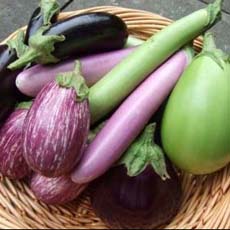
    [2] Assorted eggplant varieties (photo © Bleu Ribbon Kitchen).


    [3] Americans used the term “eggplant” after white cultivars that looked like hen’s eggs (photo © Burpee Home Gardens).

     
    First recorded in 1763, the word was originally applied to white cultivars, which look very much like hen’s eggs (photo #4).
     
    People the world over love eggplant: a versatile food that pairs with so many others.

    At some point in eggplant-loving China’s past, as part of her “bride price,” a woman had to have at least 12 eggplant recipes prior to her wedding day.

    Married or single, collect as many eggplant recipes as you like.

    ________________________
    *Nightshades are members of the Solanaceae family of flowering plants, many of which are edible, while others are poisonous (some have both edible and toxic parts). The name of the family comes from the Latin Solanum, “the nightshade plant.”

    Other edible members include capsicum (the chiles), Chinese lanterns, eggplants, garden huckleberry, ground cherry, naranjilla, pepinos, peppers, potatoes, and the tree tomato. One thing that sets these nightshades apart is their alkaloid content. Alkaloids are harmful nitrogen compounds that, in high quantities, are toxic, causing nausea, diarrhea with vomiting and headaches. In extreme cases, they lead to unconsciousness and convulsions to the point of respiratory paralysis.

    That’s why the tomato was considered poisonous by Europeans and not eaten for 200 years following its discovery. Alkaloids exist in tiny, non-harmful quantities in the nightshade foods we eat. Tobacco and the petunia are also members of the family, as well as the Datura or Jimson weed, the mandrake and the deadly nightshade or belladonna.


    CHECK OUT WHAT’S HAPPENING ON OUR HOME PAGE, THENIBBLE.COM.


    Comments off

    TOP PICK OF THE WEEK: Cookie Pop Popcorn With Oreo Pieces


    [1] The latest sweet treat to cross our desk: Cookie Pop Popcorn with Oreo pieces.


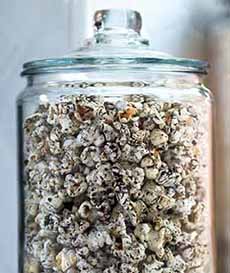
    [2] From the bag to the canister (both photos © Snax-Sational Brands).


    This may be a first for THE NIBBLE: Our Top Pick Of The Week is a junk food, a sugary snack.

    Snax-Sational, a snack food company, recently sent us samples of Cookie Pop Popcorn: a blend of popcorn and Oreo cookie pieces:

    The popcorn kernels have a sugary “creme” coating that tastes like Oreo stuffing.

    It’s a purely sweet treat: The sample we received didn’t have a salted popcorn profile. But there’s no reason you can’t toss some salt in the bag and shake it.

    Salt or not: Cookie Pop created a sensation in our office, with every coming back for additional handfuls.
     
     
    IS IT REALLY JUNK FOOD?

    The popcorn-Oreo blend is 150 calories per serving size of 1-1/4 cups. The total carbohydrate is 19g with 12g of total sugars.

    The snack is low in sodium and made with non-GMO corn. It has 1g of protein per serving.

    And yes: Popcorn is a whole-grain food with these benefits.

    It almost sounds like Cookie Pop Popcorn is a good snack choice, but make no mistake:

    This is junk food: glorious, sugary junk food. It’s also a fun food, waiting to garnish cupcakes, ice cream and hot chocolate.

    If you need a sugary jolt, treat yourself to a bag. Just pace yourself.
     
     
    THE BIRTH OF A SNACK FOOD

    The concept for Cookie Pop Popcorn came about when the founder added crushed Oreos to another snack food, popcorn. He thought he had a hit on his hands.

     
    He combined other sweet snacks with popcorn and produced a variety of flavors, of which Butterfinger Candy Pop Popcorn and Twix Candy Pop Popcorn join Cookie Pop in today’s line-up.

    You can purchase all of them on SnackPop.com.

    There’s also a store locator on the website.


    CHECK OUT WHAT’S HAPPENING ON OUR HOME PAGE, THENIBBLE.COM.


    Comments off

    TIP OF THE DAY: Green Garlic

    Green garlic—also called young garlic or spring garlic—may look like scallions. But they are the immature, spring version of the cured bulbs available year-round.

    Harvested when young, green garlic looks like scallions (a.k.a. green onions). The bulb has not yet begun to separate into cloves (photo #1).

    At this stage in its youth, the whole plant is edible. It has a sweeter, milder flavor than fully cured garlic bulbs/heads (photo #4).

    If left in the ground to to grow, the bright green tops die off after the bulbs underground have rounded out into the bulb/head.

    When the mature heads are dug up and hung up to dry, the papery cellulose layers around and between the cloves of the bulb form a protective layer that enables the heads to stay in storage for up to a year.
     
     
    DIGGING IN TO GREEN GARLIC

    When garlic is young and green, the whole plant is edible, like a scallion. It has a sweeter, milder flavor than when the garlic bulbs are fully cured.

    Green garlic often looks so similar to green onions and spring onions, that the best way to identify green garlic is simply to take a sniff. It will smell of garlic rather than onion.

    Another giveaway: Green garlic leaves are flat (photo #1); scallion leaves are tubular.
     
     
    USES FOR GREEN GARLIC

    Use green garlic raw or cooked, wherever you’d like subtle garlic flavor. Prepare it as you would a scallion, and use it in:

  • Braises, sautés* and grilled vegetables (they’re great charred, as a side)
  • Egg dishes: breakfast eggs, deviled eggs, frittatas, quiche
  • Dips and spreads, like hummus or yogurt dip (mix yogurt with green garlic pesto)
  • Grains and grain bowls
  • Herb butter (compound butter for potatoes, spreads, veggies)
  • Pesto
  • Pickled garlic (how to pickle)
  • Pasta and pizza
  • Salads and salad dressings
  • Sauces
  • Soups and soup garnish
  • Savory yogurt or yogurt sauce/dressing
  •  
    Try green garlic in a stir-fry, chopped up with eggs, or sautéed with greens. For a quick (and delicious) kitchen project, use green garlic instead of basil in your next batch of pesto.

    Use it wherever you’d use regular bulb garlic or green onions, or use it in recipes specifically designed to grilled, or pickled. Add it to a frittata, a soup, or pair it with other spring treats like asparagus. Put green garlic in pasta, a rice bowl (don’t forget to pick up pea shoots),

    Our personal favorite is a saute of asparagus, green garlic, morels, ramps and spring peas. Made with butter or olive oil, we can eat an entire batch of it on noodles or grains.

     
    WHAT ARE GARLIC SCAPES?

    Scapes are the curling shoots of young garlic plants (photo #3). They will grow into green garlic.

    For decades they were cut off in the fields and thrown away, to allow the garlic bulbs to grow larger, before growers realized that chefs and foodies were eager to buy them.

    The curling shoots have more intensity than green garlic, and it’s best to blanch them first. This unleashes a milder, sweeter flavor.

    Just dip the scapes into salted boiling water for 30 seconds, then place them in an ice bath. You’re ready to roll.

    Use garlic scapes the same ways you would green garlic.

    How about some Potato, Nettle & Green Garlic Soup?
     
     
    FOOD 101: SCALLIONS, GREEN ONIONS & SPRING ONIONS

    While many people use the term “green onions” for scallions, we prefer scallions. Why?

    There are also spring onions, different from green onions.

    Spring onions look similar to scallions a.k.a. green onions. It’s easy to confuse them.

    Sometimes the easy way to tell them apart is from the bulbs: If the ends are very bulbous, it’s a spring onion. But some varieties have smaller bulbs.


    [1] Green garlic: not scallions, a.k.a. green onions (photos #1, #2 and #5 © Good Eggs).

    Green Garlic
    [2] Some varieties of green garlic have purple at the base.


    [3] The first form of garlic to emerge is garlic scapes. They will grow into green garlic, and finally garlic bulbs/heads (photo © Vicia Restaurant | St. Louis).

    Garlic Cloves
    [4] Scapes and green garlic will eventually turn into garlic bulbs/heads (photo via Domain Image [site now closed]).

    Green Garlic Soup
    [5] Green garlic and nettle soup. Here’s the recipe from Good Eggs.

     
    Part of the confusion is that spring onions are planted as seedlings in the late fall and then harvested the next spring; hence the name.

    Another source of confusion: In the U.K. countries, including Canada, spring onions are called green onions!

    Here’s more about them.

    ________________

    *Another tip: Save the infused oil from sautés and drizzle it on fish, poultry, meat, pasta and anything else you like.


    Comments off


    © Copyright 2005-2026 Lifestyle Direct, Inc. All rights reserved. All images are copyrighted to their respective owners.