THE NIBBLE BLOG: Products, Recipes & Trends In Specialty Foods


Also visit our main website, TheNibble.com.

TIP OF THE DAY: Use Your Waffle Or Pizzelle Maker For Savory Sandwich Cones

Waffle Cone With Shrimp
[1] Shrimp, remoulade and crunchy red cabbage: our inspiration for today’s tip (photo courtesy Savannah Seafood Shack).

Waffle Cone Roller
[2] A waffle roller (at right) turns a round waffle into a cone. Here’s the technique from Celebrate-Creativity.

Homemade Waffle Cones
[3] The same sandwich cone maker creates ice cream cones (photo courtesy Chef’s Choice).

  A few years ago, we were stuck indoors at a friend’s country home by a massive rainstorm.

Plans to go shopping for dinner ingredients were discarded, and we searched the cupboards for something to make.

We found waffle mix and peanut butter and jelly in the cabinets, and a refrigerator full of breakfast and lunch materials: bacon, eggs, cole slaw, ham, cheese, salad, cream cheese, smoked salmon.

We were inspired to make savory waffles, and later wrote an article about them.

But we didn’t think to roll the waffles into cones until we saw this photo from Savannah Seafood Shack (photo #1).

The inspiration: waffle sandwich cones.
 
 
HOW TO MAKE SAVORY WAFFLE SANDWICH CONES

1. DECIDE on your main filling: BLT, chicken (a touch of maple syrup makes “chicken and waffles”), Greek salad, ham and cheese, fish fillets, shrimp, taco fixings, etc. You can find other ideas online, including this shrimp and cheese grits cone.

For a breakfast sandwich, consider “the usual suspects:” scrambled eggs, bacon/Canadian bacon, cheese, avocado, tomato, etc.

2. PICK the supplementary ingredients: bacon, lettuce, tomatoes, onion, grits, mashed potatoes, stuffing, condiments, etc.

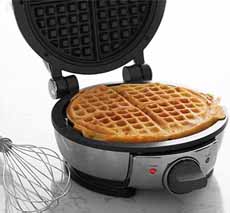
3. GET out your waffle maker or pizzelle maker. The waffle maker needs to be round to shape a pointed cone. If you don’t have a round waffle maker, see if you can borrow one.

You’ll also need a cone-rolling form (photo #2): a cone shape with a handle. You can purchase a wood version for about $10. The same mold makes homemade ice cream cones (photo #3) and pizzelles.

4. MAKE the batter. Leave the sugar out of the waffle recipe. You can add a pinch, but no more; you don’t want even a slightly-sweet waffle.

You can also flavor your batter with fresh herbs (basil, chives, cilantro, parsley), grated cheese and/or spices (cayenne, chili flakes, curry, poppy, etc.). Check out these cheddar-chive cones.

5. MAKE the waffles, cool slightly, stuff and enjoy. Use a fork, as needed.

 
MORE ABOUT WAFFLES

  • Different Types Of Waffles
  • Waffle History
  • Waffle Iron History
  •  


    Comments off

    TIP OF THE DAY: Make A Root Beer Float, Plus Root Beer History

    August 6th is National Root Beer Float Day: a type of ice cream float (a.k.a. ice cream soda) that combines ice cream, usually chocolate or vanilla, with root beer.

    Just place a couple of scoops of ice cream in a tall glass, add the root beer, and serve with a straw and a long spoon (photo #1). Yum!

    You can do this with any flavor ice cream and any coordinating soda. There are some ideas below.
     
     
    ICE CREAM FLOAT HISTORY

    Credit for the invention of the ice cream float was invented by Robert McCay Green, operator of a soda fountain in Philadelphia, Pennsylvania. In the era before bottled soft drinks, a soda fountain was a place where people would stop by for a fresh-jerked soda.

    The “soda jerk” would add syrup to a glass, then jerk the handle of the soda water [carbonated water] tap. The pressure blended the soda, although a swirl with a spoon finished the job.

    Green wanted to create something special to compete with a larger, fancier soda fountain down the street. His brainstorm: a combination of vanilla ice cream and soda water with a choice of 16 different flavored syrups. He called it an “ice cream soda.”

    A variation of the story is that, on one hot day, Green ran out of ice for his soda fountain drinks and used vanilla ice cream from a neighboring vendor, has been put to rest by his own account, published in Soda Fountain magazine in 1910 (source).

    Alas, in those days small business owners were not trademark-oriented, and the competitors soon knocked him off.

    As the ice cream soda soda concept took off, different fountain syrups were used: birch beer, cola root beer and fruit-flavored soft drinks.

    Bottled soft drinks became broadly available by 1950, enabling consumers to mix and match their own floats. Some examples of the variety:

  • Boston Cooler: ginger ale and vanilla ice cream (invented in Detroit, with no relation to Boston).
  • Brown Cow: a root beer float made with chocolate ice cream.
  • Coffee Float: vanilla ice cream with actual coffee and cream, plus coffee soda or cola (the recipe).
  • Cola Float: vanilla or chocolate ice cream with Coca-Cola or Pepsi Cola.
  • Creamsicle® Float: vanilla ice cream and orange sherbet.
  • Framboise Float: vanilla ice cream with raspberry soda.
  • Orange Whip: orange sorbet with orange soda and optional orange juice.
  • Purple Cow: vanilla ice cream with grape soda.
  • Root Beer Float: also called a Black Cow or a Brown Cow: root beer with vanilla ice cream (or flavor of choice).
  • Snow White: 7 Up or Sprite with vanilla ice cream.
  •  
    Floats are often topped with whipped cream, and may have garnishes from cherries to chocolate shavings.

  • Check out these ice crean float recipes.
  • More recipes.
  •  
     
    HOW ABOUT AN ALCOHOLIC FLOAT?

    Add an ounce or two of your favorite spirit, and have as much liqueur. One of our favorites: banana ice cream, vanilla soda, rum and banana liqueur.

      Root Beer Float
    [1] A root beer float given the glamour treatment with whipped cream and a cookie (photo ShagPhoto | IST).
    Ice Cream Soda
    [2] Ice cream floats with fruit sodas (photo courtesy of Alanna Taylor Tobin | The Bojon Gourmet).

    Ice Cream & Beer Pairings
    [3] Guinness Float. Here’s the recipe for the float, plus homemade stout ice cream (photo courtesy Silver Moon Ice Cream).

     
    You can also make a beer float:

  • Guinness Float & Double Chocolate Stout Float
  • Tipsy Leprechaun Stout Float with Irish whiskey
  •  
     
    THE HISTORY OF ROOT BEER

    Modern soft drinks would not exist, had carbonated water not been invented. Here’s the history of carbonated water, which was first sold commercially in the late 1700s; and the debut dates of early soft drinks.

    Root beer, at least in its earliest, non-carbonated form, long predates carbonation.

    Emigrants to the New World found Native Americans drinking beverages made of sassafras root and sarsaparilla vine, for culinary and medicinal reasons American culture.

    By the 16th century, colonists were using European culinary techniques to create it, and other root- and herb-based beverages.

    Ingredients could include, among others, allspice, birch bark, burdock root, dandelion root, coriander, juniper, ginger, hops, licorice, molasses, sarsaparilla, sassafras root, vanilla beans, wild cherry bark and wintergreen.

    Today, the root commonly used is the root bark of the sassafras tree (Sassafras albidum) or the sarsaparilla vine (Smilax ornata).

    With the spread of soda water/carbonated water in the early 19th century, the technique was applied to these traditional beverages. Sweet syrups were the foundation of soda fountains, and it was combined with soda water as early as the 1850s.

    Drinks like root beer were also sold as “tonics,” for their perceived medicinal qualities. The syrup was added to a glass, topped with carbonated water and given a brief stir.

    While traditional root beer was indeed made from sassafras tree roots, modern commercially produced root beer typically does not contain any sassafras root. In 1960, the FDA banned sassafras oil due to an ingredient, safrole, which was shown to be carcinogenic in rats.

    This led to the use of artificial flavorings in most commercially produced root beer. Artisan brands use extracts from which the safrolehas been removed.

    Modern, commercially-produced root beer (and other sodas) is typically sweet, foamy, carbonated, nonalcoholic, and flavored with artificial* sassafras oil (source).

    ________________

    *Sassafras root is still used to flavor traditional root beer. However, sassafras is no longer used in commercially-produced root beer since 1960, when it was banned by the FDA for use in commercially mass-produced foods and drugs. There were health concerns, highly controversial, about the carcinogenicity of safrole, a major constituent of sassafras oil, in animal studies. Some small-batch root beers do use a safrole-free sassafras extract.
      

    Comments off

    RECIPE: Root Beer Float Ice Pops For National Root Beer Float Day

    Root Beer Ice Pops
    [1] Turn a root beer float into an ice pop. Recipe and photo courtesy Volpi Foods.

    Ice Pop Molds
    [2] Buy one or two sets of ice pop molds. You can use them to freeze juice, including vegetable juice for a savory snack . These are from FumCare.


    August 6th is National Root Beer Float Day. For something even colder, try this food fun: Root Beer Float Ice Pops.

    Active prep time is 15 minutes, plus freezing.
     
    RECIPE: ROOT BEER FLOAT ICE POPS

    Ingredients For 6 Pops

  • 1 cup vanilla ice cream, softened
  • 1¾ cups root beer
  • Ice pop mold set with 6 (3½-ounce) molds
  •  
    Preparation

    1. SOFTEN the ice cream slightly on the counter, 5 minutes or so. Then fill the tip of each mold with about 2½ tablespoons of ice cream, packing the ice cream down firmly. Place in the freezer to set until the ice cream is firm again, 15 to 20 minutes. Meanwhile…

    2. BRING the root beer to a low simmer in a medium saucepan, whisking to help remove the carbonation. Simmer gently until there are no remaining carbonation bubbles, about 5 minutes (new bubbles will be caused around the edge of the liquid the process of simmering). Allow to cool.

    3. REMOVE the molds from freezer. Pour about 2 ounces of root beer into each mold. To reduce foaming, it’s best to slowly pour the root beer down the inside wall of the mold, and not straight on top of the ice cream.

    4. LET the root beer settle a moment. Then top the molds with the lids, and insert the sticks or handles.

    4. FREEZE until solid, at least 8 hours or overnight.

    5. SERVE: Unmold the pops by running the molds under water for about 60 seconds (or follow manufacturer’s directions).


    Comments off

    TIP OF THE DAY: How To Pick The Best Watermelon

    August 3rd is National Watermelon Day.

    Ready for some sweet, juicy melon? Here are tips for picking the best of the bunch.

    TIPS TO CHOOSE A MELON

    1. Look for a stemless melon, with a slight indentation on the stem end. If the melon still has a stem, it could mean that it was picked before it was ripe. Once a watermelon is picked from the vine, it stops ripening. A melon should be ripened on the vine until its stem detaches naturally.

    2. Choose a uniform shape. Odd bumps and curves may have “personality,” but can mean that the melon did not have consistent sun and/or water. Press the skin of in different spots to test for firmness.

    3. Don’t worry if it’s dull. Some growers process their melons to put an attractive shine on—the equivalent of waxing an apple. A dull melon is perfectly fine.

    4. Pick a deep green skin. The skin should be a rich green color with a smooth texture. This indicates an even amount of sun.

    5. Check the “field spot.” This is the creamy yellow spot on the bottom of the melon, showing where it was resting on the ground. It indicates that the melon had the time it needed to sweeten in the sun. If the melon is green all over, avoid it: That often indicates a melon that was picked before ripening. A white spot on the bottom is better than no spot.

    6. Heavy in the hand. Compare the melon’s weight with one of similar size, and pick the heavier one. Produce Pete advises this test with any fruit.

    7. Give it a good slap. Hold the watermelon in one hand, then slap it with your palm or thump it with your knuckles (this is called a “knuckle rap”). Listen for a melon that sounds full, which has been described as “more like a tenor than a bass.” The bass indicates a condition known as hollow heart.

    8. Buy from a good retailer. As you’ve no doubt noticed, fruit quality can vary from seller to seller. A better retailer tends to spend for better produce, so the retail price may be slightly higher. If you see melons at very low prices, they may indicate lower quality.
     
    MORE MELON TIPS

    Chilling the melon before serving enhances its flavor on the palate. It’s better to slice it first, then chill.

    If the melon lacks the sweetness you seek, here are some fixes:

  • Sprinkle with lemon or lime juice.
  •   Sliced Watermelon
    [1] If you purchase a whole melon, slice it before refrigerating it. A chilled melon tastes better (photo courtesy Good Eggs).

    Yellow Watermelon
    [2] Yellow watermelon is more available these days. The ones we’ve had have been super-sweet (photo courtesy DP Seeds)

  • Sprinkle with a bit of sugar or non-caloric sweetener (we prefer Splenda).
  •  
    HOW LONG HAS MAN CULTIVATED WATERMELON?

    The first recorded watermelon harvest occurred nearly 5,000 years ago, in Egypt. Check out the history of watermelon.

    We end with a quote from Mark Twain: When one has tasted watermelon, he knows what the angels eat.
      

    Comments off

    Gourmet Ice Cream Sandwich Recipes

    Ice Cream Sandwiches
    [1] Ice cream sandwiches are now made with every type of cookie and cookie substitute. See our list below (photo © King Arthur Flour).

    Churro Ice Cream Sandwich
    [2] Getting creative: an ice cream sandwich with churros, at Boqueria | Brooklyn. Make churro dough, roll it into lengths and wind/swirl them. Then, bake churro cookies (photo © Boqueria Restaurant).

    Strawberry Ice Cream Sandwiches
    [3] Strawberry shortcake sandwiches, made with whoopie pie-shaped “shortcake” by David Venable | QVC (photo © QVC).

    Granola Ice Cream Sandwich
    [4] Who needs cookies? You can use granola, other breakfast cereals, or hybrids like Rice Krispie Treats (photo © Pillsbury).


    August 2nd is National Ice Cream Sandwich Day, so our tip is: Make ice cream sandwiches!

    You can do much better than the ones you enjoyed childhood, those inexpensive rectangles of vanilla ice cream covered with very thin slices of chocolate wafer, which became sticky from the moisture of the ice cream.

    If you still eat ice cream sandwiches today, they’re likely more of artisan varieties, made in many flavors and more importantly, sandwiched by quality cookies and cookie substitutes. See the options below; but first, take a bite of:

    > The history of ice cream.

    > The year’s 50+ ice cream holidays.

    > The different types of frozen desserts: a photo glossary.

    > More creative ice cream sandwich recipes, below.
     
     
    ICE CREAM SANDWICH HISTORY

    According to an article in The New York Tribune in July 1900, the ice cream sandwich was created in 1899 by an unnamed pushcart peddler in the Bowery neighborhood of New York City. Vanilla ice cream was pressed between two graham wafers.

    His customers comprised everyone from shoe shine boys to stockbrokers. The pushcart vendor was so busy pressing ice cream into a tin mold to order, that he didn’t have time to make change. Customers had to pay the exact price of one cent.

    The treat was revolutionary: hand-held and portable ice cream, no dish and spoon required. The ice cream cone, which also first appeared in New York City, had not yet taken hold (here’s the ice cream cone history).

    An earlier portable ice cream treat, without the cookies, was sold in London by Italian street vendors.

    A slice of vanilla ice cream was cut from a large slab and wrapped in a piece of paper. It was known as an “okey-pokey,” the English adaptation of the vendors’ call, “O che poco,” Italian for “Oh, how little [money].” (The name gave way to the Hokey Pokey song.)

    By 1905, ice cream sandwiches had made it to other locations, including the Boardwalk in Atlantic City.

    It is often written that the version we know, the vanilla ice cream rectangle sandwiched with chocolate wafers, was invented in 1945 by Jerry Newberg, an ice cream vendor at Forbes Field in Pittsburgh. He no doubt sold them.

    However, some people who did deep research have debunked this allegation, and attest that the familiar vanilla rectangular surrounded by “sticky chocolate wafers” first appeared in the early 1900s (it can be seen in photos).

    However, 1945 is still noteworthy in ice cream sandwich history: In that year, the first ice cream sandwiches were mass produced.

    Today the frozen treat is made in many shapes (photo #1) including Mickey Mouse and other novelty designs, and is enjoyed all over the world in local flavors.
     
     
    THE FIRST “GOURMET” ICE CREAM SANDWICH

    Here and there, people may have sandwiched ice cream and cookies at home; but the first mass-produced specialty ice cream sandwich, the Chipwich, was launched in 1978.

    This “gourmet” ice cream sandwich placed vanilla ice cream between two large chocolate chip cookies, and covered the exposed sides of the ice cream with mini chocolate chips.

    It was created by a New York lawyer, Richard LaMotta, who launched it via street carts in upscale neighborhoods of Manhattan. Some 25,000 Chipwiches were sold the first day, and became a local craze. Within two weeks the company was selling 40,000 a day.

    The concept was exciting; but alas, the brand went downhill. In 2002, in financial straits, the company was sold to a larger company and the quality declined. It was subsequently discontinued. Here’s more about it.

    But Chipwich now has a new life. The trademark was bought by entrepreneurs, who have recently relaunched the brand, starting in the Northeast. Find them in a store near you.
     
     
    BEYOND THE CHIPWICH

    The success of the Chipwich in the late 1970s inspired restaurateurs and folks at home to create their own variations.
     
    The concept was taken much further. Today, you can find (or make!) just about any flavor of ice cream, frozen yogurt or sorbet, with vastly expanded “sandwich materials”:

     
    Not just every type of cookie (black and white, biscotti, ginger snaps, lemon, macarons, meringues, oatmeal, palmiers (elephant ears), pizelles, red velvet, stroopwafels), but breads, pastries and candies, like…

    …baklava, brioche, brownies and blondies, cake, caramel corn, chocolate bars, chocolate chip cookie dough, chocolate pancakes, churros, cinnamon rolls, croissants, cupcakes…

    …donuts, frozen waffles, s’mores, Pop Tarts, raisin bread toast, whoopie pies and even breakfast cereals like Corn Flakes, granola and Cocoa Pebbles and Fruity Pebbles. Plus:

    GARNISHES: The chocolate chips that garnished the Chipwich ice cream has expanded to dried fruits, granola, mini M&Ms and other small or crushed candies (like striped peppermints), Oreo crumbs, nuts, sprinkles and toffee chips.

    LAYERS: Beyond just ice cream and cookies, you can add dessert sauces, jam or preserves, or fruits before the top cookie is placed. Try a layer of caramel or fudge, or brandy-soaked cherries.

    So what are you going to do today?

    Pick up your favorite ice cream and favorite “outer,” and make ice cream sandwiches! For inspiration:
     
     
    MORE ICE CREAM SANDWICH RECIPES: SOME MODERN IDEAS

  • Blueberry Ice Cream Sandwiches On Blueberry Pound Cake
  • Brioche Or King’s Hawaiian Ice Cream Sandwiches
  • Brownie Ice Cream Sandwiches
  • Cookie Dough Ice Cream Sandwich
  • Crunchy Strawberry Ice Cream Sandwiches
  • Donut Ice Cream Sandwiches
  • Donut, Rice Krispie Treat & Waffle Ice Cream Sandwiches
  • Frozen Cheesecake “Ice Cream” Sandwiches
  • Granola Ice Cream Sandwiches
  • Ice Cream Sandwich Sundaes
  • Popcorn Ball Ice Cream Sandwiches
  • Strawberry Shortcake Ice Cream Sandwiches
  • Stroopwafel Ice Cream Sandwich
  •   


    CHECK OUT WHAT’S HAPPENING ON OUR HOME PAGE, THENIBBLE.COM.


    Comments off

    The Nibble Webzine Of Food Adventures
    RSS
    Follow by Email


    © Copyright 2005-2026 Lifestyle Direct, Inc. All rights reserved. All images are copyrighted to their respective owners.