|
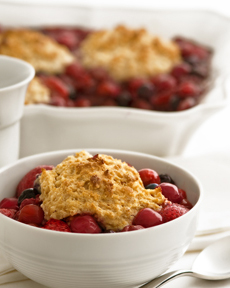
[1] Cherry cobbler—the biscuit dough dropped on top of the fruit resembles cobblestones (photo © Choose Cherries).
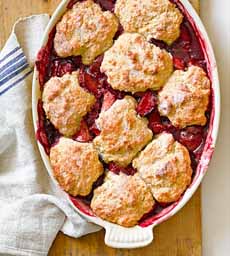
[2] It’s called a cobbler because the biscuit topping looks like cobblestones. The Le Creuset gratin pan is from Williams Sonoma (photo © Williams Sonoma).

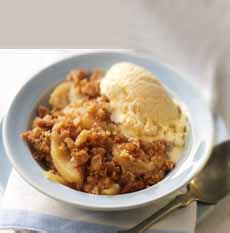
[3] An apple crisp, called a crumble in the U.K. The cooked fruit is topped with streusel crumbles (photo © Spice Islands).
[4] An apple betty, distinguished by a topping of buttered breadcrumbs. Here’s a recipe from Williams-Sonoma.

[5] A peach and blackberry buckle (photo © Tommy Bahama).
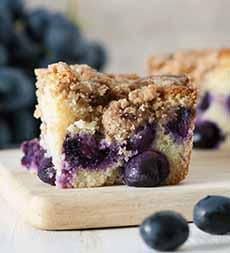
[6] The side view of a buckle (photo © Melissa’s Produce).
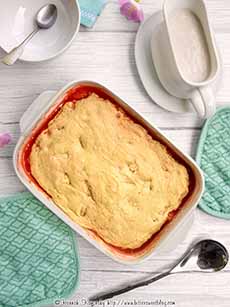
[7] A sonker or zonker covers the fruit with pancake batter before baking (photos #7 and #8 © Hannah Kaminsky | Bittersweet Blog).
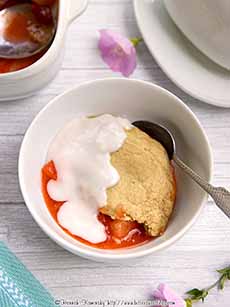
[8] A dish of sonker with milk dip—not a dip but a pour-over.
|
|
Do you know the difference between a cobbler, a crisp, and a crumble? Have you ever had a betty, bird’s nest pudding (a.k.a. crow’s nest pudding), buckle, grunt, pandowdy, or slump?
There are many kinds of baked fruit desserts, from the simplest—cored fruits, baked or roasted—to pies and tarts, which cradle the baked fruit between one or two crusts.
But one group of recipes gets confusing: deep dish baked fruit, made in pans or casseroles. There’s no crust, per se; but each variety is distinguished by its topping.
These desserts can be made with any type of fruit, but are typically made with apples, berries, or stone fruits—cherries, peaches, nectarines, and plums.
In observance of National Cherry Cobbler Day, May 17th, we explain the differences between the different baked fruit dishes. (April 13th is National Peach Cobbler Day—America loves its cobblers!)
Baked in early American kitchens, these dishes were simple to make, using seasonal fruits, flour, and sugar.
According to What’s Cooking America, colonists often served them for breakfast, as a first course or even a main course. It was not until the late 19th century that they were served primarily as desserts.
PAN-BAKED FRUIT DISHES
Any of these dishes can be served à la mode, or with whipped cream.
All are baked fruit. The key difference is in the toppings: bettys have buttered bread crumbs, cobblers have biscuits, crisps and buckles have streusel, etc.
BETTY, or brown betty (photo #4), alternates layers of fruit with layers of buttered bread crumbs. Some modern recipes use graham cracker crumbs—but it must have crumbs, not streusel, to be a betty (here’s a recipe). Who was betty? No one knows, but the dish was first mentioned in print in 1864, so the Betty who created it was working without a modern oven, much less electricity.
BIRD’S NEST PUDDING is a bit different: A pan of fruit is covered with a batter that bakes into an uneven top with the fruit poking through. It’s served in a bowl topped with heavy cream and spices.
BUCKLE, very similar to the French clafoutis (often spelled clafouti in the U.S.), adds fruit, usually berries, to a single layer of batter (photos #5 and #6). A buckle has a higher percentage of butter than a cobbler. When baked, it becomes a cake-like layer studded with berries. It is topped with a crumb layer (streusel), which gives it a buckled appearance. Alternatively, the cake, fruit, and crumbs can be made in three separate layers.
COBBLER has a pastry top instead of a crumb top (photos #1 and #2). Biscuit pastry is dropped from a spoon, the result resembling cobblestones.
CRISP is a deep-dish baked fruit dessert made with an oat-based topping (photo #3). The oats “crisp up” when baked.
CROW’S NEST PUDDING is another term for bird’s nest pudding. In some recipes, the fruit is cored, the hole filled with sugar, and the fruit wrapped in pastry.
CRUMBLE is very much like a crisp, but whereas the crisp is made with oats, a crumble has a streusel topping. While streusel is typically made with flour, butter, and sugar,t he crumbs can be made with breadcrumbs, breakfast cereal, cookie or graham cracker crumbs, or nuts.
GRUNT is a spoon pie with biscuit dough on top of stewed fruit. Stewed fruit is steamed on top of the stove, not baked in the oven. The recipe was initially an attempt to adapt the English steamed pudding to the primitive cooking equipment available in the Colonies. The term “grunt” was used in Massachusetts, while other New England states called the dish a slump.
PANDOWDY or pan dowdy is a spoon pie made with brown sugar or molasses. It has a rolled top biscuit crust that is broken up during baking and pushed down into the fruit to allow the juices to seep up. It is believed that the name refers to its “dowdy” appearance. Sometimes it is made “upside down” with the crust on the bottom, and inverted prior to serving.
SLUMP is another word for grunt.
And don’t overlook:
EVE’S PUDDING also called Mother Eve’s pudding, is a British dessert that is essentially a Victoria sponge cake baked with chopped apples on the bottom of the pan. The name is a reference to the biblical Eve. It can be served with custard, cream, or ice cream. It is a version of Duke of Cumberland’s pudding, named after Prince William, Duke of Cumberland. The first known recipe is from 1824 and used grated bread and grated suet [source].
SLAB PIE, a shallow pie that’s baked in a jelly roll pan or a rimmed baking sheet(here’s more about it).
SONKER or ZONKER, a North Carolina term for a deep-dish cobbler made with fruit or sweet potato and topped with pancake batter. It’s described as a hybrid between a pie and a cobbler (photo #7). Legend has it that the name came about as a descriptor for how the topping tends to sink into the fruit, and over time, “sinker” turned into “sonker.”
> Our colleague Hannah Kaminsky of Bittersweet Blog adds, “There’s no official consensus on what absolutely defines a sonker, but in my eyes, it’s a soupy fruit dessert that’s topped with a baked pancake batter.
> “Instead of pastry, biscuits, streusel, or breadcrumbs, you get a fluffy batter crowning berries, apples, stone fruit, or even sweet potatoes with enough liquid to call it a sauce. It can only be served with a spoon and must be placed in a bowl, unless you’re set on wearing your dessert, too (photo #8).
> “Sonkers get no frippery—neither ice cream or whipped cream. Instead, the typical pairing is a milk dip. There’s no dipping involved; a milk dip is almost like an eggless crème anglaise, or a pourable pudding.
>“A generous drizzle of milk dip adds nothing to the visual appeal of the sonker, and may in fact make it even less attractive, but trust me, you want to do the dip.”
As Kim Severson, writing in The New York Times about sonkers and zonkers, notes: “These dishes are so regional that people within the same county will disagree on the proper form.”
There are names that may be so location-specific that they have become obscure, such as boot, which may have been a local word for cobbler, crumble, etc.
There are also dumps, short for dump cakes, that “dump everything” into the baking dish or mixing bowl. While the term is mostly used for cakes, here’s an example of a apple dump that’s topped with cookie dough.
Your family may call it a particular dish by a particular name, correct or not.
But the most correct thing is: Bake fruit in season, and bake it often!
> The different types of pies and pastries.
> The different types of cakes.
> The history of pie.
|