THE NIBBLE BLOG: Products, Recipes & Trends In Specialty Foods


Also visit our main website, TheNibble.com.

RECIPE: April Fools Sushi

Our colleague Hannah Kaminski of Bittersweet Blog is a vegan author and recipe developer, so we were surprised when she sent an email with salmon sushi.

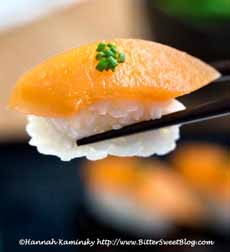
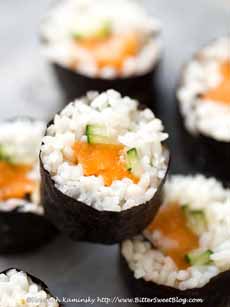
Except it’s not, as she calls it, fish-free salmon sushi: It’s cantaloupe!

Yes, there are “real” vegan sushi substitutes. We recently reported on Ocean Hugger Foods, which has created the first-of-its-kind alternative to raw tuna (more).

But this one is strictly—and deliciously—April Fools!

Here’s her recipe:

RECIPE: FISH-FREE SALMON SUSHI

Ingredients

  • 1 small, unripe cantaloupe
  • 1 cup mushroom broth
  • 4 tablespoons Braggs Liquid Aminos
  • 2 tablespoons avocado oil
  • 2 tablespoons sauerkraut brine
  • 1 tablespoon rice vinegar
  • 1 tablespoon white miso Paste
  • 1/2 teaspoon onion powder
  • 1/4 teaspoon garlic powder
  • 2 sheets toasted nori, roughly torn
  •  
    Variations

  • To make “smoked salmon,” add 1/2 – 1 teaspoon liquid smoke, to taste.
  • To make “gravlax,” add 1/4 cup roughly chopped fresh dill and the zest of half a lemon.
  •  

    Cantaloupe Sushi
    [1] Cantaloupe nigiri sushi. Photos © Hannah Kaminsky | Bittersweet Blog.

    Cantaloupe Sushi
    [2] Cantaloupe maki (rolls).

     
    Preparation

    1. CUT the cantaloupe in half, scoop and out discard the seeds. Slice those halves into four wedges each, carefully “filleting” the fruit to remove the peel. Place all eight cleaned wedges into a large, shallow container.

    2. PLACE the remaining ingredients into a food processor or blender and thoroughly purée, until completely smooth. Pour this marinade all over the melon, making sure that all pieces are fully submerged. You may need to move things around so that you have complete coverage.

    3. SEAL the container and place on a flat surface in your freezer. Allow the whole thing to fully freeze; at least 12 hours, but ideally 24 hours or longer. If you want to save the “salmon” for a later date, just leave it at this stage until you’re ready to serve it.

    4. ALLOW the tuna to fully thaw, either in the fridge or at room temperature. Drain away the excess marinade. You can save the marinade and reuse it if you like, since there’s no potential bacterial contamination as with raw fish or meat.

    5. THINLY SLICE the edges as desired for sashimi or nigiri, or cube for maki or poke.
     
     
    APRIL FOOL’S DAY HISTORY

    The origin of April Fools’ Day, sometimes called All Fools’ Day, is obscure. The most accepted explanation traces it to 16th century France.

    Until 1564, the Julian calendar, which observed the beginning of the New Year in April, was in use. According to The Oxford Companion to the Year, King Charles IX then declared that France would begin using the Gregorian calendar, which shifted New Year’s Day to January 1st.

    Some people continued to use the Julian Calendar, and were mocked as fools. They were invited to bogus parties, sent on a fool’s errand (looking for things that don’t exist) and other pranks.

    The French call April 1st Poisson d’Avril, or April Fish. French children sometimes tape a picture of a fish on the back of their schoolmates (the French version of a “Kick Me” sign), crying “Poisson d’Avril” when the prank is discovered. (Source: Wikipedia)

    What a fish has to do with April Fool’s Day is not clear. But in the name of a kinder, gentler world, we propose eliminating this holiday.
      

    Comments off

    FOOD 101: Clams On The Half Shell

    Clams On The Half Shell
    [1] Clams on the half shell with mignonette sauce, at Casino Clam Bar in New York City (photo © Casino Clam Bar).

    Clams On The Half Shell
    [2] Clams on the half shell with cocktail sauce and a side of crudites, at The Clam in New York City (photo © The Clam).

    Littleneck Clams
    [3] Littleneck clams (photo © Good Eggs).

    3 Sizes Of Hardshell Clams
    [4] It’s not hard to shuck clams. Here’s a video. Shown, on order of size: littleneck, topneck, and cherrystone clams (photo © Atlantic Aqua Farms).

    Clams On The Half Shell
    [5] A clam shucking knife is smaller than an oyster shucking knife (photo © Island Creek Oysters).

    Clam Ceviche On The Half Shell
    [6] These scrumptious clams were minced, made into ceviche, and returned to the half shell (photo © Delmonico’s | Facebook).


    National Clams on the Half Shell Day is March 31st. The half shell (photos #1 and #2) is the simplest way to serve clams, and it is a delightful, high protein, low calorie, and nutritious dish for lovers of raw seafood.

    Where’s your nearest Happy Hour with a good deal for clams on the half shell?

    If you’re a big clam lover, note that in addition to National Clams On The Half Shell Day, there are two other holidays that celebrate clams: November 1st, National Deep Fried Clams Day; and July 3rd, National Fried Clam Day.

    Below:

    > What are clams on the half shell?

    > The history of clams.

    > Wine pairings for raw clams.

    > Garnishes for clams.

    > Are you ready to shuck?

    Elsewhere on The Nibble:

    > The different types of clams.

    > Wine, beer, and cocktail pairings for clams and oysters on the half shell.

    > The year’s 56 fish and seafood holidays.
     
     
    CLAMS ON THE HALF SHELL

    Clams are bivalves, aquatic mollusks that have a compressed body with an upper and lower shell, hinged together.

    Other bivalves include oysters, mussels, and scallops, but clams and oysters are most often served on the half shell.

    They are shucked*—the top half of the shell is removed—and are most often served on a bed of crushed ice with lemon wedges and mignonette sauce or cocktail sauce. Some modern presentations use a bed of rock salt.

    This “on the half shell” presentation enables the diner to pluck the meat from the shell, optionally dip it in the sauce, and bite into the plump mollusk.

    When bivalves are shucked properly, the meat will be surrounded by its natural juices, which are lost if you scoop them out and put them on a plate.

    Other kinds of shellfish, such as scallops and mussels, can also be served on the half shell.

    While “on the half shell” means raw shellfish, there are cooked bivalves served on the half shell, such as Clams Casino, clams topped with breadcrumbs, bacon, and green bell peppers; Coquilles Saint Jacques and Oysters Rockefeller.

    In these preparations, the bivalves are topped with bread crumbs and other ingredients, and baked.

    Other preparations, such as steamed or grilled clams, should be called just that.
     
     
    THE HISTORY OF CLAMS

    Bivalves appear in the fossil record first appear in the early Cambrian period, more than 500 million years ago.

    The total number of living species is about 9,200, representing both marine and freshwater bivalves.

    There are more than 150 different edible species of clams in the world. Only a handful of these are pursued as food crops.

  • Atlantic Ocean/Gulf Coast Clams: cherrystone clam, hardshell/Quahog/top neck clam, softshell clam (steamers), surf clam
  • Pacific Ocean: butter clam, geoduck clam, littleneck clam, manilla clam
  • Both Atlantic & Pacific: razor clam
  •  
    The size of clams ranges from tiny and not worth trying to eat, up to 440 pounds like the giant clam, which is too big to eat. Check out the size classifications in the ‡ footnote.

    (Found in the South Pacific, giant clams have a diameter of 47 inches and can live for more than 100 years. Alas, they are an endangered species).

    With the evolution of humans, clams, along with oysters and other mollusks, became an important part of the diet of coastal and river people.

    Clams spend their lives partially buried in the sand of the ocean floor. They are dug at low tide, leading to the expression, “happy as a clam at high tide.”
     
     
    GARNISHES FOR CLAMS

    Even though they’re much smaller than oysters, you can still serve clams with a festive garnish.

    While most people stick to acidic condiments—cocktail sauce, mignonette sauce, a lemon wedge—get creative: >Modern Toppings: microgreens and edible flowers, heat (minced jalapeños, Calabrian chiles, a dot of wasabi), diced fresh fruit (kiwi, melon, strawberries), or chopped herbs (chives, fennel fronds, parsley).

  • Raw Veggies: finely diced radishes or carrots.
  • “Surf & Turf”: crumbled bacon or pancetta.
  •  
     
    WHITE WINE PAIRINGS FOR RAW CLAMS CLAMS

    Whether on the half shell or in ceviche, these are your go-to white wines. You want wines that are, dry, high-acid, light to medium-bodied, and mineral or saline rather than oaky or buttery.

  • The Classics: Albariño, Chabalis, Dry Riesling, dry sparkling wine, Muscadet Sèvre et Maine (the go-to in France), Sauvignon Blanc, Unoaked Chardonnay.
  • Lesser Known: Assyrtiko, Picpoul de Pinet, Vermentino.
  •  
    Cocktail Party Idea: A selection of these wines with clams on the half shell.

     
    Clams On The Half Shell & A Glass Of White Wine
    [7] Still white wines are perfection with clams, especially a minerally Chablis. Sparkling wines make things festive (Flux Photo).
     
     
    SHUCK YOUR OWN CLAMS

    What kind of clams should you buy? Whatever is freshest.

    Let the fishmonger know that you plan to serve them raw. The Quahog†, a.k.a. hardshell or top neck, is popular for serving on the half-shell.

    An Atlantic saltwater clam, it is about two inches in length, and meatier than some other varieties.

    > Here’s a video showing you how to shuck clams.
     
    You do need a special clam shucking knife, which is different from an oyster knife. You can buy one for around $10.00.

    If you have an oyster knife, of course, try it before buying one just for clams.

    Then, scrub the clam shells and get to shucking!

    ________________

    *A shuck is an outer covering such as the shell of a clam or oyster, or the outer covering of an ear of corn or a nut. Since the shuck is discarded, the word became used to describe something of little value—not worth shucks. We don’t know how it evolved to the now-archaic expression, “aw shucks,” used to express shyness, i.e., after a compliment; or to express disappointment, e.g., “Aw shucks, we’re out of coffee.”

    Quahog trivia: The Pilgrims were taught how to harvest clams and other shellfish. In the midst of the first winter of starvation, it helped keep many of the Pilgrims alive. Beads made from the quahog shell, known as wampum, were currency, used in trade throughout the region.

    The name of the clam changes based on its size, though they are all the same species:
    > Littleneck clam: The smallest and most tender (1.5″ – 2″).
    > Cherrystone clam: Medium-sized (2.5″ – 3″).
    > Top Neck clam: Slightly larger than a cherrystone (3″ – 4″), often used for stuffing or raw bars.
    > Quahog/Chowder Clam: The largest and toughest (> 4″), typically chopped for soups.
     

    CHECK OUT WHAT’S HAPPENING ON OUR HOME PAGE, THENIBBLE.COM.


    Comments off

    TIP OF THE DAY: Pavlova Dessert For Passover & Easter

    If you’ve ever seen individual meringue cups/shells in a bakery and wondered what they are: They’re the base of Pavlovas*. Light and airy, they are filled with fruit to make an impressive gluten-free and fat-free dessert (photo #2).

    Pavlova is quick-assembly dessert that’s impressive and low-calorie. It consists of a meringue base topped with fresh fruits. Most people buy the meringue shells at bakeries, but ambitious bakers can make their own.

    In addition to individual meringue shells (“mini pavlovas”), the meringue is often shaped into a layers (photo #1). If you see meringue shaped into cake-like layers with fillings in-between, that’s a Swedish Midsummer Meringue Layer Cake.

    In France, the meringue layers can be filled with crème fraîche, custard, fruit, mousse, whipped cream or other filling, and is called a vacherin (vosh-er-RAN).
     
     
    PAVLOVA YEAR-ROUND

    Pavlova is gluten-free, fat-free, a beauty for the Easter table and Passover-friendly: The ingredients are egg whites, sugar, cornstarch, lemon juice and vanilla extract.

    You can also add subtle flavor touches. This Pavlova, from chef Samir Nosrat, has touches of Indian flavors: rosewater, rose petals and cardamom.

    While it seems a light and airy dessert for warmer weather, Pavlova is a year-round treat. It’s a good finale to a big dinner. And it can be tailored to every season:

  • Spring: Berries, early stone fruits (apricots, nectarines), figs; edible flowers to garnish
  • Summer: Seasonal fruits garnished with shaved coconut, lemon mint, lemon verbena or spearmint
  • Fall: Assorted nuts (raw or candied), dried fruits garnish on the plate
  • Christmas: Brandied fruits, candied fruits, crushed peppermint plate garnish
  • Valentine’s Day: Strawberries and cream, candied rose petals plate garnish
  • Anytime: Strawberries Romanoff
  •  
     
    PAVLOVA TOPPINGS

    You can make individual meringue cups or one large meringue base.

    Once you have the meringue shells:

  • All you have to do is cut up your favorite fruits and add them to the shell.
  • If you want to exert more effort, you can marinate the fruits in wine or liqueur.
  • Add an optional topping: crème fraîche, mascarpone, raspberry purée, whipped cream.
  • Garnish with chocolate curls or candied orange peel, or something as simple as a mint leaf.
  •  
    Instead of coffee, consider serving herbal tea with a pavlova. Brew mint tea by steeping fresh mint leaves in boiling water. The combination is delightful.
     
     
    PAVLOVA HISTORY

    Pavlova is one of the most popular desserts in Australia, where it’s commonly known as Pav, for short. The dessert is named after the legendary Russian ballerina Anna Pavlova, who toured Australia and New Zealand in 1926 and 1929.

    Both countries claim to have invented this dessert, and have made it their national dessert. New Zealand may have the edge: Published recipes of fruit-filled meringue shells existed there without the name Pavlova.

    According to chef Herbert Sachse of the Hotel Esplanade in Perth, Australia, the Pavlova was born at the hotel 1935. According to hotel legend†, it was named at a meeting at which Sachse presented the cake.


    Traditional Pavlova
    [1] A traditional Pavlova, family style. Here’s the recipe from The New York Times (photo Craig Lee).

    Mini Pavlova
    [2] An individual or mini Pavlova. Here’s the recipe from Natasha’s Kitchen.

    Modern Pavlova
    [3] Here’s a modern approach from Vaucluse restaurant in New York City.

    Modern Pavlova
    [4] A Pavlova taken to the next step, at Capella restaurant in Washington, D.C. (now closed).

     
    Either the hotel licensee, the manager or Sachse remarked, “It is as light as Pavlova,” who had been a guest of the hotel during her 1929 tour.

    Years later, Sachse stated in an interview that he sought to improve the Meringue Cake recipe that he found in the Women’s Mirror Magazine, which was contributed by a New Zealand resident.*
     
    __________________

    *Pavlovas are filled with fruit, but the shells can be filled with other ingredients, for example, custard, mousse or whipped cream.

    †Source: Linda Stradley, What’s Cooking America.


    Comments off


    © Copyright 2005-2026 Lifestyle Direct, Inc. All rights reserved. All images are copyrighted to their respective owners.