THE NIBBLE BLOG: Products, Recipes & Trends In Specialty Foods


Also visit our main website, TheNibble.com.

TIP OF THE DAY: Celebrate Diwali With Indian Food

Tandoor Chef Chicken Tikka Masala

Tandoor Chef Chicken Tikka Masala

Amira Rice

Diwali Rangoli
You don’t know how to cook Indian cuisine to enjoy a quality dinner at home. [1] and [2] A family favorite, Tandoor Chef Chicken Tikka Masala (photos courtesy Tandoor Chef). [3] Amira rice, an authentic Indian brand (photo courtesy Amira Foods). [4] A relatively simple rangoli made by college students. Some designs are very elaborate (photo courtesy VanityApologies.com).

  This coming Sunday, instead of brunch at home, we’re headed to a buffet at a neighborhood Indian restaurant. It’s Diwali.

WHAT IS DIWALI?

Diwali or Deepavali is one of the most prominent Hindu festivals of India, a five-day festival of lights that celebrates the triumph of good over evil. Indians of all religions celebrate.

The date, based on the Hindu calendar, varies in countries that use other calendars (the U.S. uses the Gregorian calendar).

This year, Diwali begins on October 30th and continues through November 3rd. Here’s more from DiwaliFestival.org.

In India, families make vibrant rangolis, an art form in which patterns are created on the floor in living rooms or courtyards brightly-colored rice, dry flour, colored sand or flower petals. lighting diyas, traditional oil lamps made from clay, sharing sweets and exchanging gifts with friends and family.

Another tradition is lighting crackers—rocket shaped firecrackers or sparklers.

Here, in New York City, we eat!

You can have a joint holiday this year: Diwali on the 30th and Halloween on the 31st. Dia de los Muertos also begins on the eve of the 31st, through November 1st.

WHAT CAN YOU DO FOR DIWALI?

Cook an Indian dish, or go to an Indian restaurant.

While we have an easy rice recipe below, those with no time to cook have lots of heat-and-eat options.

that we always have on hand.

  • TastyBite is an inexpensive, shelf-stable brand in pouches. You can gather them all and have your own mini-buffet at home.
  • Saffron Road and Tandoor Chef, two top-quality frozen brands, have just about anything you could want. We often have the entrées and the crisp samosas.
  • Maya Kaimal makes authentic Indian simmer sauces. Add your own protein, and simmer away to a fragrant and delicious dinner.
  • Stonefire naan is a moist and flavorful flatbread we eat year-round, in original, whole grain and garlic (our current favorite). We serve it with breakfast eggs, make sandwiches with it, as well as serve it with Indian cuisine.
  • Swad coriander and tamarind chutneys are must-trys. Like hot sauces and salsas, they can be used with any grilled, fried or roasted foods, potatoes, grains and vegetables. Most Americans only know Major Grey’s chutney, a mango chutney sweetened for British palates. We like it, but the savory chutneys are dynamite.
  •  
     
    HERE’S HOW TO PAIR INDIAN FOOD WITH WINE & BEER.

     
    RECIPE: VEGETABLE PULAO (PILAF)

    The reason America’s home cooks don’t prepare more Indian food from scratch, is that it takes lots of specialty ingredients.

    Unless one cook it regularly, it’s more practical to enjoy the prepared food brands or head to your favorite Indian restaurant. Otherwise, find other ways to use the spices in your regular recipes, from dips to sides to mains.

    Here’s a classic rice recipe that goes with everything, from Sharmilee Jayaprakash, a food blogger who lives in the city of Coimbatore, near the western border of the state of the Indian state of Tamil Nadu. Follow her cooking at SharmisPassions.com.

    See complete cooking photos for this recipe at SharmisPassions.com.


    Ingredients

  • 1/2 cup basmati rice
  • 3 cups water
  • Spices for pot: 1 bay leaf, 1 cardamom pod, 2 whole cloves, 1 small star anise
  • Dry-roasted spices (list below)
  • 1 large onion, finely chopped
  • Rice spices (listed below)
  • 1/2 cup mixed carrots and peas
  • 1 teaspoon cooking oil for jeera (cumin) powder
  • 1/8 teaspoon roasted jeera powder (roasted, ground cumin seeds—more information)
  • Fresh mint and cilantro leaves to taste
  • 2 teaspoons ghee, divided (substitute unsalted butter)
  • 1 teaspoon ginger garlic paste
  • 1/8 teaspoon garam masala powder
  • =

  • 10 cashews
  • Salt to taste
  •  
    To Make The Jeera

  • 1/2 tablespoon oil
  • 1/2 teaspoon cumin seeds*
  •  
    For The Dry-Roasted Spices

  • 1/4-inch piece cinnamon stick
  • 2 whole cloves
  • 1 cardamom pod
  • 1/2 teaspoon whole black peppercorns
  • 1 small star anise
  •  
    ________________
    *If you have ground cumin and don’t want to buy the seeds, you can quickly toast ground cumin in a pan (how to toast spices). It will be lesss flavorful, but it’s a hack.
    ________________
     
    Preparation

    1. SOAK the rice for 15 minutes; then cook, adding the rice spices to the pot: bay leaf, cardamom, cinnamon, cloves, peppercorns and star anise. As the rice cooks…

    2. DRY ROAST (a.k.a. pan-toast) the spices for 3 minutes in a nonstick pan (how to roast spices) until the aroma wafts up. Then grind them to a semi-coarse powder with a mortar and pestle. You may not use all the powder; Shari reserved 1/2 teaspoon for another use. Set aside until Step 5.

      Indian Pilaf - Pulao

    Indian Pilaf - Pulao

    Amira Rice
    [5] Ingredients for vegetable pulao (pilaf) and [6] the finished dish, from SharmisPassions. [7] Amira, a brand of authentic Indian rices (photo courtesy Amira Foods).

     
    3. STRAIN any water from the cooked rice, spread the rice on a plate, fluff it up with a fork and let it cool.

    4. STEAM-cook the vegetables until they are slightly soft yet toothsome. (Or, thaw frozen carrots and peas). Set aside. Use the pan to sauté the onion.

    5. MAKE the jeera powder: Heat the oil in a small nonstick pan; add the cumin seeds and wait for them to crackle. Add the ginger garlic paste and onion and fry for a minute. Add the spice mixture along with roasted jeera powder and garam masala powder. Add salt to taste, and give the mixture a quick sauté. While the onions fry…

    6. FRY the cashews in ghee until golden brown and set aside.

    7. ADD the steamed vegetables to the pan and sauté for 2 minutes. Add the cooked rice, cover and cook for 2 minutes. Garnish with the coriander and mint leaves and mix well until the leaves slightly shrink. Finally, add the ghee and fried cashews.

    9. REMOVE from the heat, give it a quick stir and place in a serving bowl. Serve warm.


    Comments off

    TIP OF THE DAY: Make Halloween Bark

    Halloween White Chocolate Bark

    Orange Halloween Bark

    Halloween Candy Bark

    Halloween Chocolate Bark Recipe
    [1] White chocolate bark from Family Fresh Meals. [2] Orange Halloween bark from As The Bunny Hops. [3] The eyes have it—two sizes of eyes on bark from Chocolate Chocolate And More. [4] An elegant approach from Baked By An Introvert.

      Chocolate bark is like a chocolate bar, but vive la différence!

    Unlike chocolate bars, bark is not molded into individual rectangles. Instead, the melted chocolate is spread onto large pans to harden. While semi-hard, toppings—nuts, dried fruits, candies and more—are tossed on top in random order.

    When set, the bark is broken into shards, like brittle.

    Why is it called bark?

    HOW BARK GOT ITS NAME

    The Word Detective reminds us of the three basic “bark” nouns in English, none of which refers to chocolate:

  • Tree bark: Our word for the skin of a tree derives from the Old Norse “borkr.” It is first found in print in English around 1300.
  • Boat: “Bark” refers to a small sailing ship, is also spelled “barque.” It derives from the French, based on the Latin “barca,” and first appears in English in the late 15th century.
  • Dog’s bark: The sound made by dogs first appeared in print in 1562 as a noun, while the verb “to bark” dates back to Old English*. “Bark” in this sense is supposed to sound like an actual dog’s bark.
  •  
    Yet, most dictionaries omit the tastiest meaning of bark:

  • Chocolate: A layer of hard or semi-hard candy into/onto which other confections are embedded.
  •  
    Why is this type of chocolate confection called bark? Most authorities agree that it’s because the chocolate shards bear a slight resemblance to rough pieces of tree bark.
     
    WHO INVENTED CHOCOLATE BARK?

    We don’t know, even though it’s a relatively modern concept.

  • 1500 B.C.E.: The Olmecs begin to cultivate cacao in Central America. The roasted nibs were ground and turned into a drink flavored with local spices, including chile, cinnamon, musk, pepper and vanilla. It was thickened with cornmeal, then frothed in a bowl and served at room temperature—not a food we would recognize today as chocolate (the Spaniards who first tasted it spit it out).
  • 1527 C.E: Cacao beans and equipment to make chocolate were brought to Spain by the returning conquistadors. The pricey chocolate drink was reformulated for European palates by the chefs of the wealthy—the only ones who could afford it.
  • 1847: Solid-form chocolate was invented. Called eating chocolate, it was stone-ground, rough, grainy and chewy, the style that today is called “rustic.” As its popularity grew, confectioners created bonbons, chocolate-covered creams, gianduja, and in 1861, heart-shaped boxes for Valentine’s Day. If you want to experience rustic chocolate, try the Taza brand.
  • 1875: Milk chocolate was invented. Chocolate was still grainy and chewy.
  • 1879: The conch machine was invented. The process called conching heated and rolled the chocolate into a smooth consistency, creating the smooth and creamy chocolate we know today. It melted on the tongue—no chewing required.
  • TBD: Mendiants, chocolate disks studded with nuts and dried fruits, mimic an ancient recipe that repurposed stale brioche or kougelhopf into a dense bread pudding studded with dried fruits and nuts. It’s a safe bet that chocolate mendicants happened after 1900.
  •  
    View the entire chocolate timeline chart.
     
    ________________
    *Old English was the language of the Anglo-Saxons, from the 5th century to the 11th century. It was very different from modern English, a highly inflected language with a largely Germanic vocabulary based on Old Norse from Scandinavia. After the Norman Conquest of England in 1066, Old English was replaced by the French-based Anglo-Norman for the upper classes, and Old English developed into Middle English for everyone else (centuries later, Russia adopted the convention of speaking and writing French at court and in the homes of the upper class). Middle English lasted until the 15th century, when modern English spelling and pronunciation began to codify. Early Modern English was the language in which William Shakespeare wrote.
    ________________

     
    READY TO MAKE BARK?

    It couldn’t be easier: Melt the chocolate, throw toppings on it and break it into pieces.

    1. PICK YOUR CHOCOLATE

    Chocolate bark can be made with any kind of chocolate: dark, milk or white; plain, layered or two-tone swirled. You can also tint white chocolate; for example, to make an orange base or layer.

    Some recipes advise you to use chocolate substitutes: almond bark (which is not chocolate with almonds unless you buy it from a good chocolate shop), candy melts, Candiquick or other base made with partly hydrogenated palm kernel oil instead of cocoa butter.
    These are not real chocolate but confectionary coating, made with vegetable oil instead of cocoa butter. It’s less expensive, it melts faster, and maybe with all the candy on top, nobody will notice. Right?

    For us: wrong. We can really taste the difference. To save money with a treat for young children, who don’t have refined palates and won’t notice, O.K. Anyone else who knows what good food is deserves better.

    Almond bark is another commonly found bark, topped with almonds or other nuts. But there’s a catch: Almond bark is also a more appealing name given to vanilla flavored candy coating, a chocolate-like confection made with vegetable fats instead of cocoa butter, with artificial vanilla and possibly other artificial flavors (for example, almond). Be aware, and avoid it!


    2. PICK YOUR HALLOWEEN TOPPINGS

    Pile on the seasonal candies:

  • Candy corn (see if you can find the yellow, orange and purple [instead of white] variety)
  • Candy Corn M&Ms (orange, yellow, white)
  • Candy eyeballs (you can mix larger and smaller sizes or different colors)
  • Chocolate chips: butterscotch, peanut, vanilla
  • Coarse sea salt (especially red alea salt)
  • Gummy pumpkins or mini gummy worms
  • Gold leaf bats
  • Halloween Oreos (with the orange centers), chopped
  • Edible Confetti: black cats, ghosts and pumpkins, holiday colors,
  • Sixlets: orange or yellow
  • Reeses Pieces (they’re perfect: brown, orange and yellow)
  • Anything else you find: mini candy bats, jack o’lanterns, skulls, etc.
  •  
    Save the standard bark toppings—dried fruit, mini-marshmallows, nuts, pretzels, etc.—for non-holiday bark.
     
    3. PUT THEM TOGETHER

    RECIPE: HALLOWEEN CHOCOLATE BARK

    These ingredients are for an 8″ x 8″ pan. For a larger pan, e.g. 13″ x 17″, use 1 pound of chocolate and double the toppings.

    Ingredients

  • For 1-color chocolate: 3 cups chocolate, chopped (or chocolate chips)
  • For 2-color chocolate: 2 cups primary color and 1 cup secondary color, each chopped
  • 2-1/2 cups toppings of choice, proportioned as you wish (from list above)
  •  
    Preparation

    1. LINE a baking sheet or pan with parchment paper.

    2. PARTIALLY MELT the chocolate in a medium-size microwave-safe bowl, heating at 30-60 second intervals until about half the chocolate is melted. Remove the bowl and stir or whisk until smooth. This process essentially tempers the chocolate.

    3. POUR the chocolate onto the parchment paper and spread out slightly, ideally with an offset spatula, to a depth of 1/8″ to 1/4″ thick (bark should be thinner than a chocolate bar). If using a large pan with less chocolate, you do not have to spread the chocolate to the edges. Gently smooth the chocolate into an even layer. If layering or drizzling a second color, the lighter color should be on top. Melt the chocolate after the first layer has been smoothed.

    4. SPRINKLE on the toppings and place the baking sheet in the refrigerator until chocolate is set—solid enough to cut, about 20 minutes. Then score the sheet of chocolate, so it’s easier to break into pieces. With a sharp knife, create individual triangles and other shapes of varying sizes. Nothing should be even or uniform: It’s bark!

      Dark, Milk & White Chocolate Bars

    Chocolate Disks

    Chocolate Bark
    [5] These are not eating bars, but are couverture chocolate—large bars or blocks of two pounds or more, used by professionals. [6] Professionals also use disks of real chocolate to melt and form. Don’t confuse them with candy melts, which are not real chocolate (photos #5 and #6 courtesy King Arthur Flour). [7] Here’s how to make swirled bark from The Road Not Processed.

     
    5. USE a large, sharp knife to cut the set chocolate into random pieces: shards, triangles, irregular rectangles, etc. Store in an airtight container.
      

    Comments off

    TIP OF THE DAY: Low Calorie Halloween Food (Creepy Crudités!)

  • Counting calories?
  • Avoiding sugar?
  • Don’t like sweets?
  • Want a healthy alternative to traditional Halloween fare?
  •  
    Turn raw veggies—crudités to foodies—into a creative Halloween platter designed in the shape of Frankenstein, a jack o’lantern, owl, skeleton, scary cat, spider or witch. Believe us, these will enchant the adults as well as the kids.

    If you don’t want to make a shape, ForkAndBeans.com created a Creepy Crudités platter by Halloween-ing the vegetables themselves: carrot witch’s fingers, cauliflower brains, cucumber eyeballs, tortilla chip tombstones.

    These ideas and more come from a simple Pinterest search.
     
     
    RECIPE #1: MUMMY DIP FOR CRUDITÉS

    This cheese dip mummy was created by Phyllis Hoffman at Celebrate magazine, as posted on Blog.HWTM.com.

    It’s not kid stuff: with goat cheese, caper,s and two different types of olives, it’s sophisticated fare.
     
    Ingredients

  • 2 packages (8 ounces each) cream cheese
  • 3 packages (4 ounces each) goat cheese, softened
  • 3/4 cup green olives with pimientos, drained and chopped
  • 1 can (4.25 ounces) chopped black olives
  • 1 jar capers (3.5 ounces), drained, rinsed and chopped
  • 1/2 tablespoon minced garlic
  • 1 teaspoon ground black pepper
  • Assorted fresh green vegetables
  • Optional: Ritz or other orange crackers
  •  
    Preparation

    1. BEAT 1 package of cream cheese and the goat cheese in a medium bowl with an electric mixer. Beat at medium speed until smooth.

    2. ADD the olives, capers, garli,c and pepper, beating until combined. Refrigerate the mixture for a least 1 hour; then place the firmed dip on a serving plate and form it into a mummy shape.

    3. BEAT the remaining cream cheese at medium speed until smooth. Place the cream cheese in a pastry bag fitted with a flat leaf tip. Pipe the mummy “bandages” onto the mummy figure. Refrigerate until ready to serve with the vegetables and the optional crackers.
     
     
    RECIPE #2: FOR THE DIP, ORANGE OR BLOOD-RED HUMMUS

    What to serve with the creepy crudités? Orange or red dip, of course!

    Carrot-ginger hummus and sundried tomato hummus also provide a harvest shade of orange; beet hummus makes “blood dip.”

    If you’re not a hummus fan, there are options like this carrot and white bean dip.
     
    RECIPE #2: “BLOODY BEET” DIP

    This recipe is not hummus: Although it does use tahini, there are no chickpeas.

    Alternatively, you can add the puréed beets to hummus. With either technique, if it isn’t “bloody” enough for you, add a drop of red food color.

    Because Halloween is a busy time, we used canned beets. We’ll roast our own for Thanksgiving.
     
    Ingredients For 1 Cup

  • 1 can ((15 ounces) beets
  • 1/3 cup tahini
  • 2 tablespoons olive oil
  • 2 tablespoons lemon juice
  • 1 garlic clove, peeled
  • Salt and pepper to taste
  •   Halloween Raw Vegetables
    [1] Invite Frankenstein to the party (photo and recipe © The Produce Mom).

    Halloween Raw Vegetables
    [2] Skeletal and vegetal: There are numerous scarecrow designs on Pinterest (photo © Woman’s Day).

    Halloween Raw Vegetables
    [3] The scarecrow’s face is made from a tortilla. You can turn this design into individual cheese-and-vegetable or salad plates (photo © It’s Written On The Wall).

    Halloween Crudites
    [4] Think of this mummy as a cheese ball with a flatter shape (photo © Celebrate Magazine. If you don’t have an appropriate serving plate, get a black plastic platter from a party store.

     
    Preparation

    1. DRAIN the beets. You can reserve the beet juice for beverages, red mashed potatoes, and other uses.

    2. BLEND all ingredients in a food processor until smooth (or chunky, as you prefer). If the dip isn’t thin enough, you can add some water, one tablespoon at a time as needed (we’ve also used orange juice).

    3. TASTE and adjust seasonings. The canned beet juice is typically salted, so you may not need more salt.


    CHECK OUT WHAT’S HAPPENING ON OUR HOME PAGE, THENIBBLE.COM.


    Comments off

    TIP OF THE DAY: How To Cook Octopus

    Raw Octopus

    Ceviche With Octopus

    Grilled Octopus
    Octopus Salad With Beans
    Fancy Grilled Octopus

    Octopus Tostadas
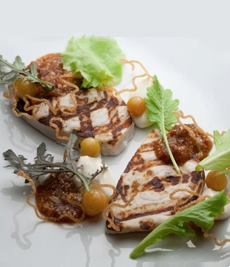
    [1] Cleaned, frozen, thawed and ready to cook (photo courtesy EuroUSA). [2] Ceviche with marinated (not grilled) octopus (photo courtesy Lola | Denver). [3] Seared and ready to plate (photo courtesy Scarpetta | NYC). [4] A classic first course or luncheon salad: grilled octopus and fancy greens atop a bean salad vinaigrette (photo courtesy l’Amico | NYC). [5] An easy yet fancy main (photo courtesy Gardenia | NYC). [6] Octopus tostadas (photo courtesy MexicanFoodMemories.co.uk).


    Over the past 10 years, charred/seared or grilled octopus has become de rigueur at just about every restaurant we patronize.

    That’s great news, because we love grilled octopus with a drizzle of olive oil. It doesn’t get more delicious than that.

    Yet, simple as it is to grill seafood, we never tried it at home. One reason: We typically don’t see mature octopus at fish markets (in mainstream markets, it’s often a special order); and we personally don’t like the miniature size (not as meaty, not as tender, etc.).

    So this past weekend, we happened upon frozen octopus at a Latin American grocer. It was tentacles only, which means we didn’t have to remove the head and beak. What could we do but buy it and give it a shot?

    It turns out that frozen octopus is actually more tender than fresh. Freezing and then thawing the tentacles helps to tenderize the meat. White wine, often used as a braising liquid to slow-cook the tentacles, is a second tenderizer.

    Octopus, first braised/poached and then charred/seared or grilled, is incredibly versatile and can take on any aromatics. The classic Mediterranean preparation is poached in white wine with garlic and oregano, served with gigante beans and/or some combination of capers, lemon, olives and tomatoes.

    But you can make anything from octopus tostadas to tandoori octopus; or go beyond the popular octopus and bean salad with a salad of fennel, mint, orange slices and red onion in a sherry vinaigrette.

    You can cut the cooked octopus into kabob chunks, serve it thinly sliced on a flatbread pizza. We made a hero sandwich with sliced octopus, roasted red peppers and giardiniera.

    Perhaps the most difficult step with octopus is he first step: deciding how you want to serve it, with so many delectable options. Some of our favorites are shown in the photos—at least, the ones we’re capable of making. Also take a look at pulpo a la gallega, an octopus and potato torta from Spain; and octopus terrine, which can be turned into octopus pastrami.

     
    RECIPE: SEARED OR GRILLED OCTOPUS

    Here’s an important note before you start: As with bacon, onions and other foods, what looks like a lot of cooks down to far less. Estimate 3/4 to 1 pound per person as a first course.

    Ingredients For 6 First Courses

  • 1/4 cup plus extra-virgin olive oil
  • 3 pounds octopus, thawed overnight in the fridge
  • 6 garlic cloves, peeled
  • 1 tablespoon plus 1 teaspoon crushed red pepper, oregano, or both
  • 1 bottle dry white wine (e.g. Pinot Grigio, Sauvignon Blanc)
  • 2 tablespoons extra-virgin olive oil
  • Salt
  •  
    Preparation

    1. REMOVE the beak from the octopus. Place a plastic cutting board in the sink, slice off the head, and flip the octopus to remove the beak, which is in the middle of the tentacles. With a paring knife, slice around the beak and pushing it through, as if coring a pear or tomato. It will to pop out the other side.

    2. HEAT 2 tablespoons of the olive oil in a large enameled cast-iron casserole or dutch oven. Add the octopus and cook over moderately high heat, turning until lightly browned (2 to 3 minutes). Transfer the octopus to a plate or bowl. Add the garlic cloves to the casserole and cook over moderate heat, stirring until lightly browned, about 2 minutes. Add the crushed red pepper and cook, stirring, until fragrant, about 20 seconds.

    3. ADD the white wine gently, and bring the braising liquid to a boil. Here’s a tip from every Italian nonna: When slow-cooking in wine, put the actual wine cork in the braising liquid to cook along with the octopus. It’s one of those tricks that no one can explain. But simple slow cooking (braising) also creates tender tentacles, so don’t go crazy looking for “the secret.” There is one tip we’ll pass along from Bon Appetit: If you want the tentacles to curl, dip them in the hot poaching broth three times before submerging.

    4. RETURN the octopus to the casserole, add up to 1 cup of water or broth if necessary, to cover the octopus. Cover the casserole and braise over moderately low heat until very tender, about 1 hour and 30 minutes. Remove from the heat and let the octopus completely in the braising liquid, another technique that keeps the flesh tender.’’

    5. REMOVE the red skin by rubbing it with a paper towel, taking care to leave the on suckers, which are the parts that get crispy when grilled. Plus, removing them will dry out the cooked octopus. If the suckers start to come off when rubbing, it means the octopus has been cooked it too long. It isn’t ruined, but do your best to keep the remainder intact for the aforementioned reasons.

     
    6. FINISH the octopus by searing in a large skillet with 2 tablespoons of olive oil, creating a deep char on the outside. We prefer to sear the tentacles whole, about 8 minutes per side (we like ours very crispy). The flesh and suckers will caramelize nicely; (you can also thinly slice the tentacles and grill cut side down over moderately high heat, for about 1 minute; then and cook for 20 seconds. We cook the octopus in long lengths, and prefer to serve it two meaty 6-inch or four 3-inch pieces. Cut the head into 1-1/2-inch pieces. We use them in green salads or as a garnish for fish.

    7. PLACE on a platter lined with paper towels to absorb any excess olive oil. Season lightly with salt. Transfer the octopus to plates. Fill the radicchio leaves with the Italian salad and set beside the octopus. Garnish with fennel fronds and serve.
     
    Variation: You can also roast the octopus, but we haven’t tried it.
     
    WHAT IS AN OCTOPUS (SCIENTIFICALLY SPEAKING)?

    The octopus (plural octopuses, octopodes or octopi) is a cephalopod mollusc in the phylum Mollusca (class Cephalopoda, order Octopoda, family Octopodidae, genus Octopus, species vulgarism, plus more than 100 total species, representing one-third of all cephalopods.

    The octopus has two eyes and four pairs of arms (tentacles) and a beak mouth at the center underside of its tentacles. An invertebrate, it has no vertebral column [backbone or spine) and no other skeleton. It most intelligent of the invertebrates.
      

    Comments off

    TIP OF THE DAY: Add Cauliflower To Mashed Potatoes

    If you’re working on a special mashed potatoes recipe for the holidays—or simply enjoy them on a regular basis—we present this mashup: a blend of mashed potatoes and cauliflower. This combination has long been recommended for better family eating. Cauliflower adds moisture to mashed potatoes, so they can be rewarmed on the stove without drying out. Thus, you can prepare the dish completely in advance and then warm it up on the stovetop.

    The added moisture enables us to reduce the amount of butter and cream typically needed for mashed potatoes.

    Not to mention, the cruciferous superstar has more nutrition and fewer calories than potatoes.

    The crispy fried tarragon is a garnish you can save for special occasions, or cook up in five minutes for any occasion. It’s a delicious garnish for any starch or grain recipe.
     
     
    RECIPE: MASHED POTATOES AND CAULIFLOWER WITH FRIED TARRAGON

    This recipe was developed by the Williams-Sonoma Test Kitchen. Prep time is 25 minutes, cook time is 25 minutes. You can make it a day in advance.
     
    Ingredients For 6 Servings

    For The Fried Tarragon

  • Vegetable oil for frying
  • 4 to 6 fresh tarragon sprigs (substitute basil or sage leaves)
  •  
    For The Mash

  • Kosher salt and freshly ground pepper
  • 2 pounds Yukon gold potatoes, peeled and quartered
  • 1 head cauliflower, cored and coarsely chopped, a few florets reserved for roasting
  • 1 tablespoon extra-virgin olive oil
  • 4 tablespoons (1/2 stick) (2 oz./60 g) unsalted butter
  • 1/3 cup heavy cream
  • Optional garnish: aleppo pepper flakes or red chile flakes
  •  
    Preparation

    1. PREHEAT the oven to 400°F.

    2. FRY the tarragon. Add the vegetable oil to a large, wide pan over medium-high heat, to depth of about 1/2 inch. Heat the oil to 350°F on a deep-frying thermometer. Add the tarragon sprigs and fry until the bubbling diminishes, about 30 seconds. Take care, as the oil will splatter.
    Using a slotted spoon, transfer to a paper towel–lined plate and sprinkle with salt. Let cool completely.

    3. MAKE the mash. Combine the potatoes and cauliflower in a large saucepan, add cold water to cover by 2 inches, and salt the water. Bring to a boil over medium-high heat; then reduce the heat to medium and simmer until the vegetables are very tender, about 20 minutes. Drain well.

    4. RICE the vegetables: Working in batches, pass the vegetables through a potato ricer into a large bowl. Alternatively, mash with a potato masher. Meanwhile…


    Mashed Potatoes & Cauliflower Recipe
    [1] Mashup: mashed potatoes and cauliflower (photo © Williams-Sonoma).

    Mashed Potatoes
    [2] Classic mashed potatoes (photo © U.S. Potato Commission).

    Colored Cauliflower
    [3] Cauliflower in your choice of colors. You can use green, orange or purple cauliflower to add a tinge of color to your mash (photo © Melissas).

    Fresh Tarragon
    [4] Tarragon: a perfect herb pairing (photo © Good Eggs).

     
    5. TOSS the reserved cauliflower florets in a bowl with the olive oil and a generous pinch of salt and pepper. Transfer to a baking sheet and roast until tender and golden brown, about 15 minutes. Remove from the oven and cover with aluminum foil to keep warm.

    6. USE the same saucepan from cooking the vegetables, and combine the butter and cream. Heat over medium heat until the butter melts and the cream just begins to simmer. Return the potato mixture to the pan, stirring it into the butter mixture. Season with salt and pepper.

    7. TRANSFER the potato mixture to a serving bowl. Garnish with the tarragon sprigs and roasted cauliflower and sprinkle with chile flakes.
     
     
    MORE FAVORITE MASHED POTATO RECIPES

  • Beet Mashed Potatoes, a vivid burgundy color for fall, Halloween and Valentine’s Day
  • Blue Cheese Mashed Potatoes
  • Creamy Low-Fat Or Non-Fat Mashed Potatoes
  • Low-Calorie Cauliflower Mashed Potatoes & Chives, with yogurt substituting for the butter and cream
  • Mashed Potato “Martini”
  • Portabella Stuffed With Mashed Potatoes & Bacon
  •  
    Halloween Mashed Potatoes

  • Mummy Mashed Potatoes
  • Spooky Shepherd’s Pie
  •   

    Comments off

    The Nibble Webzine Of Food Adventures
    RSS
    Follow by Email


    © Copyright 2005-2026 Lifestyle Direct, Inc. All rights reserved. All images are copyrighted to their respective owners.