THE NIBBLE BLOG: Products, Recipes & Trends In Specialty Foods


Also visit our main website, TheNibble.com.

STOCKING STUFFER: Lucha Crunch Bar, The Undisputed Champion

In Mexico, “lucha libre” is freestyle wrestling (literally, “free fight”).

It has developed into a stylish form of the professional wrestling, characterized by colorful masks, rapid sequences of holds and maneuvers, and “high-flying” maneuvers, some of which have been adopted into U.S. wrestling.

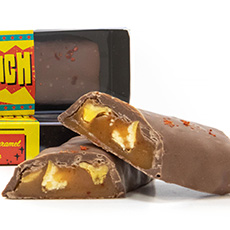
Gearharts Chocolates has ported the colorful spirit of wresting into a scrumptious chocolate crunch bar, which has become our new favorite candy.

The Lucha Crunch Bar is a 5″ x 2.5″ delight that is not to be missed.

The enticing packaging has artwork in Lucha Libre style, including a mask!

The luscious, nut-free candy bar inside is filled with Mexican-inspired flavors:

  • Caramel infused with fresh lime.
  • “Half-popped” popcorn for crunch.
  • A touch of chili rojo (red chile) for a bit of kick.
  • A cloak of Gearharts signature blend 40% milk chocolate.
  •  
    We can’t adequately describe the bodacious blend of flavors, except to say:

    All hail the Heavyweight Champion! Lucha Crunch Bar is our favorite chocolate find of the year.
     
    We’re buying a dozen as stocking stuffers, and another dozen to feed our chocolate fix.

    Hopefully, we’ll be able to limit our consumption to one bar per week.

    Get yours at GearhartsChocolates.com.


    Get yours at GearhartsChocolate.com.


    [1] A bite of Lucha Crunch Bar is a bite of heaven (both photos © Gearharts Chocolates).


    [2] The package is designed in the bright colors of Mexico and the mask of a Lucha Libre wrestler.


    THE HISTORY OF CANDY BARS

    The first candy bar was created in 1866. Here are the oldest bars, thanks to Oldest.org, from which this content was adapted.

    To see photos of the bars, click here.

  • 1847, England: Joseph Fry Chocolate Bar. Fry created the first molded chocolate bar in 1847, followed by the Chocolate Cream Bar, the first mass-produced candy bar, in 1866. It had a flavored fondant center.
  • 1875, Switzerland: Nestlé Milk Chocolate. The first milk chocolate bar was originally called the Gala Peter after Daniel Peter, who figured out how to make milk chocolate.
  • 1879, Switzerland: Lindt Chocolate Bar. Rodolphe Lindt created the breakthrough—called conching—that transformed the original hard, chewy chocolate into the smooth, creamy chocolate we know today.
  • 1900: Hershey’s Milk Chocolate Bar, United States. Milton S. Hershey’s milk chocolate bar was the first mass-produced chocolate in the United States. Before then, most of the world’s chocolate bars were made in Europe, especially Switzerland.
  • 1905, England: Cadbury Dairy Milk Bar. Cadbury had been producing chocolate bars since 1894, but the Dairy Milk Bar featured a higher proportion of milk. It was an instant hit.
  • 1908, Switzerland: Toblerone. Theodore Tobler developed the bar with his cousin Emil Baumann, adding Italian nougat (torrone), almonds and honey to milk chocolate. The name of the bar is a combination of Tobler and torrone, and the triangular shape was inspired by a pyramid of dancers at the Folies Bergères.
  • 1914, England: Fry’s Turkish Delight. From the same family that created the first chocolate bar, this bar covered Turkish Delight, a confection dusted with powdered sugar, in milk chocolate.
  • 1917, United States: Clark Bar. This milk chocolate bar with a crunchy peanut butter center was created by David L. Clark, an Irish-born candy salesman. His company later created the Zagnut Bar.
  • 1920, United States: Oh Henry. Created by the Williamson Candy Company in Chicago, this bar is a mixture of peanuts, caramel and fudge, coated in milk chocolate. The story is that the candy bar was named after a young man who often came to the factory to flirt with the female workers.
  • 1928, United States: Reese’s Peanut Butter Cups. H. B. Reese created this combination of peanut butter and chocolate. He worked in Milton Hershey’s chocolate factory and was inspired to started making his own chocolates.
  •  
    Company ownership may have changed, but all of these bars are still made today!
      

    Comments off

    TIP OF THE DAY: Baked Brie Toppings


    [1] Baked Brie with cranberries and olives. The recipe is below (photo © DeLallo).


    [2] Caramelized onion baked Brie (photo © Paul Binet | iStock).


    [3] The simplest topping: jam or preserves. Add chopped nuts or snipped herbs (photo © Murray’s Cheese).


    [4] Here, the honey and rosemary were added before the Brie was baked (photo © Urban Accents).


    [5] Cranberry-pecan baked Brie. Here’s the recipe © Damn Delicious).


    [6] A dessert Brie topped with caramel and pecans (photo © McCormick).


    We have a certain warm anticipation to having guests in the fall and winter: Baked Brie.

    We first discovered the concept in college, thanks to our friend Lesley.

    She served us a plain baked brie with Triscuits. We had eaten many a slice of Brie with wine; but the simple act of briefly baking put the creamy, oozy cheese in a new light: a party light.

    We have lots of ideas below, but let’s start with some tips.
     
     
    BAKED BRIE TIPS

  • Brie is like chicken: It pairs well with many other flavors.
  • Some people like Brie en Croûte, wrapping the Brie in puff pastry prior to baking it. We find that it overkill: You’re already serving the Brie with bread or crackers.
  • Some people like to cut the rind off the top before baking. That’s one way to make it easy to scoop out the melted cheese, but we just happen to love the rind of a Brie.
  • Add some herbs onto any topping: sweet, savory or combination. At the least, add sprigs of fresh woody herbs—lavender, rosemary, sage or thyme—to garnish the plate.
  • Toast the nuts if you have time: They’ll taste better (here’s how to toast nuts).
  • Toss some apple slices, celery sticks or whole strawberries onto the plate for people who love cheese but avoid carbs.
  • If you know that some guests can’t have nuts, leave them off. You can add them to the side of the plate for people who want to scoop some up.
  • We prefer to serve Baked Brie with toasted baguette slices plus fruit-and-nut toasts like Raincoast Crisps; but everyone has his or her favorite (and budget).
  •  
    ANOTHER TIP, which we embrace: If you have the right size baking dish or ramekin, bake the Brie in it and serve it that way. It’s the non-messy solution: Nothing oozes all over a plate or platter.

    We’re starting with a recipe for a savory Baked Brie with olives, but we have 30 recipe combinations below, for:

  • Sweet Brie Toppings
  • Sweet & Savory Brie Toppings
  • Savory Brie Toppings
  • Dessert Brie Toppings

  •  
    RECIPE: BAKED BRIE WITH OLIVES & POMEGRANATE

    This recipe from DeLallo was originally made with fresh cranberries instead of pomegranate arils.

    We found the fresh cranberries to be too tart, so we substituted the arils. Alternatively, you can use dried cranberries, which sweetly offset the saltiness of the olives.
     
    Ingredients

  • 1 baby Brie cheese (8-ounce round)
  • 1/4 cup pitted mixed olives, chopped
  • 1/4 cup chopped walnuts, toasted
  • 1/4 cup chopped fresh cranberries or whole arils or dried cranberries
  • 2 tablespoons honey
  • Bread and/or crackers to serve
  •  
     
    Preparation

    1. PREHEAT the oven to 350˚F. Place the Brie on a nonstick baking sheet. Bake until softened, about 15 minutes. Remove from the heat.

    2. TOP the Brie with the olives, walnuts and cranberries. Drizzle with honey. Serve with bread, crackers or toasts of choice.

     
    MORE BAKED BRIE TOPPINGS:

    SWEET BRIE TOPPINGS

    The best way to get the toppings to stay on the brie is to cover the top with a think spread of honey (regular or creamed) or jelly when it comes out of the oven.

    Then, quickly add the topping(s) and serve.

    Sticky toppings such as jam and similar textures don’t need any extra help.

  • Cherry preserves, balsamic vinegar and chopped toasted pecans.
  • Creamed honey, chopped honey-roasted peanuts, dried cherries.
  • Creamed honey, sliced strawberries, sliced almonds, chopped rosemary.
  • Fresh berries (optionally marinated in liqueur) with shredded basil.
  • Fresh figs and pistachios with a balsamic drizzle.
  • Grand Marnier-marinated berries.
  • Holiday Brie #1: cranberry and almonds, pecans or chopped pistachios, topped with orange zest. Here’s the recipe.
  • Holiday Brie #2: cranberry relish.
  • Holiday Brie #3: fig jam, dried cranberries, chopped toasted hazelnuts.
  • Honey Bun: mix chopped walnuts and raisins into regular or creamed honey.
  • Pumpkin pie filling and pecans (bake on top of the Brie).
  • Roasted grapes, multicolor, halved before roasting.
  • Spiced caramel with pepitas.
  • Toasted old-fashioned oats, toasted chopped walnuts, diced apples Brown sugar and cinnamon.
  •  
    When you have nothing else in the house but the Brie and the basics:

  • Fruit preserves, chutney or marmalade, with raisins and chopped nuts.
  • Honey and chopped dried fruit.
  • Honey and granola.
  •  
     
    SWEET-AND-SAVORY BRIE TOPPINGS

  • Bacon jam, with or without chopped herbs.
  • Orange marmalade with rosemary leaves.
  • Pepper jelly, with or without chopped herbs.
  • Mango chutney with chopped roasted peanuts.
  •  
    SAVORY BRIE TOPPINGS

    If you want only savory toppings, here are three of our favorites:

  • Caramelized onions and sautéed mushrooms with thyme, fresh arugula, optional crumbled bacon.
  • Chopped sundried tomatoes in EVOO (drained) plus fresh, shredded baby arugula.
  • Chopped sundried tomatoes and artichokes.
  •  
     
    DESSERT BRIE TOPPINGS

    Some people like to turn baked Brie into a dessert cheese course, with caramel or spiced caramel sauce, toasted or candied pecans and other sweet toppings of choice.

    Serve a dessert brie with graham crackers, toasted raisin bread or wheatmeal biscuits.

  • Apple crisp baked Brie, with sauteed diced apples, raisins and streusel (substitute granola for the streusel).
  • Maple-Pecan pecans in maple syrup.
  • Pecan praline: Pecan halves in butterscotch sauce.
  • Raspberries With balsamic glaze.
  •  
    Consider adding a dessert wine: a sweet Muscat/Moscato, a sparkling red Italian Brachetto, or anything your wine store clerk recommends.


    Comments off

    GIFT: Turmeric Tea For Health-Conscious Friends

    A tea-of-the-moment, which happens to be thousands of years old, is turmeric tea, a highly antioxidant, anti-inflammatory herbal tea.

    Revered as a ‘golden spice’ in Ayurvedic medicine for more than 5000 years, it has long been drunk as a tea.

    When brewing black tea, you can add ¼ teaspoon ground turmeric to the cup before pouring in the hot water. For a simple tisane, ground turmeric or fresh root slices with hot water is popular.

    But for a most impressive healthful gift, Vahdam’s Turmeric Tea Tales (photos #1 and #2) is the way to gift it in style.

    An elegant golden gift box contains vials of six turmeric teas that, the company notes, are not only healthful year-round, but are ideal to combat holiday stress and travel.

    And, we say, a fine way to usher in all those “healthier lifestyle” resolutions for the new year.

    Vahdam’s turmeric teas are flavored to add variety:

  • Turmeric Ashwagandha Tea
  • Turmeric Fennel Tea
  • Turmeric Ginger Tea
  • Turmeric Moringa Tea
  • Turmeric Saffron Tea
  • Turmeric Spiced Tea
  •  
    There are also individual tins of Turmeric Lattes (photo #3). Just add hot water or milk.

    Varieties include:
    li>Turmeric Ashwagandha Tea

  • Turmeric Classic Tea
  • Turmeric Ginger Tea
  • Turmeric Moringa Tea
  • Turmeric Mushroom Latte
  •  
    And there are even more options for everyday: tea bags and pouches of loose tea.

    Head To VahdamTeas.com to see all the options.
     
     
    WHAT IS TURMERIC

    Turmeric (TER-muh-ric) is a rhizome, an edible root of a flowering plant.

    A relative of ginger, turmeric may look like ginger root from the outside (photo #4). But inside is a vivid yellow-orange flesh, that is dried and ground into a spice (you can find it in just about any grocery store).

    Common in Indian, Southeast Asian, and Middle Eastern cuisines, turmeric has a sharp, slightly bitter flavor that adds interest to foods.

    Because of recent focus of turmeric as a superfood, fresh turmeric root is now available in health food and other food stores in the U.S. We have friends who brew tea from the fresh root daily.

    There’s more about the potential health benefits of turmeric below.
     
     
    TURMERIC IN THE KITCHEN

    In addition to brewed tea, turmeric is an ingredient in curry powder and garam masala spice mixes. It also has a place in American cuisine:

  • In scrambled eggs, frittatas, quiche, even deviled eggs.
  • To season greens, roasted vegetables, sautéed onions, beans and lentils.
  • Added to soups and smoothies.
  • Added to rice, yogurt and other pale foods (even pancakes!) for great color.
  • Blended into hummus and yogurt, marinades and salad dressings.
  •  
    Use the freshly-grated root in:

  • Marinades
  • Pumpkin: pies, muffins, cookies
  • Smoothies and fresh-pressed juices
  • Stir-frys
  • Vinaigrettes and other salad dressings
  •  
    Here’s more on how to cook with turmeric.

     
    TURMERIC & HEALTH

    Turmeric has been touted as a superfood that can fight cancer and diabetes, ease depression, and more.

    Several compounds in turmeric may contribute to better health. The most well-known of these is curcumin.

    We turned to Web MD for advice on what turmeric can, and can’t do.

    While there has been much lab testing, the Web MD notes that scientific testing on humans is limited, and more is needed.

    Research is ongoing.


    [1] Deck the halls with this healthful gift: Turmeric Tea Tales (photos #1, #2 and #3 © Vahdam Teas).

    [2] The inside of the gift box. And surprise: It’s one of Oprah’s favorite things!


    [3] Turmeric latte.


    [4] Turmeric root (photo © Malaysian Kitchen).


    [5] Turmeric root and ground spice (photo © Silk Road Spices).

     
    We’ve abridged their information here. Check out the entire article and discuss options with your healthcare provider.

  • Alzheimer’s. People with Alzheimer’s have chronic inflammation, and turmeric seems to have natural anti-inflammatory effects. But so far, there’s no strong scientific evidence of turmeric’s efficacy.
  • Arthritis. For its anti-inflammatory properties, there is hope that turmeric may help with joint pain, stiffness and other inflammation. If you decide to try it,note that black pepper is needed to help your body absorb the natural curcumin.
  • Cancer. In lab and animal studies, turmeric has stopped the growth of tumor cells and helped detoxifying enzymes work better.
  • Depression. Scientists are excited about curcumin’s potential to ease depression and help antidepressants work better. But so far, research results have been mixed.
  • Diabetes: Because curcumin can keep blood sugar levels steady, it could be a useful tool to prevent or treat type 2 diabetes.
  • Flu. If you sip turmeric tea, the curcumin might help you to fight off a variety of viruses, including herpes and the flu. But since turmeric is only about 3% curcumin, the occasional cup of tea isn’t be a cure-all.
  • Headache. Since ginger is a well-known natural headache remedy, turmeric has also been embraced anecdotally, especially for migraines. More research is needed.
  • Heart Health. Some studies have found that turmeric can lower LDL “bad” cholesterol, while others concluded that the spice has no effect. Scientists continue to look into the heart-protective possibilities of turmeric.
  • IBS. Early research indicates that turmeric could help improve IBS symptoms such as abdominal pain.Turmeric is also being studied as a treatment for diseases like Crohn’s and ulcerative colitis.
  • PMS. Curcumin supplements have been found helped ease PMS symptoms.
  •   

    Comments off


    © Copyright 2005-2026 Lifestyle Direct, Inc. All rights reserved. All images are copyrighted to their respective owners.