THE NIBBLE BLOG: Products, Recipes & Trends In Specialty Foods


Also visit our main website, TheNibble.com.

STOCKING STUFFER: Zoku Pocket Straw & The History Of Straws

Americans use millions of plastic straws each day. Plastic drinking straws are among the top 10 contributors to marine debris pollution [source].

They are one of the top five contributors to plastic marine waste, with millions of plastic straws being used every day in the U.S. alone. During a five year cleanup project around American shorelines, nearly 7.5 million straws were found [source].

> The history of drinking straws is below, including the chronology of countries and municipalities that have banned plastic straws.

These non-biodegradable straws litter our streets, lands, shorelines, and oceans. They do not biodegrade but break down into smaller microplastics that have made their way into our food chain and the deepest trenches of our oceans.

Coalitions of restaurants, bars, cafes, hotels, event venues and other organizations are committing to eliminate single-use plastic straws; but it will take time to trickle down.

Environmentally-conscious consumers are aware of the problem, and strive to eliminate single-use plastics straws, sending them back in food venues and drinking straight from the glass.

Numerous reusable straws have come onto the market to meet the demand. The one we like best is Zoku’s reusable stainless steel Pocket Straw.

  • Use it for hot or cold drinks.
  • It telescopes up to 9 inches and fits any glass size.
  • The silicone mouthpiece mimics the feel of plastic, so sipping is just like (or better than) a plastic straw.
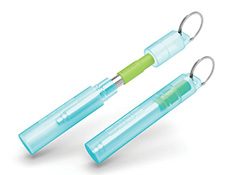
  • Small and lightweight, just 4.4″ when closed, you can carry it in a small pocket. A loop on the case lets you attach it to your keyring.
  • The hygenic carrying case and includes a cleaning brush.
  • It’s dishwasher-safe, BPA- and phthalate-free.
  •  
    We think it’s a great gift for eco-conscious friends and family.

    The right person will love it!

    And at $9.99, it doesn’b break the bank.

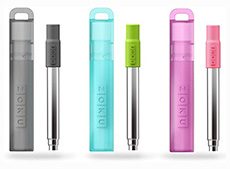
    You can buy it in Berry, Charcoal or Teal on the company website, or on Amazon, and at other retailers and e-tailers.
     
     
    THE HISTORY OF THE DRINKING STRAW

    From ancient times, man has had the need to sip from a straw.

    The first known straws were made by the Sumerians, living along the valleys of the Tigris and Euphrates rivers in the Fertile Crescent—the “birthplace of civilization”.

    It’s located in the historical region of southern Mesopotamia, modern-day southern Iraq*, dating to the 4th millennium B.C.E. [source].

    Back in during the Chalcolithic (Copper Age) and Early Bronze Ages, necessity was the mother of invention. The straw was invented to drink ancient man’s favorite drink: beer.

    It is believed that the straws were needed to avoid the solid byproducts of fermentation that sank to the bottom of the vessel.


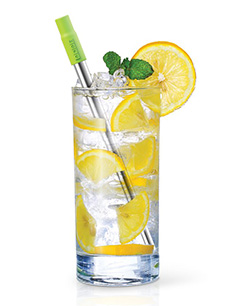
    [1] The Zoku Pocket Straw telescopes to accomodate any size glass (all photos © Zoku Home).


    [2] The straw telescopes into a 4.4″ carrying case and can hang on a key ring.


    [3] Pick your color!

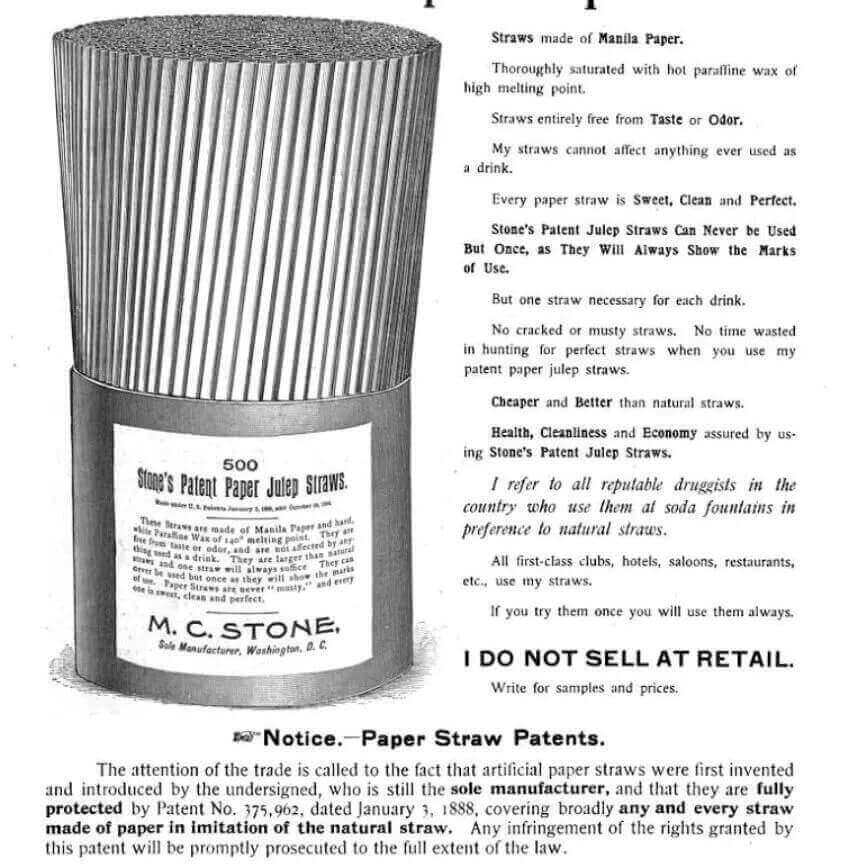
    Old newspaper ad for paper straws
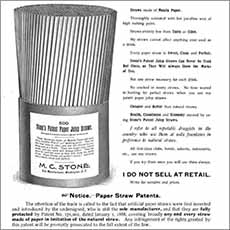
    [4] An ad for the paper drinking straw, invented in 1888. See the end of the article for a readable version.


    The oldest drinking straw in existence, found in a Sumerian tomb dating to 3000 B.C.E., belonged to someone who could afford all the food and drink he liked. It’s a gold tube inlaid with lapis lazuli.

    These early straws weren’t the simple, practical straws we might imagine; they were elaborate, ceremonial objects that demonstrated wealth and status, ornate drinking tubes made from precious metals and decorated with semi-precious stones.

    These straws were likely used for drinking beer from communal vessels. Beer was a staple beverage in Sumerian society and the straws helped to filter out grain and other sediments at the bottom of the vessel.

    The idea caught on and natural grass straws were devised by and for ordinary people. Rye grass was particularly popular: hollow, naturally waterproof, and readily available. The did have the major drawbacks of affecting the taste of beverages and deteriorating quickly.

    Over the centuries, people created metal drinking straws from common metals, but metal was always expensive.
     
     
    The Modern Paper Drinking Straw Arrives

    American Marvin C. Stone patented the modern drinking straw, made of paper, in 1888. He did not enjoy sipping his Mint Julep through the rye grass straw, which not only became mushy, but imparted a grassy taste.

    One day, he wound paper around a pencil to make a long paper tube. Sliding the pencil from the paper, he applied glue to hold it together.

    The glue, too, would ultimately dissolve during slow sipping, so he later built a machine that coated the outside of the paper with wax to hold it together. Voilà: an improvement in sipping beverages that everyone could enjoy and afford.

    He mass-producing the paper straws, making them the first affordable and accessible to the general public.

    In 1937, Joseph Friedman invented the bendable straw after watching his young daughter struggle to drink a milkshake through a straight paper straw, too tall for her to reach easily.

    Friedman inserted a screw into a paper straw and wrapped dental floss around the grooves. When he removed the screw, it left accordion-like ridges that allowed the straw to bend. He patented his “Articulable Straw” that year. Manufacturers were not initially interested, but the straw eventually became widely popular, especially in hospitals where patients could drink while lying down.

    In 1969, his Flex-Straw Company was sold to the Maryland Cup Corporation.
     
     
    Plastic Straws Move Into The Mainstream

    The 1950s saw the rise of the automobile and subsequently, the rise of Fast Food. These restaurants replaced washable plates, utensils, and glassware with low cost and portable paper for meals and drinks on the go.

    The transition to plastic straws happened gradually during the 1960s as the manufacturing infrastructure to mass produce plastic straws was put into place. While plastic was more costly than paper, it was cheap enough; and the straws didn’t lose their shape when saturated in liquid, as paper straws could.

    Existing straw manufacturers like Maryland Cup Corporation began producing them, and there was a bonus to both manufacturers and consumers:

    With the growth of fast food and to-go drinks, plastic straws could easily be pushed between the “X” crosshairs of a to-go lid without tearing.

    Better venues opted for plastic straws as a customer convenience.

    The consumer boom and the baby boom after World War II also gave rise to children-pleasing novelty straws:

  • Straws with plastic animals looped around the top of the straw (see photo).
  • Straws filled partially with chocolate or strawberry flavor, creating chocolate milk or strawberry milk by merely sipping plain milk.
  • Straws were made with a bend toward the top, to better angle into the mouth.
  •  
    For adults and kids alike, fashion came to straws:

  • Colors, stripes, polka dots.
  • Prints
  •  
    Today, you can treat guests to fancy-print straws: leopard-print straws, metallic stars, and too many others to enumerate.

    Good news going forward: Since the drinking straw issue has arisen, some paper straw manufacturers have created a thicker version of the paper straw. It holds up like plastic; and when it’s outlived its single-purpose use, it biodegrades.

    And cornstarch-based straws are on the rise, compostable and biodegradable.

    In 2024, plastic straws make up about 99% of the $3 billion global drinking-straw market. Some sources indicate that the category is growing at a CAGR of 20.27%.

    That’s a long way to go, but you can start now.

    ________________

    *Other almost-as-old civilizations include Ancient Egypt, Norte Chico in Peru, and the Indus Valley in modern-day northwest India and Pakistan.

    The history of plastic straw bans [source]:
    >August 2016: France becomes the first country to impose a total ban on plastic cups, plastic plates and plastic cutlery.
    >August 2017: Lonely Whale kicks off a digital campaign for A Strawless Ocean to educate the public and push for regulations on single-use plastic.
    >February 2018: Queen Elizabeth bans plastic straws and bottles from all royal estates, cafes, and gift shops.
    >May 2018: Vancouver becomes first major Canadian city to ban single-use plastic.
    >May 2018: Alaska Airlines eliminate plastic straws and stirrers, substituting white birch and bamboo for the 22 million plastic stir straws and citrus picks used each year.
    >July 2018: Seattle is first in the U.S. to have a plastic straw ban go into effect.
    >July 2018: Starbucks announces it plans to eliminate plastic straws from all global locations by 2020.
    >September 2018: McDonald’s announces it will replace single-use plastic straws with paper-based alternatives in all stores across UK and Ireland. The chain uses 1.8M straws per day in the UK.
    >January 2019: California enacts a “straw upon request” policy. Most cities within the state phased out plastic straws with compostable, paper-based alternatives.
    >2019: Washington D.C. also bans single-use plastic straws.
    >2020: England bans all single-use plastic straws China.
    >2021: Canada and Mexico City ban all single-use plastics.
    >2022: New Jersey rolls out single-use plastic ban, starting with plastic straws, with single-use plastic carryout bags and Styrofoam cups, plates and containers also banned that year.
    >2022: France bans single-use plastic packaging for most fruits and vegetables, which could eliminate 1 billion pieces of plastic waste.
    >2022: Three out of four people in a 28-country survey support the elimination of single-use plastics [source].


    Old Newspaper Ad
    [5] [Source.]


    CHECK OUT WHAT’S HAPPENING ON OUR HOME PAGE, THENIBBLE.COM.


    Comments off

    It’s National Charcuterie Board Day. Here’s How To Make One!

    When we entertain, whether cocktails or dinner, we serve drinks and hors d’oeuvre with as little effort as possible.

  • If we’re going to serve wine, we start with open bottles of red and white, and leave unopened bottles on the side so guests can uncork them when they’re ready for more.
  • If we’re serving cocktails, we mix pitchers of Margaritas or Bloody Marys in advance, and leave fix-your-own ingredients on the side for the Martini crowd, gin-and-tonic and whiskey-and-soda fanciers.
  •  
    For nibbles, we create a charcuterie board. There’s no preparation required, except for slicing a baguette.

    Just purchase the ingredients and place them on a cheese board or tray and arrange them in an attractive manner.

    National Charcuterie Board Day is August 26th—a great day to host a cocktail party and serve charcuterie.

    Below:

    > What is charcuterie?

    > What’s on a charcuterie board?

    > Selecting the components.

    > How much do you need?

    Elsewhere on The Nibble:

    > The history of charcuterie.

    > The different types of charcuterie: a photo glossary.

    > Wine pairings for charcuterie.

    > The year’s 20 appetizer and hors d’oeuvre holidays.

    > The year’s 75 meat holidays.
     
     
    1. WHAT IS CHARCUTERIE?

    Charcuterie (shar-KOO-tuh-REE) is a French term for fancy pork-based and related products made by a charcutier (shar-koo-tee-AIR), a specially trained pork butcher.

    Originally, the art of charcuterie was used to preserve meat in the Middle Ages. The art continues in France as a hallmark of fine cuisine.

    While many charcuterie products contain only pork as their meat base, just as often the pork is combined with other meats, fowl or game.

    Modern charcuterie has expanded to include items with no pork at all—products made only of poultry, venison, vegetables or fish.

    Check out our Charcuterie Glossary for the products are common offerings of a charcutier.
     
     
    2. WHAT’S ON A CHARCUTERIE BOARD/PLATTER/PLATE?

    It’s not just meat, although restaurants often offer meat-only charcuterie plates:

  • Cured sausages: saucisson, salami, chorizo
  • Pâtés and terrines: pâté de campagne, pâté de foie, terrine
  • Whole cured meats: prosciutto, jambon, coppa, bresaola
  •  
    But many charcuterie plates—especially those served at cocktail parties or before dinner—contain:

  • Artisan breads and toasts
  • Assorted fine cheeses (semihard, soft, blue, etc.)
  • Assorted olives
  • Dried fruits
  • Fresh fruits: grapes plus small varieties like clementines, kumquats and Lady apples and figs
  • Mustard and fig or sour cherry jam
  • Pickled vegetables: artichoke hearts, dilly beans, cornichons, peppadews, sweet gherkins
  • Pickled fruits, especially those that are easy to pick up, like apple and pear slices
  •  
    > Here’s how to quick-pickle fruits and vegetables.
     
     
    3. SELECTING THE COMPONENTS: RULES OF THUMB

  • Go for bold colors and flavors that provide a special experience (people can eat ham and Swiss at home).
  • Fresh vegetables brighten up a board, including grape tomatoes, baby carrots and radishes.
  • Dried fruits brighten up a board: apricots plus tropical dried fruits like kiwi, mango and papaya (although dates and figs are wonderful with charcuterie.
  • For fresh fruits, go for color: some raspberries and/or strawberries, multicolored seedless grapes, orange slices.
  • Mix the classic and the new items, the sweet and the salty, a contrast of textures.
  • To help with your own selection, consider cheeses, meats and condiments from a specific region or country’s cuisine. American, French and Italian are popular, but how about Greek or Scandinavian?
  • Offer enough variety for the different preferences.
  • For vegans, provide more fruit options, plus raw vegetables. If your cheese counter sells vegan cheese, pick one up. Vegan cheeses like Miyoko’s are delicious.
  • Arrange items with enough space between them. If things are too crowded, it impedes making a choice.
  • If you find that you have too much for one board, set up a second board. Put it on a separate surface, if feasible.
  • Don’t worry about buying too much. You can enjoy the leftovers for breakfast, lunch and dinner, with soups and salads, until they’re gone.
  • TIP: We often melt the leftover cheeses into a fondue, dipping leftover bread, dried fruits and charcuterie!
  •  
     
    4. HOW MUCH DO YOU NEED?

    For A Small Group

    Here’s a suggestion from DeLallo, an online purveyor of fine foods, who contributed much of the content for this article.

    For 4 to 8 guests:

  • 4-5 cheeses
  • 3-4 meats (prosciutto, salami, sausage)
  • 3-4 olive and antipasto items
  • 1-2 spreads
  • 2 crackers/breads/breadsticks
  • Dried fruits and nuts
  • Fresh items to accent the board: herbs, small fruits (mandarins, grapes), raw vegetables
  •  
    > Here’s what DeLallo chose for the smaller charcuterie board.
     
     
    For 8 Or More

    For a larger crowd, consider:

  • 5-6 cheeses
  • 4-5 meats
  • 7-8 olive and antipasto items
  • 2-3 spread
  • 5-6 starches (breads, breadsticks, crackers, gourmet toasts)
  • Fresh items to accent (herbs, fruit, veggies)
  • Dried fruit and nuts
  • Fresh items to accent the board: herbs, small fruits (mandarins, grapes), raw vegetables
  •  
    > Here’s what DeLallo chose for the charcuterie board.


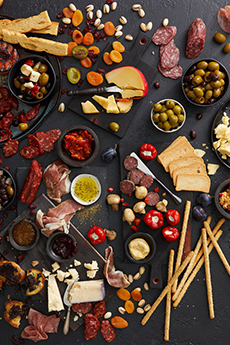
    [1] A slate board creates a dramatic backdrop for the charcuterie and cheeses (photos #1, #2 and #3 © DeLallo).


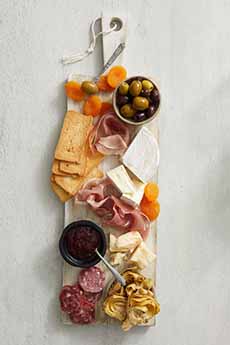
    [2] A white tray or board brightens up the goodies. You can place a small plate atop the board to hold soft cheeses or pâtéa, so they don’t “spread” onto other items.


    [3] A smaller board for two to four nibblers.

    Charcuterie Plate
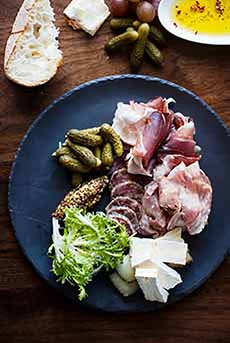
    [4] You don’t need a board, just a plate (photo © Conrad New York | Hilton).


    [5] Cornichons are savory pickles. Sweet gherkins are another option (photo © The Nibble).

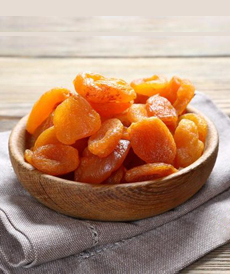
    Dried Apricots
    [6] Dried apricots are delicious with charcuterie, and add color to the board (photo © Olha Afanasieva | iStock Photo.

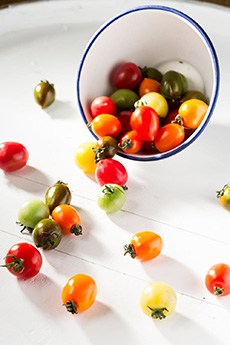
    Different Colors Of Cherry Tomatoes
    [7] Multicolored grape tomatoes are a festive garnish (photo © Lovefood Art | Pexels).

     
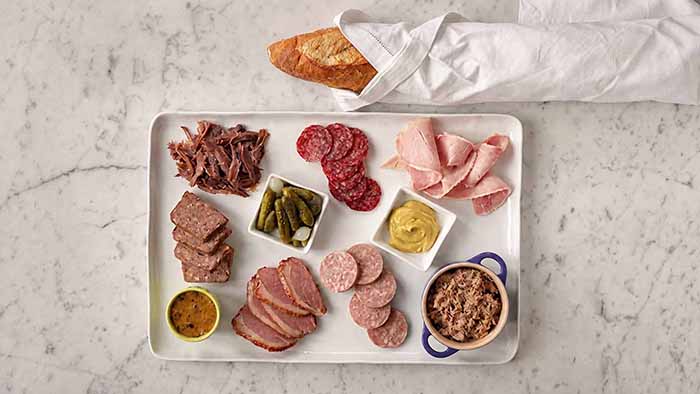
    Charcuterie On A Tray
    [8] No board needed: use a tray (photo © Les Trois Petits Cochons).
     

    CHECK OUT WHAT’S HAPPENING ON OUR HOME PAGE, THENIBBLE.COM.


    Comments off

    GIFT: Tanteo Tequila, Spicy Tequila In 3 Chile Flavors


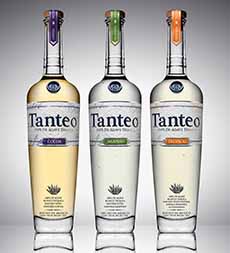
    [1] Tanteo’s three expressions of tequila, each a different chile flavor (photo © Tanteo Tequila).

    Reposado Tequila Shot
    [2] Our favorite way to drink Tanteo is sipping (photo © J.C. Fotografo | Dreamstime.


    Tanteo makes a very fine premium* blanco tequila, made with 100% Blue Weber agave.

    But the stars of the show are their well-balanced, spicy, infused tequilas:

  • Tanteo Chipotle Tequila: Infused with roasted chipotle peppers from the mountains of Chihuahua, Mexico, the flavor is smoky and spicy, with a hint of agave sweetness. We prefer this expression in a Bloody Maria.
  • Tanteo Habanero Tequila: The habanero chiles are sourced from the Yucatan Peninsula. This is the expression that will spice up a Margarita.
  • Tanteo Jalapeño Tequila: The locally sourced jalapeños provide a more moderate infusion. Make Jalapeño Margaritas!
  •  
    We were dazzled when we first tasted Tanteo Tequila. The infused flavors were different then, but they were the best infused tequilas in our experience.

    Made with 100% blue agave tequila, Tanteo uses all natural ingredients to infuse the tequila, and it’s a magical marriage.

    Most flavored tequilas use extracts to provide the flavor.

    Tanteo uses actual chiles:

  • They source fresh jalapeños, habaneros and locally roasted chipotles. Vine ripened and hand selected, each is carefully chosen at the optimal time for infusion.
  • The chile are hand-sliced and then macerated, to create to create different heat intensities.
  • The macerated chiles are infused into the tequila in small batches, using a proprietary infusion process.
  •  
    Tanteo is handmade and bottled in tiny batches, in the mountain town of Tequila, in the Mexican state of Jalisco. (By law, tequila can only be made in Jalisco.)
     
     
    HOW TO ENJOY TANTEO TEQUILA

    These are sipping tequilas and cocktail tequilas: a Bloody Maria (Bloody Mary with tequila instead of vodka) is a must if you want a very spicy rendition.

    Tanteo has cocktail recipes for each flavor.

    You can use the tequilas at dinner, too. Pair them with main course dishes that have similar flavor profiles:

  • Add a bit to a sauce.
  • Serve a snifter or shot with the dish.
  •  
    Tanteo flavor-infused tequilas are a splendid addition to your bar and a gift that recipients will be talking about for a long time.

    Discover more at TanteoTequila.com...and check out:

    The Different Types Of Tequila

    The History Of Tequila
    ________________

    *The company uses the term ultra-premium, other distillers use the term super-premium. Neither of these are official or legal designations, but marketing terminology. They typically indicate that the spirit has been distilled numerous times, to remove all impurities.


    Comments off


    © Copyright 2005-2026 Lifestyle Direct, Inc. All rights reserved. All images are copyrighted to their respective owners.