THE NIBBLE BLOG: Products, Recipes & Trends In Specialty Foods


Also visit our main website, TheNibble.com.

Jeff’s Finest Jerky, Tender & Delicious In 14 Flavors

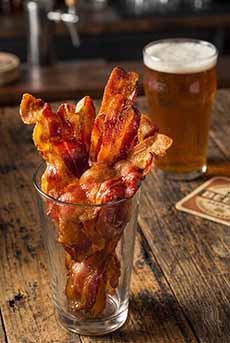
A Glass of Jeff's Bacon Jerky and a Beer
[1] Oh so delicious: jerky and a beer(photo: The Nibble).

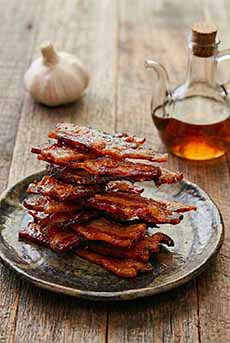
A Plate Of Garlic & Maple Syrup Jerky
[2] Sweet and pungent: garlic and maple syrup jerky (photo: The Nibble).

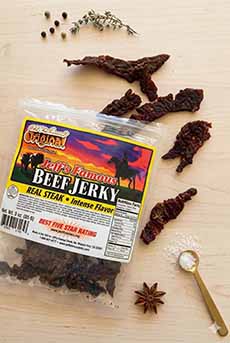
Package Of Jeff's Beef Jerky
[3] The original: Jeff’s Beef Jerky (photo: The Nibble).

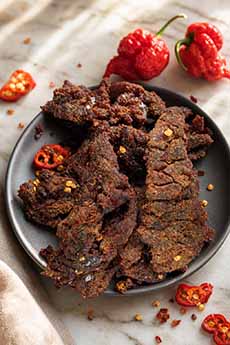
A Plate Of Carolina Reaper-Flavored Jerky
[4] For chile heads: Jeff’s Carolina Reaper Jerky (photo: The Nibble).

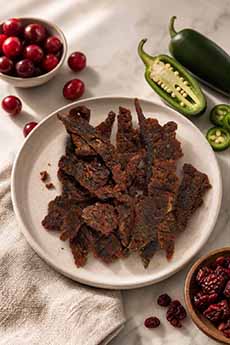
A Plate of Cranberry-Jalapeno Flavored Beef Jerky
[5] Jeff’s Cranberry Jalapeño Jerky (photo: The Nibble).

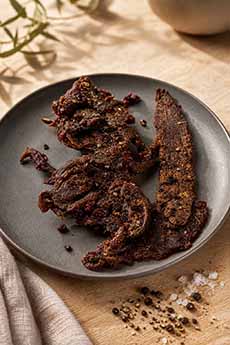
A Plate Of Black Pepper & Sea Salt Jerky
[6] Black Pepper & Sea Salt (photo: The Nibble).


Please note that the line has changed significantly since this article was originally published, with a re-branding from Jeff’s Famous Jerky to Jeff’s Finest Jerky, and a different assortment of flavors. We did a partial revision of the original article in June 2026.

Hey there, jerky lovers: June 12th is National Jerky Day.

America’s consumption of meat snacks has increased by 18% over the past five years, according to recent data from The NPD Group, a market research company.

And America wants more of this high protein, low-fat, grab-and-go snack that’s naturally gluten-free*.

Some jerky brands have topped our Top Pick Of The Week pedestal before, but they are few and far between. Even small-batch artisan brands can be too tough for us, and/or leave remnants of gristle.

Not so with Jeff’s. Each variety we tried was melt-in-your-mouth tender, with exquisite flavor. When you can say jerky has exquisite flavor, you know you’ve hit the motherlode.

Below:

> Jeff’s Jerky overview and varieties.

> The history of jerky.

Elsewhere on The Nibble:

> The year’s 25+ beef holidays.

> The year’s 90+ snack holidays.
 
 
ABOUT JEFF’S FINEST JERKY

Jeff’s Finest Jerky, of Mission Viejo, California deserves to be famous, its former name. Bacon or beef, the meats are marinated in deep, layered marinades.

The beef jerky has lower sodium than most brands, with no added MSG or nitrates. The bacon jerky has less sodium than pan-fried bacon.

The only caveat with jerky in general is that it’s high in sodium (don’t buy it for anyone on a salt-restricted diet).

But it’s almost fat free, and it’s solid protein: One ounce has about 23% of one’s daily value of protein.

We don’t like hard, overly chewy jerky. Jeff’s is so tender and tasty, you can bring it to the dinner table and pair it with fine foods.

  • We really enjoy it “surf-and-turf”-style: with oysters on the half shell, and with ceviche or pan-fried scallops.
  • You can lay it across or at the side of a protein, crumble it on top as a garnish, or mix it into other dishes like vegetables and pasta.
  • With pasta, consider Spaghetti Carbonara (which has bacon in the recipe), Fettuccine Alfredo (bacon is a delicious addition to the cream sauce), or pasta simply tossed with olive oil, bacon jerky and shaved Parmesan cheese.
  • With beer or a hearty red wine, it’s a go-to snack.
  •  
     
    JEFF’S FINEST JERKY VARIETIES

    Jeff’s makes a variety of delicious, tender jerky varieties. You can buy individual packages or a build-your-own box.

    The flavors are variously spicy, sweet, hot, and combinations thereof. More importantly, they are clean, clear and natural, beautifully layered to imbue the meat with complex flavors.

    All are hormone-free, without added MSG or preservatives, made from American meats.

    Beef Jerky Varieties

  • Black Pepper & Sea Salt
  • Classic Original
  • Classic Whiskey Bourbon
  • Cranberry Jalapeño
  • First In Class (Filet Mignon Teriyaki)
  • Fresh Garlic Brown Sugar
  • Habanero Heatwave
  • Jamaican Jerk
  • Korean Barbeque
  • Mango Habanero
  • Sweet & Spicy
  • Teriyaki
  • Tequila Lime
  • Trinidad Scorpion
  •  
    Some varieties are available in lower-sodium versions.
     
    Wild Jerky Varieties

  • Alligator
  • Bison
  • Elk
  • Python
  • Shark
  • Venison
  •  
     
    GET YOUR JERKY!

    Single-flavor packages are available, as are 12-packs, custom-mixed packs, and gift packs.

    > Discover the line at JeffsFinestBeefJerky.com.


    THE HISTORY OF JERKY

    The word jerky comes from the Quechua language of the Incas, who called their dried meat “charqui.” But they were hardly the first people to make it.

    Neither were Homo sapiens, we can deduce. Homo erectus emerged 1.5 million years ago, and evidence found five years ago in a South African cave suggests Homo erectus that built campfires.

    The remains of animal bones and plant ash could be dated to a million years ago. [source]

    By the time Homo sapiens emerged, 195,000 years ago, man had been enjoying barbecue, and by extension jerky, for some time.

    Drying food is one of the first three food preservation techniques, along with salting and, in northern climes, packing with snow in ice caves or cellars.

    Meat dried over a smoky fire is protected from egg-laying insects and multiplying bacteria (they need moisture to live). Cutting it into thin strips makes it easier to chew.

     
    All the fat is trimmed from the meat because fat doesn’t dry. The dried meat could (and can) then be stored for long periods of time without refrigeration.

    While the prehistoric method of drying the meat was used by other ancient peoples, it was not known in Europe.

    The first visitors to the New World found Native Americans making jerky† from the meat of any animal they hunted (that which wasn’t consumed immediately).

    In addition to helping early colonists stave off starvation, later pioneers who headed west quickly learned to make jerky. It was easy to transport, and was an important, high-protein addition to their diet.

    The meat for jerky could be anything from buffalo to whale. Today jerky can be found in proteins as common as turkey, tuna and salmon, to exotics such as alligator and ostrich.

    Today’s jerky eaters have the luxury of enjoying it as a snack rather than a necessity. We also have the pleasure of using tender cuts of meat marinated in a variety of spices, salt and/or sugar—seasonings that were not available to most ancients jerky-makers.

    Modern jerky is dried in low-heat smokers, as opposed to the ancient technique of hanging strips of meat racks to dry in the hot sun. (The campfire could hold only so much.)

    If your only experience with jerky has been dry and tasteless jerky, you deserve some of the good stuff.

    ________________

    *Some brands or flavors within brands may use soy sauce or other glutinous ingredient in the marinade.

    The pemmican you may have read about in tales of early America was dried meat mixed with dried berries and rendered animal fat. It was invented by Native Americans and used extensively by immigrants in the fur trade. Many years later, it served as a high-calorie food for Arctic and Antarctic explorers such as Robert Falcon Scott and Roald Amundsen.
     

    CHECK OUT WHAT’S HAPPENING ON OUR HOME PAGE, THENIBBLE.COM.


    Comments off

    TOP PICK OF THE WEEK: Mr. Black Cold Brew Coffee Liqueur, Perhaps The Best Coffee Liqueur

    Updated July 2026

    When we first tasted Mr. Black at a trade show, it was magnificent—but only available in Australia, where it was created.

    Wholesale buyers liked it too, because now it’s widely available in the U.S.

    And then, the brand got so hot that sales zoomed toward the top of the pack, and it was acquired by spirits giant Diageo.

    If you enjoy other coffee liqueurs, you’ve got to try Mr. Black.

    If you know a coffee drinker who’d enjoy sipping a rich, intense, coffee liqueur, treat them to a bottle.

    Below:

    > About Mr. Black Cold Brew Coffee Liqueur.

    > Ways to enjoy coffee liqueur.

    > A brief history of liqueur.

    > Eau de vie, cordial, liqueur, and schnaps: the difference.

    Elsewhere on The Nibble:

    > The year’s 7 liqueur holidays.

    > The year’s 25 coffee holidays.

    > October 16th is National Liqueur Day.
     
     
    WHAT IS MR. BLACK COLD BREW COFFEE LIQUEUR?

    Mr. Black is a cold brew coffee liqueur, and in our experience, one of the best coffee liqueurs you can buy.

    Each bottle is handmade at the company’s coffee roastery and distillery just north of Sydney, Australia (photo #2).

    This craft-focused spirit blends specialty-grade Arabica coffee with Australian wheat vodka and natural cane sugar. At 25% ABV, it features a rich, robust coffee profile.

    Plus, it has half the sugar and ten times the coffee content of traditional coffee liqueurs, making it a terrific for everything from sipping straight to Espresso Martinis to pouring over vanilla or coffee ice cream.

    Mr. Black was developed to appeal to serious coffee aficionados. It emphasizes the purity of coffee flavor using a blend of beans from the best growing regions.

  • Ethiopian Djimmah is a specialty coffee with a light-medium roast bringing chocolate, toffee and fruit flavors to the blend.
  • Papua New Guinea beans add zesty citrus notes.
  • Brazilian Arabica, roasted two ways, brings, fresh cold brew notes.
  •  
    Next, the beans are roasted, ground and brewed.

  • The beans are ground with ceramic burrs.
  • The different ground beans are cold-brewed separately, into concentrate.
  • They are then blended to achieve a the best range of flavor and balance.
  • Brewing artisans fine-tune the water composition, temperature and time for each batch.
  •  
    The difference between something good and something great comes down to the details, says the company, and they are correct.
     
     
    HOW TO ENJOY MR. BLACK COFFEE LIQUEUR

  • Straight up or on the rocks.
  • Made into cocktails (see the recipes), including a great Espresso Martini.
  • Added to hot or iced coffee, cappuccino, latte, or espresso.
  • Mixed into mousse or whipped cream.
  • Drizzled over ice cream or cheesecake.
  • In milkshakes or floats.
  • In a glass of hot milk or hot chocolate.
  • Mixed into chocolate sauce.
  •  
    > Discover more on the company website.

    > They’ve got lots of tempting cocktail recipes!

    You can find Mr. Black at stores nationwide and online. Here’s a store locator for both retail and e-tail.
     
     
    A BRIEF HISTORY OF LIQUEUR


    Bottle Of Mr. Black Cold Brew Espresso Liqueur
    [1] Our favorite coffee liqueur, rich and complex for serious coffee palates (photos #1 and #3 © Mr. Black | Diageo).

    Mr. Black Espresso Martini
    [2] Make the best Espresso Martini (photo © The Nibble).


    [3] Filling the bottles at the distillery.

    Espresso Liqueur Sundae
    [4] A very easy, elegant dessert: Pour a jigger of Mr. Black atop a coupe of coffee and vanilla ice cream (photo © The Nibble).

     
    A liqueur (lih-KUR) is an alcoholic drink composed of distilled spirits and additional flavorings that can include bark, flowers, fruits, herbs, roots and spices.

    And sugar! Often served with, or after, dessert, liqueurs are typically heavily sweetened.

    Liqueurs are historical descendants of herbal medicines that originated in the Middle Ages as medicinal elixirs crafted by monks and alchemists. Records have been found in Italy as early as the 13th century.

    By macerating herbs, fruits, and spices in distilled spirits and adding sugar for palatability, they sought to cure ailments and prolong life (for example, Chartreuse). The French word liqueur is derived from the Latin liquifacere, which means “to dissolve.”

    Over time, these healing medicines (i.e., alcoholic tonics) evolved into popular recreational beverages and foundational cocktail ingredients.
     
    The First Coffee Liqueurs

    Coffee was being infused into spirits in Europe by at least the 18th century. Early recipes were often homemade or made by small, local cordial producers.

    The first commercial coffee liqueur brand was Kahlúa, introduced in Mexico in 1936. Made with Arabica coffee, sugar, vanilla, and rum, it became the archetypal modern coffee liqueur.

    Tia Maria claims roots in a 17th-century Jamaican origin story, but its documented commercial production and international don’t appear until the mid-20th century. It combines Jamaican rum, coffee, vanilla, and sugar. It has more recently reformulated to a cold brew version, shown in the photo below.

    The reason we prefer Mr. Black is that it’s less sweet and more coffee-forward than the classic Kahlúa/Tia Maria tradition.

    > Here’s a longer history of liqueur.
     
    Bottles Of Leading Coffee Liqueurs
    [5] Five major coffee liqueur brands by worldwide sales, shown in alphabetical order. Kahlúa (Pernod Ricard) remains the undisputed global leader in the coffee liqueur category. Tia Maria (Illva Saronno) is a key legacy brand. Mr Black (Diageo) is the leading contemporary brand. Caffè Borghetti is the favorite in Italy. Jägermeister Cold Brew blends the original Jägermeister herbal liqueur with roasted Arabica coffee and cacao (photo © The Nibble).
     
     
    EAU DE VIE, CORDIAL, LIQUEUR & SCHNAPS: THE DIFFERENCE

    Liqueur has numerous “relatives.” Here’s are their differences.

  • Schnaps/schnapps, a generic German word for liquor or any alcoholic beverage, is more specific in English, where it refers to clear brandies distilled from fermented fruits. The English added a second “p,” spelling the word as schnapps. True Schnaps has no sugar added, but products sold in the U.S. as schnapps may indeed be sweetened. As one expert commented, “German Schnaps is to American schnapps as German beer is to American Budweiser.”
  • Eau de vie is the French term for Schnaps. American-made brands labeled eau de vie (“water of life”) are often heavily sweetened, and have added glycerine for thickening.
  • Liqueur is an already distilled alcohol made from grain which has already been fermented, into which fruits are steeped. It is sweeter and more syrupy than a European eau de vie or schnapps.
  • Cordial, in the U.S., almost always refers to a syrupy, sweet alcoholic beverage, a synonym for liqueur. In the U.K., it refers to a non-alcoholic, sweet, syrupy drink or the syrup used to make such a drink. Rose’s Lime Cordial, a British brand, is called Rose’s Lime Juice in the U.S. so Americans don’t think it’s alcoholic.
  •  
     

    CHECK OUT WHAT’S HAPPENING ON OUR HOME PAGE, THENIBBLE.COM.


    Comments off

    TIP OF THE DAY: French Toast Recipes For National French Toast Day


    [1] Dulce De Leche French Toast with macerated fresh berries, dulce de leche drizzle and a hand-whipped cream (photo © Chica | Las Vegas).

    French Toast Sandwich
    [2] French toast sandwich with jam. Here’s the recipe (photo © Zulka Sugar).

    Apple Pecan French Toast
    [3] Apple Pecan French Toast. Here’s the recipe (photo © Zulka Sugar).

    French Toast Recipe
    [4] Pumpkin-batter French Toast with a sauteed apple topping. Here’s the recipe (photo © Domesticate Me | Peapod).

    Savory French Toast
    [5] Savory French Toast topped with tomatoes and cheese. Here’s the recipe (photo © Castello Cheese).


    [6] Peach & Banana Stuffed French Toast (photo © Mackenzie Ltd.)


    November 28th is National French Toast Day, but this year it fell on Thanksgiving.

    So think of this tip not as being a day late, but as inspiration for Thanksgiving Weekend brunch. Thanks to Flavor & The Menu for the list.

    While these ideas are for pan-fried French toast, you can also bake French Toast: equally delicious!

    You can also make French Toast sandwiches like the Monte Cristo, an evolution of the Croque-Monsieur, a French sandwich of ham and Gruyère cheese, buttered and lightly browned on both sides in a skillet or under a broiler.

    Here’s the recipe so you can try it for lunch—although probably not on the same day you have French Toast for breakfast.

    Now, to the mix-and-match ingredients list. Try different combinations to find your signature French Toast recipe.
     
     
    PICK YOUR BREAD

    There are no limits on bread varieties, shapes, thickness.
     
    Traditional French Toast Breads

  • Brioche
  • Challah
  • Texas toast (thick slices of buttered white bread)
  •  
    Non-Traditional French Toast Breads

  • Babka
  • Baguette
  • Banana bread, zucchini bread, gingerbread
  • Cinnamon rolls, sticky buns
  • Croissant
  • Monkey bread
  • Panettone (recipe) or pandoro (recipe)
  • Pound cake
  • Raisin bread
  • Swirl bread (cinnamon, pumpkin)
  • Whole grain bread
  •  
     
    BATTERS

    You can dip the bread into the batter right before cooking, or soak it overnight.

    Here’s the classic custard dip, plus special batters that a surprise of flavor.

  • Classic: whole milk or heavy cream, eggs, pure vanilla extract, cinnamon and/or nutmeg
  • Pancake: use a thinner version of pancake batter to dip the bread, combining two breakfast classics
  • Savory: buttermilk, eggs, chopped fresh herbs, sea salt, cracked pepper
  • Seasonal: egg nog (recipe)
  • Textural: retro cereal coatings, healthful cereal/granola coatings, puffed grains, seeds
  • Tres leches: evaporated milk, Thai coconut milk, heavy cream, eggs and pure vanilla extract, honey, cinnamon
  •  
     
    FILLINGS

    Plain French Toast is great comfort food. But why not add an element of excitement with fillings between the layers of bread?

  • Bananas or caramelized bananas
  • Compote, sautéed fruit
  • Cream cheese (plain or flavored) or other soft cheese
  • Custard
  • Dried fruit relish
  • Flavored custard, whipped cream style cheeses
  • Ice cream
  • Jam (including PB&J French Toast)
  • Nut compotes, nut butters
  • Nutella
  • Savory: seasoned ground meat and/or vegetable blends, tomatoes and cheese (recipe), olive cream cheese and fresh basil or arugula, etc.
  •  
     
    TOPPINGS

    Sweet, savory, indulgent, healthful, fun/whimsical and premium: Take your choice.

  • Dessert interpretations: Bananas Foster, cheesecake, tiramisu, pies/crumbles, churros
  • Fresh or macerated fruit
  • Fried egg
  • Housemade relishes and compotes
  • Whipped flavored mascarpone
  • Soft savory cheese (herbed goat cheese, for example)
  •  
     
    SAUCE/SYRUP

    Classic and/or modern finishes complete your French Toast delight.

  • Caramel, including flavored caramels
  • Chocolate sauce or spiced chocolate sauce drizzle
  • Crème anglaise
  • Preserves or marmalade
  • Pure maple syrup or fruit-infused syrup
  • Warmed honey or spicy honey
  • Whipped honey butter
  •  
     
    THE HISTORY OF FRENCH TOAST


    Comments off


    © Copyright 2005-2026 Lifestyle Direct, Inc. All rights reserved. All images are copyrighted to their respective owners.