|
Not surprisingly, July is National Watermelon Month. We love watermelon in many ways, from beverages to relishes to simple slices for snacks and pickled watermelon rind for the leftover. But we’ve never come across a watermelon ice cream recipe.
Now here it is, and you don’t need an ice cream machine.
Find more sweet summer recipe ideas at Watermelon.org.
> The history of watermelon.
RECIPE #1: WATERMELON ICE CREAM BARS
This recipe has a number of steps, but the result is a delightful dessert with nuanced flavors. Watermelon gelato is layered with a whipped cream watermelon fruit curd, and set over a graham cracker crust.
The garnish for this recipe is fresh basil leaves. But if you have the inclination (we did!) and a bit more time, candied basil leaves.
Ingredients For 8 Bars
For The Watermelon Curd
3/4 cup watermelon juice (buy or use the recipe below“>below)
2 tablespoons lime juice
1/2 cup honey
1 pinch salt
3 eggs, lightly beaten
1/2 cup butter (1 stick), cut into small cubes
For The Crust
8 graham crackers, crushed
2 tablespoons honey
1 pinch salt
4 tablespoons butter, melted and cooled
For The Whipped Cream
1 cup heavy whipping cream
Preparation
1. MAKE the watermelon curd. In a medium, heavy-bottomed saucepan, combine the watermelon juice, lime juice, honey, and salt. Stir to combine, then add the eggs.
2. PLACE the pan over medium heat and cook, adding the cubed butter and stirring constantly, until the mixture thickens and coats the back of a wooden spoon.
3. IMMEDIATELY REMOVE remove the pan from the heat and carefully pour the mixture through a fine-mesh sieve. Cool completely in the refrigerator.
4. MAKE the crust. Preheat the oven to 350°F. In a food processor, pulse the graham crackers until rough crumbs form. Add the honey, salt, and melted butter; pulse until the mixture resembles wet sand.
5. LINE an 8-by-8-inch pan with parchment paper, then press the graham cracker mixture into the bottom of the pan in an even layer. Bake the crust for about 10 minutes, or until it just beginning to brown. Allow the crust to cool completely.
6. MAKE the whipped cream: When crust and curd are completely cooled, whip the cream in a large bowl, until stiff peaks form.
7. GENTLY PUSH the cream to one side of the bowl and pour in the watermelon curd. Using a spatula, gently fold the cream and watermelon curd together until no streaks are visible.
8. POUR the creamy watermelon mixture over graham cracker crust. Freeze the dessert completely, for 4-6 hours or overnight. When ready to serve…
9. LOOSEN the sides with a small spatula or butter knife. Turn out onto a cutting board and use a large spatula to flip so the graham cracker crust is on the bottom. Cut into eight bars and top each with a basil leaf.
RECIPE #2: WATERMELON JUICE
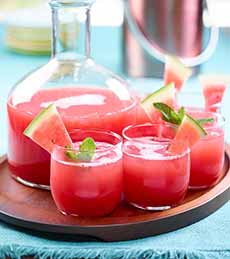
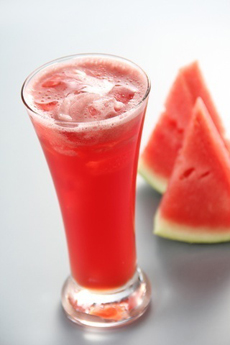
Watermelon juice is so delicious, and the lowest in calories among the fruit juices. It’s easier to make this recipe with seedless watermelon (photo #5), so you don’t have to pick out the seeds before blending the fruit.
Ingredients
1 watermelon, washed and cut into chunks
Preparation
1. PROCESS 2-3 cups of watermelon at a time in a blender, until smooth.
2. STRAIN into serving pitcher or other container. Note that if you decide not to strain it, the juice will need to be stirred until blended prior to serving.
________________
*Some people claim that seeded watermelons have a better flavor than seedless varieties. This isn’t so. The flavor and sweetness of a watermelon is determined by many different factors, such as the variety, climate and soil where it was grown, and when it was harvested.
Seeded watermelons are less expensive, and people who like to chew the seeds will get many nutrients from them.
Seedless watermelons were bred some 50 years ago by altering the number of chromosomes (this was natural breeding, NOT genetic modification).
Watermelon trivia: The seeds are called pips, the industry term for a small, hard fruit seed especially, one of a several-seeded fleshy fruit like watermelon. [source].
|