THE NIBBLE BLOG: Products, Recipes & Trends In Specialty Foods


Also visit our main website, TheNibble.com.

The History Of The BLT For National BLT Sandwich Month

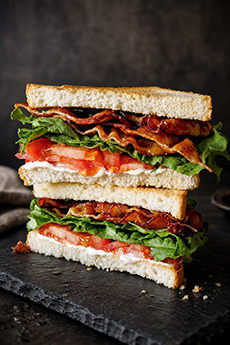
Triple Decker BLT
[1] A classic BLT. Here’s the recipe from Southern Living (photo © Southern Living).

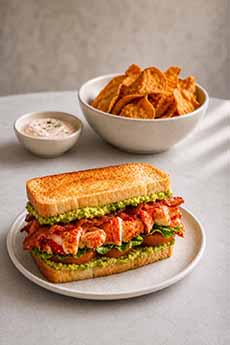
Lobster BLT
[2] How about a lobster BLT with optional avocado and a side of sweet potato chips?| You deserve it Here’s the recipe from How Sweet Eats (photo © The Nibble).

Turkey Avocado BLT On Croissant
[3] A turkey avocado BLT. Here’s the recipe from Culinary Hill (photo © Culinary Hill).

Grilled Pineapple BLT
[4] A BLT with grilled pineapple and sriracha mayo. Here’s the recipe from Half Baked Harvest (photo © Half Baked Harvest).

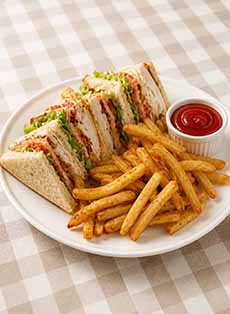
BLT With Spicy Fries
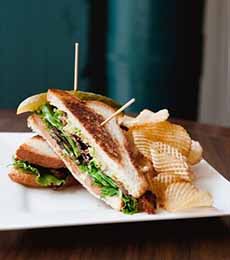
[5] What we now know as a BLT began as a “club sandwich” in London mens’ clubs. We’d call it a turkey BLT. It’s shown here with spicy fries (photo © The Nibble).

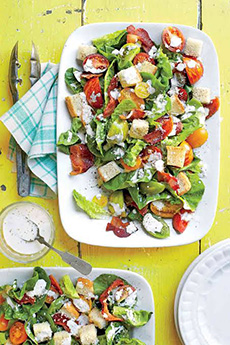
BLT Salad
[6] You can skip the bread and have a BLT salad. Here’s the recipe from Southern Living (photo © Southern Living).

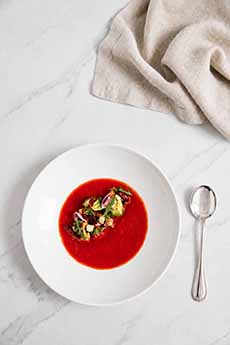
Gazpacho With BLT Garnish
[7] Gazpacho with a BLT garnish, from Munchery, a fine food delivery service (photo © Munchery).

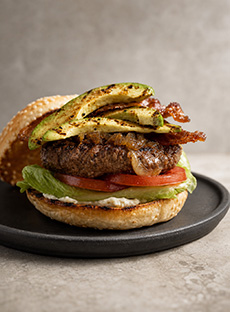
BLT Burger
[8] A grilled avocado BLT burger. Here’s the recipe from the California Avocado Commission (photo © California Avocado Commission).

BLT With Avocado: A BLAT
[9] Adding sliced avocado turns a BLT into a BLAT (photo © The Mercury | Atlanta).


Updated July 2026

April is National BLT Month; July 22nd is National BLT Day.

The bacon, lettuce and tomato sandwich with mayonnaise, often served as a triple-decker sandwich on toast, is one of America’s favorite sandwiches (and a U.K. favorite, too).

While toast, bacon and lettuce have been enjoyed at table since Roman times, two of the other ingredients took a bit longer to come together.

Below:

> The history of the BLT.

> Creative customizations for your “signature” BLT.

> The history of the club sandwich.

> The history of each BLT ingredient (interesting!).

> More BLT recipes and party ideas.

Elsewhere on The Nibble:

> The different types of sandwiches: a photo glossary.

> The history of the sandwich.

> The different types of bacon: a photo glossary.

> The different types of lettuce.

> The year’s 28+ sandwich holidays.

> The year’s 11 bacon holidays.
 
 
1. THE HISTORY OF THE BLT

Although its ingredients have existed for thousands of years, there is little evidence of BLT sandwich recipes before 1900. The first known mention of a BLT sandwich appears in a 1903 Ladies Home Journal. That same year, the Good Housekeeping Everyday Cook Book featured a recipe for a club sandwich included bacon, lettuce, tomato, mayonnaise and a slice of turkey sandwiched between two slices of bread.

According to Merriam‑Webster, the first known print appearance of the acronym BLT is 1950. Historical accounts suggest the abbreviation emerged as diner shorthand during the 1940s.

The BLT became popular after World War II due to the rapid expansion of supermarkets, which made its ingredients, especially tomatoes, available year-round.

See below for creative modern variations to the classic B.L.T.
 
 
2. THE HISTORY OF EACH BLT INGREDIENT

The oldest of the five ingredients is bread.

The art of using yeast to leaven bread was mastered by the ancient Egyptians. Loaves of bread presented more culinary opportunities than flatbreads.

> The history of bread.

Then came lettuce.

Lettuce was first cultivated by the ancient Egyptians, who turned it from a weed into a food plant as early as 2680 B.C.E. It was taken to Greece and Rome, and by 50 C.E., many types of lettuce were grown there.

> The different types of lettuce.
 
 
Next, the bacon.

Wild boar meat was cured be smoking, salting and drying since Paleolithic times. (The Paleolithic, also known as the Stone Age, extended from 750,000 B.C.E. or 500 B.C.E. to approximately 8,500 B.C.E. [source]).

Pigs were domesticated from wild boar as early as 13,000–12,700 B.C.E. But there was nothing identifiable as modern bacon.

The modern bacon we know and love began to appear in the mid-1700s.

Previously, the word “bacon” referred to all pork, then the back meat, then all cured pork. British farmers who noticed that certain breeds of pig had much plumper sides, engendered a movement so that “bacon” was finally distinguished as the side of pork, cured with salt.

Here are the history of bacon, and the different types of bacon.

> The history of bacon.

> The different types of bacon.
 
 
Next, tomatoes.

Tomatoes were brought to Europe from the New World at the end of the 16th century. But not as food.

The original tomatoes were like yellow cherry tomatoes. Considered poisonous (they’re members of the Nightshade family), they were enjoyed as houseplants.

Tomatoes weren’t eaten for two more centuries, and then only because of a famine in Italy in the early 1800s.

They arrived in England in the 16th century (see the history of tomatoes).

> The history of tomatoes.
 
 
Finally, mayonnaise.

At the same time, there was no mayo for the BLT. The original mahónnaise sauce was invented in 1756, but it was not until years later that it evolved into what is recognized as modern mayo.

The great French chef Marie-Antoine Carême (1784-1833) lightened the original recipe by blending the vegetable oil and egg yolks into an emulsion, creating the mayonnaise that we know today.

> The history of mayonnaise.
 
 
But no one had yet invented the sandwich!

It took John Montagu, Fourth Earl Of Sandwich, to invent the eponymous food in 1762 (history of the sandwich).

A marathon gambler, he would not leave the gaming table to eat, so asked for meat and a couple of pieces of bread. He could throw dice with one hand and eat with the other, no knife or fork required. (Sushi was invented for the same reason.)

The first sandwiches were gambling food: something easy to eat without utensils. Fancier sandwiches evolved, but it took more than 100 years for someone needed to invent the club sandwich.
 
 
3. THE INVENTION OF THE CLUB SANDWICH

While tea sandwiches with bacon, lettuce and tomato were served during Victorian times, a search of 19th and early 20th century American and European cookbooks points to the club sandwich as the progenitor of the BLT.
According to Food Timeline, most food historians concur that the club sandwich was probably created in the U.S. during the late 19th/early 20th century.

No printed record has been found to date, so the where and who remain a matter of culinary debate. The reigning theory points to the Saratoga Club in Saratoga, New York

The club sandwich was very popular and spread to other mens’ clubs.

A printed recipe appeared for the first time in the 1903 Good Housekeeping Everyday Cook Book. It called for bacon, lettuce, tomato, mayonnaise and a slice of turkey sandwiched between two slices of bread (no one has yet discovered when the third slice of bread was added).

So, violà: the club sandwich, a turkey BLT (photo #5), hits menus and cookbooks. When no turkey was desired, the “club sandwich without turkey” became a bacon, lettuce and tomato sandwich—later shortened to BLT.

There’s an unsubstantiated story of a man who came home hungry after his family and servants had retired. He searched the pantry for a snack, deciding to make some toast. As he looked in the ice chest for butter for the toast, he found cooked bacon, chicken, a tomato and mayonnaise.

He made a sandwich and was so happy with his creation that he mentioned it to friends at his club. They had the kitchen recreate it, and it went onto the menu as the “club sandwich.”
 
Was it the Saratoga Club? Did an unnamed man invent it? Maybe yes, maybe no.
 
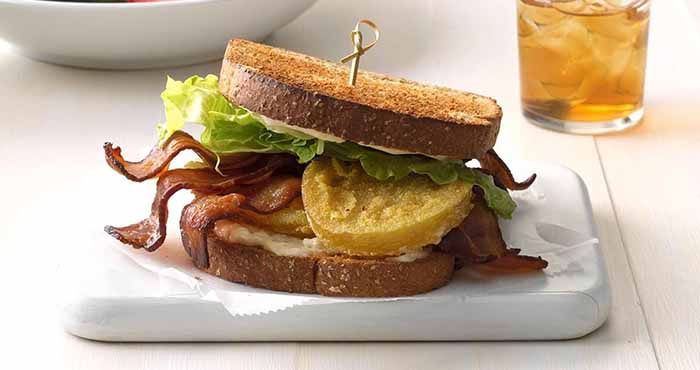
BLT With Fried Green Tomatoes
[10] A BLT with fried green tomatoes. Here’s the recipe (photo © Taste Of Home).
 
 
4. THE BLT TODAY

The BLT on toast has been recreated with many variations. The most prominent may be the BLTA, bacon, lettuce, tomato and avocado.

But why stop there? Create your own signature BLT from these ingredients! Consider:

  • Different breads: toasted or not, from bagels, brioche and croissants to pinwheels, wrap sandwiches and…taco shells and wafflewiches.
  • Different bacon: bacon jam, Canadian bacon, candied bacon, guanciale (jowl bacon), pancetta, pepper bacon, pork belly, wild boar bacon, etc.
  • Different lettuces: arugula, bibb, romaine, non-lettuces like basil or watercress—and garnish with some sprouts.
  • Different tomatoes: cherry tomatoes, fried green tomatoes (photo #10), multicolor heirloom tomatoes, marinated sundried tomatoes.
  • Smaller: BLT appetizer bites, tea sandwiches, skewers.
  • Added elements: avocado slices/guacamole, basil leaves, chicken salad, fried egg, grilled pineapple or shishito peppers, grilled salmon, lobster, grilled butterflied shrimp, soft shell crab.
  • Flavored mayo: basil, bacon, curry, garlic, harissa, mayo mixed with bacon jam, mayo mixed with tomato pesto, etc.
  • Heat: sriracha mayonnaise, chili butter.
  • Fusion: BLT burger, BLT wedge salad, Buffalo chicken BLT, grilled cheese BLT.
  •  
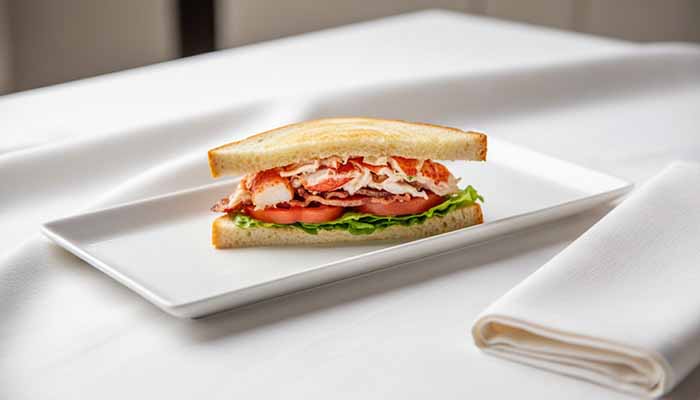
    Lobster BLT Sandwich
    [11] Add some luxury: a Lobster BLT! We call it a Surf & Turf BLT (photo © The Nibble).
     
     
    5. MORE BLT RECIPE IDEAS

    Cocktails

  • BLT Bloody Mary With Bacon Vodka
  • BLT Cocktail
  •  
    Not A Sandwich

  • BLT Gazpacho
  • BLT Guacamole Crostini
  • BLT Pancakes
  • BLT Pasta Salad
  • BLT Slaw
  •  
     
    6. BLT PARTY IDEAS

    Get together a group and assign a different version of BLT to each. Make a whole meal of it…perhaps with chocolate-covered bacon for dessert.

    Don’t restrict your thinking: A Cobb Salad is a BLT salad with some additions (avocado, blue cheese and chicken).
     
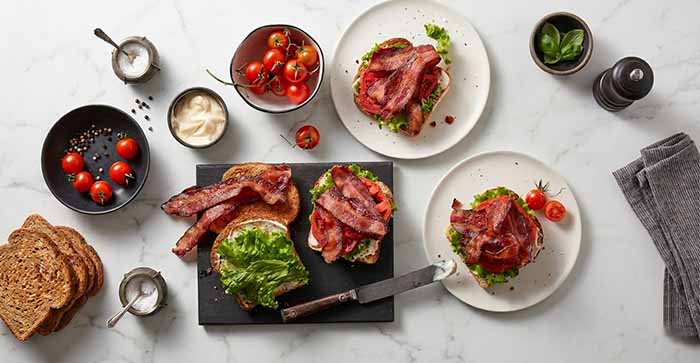
    BLT Sandwich Ingredients [12] When regular tomatoes aren’t in season and the ones in the store don’t taste great, cherry tomatoes may be a tastier option (Gemini Photo).
     

    CHECK OUT WHAT’S HAPPENING ON OUR HOME PAGE, THENIBBLE.COM.


    Comments off

    TIP OF THE DAY: Bone Broth For Breakfast

    Breakfast Soup With Hard Boiled Egg

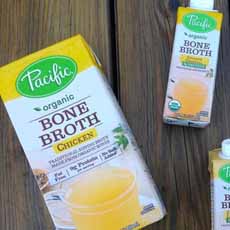
    Chicken Bone Broth
    [1] A hot, hearty, nutritious breakfast (photo courtesy Good Eggs). [2] You can buy bone broth in multiple or individual serving sizes (photo courtesy Appetite For Health).


    Over the last couple of years, bone broth—made from the bones of beef or chicken—has become the nutrition du jour, for lunch, dinner, and for breaks during the day.

    How about for breakfast? In Asia, soup is a breakfast standard.

    It’s hot, hearty, nourishing comfort food.

    And you can make it with whatever you like.

    We adapted this recipe from one by Good Eggs.

    You can substitute whatever broth you prefer (miso, pho, etc.). You can buy the packaged broth, and even individual portions of it (such as with Nona Lim’s and Pacific brands).

    If you have other vegetables in the crisper, or a piece of leftover chicken, just cut or shred them and toss them in.

    If you’d like tofu instead of ramen, ditto.

    And if you’d like to have the broth for lunch or a snack, no one will question your judgment.
     
     
    RECIPE: BREAKFAST SOUP WITH BONE BROTH

    Ingredients For 3 Servings

  • 12 ounces broth
  • 5 ounces (one packet) ramen
  • 1 head bok choy or ½ head chard or kale, sliced into ½” ribbons
  • 3 scallions, green and white parts chopped roughly
  • 3 eggs
  • 1/2 to 1 cup of fresh cilantro, chopped roughly (substitute mint, basil, parsley, chervil)
  • Optional: hot sauce or other favorite seasoning
  •  
    Preparation

    1. HEAT the broth, diluting with water as desired. When the broth boils, add the ramen and cook for 2-3 minutes. Then add the greens and scallions, and any extra vegetables or proteins.

    2. SIMMER for another 3-5 minutes, until the greens are bright and tender but still have texture.

    3. BOIL a small pot of water, add the eggs and simmer for 7 minutes and 20 seconds. Remove from the water and place in an ice bath. Peel them when they are touchable.

    4. PORTION the broth into bowls, along with halved egg. Garnish with herbs as desired.


    Comments off

    PRODUCT: Easy Coconut Macaroon Mix For Passover

    Macaroons are a delicious cookie year-round. The originals were invented by Italian monks from ground almonds. The name derives from the Italian maccherone.

    Italian Jews adopted the cookie for eight-day observation of Passover, because it was free of restricted ingredients like flour and leavening.

    The macaroon was introduced to other European Jews and became popular as a year-round sweet. Over time, coconut was added to the ground almonds and, in certain recipes, replaced them.

    Macaroons arrived in France in 1533 with the pastry chefs of Catherine de Medici, wife of King Henri II.

    But the French macaron, a meringue sandwich, was centuries away.

    The concept was invented by Pierre Desfontaines Ladurée, who, at the beginning of the 20th century, had the idea to join two meringues and fill them with ganache.

    Here’s more history of macaroons and macarons.

    MAKE MACAROONS FOR PASSOVER

    You can make them from scratch, or pick up a box or two (or three) of King Arthur Flour’s Coconut Macaroon Cookie Mix.

    It’s $5.95 per box, yielding approximately 2 dozen macaroons; and it’s certified kosher.

    They’re super-easy to make: Just add water to the mix, scoop them into balls and bake.

    If you love coconut, this is your cookie. Ever so slightly toasty on the outside, moist and chewy inside.

    They’re as good or better than any from-scratch recipe we’ve had.

    While the ingredients themselves do not have gluten, the mix is not certified gluten-free because it hasn’t been tested for the presence of gluten.

    VARIATIONS

    You can dress them up macaroons by:

  • Dipping them in quality chocolate, all dipped or half dipped.
  • Drizzling them with chocolate.
  • Adding mini chocolate chips or toffee chips to the batter.
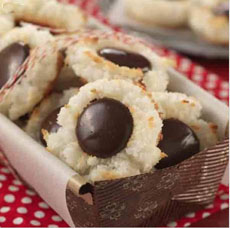
  • Making them thumbprint style, with a chocolate or other flavor disk on top (photos #1 and #2).
  • Baking squares with a chocolate bottom (photo #3).
  •  
    BAKING TIPS

    Use parchment so the white bottoms don’t get too dark or scorch, and reduce the oven temperature to 350°F,

    Even so, watch them closely as they bake.

    If the mix is too dry, before baking, add another 1/4 cup of water (or as needed).

      White Chocolate Coconut Macaroons

    Chocolate Coconut Macaroons

    Chocolate Coconut Macaroons

    Coconut Macaroon Mix

    All photos courtesy King Arthur Flour.


    Comments off


    © Copyright 2005-2026 Lifestyle Direct, Inc. All rights reserved. All images are copyrighted to their respective owners.