THE NIBBLE BLOG: Products, Recipes & Trends In Specialty Foods


Also visit our main website, TheNibble.com.

TIP OF THE DAY: Piñata Cake

Our job includes a lot of research, which often turns up surprising things.

One of this is piñata cake, a concept that originated in the U.K. and is also popular in Australia.

We also found it in Germany, called surprise cake.

You don’t hit a piñata cake with a stick. It’s when you cut into the cake that the treasures (candy) spill out.

The treasures are theme candies that fill a “secret” center well in the cake. The well is cut after the layers are baked, so you can place anything in the well without fear of melting.

(If you’re in the chips, silver dollars would be nice!)

The uncut top layer then goes on top of the well layers, and the whole cake is frosted.

A four-layer cake is recommended to have enough room for lots of candy to tumble out.

You can make them in any occasion. We’re keeping a recipe for a Valentine’s Day: a red velvet cake in red and pink layers, filled with Valentine candy.
 
IT’S EASY!

“We can’t stress enough just how easy these cakes are,” says The Whoot in Australia. “Everyone will think you must have gone to so much effort.

“It has a very festive look and you can make it in colors to suit any theme.”

The only caveats are:

  • You need to bake a dense cake. The cake circle needs to be hardy to hold the sweets in the well.That means no no airy cakes, angel cakes or sponge cakes.
  • Don’t cut too wide a well. The perimeter needs to be sturdy enough to hold up the cake.
  •  
    THE HISTORY OF PIÑATA CAKE

    A 2015 article in London’s The Daily Mail says that “Asda kicked off the trend last year with their Smartie pinata cake and Lakeland [a manufacturer] soon followed, selling all the paraphernalia needed to create ‘surprise’ cake.”

    Asda is a supermarket chain in the U.K., that first created the cake for sale in its stores.

    After the success of the cake, Asda printed the recipe on its lifestyle website.

    The first cookbook with a piñata cake recipe seems to be Cakeology by Juliet Sear, published in 2015.

    She notes that piñata cakes had become popular in the past year, i.e., 2014.
     
    PIÑATA CAKE FOR EASTER

    For a holiday in which the Easter Bunny brings baskets full of surprises, piñata cake this makes a great holiday cake.

    Carrot cake, the favorite of the Easter Bunny, is both theme-appropriate and dense.

    If you have the frosting skills, you can you can make a basket weave frosting, turning the “piñata” into an Easter basket filled with Easter treats.

    Of course, piñata cake works for any holiday, any occasion, any theme colors. The decorations on top can be as simple or ornate as you wish.

    Ask someone else to cut the cake, and be the first to see the surprise.

      Pinata Cake

    Pinata Cake

    Pinata Cake

    Pinata Cake
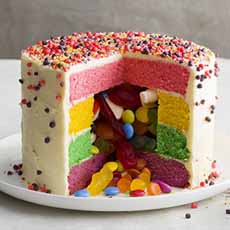
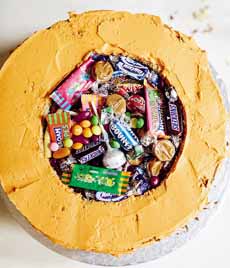
    Some of the many ways to create a piñata cake. Links to the recipes are below.

     
    RECIPES

    Here are the recipes in the photos:

  • Cake #1: piñata cake recipe in spring pastels, from Australia’s In The Playroom.
  • Photo #2: a glamorous piñata cake recipe* from Germany’s Dr. Oetker, which calls it a surprise cake.
  • Cake #3: a rainbow piñata cake recipe from Bakers Corner, Australia
  • Cake #4: The secret well. Photo courtesy Cakeology.
  •  
    CHECK OUT THE DIFFERENT TYPES OF CAKES IN OUR CAKE GLOSSARY.
     
    ________________

    *The recipe is in German and uses Dr. Oetker baking products. We present the photo as a guideline for the most elegant piñata cake we found. You can cut and paste the recipe into Google Translate if you want a translation.
      

    Comments off

    Turkey Neck Soup Recipe & The History Of Turkeys (& The Soup)

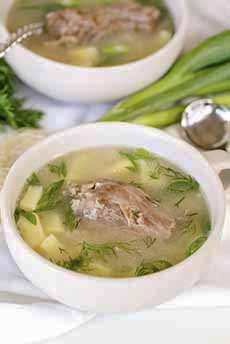
    A bowl of Turkey Neck Soup with fresh herbs and chopped scallions
    [1] Momsdish says that her turkey neck soup is “absolutely the best.” Here’s her recipe (photo © Momsdish).

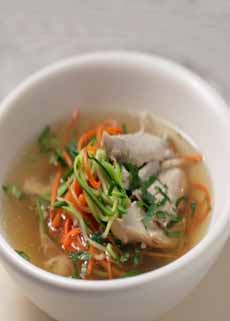
    Broth With Vegetables
    [2] The vegetables in this soup are made with a vegetable spiralizer (photo courtesy Wholesomeness.com.au).

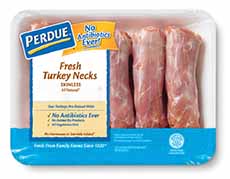
    A package of Perdue turkey necks.
    [3] Turkey necks (photo © Perdue).

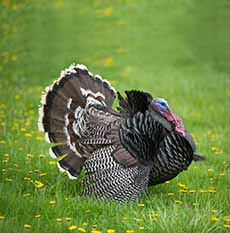
    Wild Turkey
    [4] One of the two varieties of wild turkey, the North American wild turkey, is the source of all the domesticated turkeys we eat (photo © Randy Fath | Unsplash).

    Ocellated Wild Turkey
    [5] The other variety is the ocellated turkey, native to Belize, Guatemala, and the Yucatan Peninsula. What a beauty! It was never domesticated(photo © Imgur).

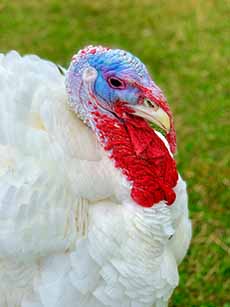
    White Turkey
    [6] The Broad Breasted White breed is the most commonly raised turkey due to its rapid growth, large breast size, and mild flavor (photo © Greg Lippert | Unsplash).

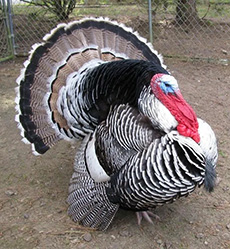
    The Narragansett heritage turkey
    [7] The Narragansett, a heritage†† turkey breed (photo by Temuls Lightning Poncho, CC BY-SA 4.0).


    THE NIBBLE first created its Daily Food Holiday Calendar in 2004. But it’s taken us this long to address one of the more unusual holidays: National Turkey Neck Soup Day, March 30th.

    Turkey neck soup is a concept we’d only come across on the calendar. This year, for the first time, we had enough down time to wonder:

    Who established a holiday for turkey neck soup?

    And do you need more than one turkey neck?

    We couldn’t find an answer to who, but it turns out that turkey neck soup is a more economical way to feed a family than, say chicken or turkey soup made with the main parts of the poultry.

    And yes, you do need more than one turkey neck. Some people freeze the necks from the giblets bags that come in whole turkeys and chickens, until they have enough.

    You can buy turkey necks in the poultry department of supermarkets from Perdue and Shady Brook Farms, along with non-branded packages.

    Turkey necks themselves are bony, but they do have meat; and thus can be used to make that Paleo diet darling, bone broth.

    Below:

    > Recipe ideas for turkey neck soup.

    > The history of turkey neck soup.

    > A brief history of turkey.

    > Turkey trivia.

    Elsewhere on The Nibble:

    > The history of soup and the different types of soup, a photo glossary.

    > The year’s 7 turkey holidays.

    > The year’s 18+ soup and stew holidays.

    > A more extensive history of turkey in the East Coast.
     
     
    RECIPE IDEAS FOR TURKEY NECK SOUP

  • The classic, economical recipe combines turkey necks with root vegetables—carrots, parsnips, rutabaga, turnips—plus onion, celery and parsley. Potatoes, noodles or rice can bulk up the recipe. Check out the recipe from photo #1.
  • Here’s a recipe with veggies and rice.
  • A variation, this recipe adds both rice and potatoes to create a heartier “main dish” soup.
  • Some recipes called “turkey neck soup” start with the entire carcass from a roast turkey dinner. The neck from the giblets bag is usually available to toss in; and perhaps the other giblets, if they didn’t go into the gravy.
  •  
    However, if a so-called turkey neck soup has a good portion of turkey meat, then it’s regular turkey soup. If cooks have all that meat at hand, they don’t need to focus on the neck.
     
     
    THE HISTORY OF TURKEY NECK SOUP

    The first turkey neck soup was made somewhere in what is now Mexico and the eastern and southwestern U.S., where the wild turkey originated (photos #4 and #5).

    Like many ingredients in soups and stews, turkey neck soup likely evolved as a practical way to use all parts of the turkey, including the neck, which isn’t as easy to eat otherwise*.

    Turkey neck soup is still common in various cultures and cuisines where turkey is eaten, including American Southern cooking, where it’s often cooked like chicken soup, seasoned with herbs and vegetables. See other preparations in the footnote† below.

    Similar soups elsewhere around the world, where poultry necks are valued for both their rich flavor and collagen content.

    Today the soup represents a traditional form of nose-to-tail cooking that predates modern food waste concerns, focusing on using every part of the animal.
     
     
    The History Of Turkeys: When Did The Turkey Originate?

    Wild turkeys (Meleagris gallopavo) have been around for millions of years. Fossil evidence suggests that their ancestors appeared in North America around 5 million years ago, during the Miocene epoch.

    The modern wild turkey species likely evolved around 2.5 million years ago, during the Pleistocene epoch.

    Turkeys are part of the Phasianidae family, which includes pheasants, quail, and chickens,. They share a common ancestor with other game birds that date back even further.

    (Ducks belong to a different family, Anatidae, which includes geese and swans‡.)

    Indigenous peoples in the Americas domesticated turkeys over 2,000 years ago, long before European contact.

    Archaeological evidence suggests that Native Americans domesticated turkeys as early as 200 B.C.E. to 500 C.E., particularly in central Mexico and the southwestern U.S. (Turkeys were one of the few animals domesticated by pre-Columbian Mesoamerican peoples, bred turkeys for both for their meat and feathers.)

    The birds found their way to the East Coast, with the gratitude of the Pilgrims for whom they were a critical food source.

    There are two main species of turkey:

  • The North American wild turkey (Meleagris gallopavo), which was domesticated by indigenous peoples and is the ancestor of the domestic turkey we eat today.
  • The ocellated turkey (Meleagris ocellata), native to the Yucatán Peninsula in Mexico and parts of Central America, which was never widely domesticated.
  •  
    When Spanish conquistadors arrived in the Americas in the early 16th century, they encountered domesticated turkeys and brought them back to Europe. From Spain, turkeys quickly spread throughout Europe and were later reintroduced to North America by European colonists.
     
     
    How Did The All-American Bird Get Named For A Foreign Country?
     
    In many languages, the turkey is named after countries that had nothing to do with its origin. For example:

  • In English, the name “turkey,” suggesting an origin in Turkey.
  • In French it’s “dinde” from d’Inde, meaning “from India.”
  • In Turkish itself, it’s “hindi,” again referencing India.
  •  
    These names reflect the confusion about geographic origins during the Age of Exploration.

    And the original name for the bird?

    The Aztec (Nahuatl) name for turkey is huexolotl or uexolotl (pronounced way-SHO-lotl).

    The linguistic root of huexolotl still exists in modern Mexican Spanish, where the word for turkey is “guajolote.”

    [Source: Claude.ai 2025-03-30]


    TURKEY TRIVIA

  • A baby turkey is called a poult, chick, or turklette. An adolescent male is a jake, an adult male turkey is tom, and a female is a hen.
  • Only male turkeys can gobble. Mostly in the spring and fall, the gobble is a mating call that attracts the hens. Wild turkeys gobble when they’re surprised by loud sounds and when they settle in for the night. The wild turkey can make at least 30 different calls!
  • Wild tom turkeys can weigh up to 20 pounds, and the wild hen up to 12 pounds. As a result of selective breeding, the domestic tom can weigh up to 50 pounds, and the domestic hen up to 16 pounds.
  • The average life span of a wild turkey is 3 or 4 years. It generally feeds on seeds, nuts, insects, and berries. The average life span of a domestic turkey, from birth to harvesting, is 26 weeks.
  • Benjamin Franklin once joked that the turkey would be a better national symbol than the bald eagle‡‡.
  • The loose red skin attached to the underside of a turkey’s beak is called a wattle. When a male turkey is excited, especially during mating season, the wattle turns a scarlet red. The fleshy flap of skin hanging over his beak is called a snood and also turns bright red when the bird is excited. The small wobbly part on the turkey’s chest is called the beard, made of keratin bristles (keratin is the same substance that forms hair and horns on other animals).
  •  
    Baby Turkey a.k.a. Poult
    [8] A poult (public domain photo).

    ________________

    *Turkey necks, while most commonly used in soup in the U.S., are also braised/roasted, smothered in gravy, grilled, smoked, even deep-fried.

    †There are also heritage breeds such as the Black Spanish, Bourbon Red, Narragansett (photo #7), Royal Palm, and Standard Bronze; but these are less common in supermarkets and typically obtained from butchers. See them here.

    ††A heritage breed is a traditional livestock breed that was developed over time through natural selection and selective breeding, often before the rise of industrialized agriculture. These breeds are typically genetically diverse, hardy, and well-adapted to specific environments or traditional farming methods. For turkeys, this means natural mating (no artificial insemination) and slow growth (6-7 months to reach market weight compared to 3–4 months for commercial breeds like the Broad Breasted White).

    ‡The distant common ancestor of both chickens (Phasianidae family) and ducks (Anatidae family) was likely a primitive Galliformes-Anseriformes bird that lived some 60–90 million years ago during the Late Cretaceous or early Paleogene period. Both chickens and ducks belong to the order Galloanserae, a major bird clade that includes Galliformes (landfowl like chickens, turkeys, and quail) and Anseriformes (waterfowl like ducks, geese, and swans). A clade is a group of organisms that includes a common ancestor and all of its descendants. It represents a single branch on the tree of life.

    ‡‡Franklin wrote to his daughter: “For my own part, I wish the bald eagle had not been chosen as the representative of our country; he is a bird of bad moral character; he does not get his living honestly…like those among men who live by sharping and robbing…he is generally poor, and often very lousy. Besides, he is a rank coward; the little king-bird, not bigger than a sparrow, attacks him boldly and drives him out of the district…For in truth, the turkey is in comparison a much more respectable bird, and withal a true original native of America. Eagles have been found in all countries, but the turkey was peculiar to ours…”
     

    CHECK OUT WHAT’S HAPPENING ON OUR HOME PAGE, THENIBBLE.COM.


    Comments off

    TIP OF THE DAY: Sheet Pan Dinners

    For its Fish Friday Favorites series, McCormick enlists food bloggers to develop easy recipes.

    This week’s theme is “baked in sheet pans,” using McCormick’s packets of seasoning mixes.

    McCormick makes 18 different seasoning packets: two each for Bag & Season (for meats), Chili, Gluten Free, Gravy, Home Style Classics, Italian, Mexican, Slow Cooker and Snacks & Dips. Here’s more about them (scroll down the page).

    We thoroughly endorse these easy dinner ideas: fresh, nutritious home cooking in a half hour or less, with big flavors and minimal clean-up.

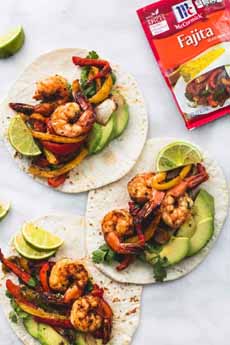
    RECIPE #1: SHEET PAN SHRIMP-LIME FAJITAS

    Who doesn’t like fajitas?

    “Sheet pan chili lime shrimp fajitas make an easy, healthy, and delicious one-pan 20-minute meal—with tons of flavor the whole family will love,” says Tiffany of La Creme De La Crumb.

    Prep time is 10 minutes, cook time is 10 to 15 minutes.

     
    Ingredients For 4 Servings

  • 1 pound large white shrimp, peeled and deveined
  • 3 bell peppers, thinly sliced (go for a combination of red, yellow, and green)
  • ½ medium onion, chopped
  • ¼ cup oil
  • 1 packet McCormick Fajita Seasoning Mix
  • 2 teaspoons chili powder
  • 2 tablespoons lime juice, plus additional lime wedges for serving
  • 8-10 six-inch flour tortillas*
  • 1 avocado, sliced
  • Garnish: chopped cilantro
  •  
    Preparation

    1. PREHEAT the oven to 400°F. Combine the first 7 ingredients (shrimp through lime juice) in a large bowl. Stir to combine and coat the shrimp and peppers well in the seasonings.

    2. SPREAD everything out on a large baking sheet pan in a single layer (note: line the pan with foil or parchment for easy clean-up). Items can overlap; just not heaped in a pile. Bake for 10-15 minutes until shrimp is pink, the tails begin to char slightly and the peppers are tender.

    3. DISTRIBUTE the shrimp and peppers on top of the tortillas along with avocado slices. Top with freshly shopped cilantro and serve with lime wedges for squeezing.

    ________________

    *Traditionally, a fajita uses the smallest tortilla, 6 inches in diameter; a soft taco 8 inches; and a burrito 10 inches.
    ________________
     
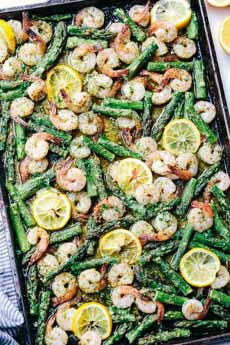
    RECIPE #2: SHEET PAN SHRIMP SCAMPI WITH ASPARAGUS

    “Those of you who are observing Lent: Don’t let Lent have you fishing for flavor! This sheet pan meal is big on flavor—and you don’t have to sacrifice on taste,” says Alyssa, The Recipe Critic.

    “I love using McCormick’s seasoning mix packets in recipes. They make it so easy to put together flavors and bust out a complete meal that will your family will love.”

    Who doesn’t love Shrimp Scampi†? Prep time is 5 minutes, cook time is 8 minutes.

    Ingredients For 4-6 Servings

  • 1 pound large shrimp, shelled and deveined
  • 1 pound asparagus, cut into two inch pieces
  • ¼ butter, melted
  • ¼ cup olive oil
  • 1 tablespoon lemon juice
  • 1 packet McCormick Garlic Butter Shrimp Scampi Seasoning Mix
  • Garnish: 1 lemon, sliced
  •    
    Sheet Pan Fajitas

    Shrimp Scampi Recipe

    Sheet Pan Shrimp & Asparagus

    [1] Shrimp and lime fajitas (photo courtesy Le Creme De La Crumb | McCormick). [2] Seasoning the ingredients and [3] the final dish, emerging from the oven (photos The Recipe Critic | McCormick).

     
    Preparation

    1. PREHEAT the oven to 450°F. Lightly grease a sheet pan and set aside (note: first line the pan with foil or parchment for easy clean-up).

    2. PLACE the shrimp and asparagus in a large mixing bowl. Pour the melted butter, olive oil and lemon juice on top, sprinkle on the seasoning packet and mix until combined.

    3. SPREAD the shrimp and asparagus on the sheet pan in an even layer (note: line the pan with foil or parchment for easy clean-up). Scatter the lemon slices on top. Bake for 8 minutes or until the shrimp is pink and cooked through. Serve immediately.
    ________________

    †FOOD TRIVIA: Scampi is the Italian word for a prawn. In the U.S., it became the name of an Italian-American dish, Shrimp Scampi: broiled butterflied shrimp that been brushed with garlic butter or oil (and sometimes a splash of white wine). It’s amusing among the cognoscenti that Americans request a dish that translates to Shrimp Shrimp. But that’s not all of today’s trivia:

    SHRIMPS VS. PRAWNS: THE DIFFERENCE. Prawns and shrimps are both crustaceans with 10 legs. They can be found in salt water and fresh water all over the world, and have similar flavors. While the terms are often used interchangeably, with prawns, the first three of the five pairs of legs on the body have small pincers; with shrimps only, two pairs are claw-like. In the U.K. and Australia, prawn is the name consumers and restaurants use for what is called shrimp in the U.S. Both crustaceans are found in a variety of sizes. More information.


    Sheet Pan Baked Salmon
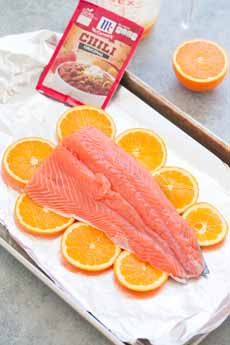
    [4] After 5 minutes of prep time, baked salmon in orange-butter sauce is ready in another 20 minutes (photo courtesy Avery Cooks | McCormick).
     

    RECIPE #3: SHEET PAN ORANGE CHILI SALMON

    “This salmon is healthy, so easy, ready in 30 minutes, and has restaurant-quality flavor,” says Averie of Avery Cooks. “It’s so moist and juicy. I seasoned the salmon with McCormick Chili Seasoning Mix (Original) for a pop of heat, which is perfectly balanced by the honey and orange juice. The seasoning adds flavor without being spicy and it doesn’t overpower the fish.”

    Prep time is 5 minutes, cook time is 20 to 25 minutes.
     
    Ingredients For 2 to 3 Servings

  • 1 to 1.25 pounds skin-on salmon fillet
  • 1 orange, sliced into thin rounds
  • 1/2 cup unsalted butter
  • 3 to 4 tablespoons honey
  • 3 to 4 tablespoons orange juice from about half an orange (substitute packaged orange juice)
  • 2 teaspoons McCormick Chili Seasoning Mix Original Flavor
  • 1/2 teaspoon salt, or to taste
  • 1/2 teaspoon freshly ground black pepper, or to taste
  • Garnish: 1 tablespoon finely chopped fresh parsley
  •  
    Preparation

    1. PREHEAT the oven to 375°F and place a piece of foil on the baking sheet to cover it completely. Place the salmon on the foil, skin-side down, with the longer side of the fish parallel to the longer side of the sheet pan. Pull the edges of the foil up 2 inches over the pan rim, or enough so that when you pour the butter sauce over the top, it will be contained in the foil.

    2. NESTLE the orange slices underneath the salmon, spaced evenly around the fillet. Set aside.

    3. PLACE the butter in a microwave-safe glass measuring cup or bowl and heat on high power to melt, about 1 minute. Stir in the honey and orange juice. Pour or spoon about two-thirds of the mixture over the salmon; reserve the remainder. Evenly season with the seasoning mix, and add salt and pepper, to taste.

    4. ADD another sheet of foil on top and crimp or pinch both pieces together to get the seal as tight as possible. If you have time, set the pan aside to allow the fish marinate for about 10 to 15 minutes; you’ll get enhanced flavor. Bake for 15 minutes.

    5. REMOVE the pan from the oven and cut open up the top of the packet so the salmon is exposed (but the edges are still raised to contain the sauce). Set the broiler to to high. Spoon the reserved sauce over the salmon, if desired. Use your judgment: If there’s already lots of juice, you don’t need to add more (you don’t want it to start leaking). If you have extra sauce, pour it over the finished dish or bring it to the table in a pitcher.

    6. BROIL the salmon for 5 to 10 minutes, or until as golden as desired. The exact broiling time will depend on the size and thickness of the salmon, oven variances and personal preference. Keep a close eye on the salmon because all broilers are different and you don’t want to burn the fish.

    7. GARNISH with parsley and serve immediately. This recipe is best warm and fresh, but will keep airtight in the fridge for up to 3 days.


    Comments off


    © Copyright 2005-2026 Lifestyle Direct, Inc. All rights reserved. All images are copyrighted to their respective owners.