|
The first Thursday of April National Burrito Day. You don’t have to twist most arms to enjoy one.
THE NIBBLE is having a lunch of gourmet burritos. Below:
> Gourmet burrito ingredients.
> Burrito history.
> The modern burrito.
Elsewhere on The Nibble:
> The year’s 25+ Mexican and Tex-Mex food holidays.
BURRITO HISTORY
A step back in history: In 1519 the Spanish conquistadors arrived in what today is Mexico, bringing with them wheat flour and pigs. This enabled flour tortillas and carnitas. Flour tortillas are more flexible than corn tortillas, and therefore, easily rollable.
A modern question is: Why are carnitas in a flour tortilla called a burrito—“little donkey” in Spanish?
No one knows for sure, but the leading guess is that it was named for its shape, which resembles the bedrolls carried on the back of donkeys.
While the modern burrito is no more than 100 years old, Mesoamericans often rolled their food in tortillas for convenience (no dishes or utensils needed). Avocados, chili peppers, mushrooms, squash, and tomatoes were sliced and rolled.
The Pueblo peoples of the Southwestern U.S. were even closer to the mark. They made tortillas with beans and meat sauce fillings, prepared much like the modern burrito [source].
But the word “burrito” doesn’t appear in print until 1895, in the Spanish-language Dictionary of Mexicanisms. It was a name used in the region of Guanajuato, in north-central Mexico. It is described as “a rolled tortilla, with meat or other food within, called coçito in Yucatan and taco in the city of Cuernavaca and in Mexico City.”
That there was a rolled food called burrito in 1895 dispenses with the folk tale of a man named Juan Méndez, who sold tacos from a street stand during the Mexican Revolution (1910–1921) in Ciudad Juárez. As he used a donkey for transport, customers began to call his tacos “food of the burrito,” the little donkey and the name eventually stuck.
Food historians opine that the modern burrito may actually have been invented in the U.S., as a convenient lunch for Mexican agricultural workers.
THE MODERN BURRITO: BORN IN THE U.S.A.
The precise origin is not known, but it is generally believed to have originated in a Mexican-American community in the U.S., among farm workers in California’s Central Valley (Fresno, Stockton).
According to Wikipedia, the farm workers who spent all day picking produce in fields would bring lunches of homemade flour tortillas, beans, and salsa picante (hot sauce)—inexpensive and convenient.
Burritos first appeared on American restaurant menus in the 1930s, beginning with El Cholo Spanish Cafe in Los Angeles. El cholo is the word used by Mexican settlers in California for field hands.
Burritos were mentioned in the U.S. media for the first time in 1934, appearing in the Mexican Cookbook, a collection of regional recipes from New Mexico by historian Erna Fergusson.
The book includes “celebrated favorites such as enchiladas, chile rellenos, and carne adovada, as well as the simple, rustic foods traditionally prepared and served in New Mexican homes.”
It was “inspired by the delight and enthusiasm with which visitors to the Southwest partook of the region’s cuisine.” You can still buy a copy.
In 1999, food writer John Mariani wrote that “What makes burritos different from most other Mexican-American foods is the metamorphosis of this dish.
“We tracked down the earliest print references for ‘burritos’ cited by food history in American/English reference books. They are nothing like the burritos we are served today…
“When and where did the change happen? In the early 1960s, in Southern California. The who and why remain a mystery.
Our survey of historic newspapers suggests food trucks played a role. Burritos are efficient, economical, easy, and delicious.” [Source: Encyclopedia of American Food and Drink, John F. Mariani [Lebhar-Friedman:New York] 1999 (p. 48)]
TODAY’S BURRITOS
In Mexico, meat and beans or refried beans can be the only burrito fillings. In the U.S., things get more elaborate.
American burrito fillings may include not only the refried (or other) beans and meat but rice, lettuce, salsa (pico de gallo, salsa picante), guacamole, shredded cheese (cheddar or jack), sour cream and vegetables.
Burrito sizes vary—they’re super-sized in the U.S., up to 12 inches. You can also find them in 9- and 10-inch diameters.
In 1964, Duane R. Roberts of Orange County, California sold the first frozen burrito. He made so much money that he was eventually able to buy Riverside’s iconic Mission Inn and refurbish it.
Tia Sophia’s, a Mexican café in Santa Fe, New Mexico, claims to have invented the original breakfast burrito in 1975, filling a rolled tortilla with bacon and potatoes. It was served “wet,” topped with chili and cheese.
Many Americans had their first breakfast burrito when McDonald’s introduced the Sausage Burrito in 1991: a flour tortilla, sausage, American cheese, scrambled eggs, onions, and peppers.
Taco Bell didn’t introduce a breakfast burrito until 2014.
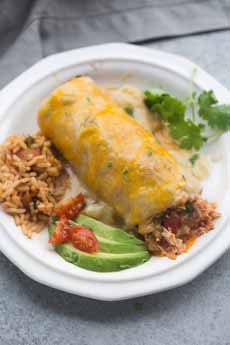
This brings us to the choice of the grab-and-go burrito, eaten by hand, and wet burritos, on a plate covered with sauce and other garnishes, eaten with a knife and fork.
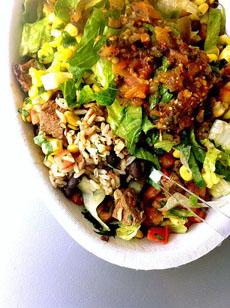
And then there’s the burrito bowl, pioneered by Chipotle: the fillings of a burrito eaten with a fork, no tortilla.
Chipotle now sells more bowls than conventional burritos. The bowls save 300 calories [source].
The U.S. even developed the breakfast burrito, and astronauts eat them in outer space!
GOURMET BURRITO INGREDIENTS
We’re not the type to put gold leaf, foie gras, and sturgeon caviar on food just to create the world’s most expensive [fill in the blank]. But we do enjoy the luxury of playing with top-drawer ingredients.
Rice and beans are fillers. You can make a burrito without them or can serve them on the side.
Or, you can take them up a notch with fancier rice and beans.
Here are typical burrito ingredients and their upscale variations. If you don’t like our ingredients, tell us what you’d use instead.
Beans (kidney, pinto, refried) > heirloom beans: cranberry, scarlet runner, yellow Indian woman…or lentils.
Carnitas (braised pork) > pork belly.
Cheese (cheddar or jack) > gruyère.
Diced tomatoes > heirloom tomatoes, marinated yellow cherry tomatoes, fresh tomato sauce (diced tomatoes with seasonings), tomato jam.
Chicken (thigh meat): ditto, with the skin removed, crisped, and tossed into the burrito (cracklings).
Cilantro > cilantro plus basil and parsley.
Diced onions > Caramelized onions, onion preserves.
Fried fish > roasted or grilled salmon.
Garlic > roast garlic cloves, whole or mashed.
Iceberg or romaine lettuce > butter lettuce, curly leaf lettuce, mesclun mix with baby arugula, red endive or radicchio, red leaf lettuce, watercress.
Lime wedge > lime zest sprinkled on top before rolling.
Rice > jasmine rice, multigrain rice, saffron rice, wild rice, and other grain (barley, quinoa, e.g.).
Exotic rice > Bhutanese red rice, black rice (forbidden rice), Kalijira rice from Bangladesh (considered the finest tiny aromatic rice in the world) (types of rice)
Shrimp the same (it’s hard to improve on grilled shrimp).
Steak (skirt or hanger) > filet mignon, roast lamb.
For lunch today, we’re having:
Filet mignon and wild rice burrito with shredded gruyère and [leftover] beluga lentils.
Grilled shrimp burrito with romaine and arugula, green rice (parsley), gruyère, and dilled sour cream.
Grilled salmon burrito, with dilled rice, sour cream, salmon caviar, and [leftover] yellow lentils.
Have whatever burrito you like, but definitely have a burrito. Where would we be without them?
|
|

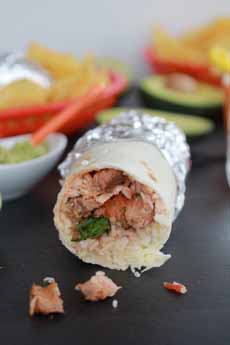
[1] Steak and cilantro burrito. Here’s the recipe from Half Baked Harvest (photo © Half Baked Harvest).
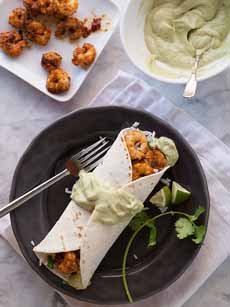
[2] Gourmet burrito: grilled shrimp and avocado cream. Here’s the recipe from Foodie Crush (photo © Foodie Crush).
[3] Breakfast burrito: Now an American staple, it first appeared in 1975. Here’s a recipe from She Wears Many Hats (photo © She Wears Many Hats).
[4] Chipotle restaurants brought burritos and burrito bowls across America, like this steak burrito bowl (photo © Chipotle).
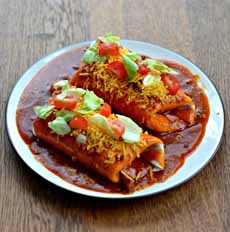
[5] Wet burritos: definitely not grab-and-go. Here’s the recipe from Hezzi D’s Books & Cooks (photo © Hezzi D’s Books & Cooks).
[6] Not wet, but smothered in a poblano-cheeese sauce. Here’s the recipe from Tastes Better From Scratch (photo © Tastes Better From Scratch).
[7] A burrito bowl provides the fillings without the tortilla (photo © Simply Recipes).
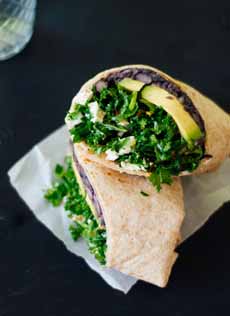
[8] Trendy and vegan: a kale burrito with black beans and avocado. Here’s the recipe from Cookie and Kate (photo © Cookie and Kate).
|