The History Of The Cobb Salad, Cobb Sandwich & More Recipes
|
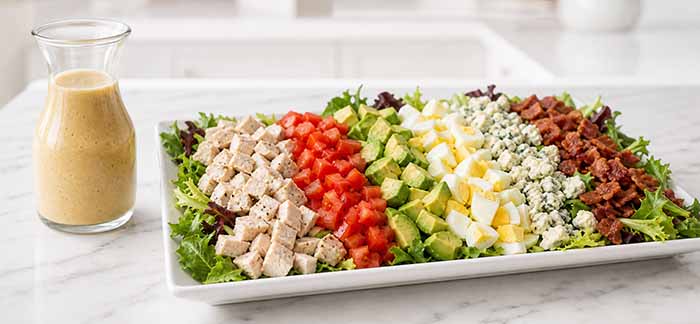
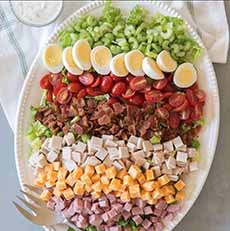
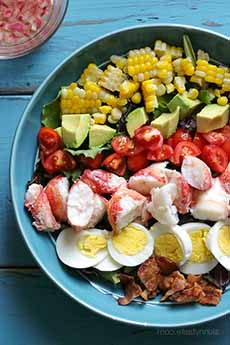
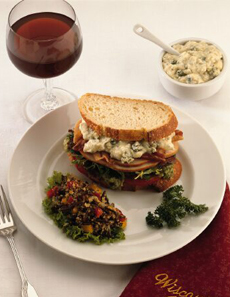
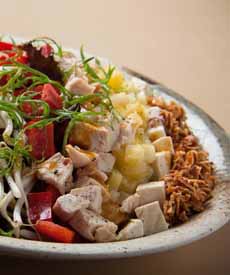
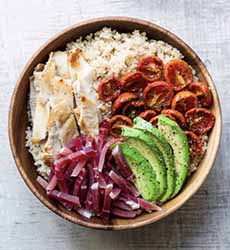
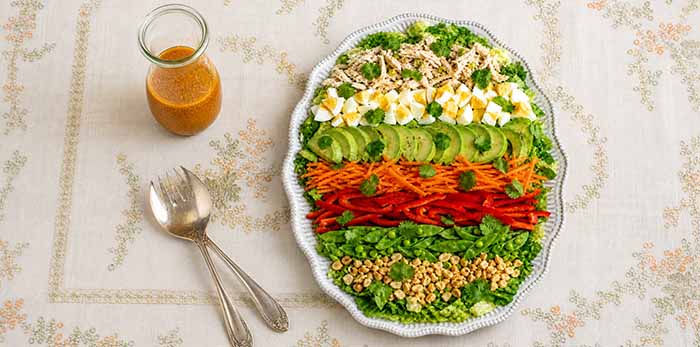
The Cobb Salad endures on restaurant menus, decades after once-popular luncheon salads such as Allerton Salad, aspics, Russian Salad, spinach salad (with mushrooms and bacon), stuffed tomatoes and Waldorf Salad have faded into obscurity. And thank goodness it’s still here, because it’s one of our favorites. Below: > The history of the Cobb Salad. > Expanding the Cobb Salad with added ingredients. Elsewhere on The Nibble: > More yummy Cobb Salad recipe variations. > The history of the chopped salad. > More Cobb Salad recipes. Late one evening in 1937, Bob Cobb, owner of The Brown Derby restaurant in Hollywood, was scrounging in the kitchen’s refrigerator for a snack. He grabbed a head of iceberg lettuce, an avocado, some romaine, watercress, tomatoes, a cold breast of chicken, a hard-cooked egg, chives, blue cheese and some old-fashioned French dressing*. He took some crisp bacon from one of the chefs and started chopping. He laid each ingredient in a row, in a bowl. Cobb shared the salad with his friend Sid Grauman, proprietor of Grauman’s Chinese Theatre, who came back and asked for a “Cobb Salad” the next day. It was put on the menu and became an overnight sensation. Customers like movie mogul Jack Warner regularly dispatched his chauffeur to pick one up. Since then, the salad has often been served with the ingredients laid out on the plate in rows, rather than tossed or with the other ingredients layered atop the greens, like a chef salad. However…. In the original 1930s Hollywood Brown Derby presentation, the salad was brought to the table as a mound of finely chopped ingredients that the waiter would toss with the dressing at the table (it could be brought to the table pre-mixed). The “striped” version that’s popular today was a later evolution in food styling. The original fame of the Brown Derby’s Cobb Salad came from how finely the ingredients were minced, much like today’s chopped salad, where every forkful had a bit of every ingredient. The focus was on the blend of flavors, not a visual pattern. As the salad became a mid-century American staple, chefs and cookbook photographers realized that a big bowl of finely chopped, mixed greens and proteins didn’t look particularly appetizing in photos. By arranging the ingredients in distinct rows (“stripes”), restaurants could showcase the quality ingredients: fresh avocado, high-quality blue cheese, and real chicken breast (photo #7, below). No one person has been credited with the first “striped” salad. It evolved through food photography and magazine styling in the 1950s and 1960s. This layout became so iconic that now, almost any salad served in rows—regardless of the ingredients—is often called a “Cobb-style” presentation. By the time the Cheesecake Factory and other modern chains popularized their versions), the rows had become the industry standard for the Cobb Salad’s identity. Over time, people have added an extra ingredient, like the ham in photo #1 and the corn kernels in photo #2, celery, bell pepper, scallions, croutons, and so on—a “kitchen sink” approach. People who don’t like blue cheese substitute Cheddar. People who don’t like tomatoes substitute red pepper. People who don’t eat bacon substitute kidney beans. There have been variations like Wolfgang Puck’s Lobster Cobb Salad. And now, here’s the Cobb Sandwich. If you want to add to the classic, here’s a checklist: Cobb has definitely become a “kitchen sink” salad over time. Here are other ingredients you’ll often see that weren’t part of the original Brown Derby version: |
|
|
|
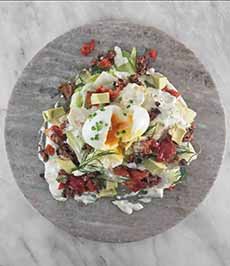
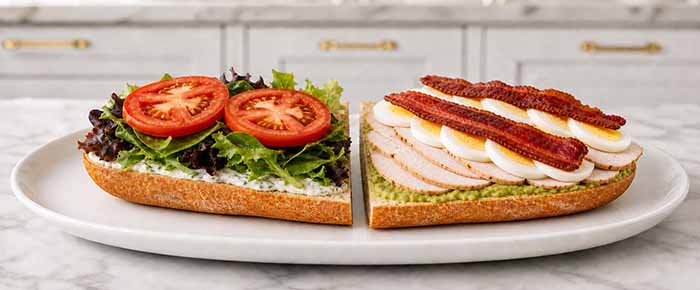
The Cobb sandwich puts Cobb salad ingredients on a baguette (photo #8 above) or sourdough (photo #4). Ingredients For 4 Servings Blue Cheese Mayonnaise 1. COMBINE blue cheese and mayonnaise in a small bowl; mix well and set aside. 2. MIX the avocado purée, lemon juice, salt and pepper until well blended. 3. ASSEMBLE: Spread one bread slice with 1 to 2 tablespoons of the blue cheese mayonnaise. Layer the mixed salad greens and 2 tomato slices. Spread the other bread slice with avocado purée, slices of turkey, 1/2 sliced hard-boiled eggs, and 2 bacon strips on the bread. Combine the two sides and secure with a pick as need. Repeat to make three more sandwiches. Can you call something a Cobb Salad variation when the only ingredients it shares with the original are lettuce and chicken—ingredients common to more than a few salads? We’d say no, but we like this salad with a more appropriate name, like Asian Chicken Salad. For The Dressing 1. COMBINE the dressing ingredients in a jar with a lid. Cover and shake to combine. Set aside. 2. MIX the lettuce, cabbage, snow/snap peas, bean sprouts and parsley in large serving bowl; toss to combine. Arrange the chicken, avocados, carrots, green onions and mushrooms on top. 3. SPRINKLE the rice noodles and almonds on top. Drizzle the dressing over the salad and serve immediately. *The French use vinaigrette—oil and vinegar—as a salad dressing. Originally, “French dressing” was synonymous with vinaigrette. Over time, a sweet, decidedly non-French, orange-colored vinaigrette (from ketchup, not a very French condiment) appeared in the U.S. and Canada. It’s what “French dressing” is today. To make it, combine 1/4 cup white wine vinegar, 1/3 cup olive oil, 1/4 cup ketchup, 1 tablespoon sugar, 2 teaspoons paprika, 1 teaspoon Worcestershire sauce, a pinch of salt. Our mother halved the sugar and threw in a clove of garlic. CHECK OUT WHAT’S HAPPENING ON OUR HOME PAGE, THENIBBLE.COM. |
||