|
Fewer than one in 10 Americans are eating the recommended amount of fruits vegetables daily, according to a report by the Centers For Disease Control (CDC)*: just 12% of us are eating enough fruits, just 9% are eating our vegetables.
Men, young adults and low-income people have even lower rates of fruit and vegetable consumption.
While 15.1% of women eat the recommended amount of fruit each day, just 9.2% of men do the same.
On the veggie scale, 11.4% of wealthy Americans eat enough vegetables, but only 7% of poor people do.
It’s an issue for the health of all Americans: A poor diet is linked to cancer, obesity, heart disease and diabetes. That’s why public health authorities have long endorsed a diet rich in fruit and vegetables.
For those who remember Five A Day—an older USDA program that recommended five portions of fruit and vegetables daily—it’s old news. Current thinking is that 10-a-day is even better. (But it it’s all you can manage right now, five a day is better than fewer portions a day.)
NEW YEAR’S RESOLUTION
If you want to eat better, here’s a strategy:
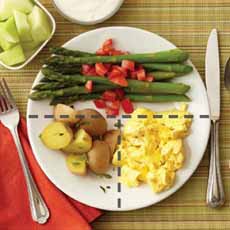
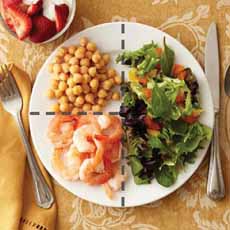
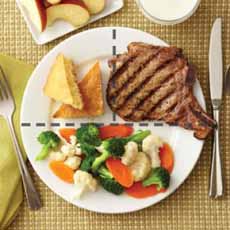
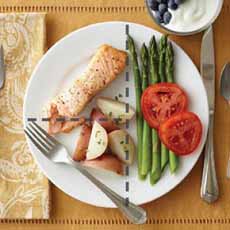
Fill half your plate with fruits and veggies, as shown in the photos.
The experts recommend 10 three-ounce (80g) servings of fruits and vegetables a day, which amounts to 1.8 pounds (800g) of produce.
What does one serving look like? Again, look at the photos. It’s easy for adults to double up the portion size to reach our daily goal.
Even eating half of the suggested amount is associated with a 16% reduced risk of heart disease, an 18% reduced risk of stroke, a 13% reduced risk of cardiovascular disease, a 4% reduced risk of cancer and a 15% reduction in the risk of premature death (source).
But don’t do it for statistics. Do it because it’s good for you, and because those fruits and vegetables actually taste good!
WHAT IS A VEGETABLE? NOT A POTATO!
While almost everyone can classify particular produce items as fruit†, there is some confusion to what is a vegetable.
Grains are not vegetables, they are starches. This includes barley, corn, oats, rye, wheat, quinoa and others. Whole grains are good for you and should be included on the plate. But alas, you can’t count an ear of corn or a side of quinoa as a vegetable. All of these (and the foods made from them—bread, cereal, cooked grains, pasta, etc.) belong to the grain group.
Potatoes and other tubers are not vegetables. Potatoes, Jerusalem artichokes (sunchokes), jicama and yams are botanically classified as vegetables, but nutritionally they are classified as starches. This is because when eaten as part of a meal, they are generally served in place of other starchy carbohydrates, such as bread, pasta or rice.
Don’t confuse “starches” with “starchy vegetables.” Starchy vegetables have carbohydrates, but they are the unrefined carbs that the body needs. They fall into the vegetable category. Examples are peas, winter squash and root vegetables like beets, celeriac, parsnips and turnips. Read more here.
Beans and other legumes are protein foods. They fall into a unique category, because of their high nutrient content, they can substitute for meat and fish. The USDA Food Patterns classify beans as a subgroup of the Vegetable Group, but also indicate that they may be counted as part of the Protein Foods Group. Consuming beans and other legumes is recommended for everyone.
WHAT SHOULD YOU BUY NOW?
|
|

[1] For breakfast, add sautéed vegetables to the plate. All photos courtesy Diabetic Living Online.
[2] For lunch, have a burger, tuna, or shrimp salad (shown) with half a plate of salad…or more. Mayonnaise or other dressing is fine.
[3] For dinner, chicken, pork, steak or your protein of choice, with a half plate of vegetables.
[4] Fish or seafood as your protein makes dinner even more “better-for-you.”
|
Winter doesn’t provide the widest choice of fruits and vegetables, but there’s much more variety than you might think. A partial list:
Fruits: dates, grapefruits, kiwis, mandarins, oranges, papayas, passionfruits, pears, persimmons
Vegetables: beets, Brussels sprouts, collards, endives, kale, leeks, parsbips, turnips, winter squash
Here’s a complete list; get ready to hit the stores.
Soon, spring produce will provide a bigger bounty, including favorites such as apricots, asparagus, blackberries, chard, figs, green peas, honeydew, mango, morels and strawberries.
For ideas and guidance year round, visit Fruit & Veggies: More Matters.
FOOD TRIVIA: THE WORD “VEGETABLE”
The English word “vegetable” is first found in print in the early 1400s. It derived from an Old French word that applied to any plant. It was not until the 1760s that the word became established to mean a plant, edible herb, or root cultivated for food [source].
For etymology geeks: “Vegetable” derives from the Latin vegetare, which evolved into the Old French and late Latin word, vegetabilis. Those latter words came to mean “animating,” in the sense of growing.
By the mid-15th century, it meant “non-animal life,” i.e., any plant.
Subsequent, pejorative, uses of “vegetable” refer to people:
A person who leads a monotonous life (i.e., “vegetates”), dating from 1921.
A person who is totally incapacitated mentally, dating from 1976 [source].
________________
*The information comes from the CDC’s Behavioral Risk Factor Surveillance System (BRFSS). The most recent numbers are from the 2015 study, by telephone interview. The BRFSS looks at how Americans eat and behave. Researchers asked how often people eat beans, dark greens, orange vegetables, “other” vegetables, whole fruit and fruit juice.
†We’re referring to conventional consumer perceptions of fruit. Botanical standards differ from popular views that “if it’s sweet, it’s a fruit.” In botany, a fruit is any produce that holds its seeds inside their bodies. This includes apples, cherries and melons, but also avocados, cucumbers, squash and tomatoes, among others. Vegetables, which do not hold their seeds inside, include celery, greens, lettuce and root vegetables, among others.
|
|