THE NIBBLE BLOG: Products, Recipes & Trends In Specialty Foods


Also visit our main website, TheNibble.com.

RESTAURANT: Vermillion

Last night, while others were enjoying corned beef and cabbage with green beer, we broke with tradition in a big way.

We dined at Vermillion in midtown Manhattan. The soaring, bi-level space is the New York branch of the Chicago Vermillion established by Rohini Dey, a former international banker and McKinsey consultant.

Serving a unique Indian-Latin fusion menu, the flavors and presentation are as stylish as Ms. Dey herself. First, the cuisine:

In a complete relaunch of the menu, Ms. Dey’s concept to fuse the two colorful cuisines has been interpreted by co-executive chefs Anup Patwal and Aseema Mamaji from India, and sous chef Javier Alvarez from Latin America. The gifted young team brings verve, energy and an elegant touch to the food.

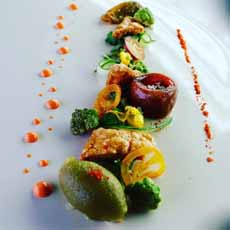
Beyond the flavorful, there’s a “wow” experience in the presentation. Thought has been given to turning each dish into culinary art; whether it’s a specially crafted chrome rack from which four different types of kabobs hang in alluring fashion, or a slice of tree trunk used as a charger.

  caldeirada-de-peixe-vermillion-230
Caldeirada de peixe, a traditional Brazalian seafood stew accented with Indian spices and a side of coconut rice. Photo courtesy Vermillion Restaurant.
 

Absolutely everything demands to be consumed. Even garnishes of pickled red onion or green chile are exciting. We didn’t leave a scrap on the plate!

The seasonings are spectacular. There’s just enough of the custom-blended spices and heat to blend perfectly, appropriately understated without providing a punch not wanted in fine dining. It’s not often that we encounter such finesse with spices. Kudos to the chefs!

In addition to fusion dishes, there’s a menu of classic Indian entrées. There is nothing we don’t want to try, and we can’t wait to go back.

While dinner can cost what you’d expect for such fine cuisine, lunch is quite affordable: two courses for $20 or three courses for $24.

Wine tip: The Chateau Ste Michelle Riesling, made with grapes from Washington’s Columbia Valley, is perfect with the cuisine. Off-dry, with notes of sweet lime, peach and subtle minerality, it is a charming complement to the spice and heat.

There’s a comfortable cocktail lounge downstairs and a private dining room upstairs, on the main dining floor. The restaurant is at 480 Lexington Avenue at 46th Street. Visit the company website or call for reservations: 212-871-6600.


Comments off

TIP OF THE DAY: Bake Irish Soda Bread

Having published a recipe for Irish soda muffins for St. Patrick’s Day, we hadn’t planned to feature Irish soda bread this year.

Then, we received this recipe from The Baker Chick and realized how much we wanted to tear into a warm loaf of soda bread and slather it with Kerrygold butter from Ireland.

So we bumped our previously scheduled Tip Of The Day for this suggestion: Bake a loaf of Irish soda bread.

If you’re already at work, bake it when you get home. It’s delicious with dinner—or in our case, instead of dinner. (We can make a joyous meal of great bread and butter.)

Traditional Irish soda bread, the recipe below, has just four ingredients: flour, baking soda, salt and buttermilk.

Other recipes add butter, caraway seeds, chocolate, eggs, orange peel or zest, raisins and/or sugar.

That’s absolutely delicious; it’s just not the original.

The style of soda bread we enjoy in the U.S. is American-style, developed by Irish immigrants with butter, sugar and raisins.

We adapted the recipe to meet in the middle: no butter or egg, but a bit of raisins and caraway.
 
 
RECIPE: TRADITIONAL IRISH SODA BREAD

Ingredients For 1 Loaf

  • 1 pound (3-1/2 cups) unbleached all-purpose flour; more as needed
  • 3/4 teaspoon baking soda
  • 1 teaspoon salt
  • 1-1/2 to 1-3/4 cups buttermilk
  •  
    We couldn’t help ourselves: We added these optional, non-traditional ingredients:

  • 1/2 cup raisins, sultanas or dried cherries, currants or cranberries
  • 1 tablespoon caraway seeds
  •  
    But in the name of tradition, we held back on the butter, egg and sugar.
     
    Preparation

       
    irish-soda-bread-thebakerchick-230
    [1] Traditional Irish soda bread has no raisins or caraway (photo © The Baker Chick).

    Irish Soda Bread Recipe
    [2] Irish soda bread baked with raisins and/or caraway is a later development (photo © Hot Bread Kitchen).

     
    1. PREHEAT the oven to 450°F.

    2. STIR together the flour, salt and baking soda in a large mixing bowl. Make a well in the middle of the mixture and pour in 1 1/2 cups of the buttermilk. Use a wooden spoon or your hand to combine the ingredients. You want the dough to be soft, so don’t over-mix it. Add more buttermilk if needed to get the dough to come together.

    3. TURN the dough onto a floured surface and give it just a few kneads (more will result in a tougher crumb). Shape it into a 6-inch diameter disk, about 2 inches high. Use a sharp knife to score a shallow X on the top of the loaf. Transfer to a cookie sheet or pizza stone and bake for 15 minutes.

    4. REDUCE the heat to 400°F and bake for another 20-25 minutes, or until the crust is golden, and the bread sounds hollow when you tap it.


    kerrygold-brick-230
    [3] For St. Patrick’s Day, spring for Kerrygold butter, made with milk from cows who graze
    on the green grass of the Emerald Isle (photo © Kerrygold).
      THE HISTORY OF IRISH SODA BREAD

    Baking soda, called bread soda in Ireland, was invented in the early 1800s. In those days most people didn’t have an oven—they cooked in a fireplace over coals or a peat fire (called turf fire in Ireland). They placed the dough in a lidded cast-iron pot which went right on top of the fire.

    In County Donegal and County Leitrim, there was a tradition of adding caraway seeds to bread. Immigrants brought that recipe to the U.S. In America, the recipe evolved to include butter, eggs, raisins and sugar—ingredients which frugal housewives in Ireland wouldn’t have thought to add to the dough.

    Today, the soda bread recipe options include:

  • White soda bread: all-purpose flour, baking soda, salt, buttermilk and optional caraway seeds.
  • Brown soda bread, also a traditional recipe that substitutes whole wheat flour for part or all or all of the white flour.
  • Irish soda bread with raisins and caraway, the classic Irish-American version also made with sugar, butter, and eggs.
  • Numerous modern recipes, from healthier variations of whole grains, flax and sunflower seeds to walnut soda bread to oat soda bread with browned butter, rosemary and black pepper.
  •  
    Check out these and other recipes here.

    FOOD TRIVIA: The cross cut into the top of the loaf before baking allows the heat to penetrate into the thickest part of the bread. As a bonus, in a Catholic country it adds the symbolic note of giving thanks.


    Comments off

    COCKTAIL: Green Drink For St. Patrick’s Day

    From the Owl’s Brew, specialists in tea crafted for cocktails: artisanal, fresh-brewed and ready-to-pour tea.

    For St. Patrick’s Day, they sent us this appropriately green cocktail that uses one of their brews (here’s a store locator); or you can brew your own.

    They call the cocktail The Green Garden, but you can call it The Emerald Isle.

    RECIPE: THE GREEN GARDEN

    Ingredients For 1 Drink

  • 2 parts The Classic brewed tea*
  • 2 parts cold pressed green juice (recommended: cucumber & mint or mixed greens with apple & lemon)
  • 1 part vodka
  • 1 part saké
  •  
    *The Classic is a blend of English Breakfast Tea and lemon peel, with a bit of tartness from lemon juice and lime juice. If you can’t find the product locally, you can brew your own.

      green-garden-owlsbrew-230
    As green as the Emerald Isle. Photo courtesy Owl’s Brew.
     
    Preparation

    1. COMBINE the ingredients and stir or shake.

    2. POUR over ice into a mason jar or strain into a martini glass.
      

    Comments off

    FOOD HOLIDAY: National Artichoke Hearts Day

    artichoke-baked-potato-bonefishgrill-230
    [1] Celebrate with an artichoke baked potato (photo courtesy Bonefish Grill; recipe at right).

    Sangria Artichokes

    [2] The flower [not shown] grows in the center top of the globe, which grows atop a long stem (photo courtesy Frieda’s Produce).

    Cardoons
    [3] It looks like celery, but these are cardoons, the ancestor of the artichoke (photo courtesy Turmeric Saffron).


    March 16th is National Artichoke Heart Day, an occasion to mix up our favorite luxurious yet low-calorie dishes, we named “Luxury Salad.”

    It combines artichokes with hearts of palm, roasted red pepper (pimento), red onion and black olives in a white wine vinaigrette. Here’s the recipe.

    But we’re all about options, and we’re making a stuffed baked potato from some of the artichoke hearts.

    We were inspired by this photo from Bonefish Grill. The elaborate recipe topped with an artichoke heart seems an elegant way to celebrate National Artichoke Hearts Day.

    The potato is stuffed with some sautéed spinach, then crowned with a poached egg and the artichoke heart.
     
     
    RECIPE: ARTICHOKE STUFFED POTATO

    Ingredients For One Serving

  • 1 baked potato
  • 3 tablespoons sautéed spinach
  • 1 poached egg
  • 1 artichoke heart, drained
  • Optional: hollandaise sauce (recipe)
  • Garnish: tarragon chiffonade
  •  
    Preparation

    1. BAKE the potato(es). When the potatoes are almost done…

    2. Sauté the spinach and poach the egg(s). Warm the artichoke heart(s) in the microwave.

    3. SLICE the top off the potato(s) to provide an even platform. Scoop out a bit of the potato to create a shallow well for the spinach.

    4. FILL the well with the spinach, top with the poached egg and hollandaise sauce. Crown with the artichoke heart, sliced in half as necessary. Garnish with the tarragon.
     
     
    THE HISTORY OF ARTICHOKES

    The artichoke (Cynara cardunculus) first grew wild in the Mediterranean. It is a member of the thistle family of flowering plants.

    The wild version of the artichoke, which still grows wild and is also cultivated, is the cardoon (photo #3). While it doesn’t look like the globe artichoke that has become part of the modern diet, it tastes very similar.

    The artichoke is first found in print as a garden plant in the 8th century B.C.E., by Homer and others. Centuries later, Pliny the Elder mentioned the growing of “carduus” in Carthage (North Africa, where it is still found in its wild state) and Cordoba (Spain).

    Further cultivation took place in the medieval period, and subsequently in Italy and France in the late 15th and early 16th centuries.

    Different varieties of artichokes were bred and cultivated, some as small as a hen’s egg, others larger than a first.

    Typically, the leaves are eaten; but the prize is the “heart” under the choke, the inedible thistly part on top of it. We enjoy eating the stems. If they are on the artichokes you buy, don’t throw them away!

    Like asparagus, the bottom portion may need to be peeled. But the stem has the flavor of the artichoke heart. Try it, you’ll like it.

     
    Naming The Artichoke

    The ancestor of our word “artichoke” comes from Arab-occupied Spain. An Arabic word for the plant, al-karsufa, turned into the Spanish alcarchofa.

    When the plant reached Italy, it became articiocco, pronounced arti-choke-oh. Arti– was a version of “arch,” meaning high; and ciocco was the local word for “stump.” (The word evolved to the modern Italian, carciofo.)

    Dutch traders introduced “arti-choke-ohs” to England, where the name was anglicized to artichoke. In 1530, artichokes were noted growing in Henry VIII’s garden at Newhall.

    Artichokes crossed the pond in 19th century, brought to Louisiana by French immigrants. Spanish immigrants brought them to California.

    Artichokes are now popular in American cuisine: baked, braised, fried, marinated, steamed; and in preparations from antipastos to dips to relishes/salsas, salads, soups and stuffings.


    Comments off

    PRODUCT: Pointed Cabbage, The New Brassica* In Town

    Even if you don’t eat cabbage regularly, you may be having some corned beef and cabbage tomorrow, St. Patrick’s Day.

    If you think there’s nothing new in cabbage, check out the new cabbage in town. Originally grown in Spain as Sweetheart or Sweet Heart cabbage, it is now grown in California branded as Kool cabbage.

    It is delicious pointed cabbage, another name by which it is known. Still other names include duchy cabbage, hearted cabbage and hispi.

    A conical-shaped member of the cabbage family, the leaves are more open (less tight) than those of a conventional green cabbage, with a softer texture and sweeter taste. It also requires less time to cook.

    Note that while a pointed cabbage is, in fact, cool, kool is the Dutch word for cabbage. It gave its name to koolsla, which in the U.S. became cole slaw (kool = cabbage, sla = salad).
     
    COOKING POINTED CABBAGE

    Kool/pointed cabbage is best enjoyed cooked, as opposed to raw in slaws and salads.

      sweet_heart_kool_cabbage_europeancuisines-230
    Sweetheart or Kool cabbage, known by a variety of other names. Photo courtesy EuropeanCuisines.com. Check out their recipe for Shredded Baby Cabbage in Cream Sauce.
  • Melissas.com, which sells the cabbage online, suggests removing the center core and using the leaves in stir fry, boiled or steamed as a stand-alone side dish or grilled as a topping for steak or lamb chops.
  • Cut the cabbage in half and then into quarters, removing the hard core from each quarter at an angle. Then slice and wash thoroughly.
  •  
    It’s easy to overcook cabbage and bring out those odoriferous sulfur compounds.

  • To steam cabbage, place it in a steamer and cook for 5-10 minutes until tender but still crisp.
  • To boil cabbage, bring a pan of water to the boil, add the prepared cabbage and cook for 5 8 minutes until tender but still crisp.
  • To stir-fry cabbage, heat 1 tablespoon of oil in a frying pan, add the cabbage and stir fry for 4-5 minutes or until tender but still crisp.
  • To grill cabbage, preheat the grill to medium. Cut the cabbage into wedges (8 for a conventional cabbage) and remove the core. Place on a piece of foil large enough to wrap all the wedges. Season to taste (garlic powder, salt, pepper), seal in the foil and grill for 30 to 40 minutes until tender.
     
    Don’t forget the corned beef!
     
    *Brassica is the plant genus that comprises the cruciferous vegetables, nutritional powerhouses packed with potent, cancer-fighting phytonutrients (antioxidants). They include arugula, bok choy, broccoli, Brussels sprouts, cabbage, cauliflower, horseradish/wasabi, kale, kohlrabi, mustard, radish, rapeseed/canola, rapini, rutabaga, turnips and others.


  • Comments off

    The Nibble Webzine Of Food Adventures


    © Copyright 2005-2026 Lifestyle Direct, Inc. All rights reserved. All images are copyrighted to their respective owners.